Fontan Procedure: How It Works, Stages, Risks, and Long-Term Outlook

Updated: 3 days ago
Medically reviewed by Dr. Baraa Alnahhal, MD · Last reviewed: October 2026
Source currency note: This guide reflects medical information reviewed in November 2025. Always confirm current guidance with your healthcare professional.
Quick Answer: What is the Fontan procedure?
The Fontan procedure is a heart surgery for children born with only one working ventricle that sends oxygen-poor blood from the lower body straight to the lungs. It is the last of several staged surgeries, usually done between ages 2 and 5. It is not a cure, but more than 8 in 10 people live 30 years or longer. [4]
What the research says
Survival after the Fontan operation has steadily improved. An American Heart Association scientific statement estimates that patients operated on today may hope for a 30-year survival of more than 80%, and that up to 70,000 people worldwide are alive with Fontan circulation. It also notes that liver fibrosis and kidney dysfunction are common and may progress over time, which is why lifelong follow-up matters (Rychik et al., Circulation, 2019).
Combined heart-liver transplant looked comparable to heart transplant alone when the Fontan circulation fails. A 2025 systematic review and meta-analysis of 16 studies found one-year mortality rates of 0.09 with combined heart-liver transplantation and 0.14 with heart transplantation alone, a difference that was not statistically significant (p = 0.28). The authors concluded that combined transplantation can be considered when liver disease is also present (Holmvard et al., Pediatric Transplantation, 2025).
High filling pressure in the single ventricle predicts worse outcomes. In a registry of 861 patients with a Fontan circulation, 11.3% had diastolic dysfunction (an end-diastolic pressure above 13 mm Hg). It was linked to a more than 3-fold higher risk of death, serious arrhythmia, plastic bronchitis, protein-losing enteropathy, or transplant listing (hazard ratio 3.37; 95% CI 2.03 to 5.59) (Alsaied et al., American Heart Journal, 2025).
Understanding the Fontan Procedure
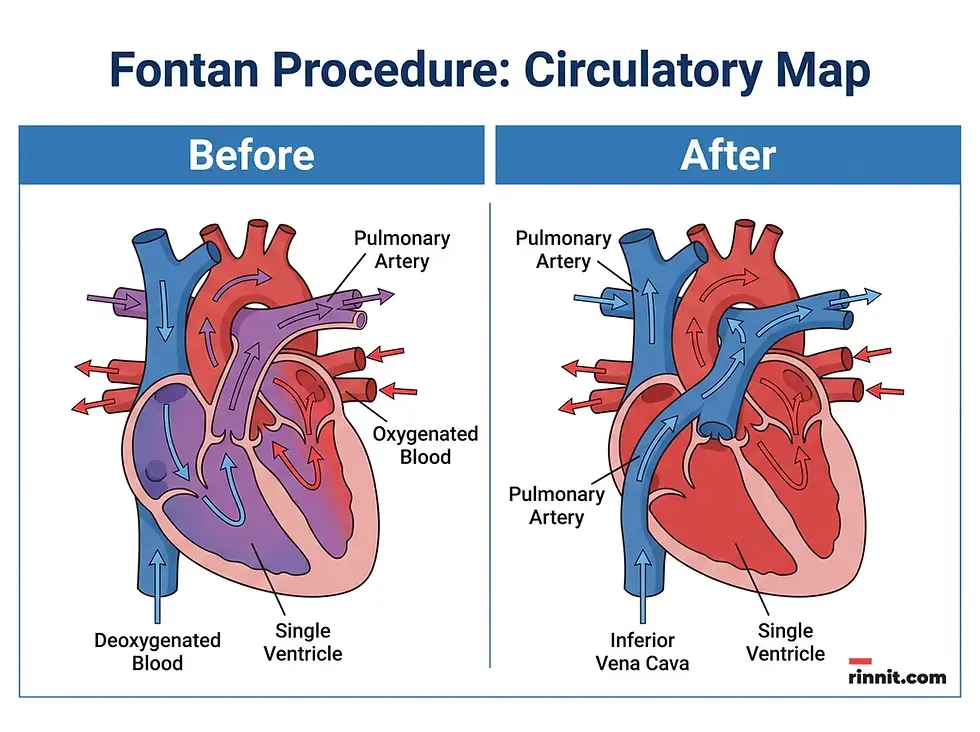
The Fontan procedure is a life-saving operation designed for children born with complex congenital heart defects in which only one of the two lower heart chambers (ventricles) works properly. In a typical heart, one ventricle pumps blood to the lungs while the other pumps it to the rest of the body. When a child has a single working ventricle, that chamber must perform both tasks, which strains the heart and makes oxygen delivery less efficient. The Fontan surgery addresses this by rerouting the circulation.
During the operation, the surgeon connects the inferior vena cava, the large vein that carries oxygen-poor blood from the lower body, to the pulmonary artery with a tube. Blood then flows straight to the lungs to pick up oxygen without passing through the heart. This leaves the single working ventricle responsible only for pumping oxygen-rich blood to the body, which limits the mixing of oxygen-rich and oxygen-poor blood and reduces the heart's workload. The surgery usually takes four to five hours.
Conditions Treated
The Fontan procedure is used for several congenital heart conditions that leave a child with a single functional ventricle. These conditions are typically diagnosed shortly after birth or during prenatal screening.
Condition | Description |
Hypoplastic left heart syndrome (HLHS) | The most common reason for a Fontan procedure; the left side of the heart is severely underdeveloped. |
Tricuspid atresia | The valve between the right atrium and right ventricle is missing or closed. |
Pulmonary atresia | The valve between the heart and the pulmonary artery does not form correctly. |
Double inlet left ventricle | Both the left and right atria empty into a single functional left ventricle. |
Ebstein's anomaly | A severe malformation of the tricuspid valve that reduces heart efficiency. |
Surgical Stages and Timing
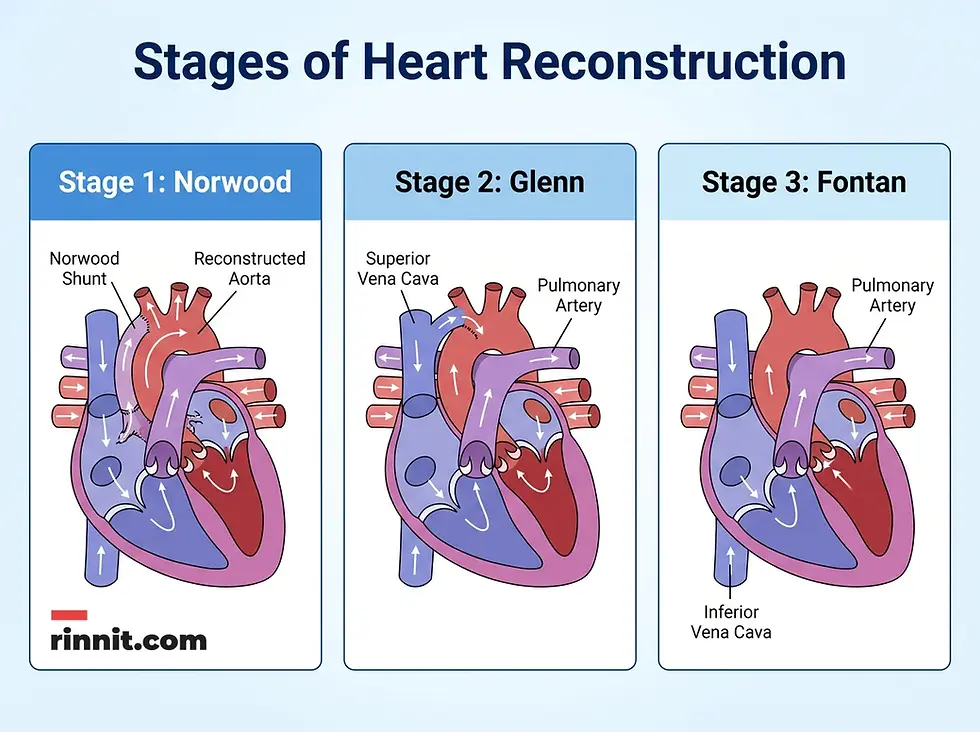
The Fontan procedure is rarely a child's first operation. It is usually the final step in a staged reconstruction that begins in infancy, and the timing of each stage depends on the child's growth and overall health.
Norwood procedure: often performed in the first week of life to help the right side of the heart pump blood to the body and lungs.
Glenn procedure: typically performed at around 4 to 6 months of age to send oxygen-poor blood from the upper body to the lungs by connecting the superior vena cava to the pulmonary artery.
Fontan procedure: usually performed between ages 2 and 5, though it can occur up to age 15.
Before recommending a Fontan procedure, the care team checks that the working ventricle is strong enough to pump well and that the lungs are healthy enough to handle blood flow without a pump. Preparation usually includes an echocardiogram, an electrocardiogram, a heart catheterization, and breathing and oxygen checks.
Risks and Long-Term Management
The Fontan procedure significantly improves life expectancy, but it creates a unique circulation that requires lifelong specialized care. Patients are monitored for both short-term surgical complications and long-term effects.
Short-term complications
Right after surgery, some children develop fluid buildup around the lungs (pleural effusions), irregular heartbeats, or temporary kidney and liver problems. Most children stay in the hospital for 7 to 13 days, including time in the intensive care unit, while these early recovery issues are managed.
Long-term outlook
Advances in surgical technique have greatly improved outcomes. More than 8 in 10 people live 30 years or longer after the operation, and many reach their 40s and beyond. Over time, however, the Fontan circulation can lead to complications such as:
Protein-losing enteropathy: difficulty absorbing protein from the digestive tract.
Plastic bronchitis: thick secretions that can block the airways.
Fontan-associated liver disease (FALD): chronic congestion that can damage the liver over several decades.
Blood clots: clots (embolism) can form because of the slower blood flow in this circulation.
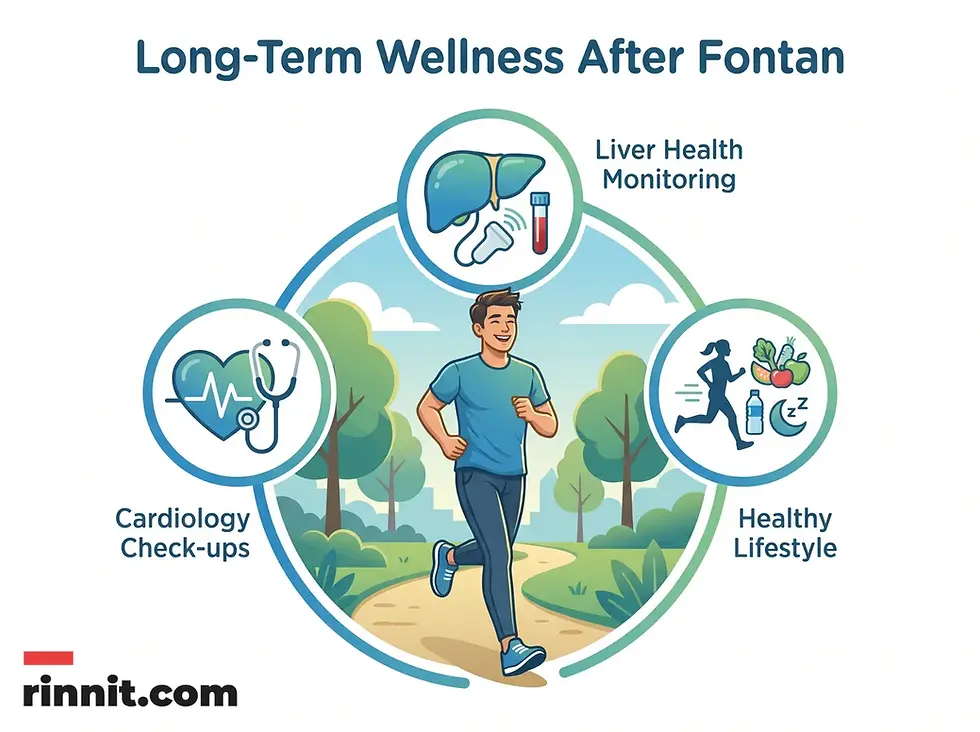
In some people, the heart or liver begins to fail significantly 15 to 20 years after the procedure, a situation known as a “failed Fontan.” In that case, a heart transplant or a combined heart-liver transplant may be needed. Regular check-ups every six to 12 months, often with heart and liver tests, help detect and manage these risks early.
Call your child's provider if they have bleeding or fluid from the chest wound, a fever or signs of infection, or increasing difficulty breathing [4].
Conclusion
The Fontan procedure is a remarkable surgical achievement that allows children with single-ventricle heart defects to grow, play, and live full lives. It is a complex journey that involves several operations and lifelong vigilance, but most children do well after the surgery. Families should work closely with a pediatric cardiologist to build a long-term care plan tailored to their child.
Next step: If your child is approaching the age for a Fontan procedure, discuss the specific surgical approach and the expected recovery timeline with the surgical team. Consistent follow-up care is the most important factor in protecting heart and liver health into adulthood.
Frequently Asked Questions
What is the Fontan procedure?
The Fontan procedure is a heart surgery for children born with one working ventricle. It redirects oxygen-poor blood from the lower body directly to the lungs, bypassing the heart.
At what age is the Fontan procedure performed?
The surgery is most commonly performed between the ages of 2 and 5, although it can be done anywhere from ages 2 to 15 depending on the child's health.
Is the Fontan procedure a cure?
No. It is not a cure for single-ventricle defects, but it helps the heart work more efficiently and improves oxygen levels.
How long is the recovery after Fontan surgery?
Most children stay in the hospital for 7 to 13 days, with the first few days in the intensive care unit. Full recovery at home typically takes several weeks as the child gradually returns to normal activities.
Can Fontan patients participate in sports?
Many children can take part in physical activities, though they may tire more easily than their peers. Specific activity levels should be discussed with a cardiologist.
What are the long-term risks of the Fontan procedure?
Long-term risks include heart failure, irregular heartbeats, protein-losing enteropathy, plastic bronchitis, blood clots, and Fontan-associated liver disease (FALD).
Do all Fontan patients need a heart transplant?
No. One study found that about 1 in 10 adults needed a heart transplant after Fontan surgery. When the Fontan circulation fails, which can happen 15 to 20 years after the operation, a heart or combined heart-liver transplant may be needed.
Can Fontan patients have children?
Some can. People without complications may be able to have children, but pregnancy carries a higher risk of bleeding, miscarriage, and preterm birth, so it requires close coordination between a cardiologist and an obstetrician and a full heart check-up beforehand.
What is the life expectancy after a Fontan procedure?
More than 8 in 10 people live at least 30 years after the surgery, and many now live into their 40s and beyond. Survival is lowest for people with hypoplastic left heart syndrome.
What follow-up care is needed after the Fontan procedure?
Lifelong monitoring by a cardiologist, typically with check-ups every 6 to 12 months and regular heart and liver function tests.
Related Reading
Glenn Procedure: A Critical Milestone in Congenital Heart Surgery describes the surgery that usually comes right before the Fontan.
Understanding the Norwood Procedure for HLHS explains the first surgery in staged single-ventricle repair.
Hypoplastic Left Heart Syndrome (HLHS): What It Is, Symptoms, Surgery Stages, and Lifelong Care covers a common heart defect treated with the Fontan.
Adult Congenital Heart Disease: What It Is, How It's Diagnosed, and Why Lifelong Follow-Up Matters explains lifelong heart care for adults born with heart defects.
References
Rychik J, Atz AM, Celermajer DS, et al. Evaluation and management of the child and adult with Fontan circulation: a scientific statement from the American Heart Association. Circulation. 2019;140(6):e234-e284. PMID 31256636. https://doi.org/10.1161/CIR.0000000000000696
Holmvard O, Póvoa-Corrêa M, Macintyre Innocenzi A, et al. Mortality outcomes of combined heart and liver transplantation and isolated heart transplantation following Fontan procedures: a systematic review and meta-analysis. Pediatric Transplantation. 2025;29(7):e70174. PMID 40916564. https://doi.org/10.1111/petr.70174
Alsaied T, Li R, Grant H, et al. Defining diastolic dysfunction post-Fontan: threshold, risk factors, and associations with outcomes. American Heart Journal. 2025;290:288-296. PMID 40651647. https://doi.org/10.1016/j.ahj.2025.07.007
Cleveland Clinic. Fontan procedure. Cleveland Clinic. November 19, 2025. https://my.clevelandclinic.org/health/treatments/24545-fontan-procedure
Medical disclaimer
This article was prepared for general information only and is not a substitute for professional medical advice.



Comments