Factitious Disorder Imposed on Self (FDIS): The Complete Guide to Signs, Causes, Diagnosis and Treatment

Updated: 2 days ago
Medically reviewed by Dr. Baraa Alnahhal, MD · Last reviewed: October 2026
Quick Answer
Factitious disorder imposed on self is a mental health condition involving intentional falsification of physical or psychological symptoms. Unlike malingering, which seeks external gain, its motivations are typically unconscious and emotional, such as a need for care or attention. Diagnosis requires clear evidence of deception, and treatment focuses on reducing self-harm and addressing psychological triggers through therapy.
What the research says
Published cases show most people self-induce illness, and depression is more common than personality disorder. A systematic review of 455 cases from 372 studies found that 66.2% of patients were female, the mean age at presentation was 34.2 years, and 58.7% chose to self-induce illness or injury rather than simulate or falsely report it; among cases reporting psychiatric comorbidity, depression was described more often than personality disorder (41.8% vs 16.5%) (PubMed: Yates & Feldman, Gen Hosp Psychiatry, 2016 [1]).
Diagnosis depends on careful record review, and care works best as a team. A Lancet review concluded that factitious disorders are rarely diagnosed, that identification largely depends on systematically collecting information, including a detailed chronology and scrutiny of the medical record, and that management ideally requires a team-based approach with close involvement of the primary care doctor (PubMed: Bass & Halligan, Lancet, 2014 [2]).
What Is Factitious Disorder Imposed on Self (FDIS)? An Overview
Factitious disorder imposed on self is a complex mental health condition where an individual appears sick, pretends to feel symptoms, or intentionally makes themselves ill [3] [5]. While most reported symptoms relate to physical illnesses, such as chest pain, fever, or stomachaches, some individuals may also pretend to experience psychological symptoms, such as hearing voices or experiencing hallucinations [3].
Key Point | Description |
Definition | A mental health condition where one falsifies, creates, or exaggerates illness symptoms |
Former Name | Munchausen syndrome, named after an 18th-century German officer known for embellishing life stories |
Nature | Classified as a form of self-harm; behavior is typically intentional but the motivation is unconscious |
Prevalence | Rare and difficult to track accurately due to “doctor shopping” across multiple facilities |
Genetic Link | No known genetic or hereditary link has been identified to date |
This condition is considered dangerous because the behaviors used to induce symptoms, such as damaging wounds to prevent healing or consuming contaminated food, can lead to serious physical injury or even death [3].
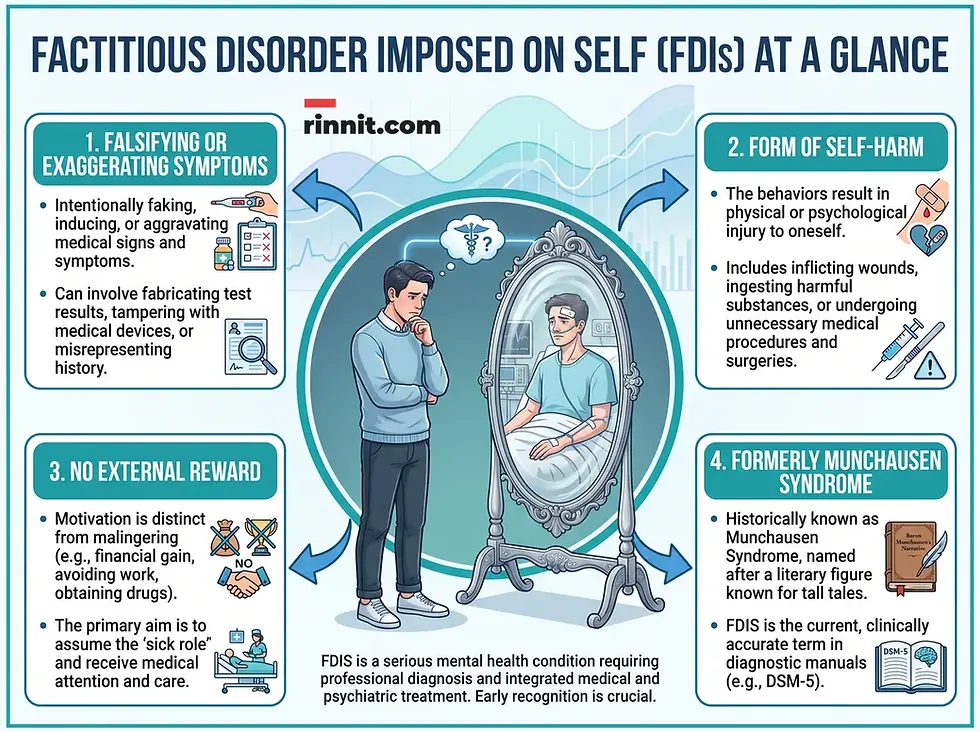
The History of the Term “Munchausen Syndrome”
The condition was originally named after Baron Munchausen, a German officer from the 1700s who was famous for telling highly embellished stories about his life [3]. While the term “Munchausen syndrome” is still widely recognized in popular culture, modern healthcare providers have moved away from it [3].
The current clinical term, factitious disorder imposed on self, is considered more accurate as it reflects the complexity of the condition rather than just the embellishing behavior [3].
Behaviors and Signs of FDIS
Individuals with FDIS typically know they are pretending, yet they are not seeking tangible benefits like disability payments or avoiding work [3] [4]. Instead, the benefits are emotional and often unconscious [4].
Behavior | How It Shows Up |
Symptom Falsification | Claiming to have pain, headaches, or psychological distress that does not exist |
Self-Induction | Intentionally making oneself sick by eating spoiled food or interfering with wound healing |
Test Tampering | Contaminating urine samples or altering diagnostic test results to appear ill |
Medication Deception | Pretending to take prescribed medications while actually hiding or spitting them out |
Recognizing the Warning Signs
Identifying FDIS can be challenging for both loved ones and healthcare providers. Common red flags that may indicate the condition include [3]:
Inconsistent Medical History: A long, complex, and often contradictory history of illnesses and treatments.
“Doctor Shopping”: Visiting many different healthcare facilities, often under different identities or by falsifying personal information.
Isolation from Support: A strong reluctance to allow healthcare providers to speak with family members, friends, or previous doctors.
Symptom Patterns: Symptoms that only occur when the individual is alone or that change immediately following a test result or the start of a new treatment.
Requesting Procedures: An unusual willingness or desire to undergo painful tests, surgeries, or risky medical procedures.
What Causes Factitious Disorder Imposed on Self?
The exact cause of FDIS remains unknown [3] [4], though experts believe it involves a combination of psychological and biological factors, including brain chemistry and personality traits.
Possible Motivation | Description |
Need for Care | A deep-seated desire for someone else to take care of physical or emotional needs |
Superiority | Looking for a sense of power or superiority over healthcare professionals |
Fear of Abandonment | Using illness as a way to reduce anxiety surrounding the fear of being left alone |
Identity Creation | Attempting to create a new personal identity centered around being a “patient” |

Risk Factors
While FDIS is rare, certain life experiences may increase the risk of developing the condition. These include [3] [4]:
Childhood trauma, abuse, or neglect.
A history of frequent or serious illnesses during childhood, either for the individual or a loved one.
Significant family dysfunction.
Spending an extensive amount of time in healthcare facilities during formative years.
How Is FDIS Diagnosed?
Diagnosing FDIS is exceptionally difficult because the condition is rooted in dishonesty. Healthcare providers must rule out all possible physical and mental health conditions before considering FDIS, a process that often requires several tests and a coordinated effort among multiple specialists [3].
Diagnostic Step | What It Involves |
Rule-Out Testing | Using blood tests, urine analysis, and imaging to ensure no underlying physical illness exists |
Observation | Careful monitoring of the individual’s behavior and attitude toward their symptoms and treatments |
Psychological Assessment | Evaluation by a psychiatrist or psychologist using specialized assessment tools |
History Verification | Attempting to verify medical records and speaking with previous providers (if permitted) |
DSM-5 Diagnostic Criteria
Healthcare providers use the Diagnostic and Statistical Manual of Mental Disorders, Fifth Edition (DSM-5) to confirm a diagnosis. The four primary criteria for FDIS are [3] [4]:
Falsifying physical or psychological signs, symptoms, or inducing injury or disease.
Presenting oneself to others as ill, impaired, or injured.
Engaging in deceptive behavior even when there is no obvious external reward.
The behavior is not better explained by another mental health condition.
Treatment and Management of FDIS

The primary goal of treatment is to modify harmful behaviors and reduce the misuse of medical resources, followed by addressing the underlying psychological triggers [3].
Treatment Component | How It Helps |
Harm Reduction | Coordinated care to prevent unnecessary and potentially harmful medical tests or surgeries |
Cognitive Behavioral Therapy (CBT) | Helping the individual identify and change the thinking and behavioral patterns driving the FDIS |
Family Therapy | Educating family members about the condition to improve support systems |
Group Therapy | Reducing feelings of isolation and addressing fears of abandonment |
Treatment is often challenging because many individuals with FDIS deny they have the condition [3]. Successful management usually requires a psychiatrist and a primary care physician working closely together [2] [3] to provide education and prevent further self-harm.
Outlook and Living With FDIS
The prognosis for FDIS varies significantly based on the individual’s willingness to accept the diagnosis and follow a treatment plan [3].
Most people with FDIS experience recurring episodes throughout their lives, meaning that ongoing, long-term treatment is usually necessary [3].
Complications of Untreated FDIS
Complication | Description |
Medical Harm | Side effects or injuries from unnecessary surgeries, medications, or diagnostic tests |
Serious Injury | Permanent damage caused by self-induced illness or wound interference |
Financial Strain | Significant costs associated with frequent hospital visits and “doctor shopping” |
Death | Life-threatening situations resulting from self-harm or avoidable medical errors |
Conclusion and Next Steps
Factitious disorder imposed on self is a serious mental health condition that requires professional intervention. While the path to recovery can be difficult due to the nature of the disorder, coordinated care and therapy can help reduce harm and address the underlying emotional needs.
If you suspect you or a loved one may be struggling with FDIS:
Seek Professional Help: Contact a mental health professional or your primary care physician to discuss your concerns.
Be Honest: Open communication with a trusted provider is the first step toward breaking the cycle of deception.
Call for Emergencies: If there is an immediate danger of self-harm or a life-threatening medical situation, call 911 or your local emergency services immediately.
Related on Rinnit: Factitious Disorders: Types, Signs, Causes, Diagnosis, Treatment and Outlook · Factitious Disorder Imposed on Another (FDIA): Signs, Causes, Diagnosis, Treatment · Self-Injury (Self-Harm): Complete Guide to Signs, Causes, Risks, and Treatment
Further reading: Cleveland Clinic — Factitious Disorder Imposed on Self (Formerly Known as Munchausen Syndrome)
Frequently Asked Questions
1. What is the difference between FDIS and malingering?
Malingering involves faking illness for a clear external gain, such as avoiding work, legal issues, or obtaining financial benefits. In contrast, FDIS involves faking illness for unconscious emotional reasons, such as a need for attention or care, with no obvious external reward.
2. Is FDIS a form of self-harm?
Yes, FDIS is considered a form of self-harm because the individual intentionally makes themselves ill or interferes with their own healing processes, which can lead to permanent injury or life-threatening complications.
3. Can children have FDIS?
FDIS typically refers to an adult imposing symptoms on themselves. When a caretaker imposes symptoms on a child or another person, it is called factitious disorder imposed on another (FDIA), formerly known as Munchausen syndrome by proxy.
4. Is there a cure for factitious disorder imposed on self?
There is no “cure” in the traditional sense, but the condition can be managed through long-term psychotherapy, such as cognitive behavioral therapy (CBT), and coordinated medical care to prevent further self-harm.
5. Why was the name changed from Munchausen syndrome?
The name was changed to factitious disorder imposed on self to more accurately describe the clinical nature of the condition, focusing on the act of falsifying symptoms rather than just the historical reference to Baron Munchausen.
6. How common is FDIS?
FDIS is considered rare, though exact statistics are difficult to determine because individuals often visit multiple healthcare providers and may use different identities, leading to misleading data.
7. Does FDIS run in families?
There is currently no evidence to suggest that FDIS is hereditary or linked to specific genetic factors. Research into the biological causes of the condition is ongoing.
8. What are the most common symptoms people fake in FDIS?
Most symptoms are physical, such as chest pain, fever, or stomachaches, but individuals may also fake psychological symptoms like hearing voices or having hallucinations.
9. How do doctors catch FDIS?
Doctors may suspect FDIS if medical records are inconsistent, symptoms only occur when the patient is alone, or if the patient is unusually eager to undergo risky surgeries without a clear medical need.
10. What happens if FDIS is left untreated?
Untreated FDIS can lead to severe medical complications, permanent physical damage from unnecessary procedures, and in some cases, it can be life-threatening or result in death.
11. Can therapy help someone with FDIS?
Yes, cognitive behavioral therapy (CBT), family therapy, and group therapy are effective tools for helping individuals manage their behaviors and address the underlying emotional triggers of the disorder.
References
Yates GP, Feldman MD. Factitious disorder: a systematic review of 455 cases in the professional literature. Gen Hosp Psychiatry. 2016;41:20-28. doi:10.1016/j.genhosppsych.2016.05.002. PMID: 27302720.
Bass C, Halligan P. Factitious disorders and malingering: challenges for clinical assessment and management. Lancet. 2014;383(9926):1422-1432. doi:10.1016/S0140-6736(13)62186-8. PMID: 24612861.
Cleveland Clinic. Factitious disorder imposed on self (formerly known as Munchausen syndrome). Cleveland Clinic Health Library. Medically reviewed; last updated December 1, 2024. https://my.clevelandclinic.org/health/diseases/9833-munchausen-syndrome-factitious-disorder-imposed-on-self
Dimsdale JE. Factitious disorder imposed on self (Munchausen syndrome). Merck Manual Professional Edition. Peer reviewed by Zimmerman M. Last updated June 2026. https://www.merckmanuals.com/professional/psychiatric-disorders/somatic-symptom-and-related-disorders/factitious-disorder-imposed-on-self
National Health Service (UK). Munchausen syndrome. nhs.uk. Page last modified October 6, 2022. https://www.nhs.uk/mental-health/conditions/munchausen-syndrome/
American Psychiatric Association. Somatic symptom and related disorders. In: Diagnostic and Statistical Manual of Mental Disorders, Fifth Edition, Text Revision (DSM-5-TR). American Psychiatric Association Publishing; 2022. https://www.psychiatryonline.org/dsm
Medical Disclaimer
This article is for informational purposes only and does not constitute medical advice. Always seek the advice of your physician or other qualified health provider with any questions you may have regarding a medical condition. Never disregard professional medical advice or delay in seeking it because of something you have read here.



Comments