Factitious Disorder Imposed on Another (FDIA): Signs, Causes, Diagnosis, Treatment and When to Get Help — What You Need to Know

Updated: 2 days ago
Medically reviewed by Dr. Baraa Alnahhal, MD · Last reviewed: September 2026
Quick Answer: Factitious disorder imposed on another (FDIA), formerly Munchausen syndrome by proxy, is a mental health condition where someone claims a person in their care needs medical attention when they don't. The victim is often a child under 6, a person with disabilities or an adult over 65. Behaviors include reporting false symptoms, harming the victim to cause symptoms or tampering with test results — it's a form of abuse. Diagnosis is difficult because it involves deception. Treatment focuses on protecting the victim first, then cognitive behavioral therapy for the caregiver. If someone is in immediate danger, contact 911.
TL;DR: FDIA at a Glance
Factitious disorder imposed on another is a mental health condition where you claim someone in your care needs medical attention even though they don't. It was formerly called Munchausen syndrome by proxy. The person in care is often a child (usually under 6), a person with disabilities or an adult over 65.
FDIA is a type of factitious disorder — and it's also a form of abuse. Making false medical claims is dangerous: it can lead to unnecessary tests and even risky procedures while the healthcare team tries to figure out what's wrong. There's no reliable way to count cases because many go undetected.
Treatment protects the victim first, then addresses the caregiver's behavior with therapy. Social services, law enforcement, Child Protective Services, Adult Protective Services and healthcare providers must work together. Help is available for everyone involved.
Limitation statement: The referenced clinical source states there are no reliable statistics on how many people in the United States have this condition, and that many cases go undetected. No prevalence statistics are invented in this article.
If someone is in immediate danger, don't hesitate to contact 911 or your local emergency services number.
Fact | What the source says |
What it is | Claiming someone in your care needs medical attention when they don't; formerly Munchausen syndrome by proxy |
Who it affects | A child (usually under 6), a person with disabilities or an adult over 65 in your care |
Classification | A mental health condition, a type of factitious disorder — and a form of abuse |
Danger | Unnecessary tests and risky procedures while providers investigate |
Diagnosis | Difficult because it involves deception; DSM-5 criteria apply |
Treatment | Protect the victim first; cognitive behavioral therapy for the caregiver |
Prevention | No known prevention; early treatment reduces harm |
Severity | A criminal offense that can lead to the victim's death |

What Is Factitious Disorder Imposed on Another (Munchausen Syndrome by Proxy)?
Factitious disorder imposed on another is a mental health condition where you claim that someone within your care needs medical attention even though they don't. A person within your care could be a child (usually under the age of 6), a person with disabilities or an adult over age 65.
Making false medical claims can be dangerous. It can lead to unnecessary medical tests and even risky procedures while the healthcare team tries to figure out what's wrong.
This condition is a type of factitious disorder. It's also a form of abuse. Help is available for both the person diagnosed with FDIA and the victim.
How common is FDIA?
FDIA isn't common. And there aren't any reliable statistics regarding the number of people in the United States who have this condition. It's difficult to assess the frequency because many cases go undetected.
Was it previously called Munchausen syndrome by proxy?
Yes. In the past, it was called Munchausen syndrome by proxy. This name referred to a historical figure named Baron Munchausen, who was known for exaggerated stories. The change provides a more accurate description of a person's behavior.
What Causes FDIA?
Healthcare providers aren't sure of the exact cause of this condition. Studies show that motivations to perform these behaviors may relate to a history of past trauma, abuse or neglect; loss of a parent or caregiver; extreme stress; and wanting attention from others.
Possible Motivation | What It Involves |
Past trauma, abuse or neglect | A history of these experiences |
Loss | Loss of a parent or caregiver |
Stress | Extreme stress |
Attention | Wanting attention from others |
What Are the Symptoms of FDIA?
If you have this condition, you might tell a healthcare provider that someone in your care is experiencing symptoms they aren't actually experiencing. You might physically harm someone else to cause symptoms (like withholding food to prevent weight gain). You might change the results of a diagnostic test of someone (like contaminating a urine sample). Or you might interfere with someone else's treatment plan to prevent them from getting better.
What are the warning signs in the person within your care?
Signs of FDIA in the person within your care may include never being left alone or out of your sight, a history of many hospitalizations, tests and procedures, and inconsistent medical records. Symptoms may not fit a single condition or lead to a conclusive diagnosis, and may only happen at home or not appear in the presence of a healthcare provider. Symptoms may improve in the hospital but worsen at home. Blood or urine in lab samples may not match the blood type or urine of the person within your care, or there may be signs of contamination.
Warning Sign in the Person in Care | What It Looks Like |
Never left alone | They're never left alone or out of your sight |
Many medical visits | History of many hospitalizations, tests and procedures |
Inconsistent records | Medical records are inconsistent |
No clear diagnosis | Symptoms don't fit a single condition or lead to a conclusive diagnosis |
Location-dependent | Symptoms only happen at home or don't appear in the presence of a healthcare provider |
Improves in hospital | Symptoms improve in the hospital but worsen at home |
Contaminated samples | Blood or urine in lab samples don't match the person's blood type or urine, or show signs of contamination |
Is FDIA hereditary?
There's no known genetic cause of factitious disorder imposed on another.
What are the risk factors?
This condition is most often diagnosed in female caretakers. It's also more common among people who also have a personality disorder.
Common characteristics found among people diagnosed with this condition include having a large amount of knowledge about medical care and health information, being very personable and easy to get along with, and being highly involved and devoted to being a caretaker.
Risk Factor / Characteristic | Detail |
Who is most often diagnosed | Female caretakers |
Co-occurring condition | More common among people who also have a personality disorder |
Medical knowledge | A large amount of knowledge about medical care and health information |
Demeanor | Very personable and easy to get along with |
Involvement | Highly involved and devoted to being a caretaker |

How Is FDIA Diagnosed?
It's difficult for healthcare providers to diagnose FDIA because the condition involves dishonesty. A provider will first rule out any possible conditions related to the symptoms presented by the person within your care before considering an FDIA diagnosis for you. This can take time.
Your provider will start by reviewing the symptoms of the person within your care, offering a physical exam and testing if necessary. They'll ask you questions about their medical history and family medical history.
Your provider will be looking for clues during the exam that may point to a factitious disorder, like visiting multiple different healthcare facilities for care, an inconsistent medical history, not wanting to share previous medical records or allow healthcare providers to speak with friends and family about concerns, and not allowing healthcare providers to speak to the person within your care alone.
If suspected, your provider will address the behavior and make sure you and the person within your care are safe.
What are the diagnostic criteria in the DSM-5?
The diagnostic criteria in the American Psychiatric Association's Diagnostic and Statistical Manual of Mental Disorders, fifth edition (DSM-5) include:
Falsifying physical or psychological signs or symptoms, or creating an injury or condition in order to deceive someone.
One person presents someone else (victim) to others as ill, impaired or injured.
The deceptive behavior happens without obvious external rewards.
The behavior isn't caused by another mental health condition.
DSM-5 Criterion | What It Requires |
1. Falsification | Falsifying physical or psychological signs or symptoms, or creating an injury or condition to deceive someone |
2. Presentation | One person presents someone else (victim) as ill, impaired or injured |
3. No external reward | The deceptive behavior happens without obvious external rewards |
4. Not caused by another condition | The behavior isn't caused by another mental health condition |
How Is FDIA Treated?
The first goal of treatment is to modify harmful behaviors and reduce the misuse or overuse of medical resources. Then, your care team will address any underlying causes of your behavior.
Healthcare providers will work together to make sure the person under your care isn't in danger and doesn't undergo unnecessary medical testing or treatment.
What help does the victim get?
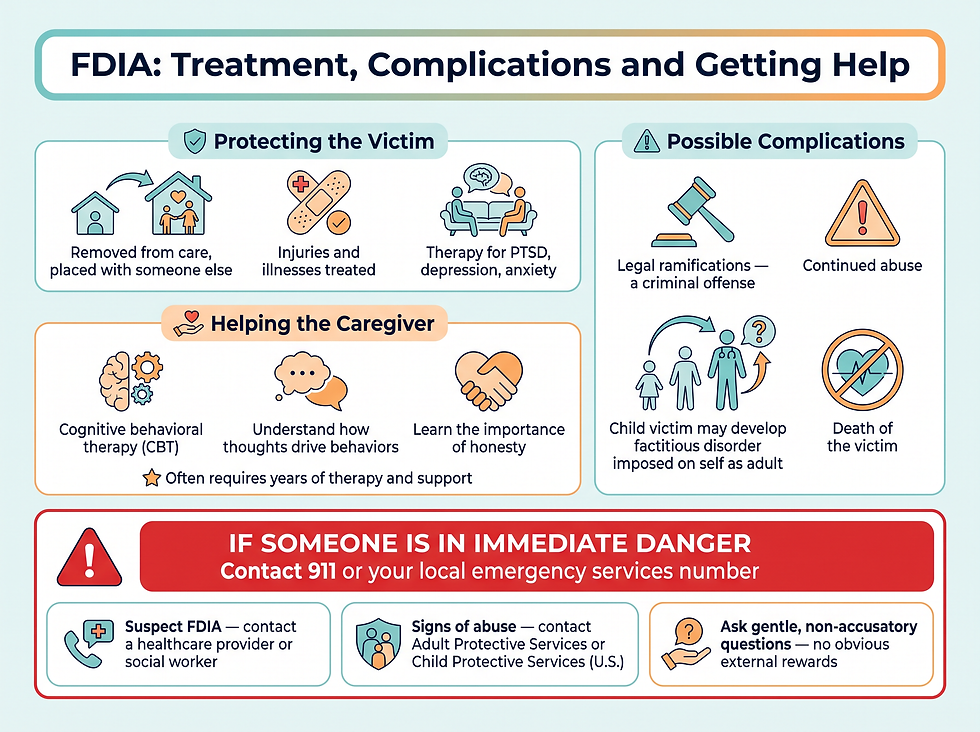
Additional help for the victim may include removing them from your care and placing them in the care of someone else, treating any injuries or illnesses, and talking to a mental health provider, therapist or other physician about possible post-traumatic stress disorder (PTSD), depression, anxiety or other complications that may arise as a result of abuse.
How does therapy help the caregiver?
To address any underlying causes of your behavior, your healthcare provider may refer you to a type of psychotherapy called cognitive behavioral therapy (CBT). The goal of therapy is to identify how your thoughts and feelings contribute to your behaviors. You'll also learn about the importance of honesty. A mental health professional will help you adjust your thinking and behaviors.
Generally, FDIA is a very difficult disorder to treat and often requires years of therapy and support. Social services, law enforcement, Child Protective Services, Adult Protective Services and healthcare providers must all work together as a team to stop the behavior.
Treatment Component | What It Involves |
First goal | Modify harmful behaviors; reduce misuse or overuse of medical resources |
Underlying causes | Addressed after harmful behaviors are modified |
Victim safety | Care team ensures the person isn't in danger and avoids unnecessary testing/treatment |
Victim support | Removed from care and placed with someone else; injuries/illnesses treated; therapy for possible PTSD, depression, anxiety or other abuse complications |
Caregiver therapy | Cognitive behavioral therapy (CBT) — identify how thoughts/feelings contribute to behaviors; learn the importance of honesty; adjust thinking and behaviors |
Team approach | Social services, law enforcement, CPS, APS and healthcare providers work together |
Difficulty | Very difficult to treat; often requires years of therapy and support |
Can FDIA Be Prevented?
There's no known way to prevent this condition. However, there's less risk of harm by seeking treatment as soon as symptoms begin. For example, removing a person from your care could prevent unnecessary harm.
FDIA can lead to serious complications, including legal ramifications (this form of abuse is a criminal offense), continued abuse of a victim, development of factitious disorder imposed on self for a child victim as they reach adulthood, and death of the victim. Making sure this condition receives proper treatment as soon as possible may prevent these complications.
Possible Complication | Detail |
Legal ramifications | This form of abuse is a criminal offense |
Continued abuse | Ongoing abuse of a victim |
Future disorder | A child victim may develop factitious disorder imposed on self as they reach adulthood |
Death | Death of the victim |
Prevention of complications | Prompt treatment may prevent these complications |
When Should I Get Help?
Contact a healthcare provider or social worker if you suspect FDIA behaviors happening with a loved one. If you see signs of abuse, contact Adult Protective Services or Child Protective Services (U.S.). If someone is in immediate danger, don't hesitate to contact 911 or your local emergency services number.
Situation | What to Do |
You suspect FDIA with a loved one | Contact a healthcare provider or social worker |
You see signs of abuse | Contact Adult Protective Services or Child Protective Services (U.S.) |
Someone is in immediate danger | Contact 911 or your local emergency services number |
What questions should I ask someone if I notice FDIA behaviors?
If you suspect a loved one may have FDIA, you might want to ask the following questions to learn more: How often do you visit a provider's office? Are you visiting the same provider or multiple different providers? How does the person within your care feel after getting a lot of testing done? Does the person within your care have symptoms when you're not around? Are you experiencing a lot of stress as a caregiver?
Understand that you may not get clear answers to these questions, as FDIA causes deceptive behaviors. To gather information, try to avoid accusing the caretaker with your questioning. Approach the conversation gently and with a willingness to learn more.
What the care team says (verbatim): "Factitious disorder imposed on another can not only be difficult to treat, but it can also be hard to identify, especially if you or a loved one experience it. The deceptive behaviors are harmful. They can lead to lifelong complications. But you can stop the cycle of abuse. Don't hesitate to have an honest conversation and connect with national and local resources if necessary. Help is available for everyone involved."
Conclusion: Recognizing FDIA Can Save a Life
FDIA is a mental health condition — and a form of abuse — where someone claims a person in their care needs medical attention when they don't. The victim is most often a child under 6, a person with disabilities or an adult over 65. False medical claims lead to unnecessary tests and risky procedures, and the deception makes diagnosis difficult.
Treatment protects the victim first — removing them from harm, treating injuries and addressing possible PTSD, depression or anxiety — then addresses the caregiver's behavior through cognitive behavioral therapy. The condition is difficult to treat and often requires years of support, with social services, law enforcement, protective services and healthcare providers working as a team. If you suspect FDIA, reach out to a healthcare provider, social worker or protective services — and if someone is in immediate danger, call 911. Help is available for everyone involved.
Take these three steps:
Learn the warning signs — know what behaviors and patterns (many hospitalizations, symptoms that appear only at home, contaminated lab samples) may signal FDIA in someone you know.
Act on suspicion, don't accuse — contact a healthcare provider or social worker if you suspect FDIA; use gentle, non-accusatory questions and reach Adult Protective Services or Child Protective Services if you see signs of abuse.
Protect life in emergencies — if someone is in immediate danger, contact 911 or your local emergency services number without hesitation; prompt treatment reduces the risk of lifelong complications or death.
This article provides general information and is not a substitute for professional medical advice. Always consult a qualified healthcare provider for diagnosis and treatment.
Frequently Asked Questions
What is factitious disorder imposed on another?
It's a mental health condition where you claim that someone within your care needs medical attention even though they don't.
What is another name for FDIA?
It was formerly known as Munchausen syndrome by proxy.
Who was Baron Munchausen?
He was a historical figure known for exaggerated stories, which is why the condition was formerly named after him. The name change provides a more accurate description of the behavior.
Who is typically the victim of FDIA?
A person within your care — often a child (usually under the age of 6), a person with disabilities or an adult over age 65.
Is FDIA a mental health condition?
Yes. It's a mental health condition and a type of factitious disorder. It's also a form of abuse.
Is FDIA a form of abuse?
Yes. The referenced clinical source states that FDIA is also a form of abuse.
Why is FDIA dangerous?
Making false medical claims can lead to unnecessary medical tests and even risky procedures while the healthcare team tries to figure out what's wrong.
How common is FDIA?
It isn't common, and there aren't any reliable statistics regarding the number of people in the United States who have this condition. Many cases go undetected.
What causes FDIA?
Providers aren't sure of the exact cause. Motivations may relate to a history of past trauma, abuse or neglect, loss of a parent or caregiver, extreme stress and wanting attention from others.
What behaviors does someone with FDIA show?
They might report symptoms the person isn't actually experiencing, physically harm someone to cause symptoms (like withholding food to prevent weight gain), change diagnostic test results (like contaminating a urine sample) or interfere with someone's treatment plan to prevent them from getting better.
What are the warning signs in the victim?
They're never left alone or out of the caretaker's sight; they have a history of many hospitalizations, tests and procedures; medical records are inconsistent; symptoms don't fit a single condition; symptoms only happen at home or not in the presence of a provider; symptoms improve in the hospital but worsen at home; and lab samples don't match the person's blood type or urine or show contamination.
Can lab results point to FDIA?
Yes. Blood or urine in lab samples may not match the blood type or urine of the person within your care, or there may be signs of contamination.
Is FDIA hereditary?
There's no known genetic cause.
Who is most often diagnosed with FDIA?
It's most often diagnosed in female caretakers.
What conditions are associated with FDIA?
It's more common among people who also have a personality disorder.
What personality traits are common in people with FDIA?
They often have a large amount of knowledge about medical care and health information, are very personable and easy to get along with, and are highly involved and devoted to being a caretaker.
Why is FDIA difficult to diagnose?
Because the condition involves dishonesty. A provider must first rule out any possible conditions related to the victim's symptoms before considering an FDIA diagnosis, which can take time.
What clues do providers look for?
Visiting multiple different healthcare facilities, an inconsistent medical history, not wanting to share previous medical records or allow providers to speak with friends and family, and not allowing providers to speak to the person within your care alone.
What are the DSM-5 criteria for FDIA?
Falsifying physical or psychological signs or symptoms, or creating an injury or condition to deceive; one person presenting someone else as ill, impaired or injured; deceptive behavior without obvious external rewards; and the behavior not being caused by another mental health condition.
Does FDIA require external rewards?
No. The DSM-5 specifies the deceptive behavior happens without obvious external rewards.
What is the first goal of FDIA treatment?
To modify harmful behaviors and reduce the misuse or overuse of medical resources.
How does treatment protect the victim?
The care team ensures the person isn't in danger and doesn't undergo unnecessary testing or treatment. The victim may be removed from the caregiver's care and placed with someone else.
What therapy is used for FDIA?
Cognitive behavioral therapy (CBT). Its goal is to identify how thoughts and feelings contribute to behaviors and to teach the importance of honesty.
How long does FDIA treatment take?
It's a very difficult disorder to treat and often requires years of therapy and support.
Who is involved in stopping FDIA?
Social services, law enforcement, Child Protective Services, Adult Protective Services and healthcare providers must all work together as a team.
Can FDIA be prevented?
There's no known way to prevent it. But there's less risk of harm by seeking treatment as soon as symptoms begin.
What complications can FDIA cause?
Legal ramifications (it's a criminal offense), continued abuse of a victim, development of factitious disorder imposed on self for a child victim as they reach adulthood, and death of the victim.
What questions can I ask a loved one I suspect has FDIA?
How often do you visit a provider's office? Are you visiting the same provider or multiple providers? How does the person in your care feel after lots of testing? Do they have symptoms when you're not around? Are you experiencing a lot of stress as a caregiver?
Should I accuse someone directly about FDIA?
No. Try to avoid accusing the caretaker with your questioning. Approach the conversation gently and with a willingness to learn more — you may not get clear answers because FDIA causes deceptive behaviors.
When should I contact Adult Protective Services or Child Protective Services?
If you see signs of abuse. In the U.S., these are the appropriate protective services to contact.
What should I do if someone is in immediate danger?
Don't hesitate to contact 911 or your local emergency services number.
Additional Resources
For further reading, these authoritative external references support the information above:
Content reviewed and produced following the Rinnit editorial framework. Last updated: September 28, 2026.
Comments