
Self-Injury (Self-Harm): Complete Guide to Signs, Causes, Risks, and Treatment

Updated: 2 days ago
Medically reviewed by Dr. Baraa Alnahhal, MD · Last reviewed: September 2026
TL;DR
Nonsuicidal self-injury is the act of harming your own body on purpose, such as cutting or burning, and it's usually not meant as a suicide attempt. It's a harmful way to cope with emotional pain, sadness, anger, and stress. It may bring a brief sense of calm but is usually followed by guilt and shame. Teenagers and young adults are most likely to self-injure, and it often starts in the early teen years. Treatment centers on psychotherapy — such as CBT and dialectical behavior therapy — because no medicine specifically treats self-injury. If you're in crisis, call or text 988 to reach the U.S. 988 Suicide & Crisis Lifeline, available 24/7, or call 911 in an emergency.
Quick Answer: What Is Self-Injury?
Self-injury (also called cutting or nonsuicidal self-injury) is deliberately harming your own body — most commonly by cutting, burning, or scratching — and it is usually not a suicide attempt. It's a harmful way of coping with emotional pain, stress, and anger, offering brief relief followed by guilt and shame. Diagnosis relies on a physical and psychological evaluation rather than a specific test, and treatment is based on psychotherapy such as cognitive behavioral therapy or dialectical behavior therapy, sometimes with medicines that treat underlying conditions like depression.
What Is Self-Injury?
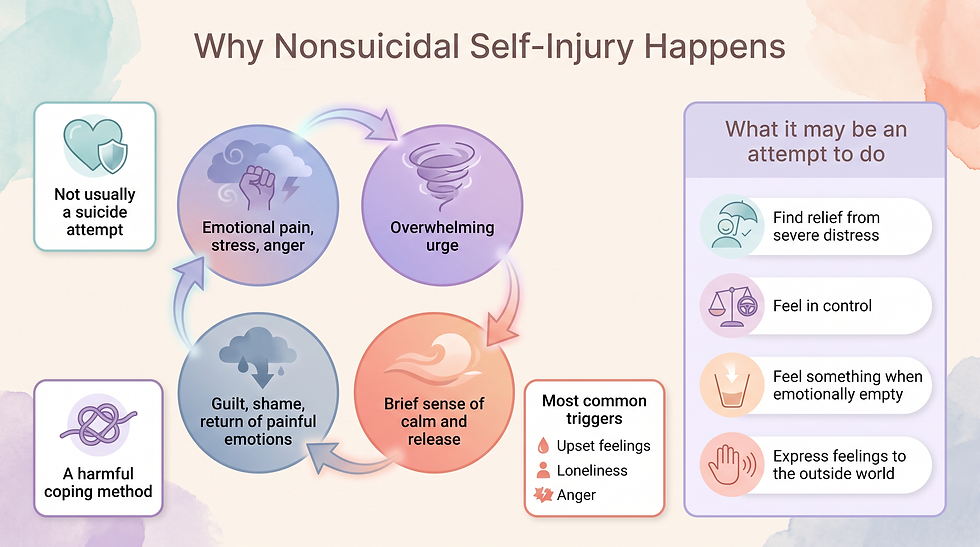
Nonsuicidal self-injury, often simply called self-injury, is the act of harming your own body on purpose, such as by cutting or burning yourself. It's usually not meant as a suicide attempt. This type of self-injury is a harmful way to cope with emotional pain, sadness, anger, and stress.
While self-injury may bring a brief sense of calm and a release of physical and emotional tension, it's usually followed by guilt and shame and the return of painful emotions. Life-threatening injuries are usually not intended, but more-serious and even fatal self-harm could happen. Getting the proper treatment can help you learn healthier ways to cope.
Key Fact | Detail |
|---|---|
What it is | Deliberately harming your own body on purpose, such as cutting or burning |
Suicide attempt? | Usually not meant as a suicide attempt |
What it manages | Emotional pain, sadness, anger, and stress |
Short-term effect | A brief sense of calm and release of tension |
What follows | Guilt and shame, and the return of painful emotions |
Most common ages | Teenagers and young adults; often starts in preteen or early teen years |
Why Do People Self-Injure?
There's no one single or simple cause that leads someone to self-injure. In general, self-injury may result from poor coping skills — an inability to cope in healthy ways with stress and emotional pain. Difficulty managing emotions is another driver; having a hard time controlling, expressing, or understanding emotions may lead to self-injury. The mix of emotions that triggers self-injury is complex, including feelings of worthlessness, loneliness, panic, anger, guilt, rejection, and self-hatred. Being bullied or having questions about sexual identity may be part of the mix.
Self-injury may be an attempt to manage or reduce severe distress or anxiety and provide a sense of relief, to provide a distraction from painful emotions through physical pain, or to feel a sense of control over the body, feelings, or life situations. Some people self-injure to feel something — anything, even physical pain — when feeling emotionally empty. It can also express internal feelings in an external way, communicate feelings of stress or depression to the outside world, or serve as a way to punish oneself.
Why Someone May Self-Injure | Description |
|---|---|
Find relief | Manage or reduce severe distress or anxiety |
Distract from pain | Use physical pain to distract from painful emotions |
Feel in control | Gain a sense of control over the body, feelings, or life |
Feel something | Feel anything, even physical pain, when emotionally empty |
Express feelings | Express internal feelings in an external way |
Communicate | Communicate stress or depression to the outside world |
Self-punishment | Punish oneself |
Warning Signs and Forms of Self-Injury
Symptoms of self-injury may include scars, often in patterns, and fresh cuts, scratches, bruises, bite marks, or other wounds. Excessive rubbing of an area to create a burn is another sign. Someone may keep sharp objects or other items used for self-injury on hand, or wear long sleeves or long pants to hide self-injury, even in hot weather. Frequent reports of accidental injury, difficulties in relationships with others, behaviors and emotions that change quickly — impulsive, intense, and unexpected — and talk of helplessness, hopelessness, or worthlessness are also warning signs.
Self-injury mostly happens in private. Usually, it's done in a controlled manner or the same way each time, which often leaves a pattern on the skin. Examples of self-harm include cutting, scratching, or stabbing with a sharp object, which is one of the most common methods, as well as burning with lit matches, cigarettes, or heated, sharp objects such as knives. Other forms include carving words or symbols on the skin, self-hitting, punching, biting, or head banging, piercing the skin with sharp objects, and inserting objects under the skin.
Most frequently, the arms, legs, chest, and belly are the targets of self-injury, but any area of the body may be a target, sometimes using more than one method. Becoming upset can trigger urges to self-injure. Many people self-injure only a few times and then stop, but for others it can become a longer-term, repeated behavior.
Warning Sign | What to Look For |
|---|---|
Patterned scars | Scars, often arranged in patterns |
Fresh wounds | Cuts, scratches, bruises, bite marks, or other injuries |
Hiding injuries | Wearing long sleeves or pants to hide self-injury, even in hot weather |
Frequent "accidents" | Repeated reports of accidental injury |
Mood shifts | Behaviors and emotions that change quickly, impulsive, intense, and unexpected |
Negative talk | Talk of helplessness, hopelessness, or worthlessness |
Relationship trouble | Difficulties in relationships with others |
Common Methods and Target Areas
Form of Self-Injury | Detail |
|---|---|
Cutting, scratching, or stabbing | One of the most common methods, done with a sharp object |
Burning | With lit matches, cigarettes, or heated, sharp objects |
Carving | Words or symbols carved on the skin |
Hitting | Self-hitting, punching, biting, or head banging |
Piercing | Piercing the skin with sharp objects |
Inserting objects | Inserting objects under the skin |
Risk Factors
Teenagers and young adults are most likely to self-injure, but those in other age groups do it, too. Self-injury often starts in the preteen or early teen years, when emotional changes happen fast, often, and unexpectedly. During this time, teens also face increasing peer pressure, loneliness, and conflicts with parents or other authority figures.
Several factors may increase the risk. Having friends who self-injure makes it more likely for someone to begin self-injuring. Life issues such as past experiences of neglect, sexual, physical, or emotional abuse, or other traumatic events may increase risk, as can growing up and remaining in an unstable family environment. Other risk factors include questioning personal or sexual identity and social isolation.
Mental health issues also play a role. Being highly self-critical and struggling with problem solving increases the risk of self-injury. Self-injury is commonly linked with certain mental health conditions, such as borderline personality disorder, depression, anxiety disorders, post-traumatic stress disorder, and eating disorders. Finally, being under the influence of alcohol or recreational drugs may increase the risk.
Risk Factor | Detail |
|---|---|
Age | Teenagers and young adults most likely; often starts in preteen or early teen years |
Friends who self-injure | Makes beginning self-injury more likely |
Trauma and family life | Neglect, abuse, traumatic events, unstable family environment |
Identity and isolation | Questioning personal or sexual identity; social isolation |
Mental health conditions | Linked with borderline personality disorder, depression, anxiety disorders, PTSD, eating disorders |
Substance use | Alcohol or recreational drugs may increase risk |
Complications and Suicide Risk
Self-injury can cause complications such as worsening feelings of shame, guilt, and low self-esteem, and infection, either from wounds or from sharing tools. Permanent scars or other permanent harm to the body can result, along with worsening of underlying issues and conditions if they are not properly treated. Severe injury that could possibly lead to death is another complication.
Self-injury is not usually a suicide attempt, but it can increase the risk of suicide because of the emotional problems that trigger self-injury. The pattern of damaging the body in times of distress can make suicide more likely.
When to Seek Help
If you're injuring yourself, even in a minor way, or if you have thoughts of harming yourself, reach out for help. Any form of self-injury is a sign of bigger stressors that need attention. Talk to someone you trust — such as a friend, family member, healthcare provider, spiritual leader, or a school counselor, nurse, or teacher. They can help you take the first steps to successful treatment. While you may feel ashamed and embarrassed about your behavior, you can find supportive, caring help from people who aren't going to judge you.
If you've injured yourself severely or believe your injury may be life-threatening, or if you think you may hurt yourself or attempt suicide, call 911 or your local emergency number right away. Consider these options if you're having suicidal thoughts: call your mental health provider if you're seeing one; contact a suicide hotline — in the U.S., call or text 988 to reach the 988 Suicide & Crisis Lifeline, available 24 hours a day, seven days a week, or use the Lifeline Chat, with services free and confidential (a Spanish language phone line is available at 1-888-628-9454); seek help from your school nurse, counselor, teacher, or healthcare provider; reach out to a close friend or family member; or contact a spiritual leader or someone in your faith community.
Situation | What to Do |
|---|---|
Any self-injury or urges | Reach out for help — it's a sign of bigger stressors needing attention |
Severe or possibly life-threatening injury | Call 911 or your local emergency number right away |
Thoughts of hurting yourself or suicide | Call 911; call or text 988 (U.S. 988 Suicide & Crisis Lifeline, 24/7, free and confidential) |
Seeking first support | Talk to someone you trust: friend, family, provider, counselor, or teacher |
If a Friend or Family Member Self-Injures
If you have a friend or family member who is self-injuring, you may be shocked and scared. Take all talk of self-injury seriously. Although you might feel that you'd be betraying a confidence, self-injury is too big a problem to ignore or to deal with alone.
For a child, you can start by talking with a pediatrician or other healthcare provider, who can do an initial evaluation or make a referral to a mental health professional. Express your concern, but don't yell at your child or make threats or accusations. For a preteen or teenage friend, suggest that your friend talk to parents, a teacher, a school counselor, or another trusted adult. For an adult, gently express your concern and encourage the person to seek medical and mental health treatment.

Prevention
There is no sure way to prevent someone's self-injuring behavior, but reducing the risk includes strategies that involve both individuals and communities. Parents, family members, teachers, school nurses, coaches, or friends can help. Someone at risk can be identified and offered help; they can be taught how to better manage stress and deal with life's problems and can learn healthy coping skills to use during periods of distress.
Encouraging supportive social networks helps, since feeling lonely and disconnected may be part of self-injury. Helping someone form healthy connections to people who don't self-injure can improve relationship and communication skills. Raising awareness — learning the warning signs of self-injury and what to do when you suspect it — is another strategy. Peers tend to be loyal to their friends, so encourage children, teens, and young adults to avoid secrecy and reach out for help if they have a concern about a friend or family member. Finally, news media, music, and other highly visible outlets that feature self-injury may nudge children and young adults with mental or emotional issues to experiment; teaching children critical thinking skills about the influences around them might reduce the harmful impact.
How Is Self-Injury Diagnosed?
Although some people may ask for help, sometimes family or friends discover the self-injury, or a healthcare provider doing a routine medical exam may notice signs such as scars or fresh injuries.
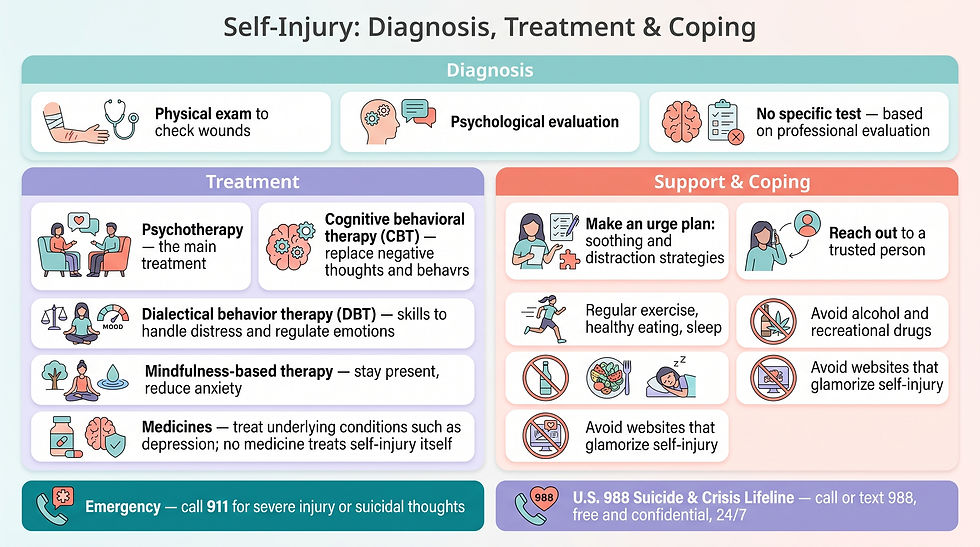
There's no specific test to diagnose self-injury. Diagnosis is based on a physical and psychological evaluation. You may be referred to a mental health professional with experience in treating self-injury for evaluation. This professional talks to you about your life, thoughts, feelings, and behaviors. A mental health professional also may evaluate you for other mental health conditions that could be linked to self-injury, such as depression or personality disorders.
Diagnostic Step | What Happens |
|---|---|
Physical exam | A provider checks for signs such as scars or fresh injuries |
Psychological evaluation | A mental health professional discusses your life, thoughts, feelings, and behaviors |
No specific test | Diagnosis is based on the combined evaluations |
Related screening | Evaluation for linked conditions such as depression or personality disorders |
Treatment Options
The first step is to tell someone about your self-injuring behavior so you can get help. Treatment is based on your specific issues and any related mental health conditions you might have, such as depression. Because self-injury can become a major part of your life, it's best to get treatment from a mental health professional who is experienced in treating self-injury. If the self-injury behavior is linked with a mental health condition, such as depression or borderline personality disorder, the treatment plan focuses on that condition, as well as the self-injury behavior. Treating self-injury behavior can take time, hard work, and your own desire to recover.
Psychotherapy
Known as talk therapy or psychological counseling, psychotherapy can help you identify and manage underlying issues that trigger self-injury, learn skills to better manage distress, and learn better ways to manage intense emotions. It can help you boost your self-image, develop skills to improve your relationships and social skills, and develop healthy problem-solving skills.
Several types of individual psychotherapy may be helpful. Cognitive behavioral therapy (CBT) helps you identify unhealthy, negative beliefs and behaviors and replace them with more effective ones, and you can gain skills that help you cope in different situations when needed. Dialectical behavior therapy, a type of CBT, teaches behavioral skills to help you handle distress, manage or regulate your emotions, and improve your relationships with others. Mindfulness-based therapies help you live in the present and cope with difficult emotions and negative thoughts; they can reduce anxiety and depression and improve your general well-being. In addition to individual therapy sessions, your provider may recommend family therapy or group therapy.
Medicines
There are no medicines to specifically treat self-injuring behavior. However, if you're diagnosed with a mental health condition, such as depression or an anxiety disorder, your healthcare provider may recommend antidepressants or other medicines to treat the underlying condition that's linked with self-injury. Treatment for these conditions may help reduce the urge to hurt yourself.
Inpatient Care
If you injure yourself severely or repeatedly, your healthcare provider may recommend that you be admitted to a hospital for psychiatric care. Being cared for in a hospital, often short term, can provide a safe environment and more-intensive treatment until you get through a crisis. Mental health day-treatment programs that focus on learning behavioral coping skills to manage distress also may be an option.
Treatment | How It Helps | Notes |
|---|---|---|
Psychotherapy | Identifies triggers, teaches distress and emotion management, boosts self-image | The main treatment for self-injury |
Cognitive behavioral therapy (CBT) | Replaces unhealthy negative beliefs and behaviors with effective ones | A form of psychotherapy |
Dialectical behavior therapy (DBT) | Teaches skills to handle distress, regulate emotions, improve relationships | A type of CBT |
Mindfulness-based therapy | Helps you live in the present and cope with difficult emotions | May reduce anxiety and depression |
Medicines | Treats underlying conditions such as depression or anxiety | No medicine specifically treats self-injury |
Inpatient or day-treatment care | Safe, intensive environment to get through a crisis | For severe or repeated self-injury |
Self-Care and Coping
In addition to professional treatment, self-care steps help. Follow your treatment plan: keep therapy appointments, practice and use coping skills learned in therapy, and take any prescribed medicine as directed. Recognize the situations or feelings that might trigger your desire to self-injure, and make a plan for other ways to soothe or distract yourself or to get support, so you're ready the next time you feel the urge.
Ask for help — keep your mental health provider's phone number handy, tell your provider about all incidents related to self-injury, and choose a trusted family member or friend as the person you'll immediately contact if you have an urge or if self-injury happens. Take care of yourself: learn to include physical activity and relaxation exercises as a regular part of your daily routine, eat healthy, and ask your healthcare provider for advice if you have sleep problems, which can have a big impact on behavior. Avoid alcohol and recreational drugs, since they affect your ability to make good decisions and can put you at risk of self-injury. Take care of your wounds if you injure yourself, or seek medical treatment if needed, and call a trusted family member or friend for help and support. Don't share items used for self-injury; that raises the risk of infectious diseases.
If you self-injure, connect with others who can support you so that you don't feel alone — reach out to a trusted family member or friend, contact a support group, or contact your healthcare provider or mental health provider. Avoid websites that support or glamorize self-injury; instead, seek out sites that support your recovery efforts. Learn to express your emotions in positive ways — become more physically active, practice relaxation techniques, or participate in activities you find personally meaningful, such as dance, art, or music.
If a friend or loved one self-injures, get information about self-injury to understand why it occurs and how to help stop the harmful behavior, and learn the strategies and relapse prevention plan your loved one developed with their therapist so you can encourage them. Try not to judge or criticize — criticism, yelling, threats, or accusations may increase the risk of self-injuring behavior. Offer support, praise efforts to express emotions in healthy ways, and try to spend positive time together. Let your loved one know you care no matter what; remind them they're not alone and that you're available to talk. You may not change the behavior, but you can help the person find resources, identify coping strategies, and offer support during treatment. Support the treatment plan by encouraging prescribed medicine and keeping therapy appointments. Make a safe home environment by removing or limiting access to matches, knives, razor blades, or other items that may be used for self-injury. Share coping strategy ideas, serve as a role model by using healthy coping strategies yourself, find support of your own through trusted people or support groups, and take care of yourself with rest, physical activity, and things you enjoy.
Preparing for Your Appointment
Your first appointment may be with your primary care provider, a school nurse, or a counselor. But because self-injury often requires specialized mental health care, you may be referred to a mental health professional for more evaluation and treatment. Be ready to provide accurate, thorough, and honest information about your situation and your self-injuring behavior. You may want to take a trusted family member or friend along for support and to help you remember information.
To help prepare, make a list of the symptoms you've had, including triggers for self-injury, how long you've been self-injuring, whether you use any objects, and where on your body you usually self-injure. Note key personal information, including any major stresses or recent life changes, along with all medicines, vitamins, herbs, or other supplements you're taking, including doses, and questions to ask your mental health provider.
What treatments are available? Which do you recommend for me?
What side effects are possible with that treatment?
What are other options to the approach that you're suggesting?
Are there medicines that might help? Is there a generic version?
What should I do if I have an urge to self-injure between therapy sessions?
What else can I do to help myself?
How can I — or those around me — recognize that things may be getting worse?
Can you suggest resources that would help me learn more about my condition and its treatment?
Your mental health provider is likely to ask questions too. Be ready to discuss when you first began harming yourself, what methods you use, how often you cut or injure yourself, and where on your body you self-injure. You'll likely talk about what feelings and thoughts you have before, during, and after self-injury, what seems to trigger it, and what makes you feel better or worse. Be prepared to discuss whether you have a supportive social circle, what emotional issues you're facing, and how you feel about your future. Your provider may also ask whether you've had previous treatment for self-injury, whether you have suicidal thoughts when you're feeling down, and whether you drink alcohol or use tobacco or recreational drugs. Preparing for these questions will help you make the most of your time with the provider.
Conclusion
Self-injury is deliberately harming your own body — most often cutting or burning — and while it's usually not a suicide attempt, it's a harmful way of coping with emotional pain that brings brief relief before guilt and shame return. It most often begins in the preteen or early teen years, affects teenagers and young adults most, and is linked with stress, trauma, isolation, and mental health conditions such as depression and anxiety. There's no specific test for it; diagnosis rests on a physical and psychological evaluation. Psychotherapy — including CBT, dialectical behavior therapy, and mindfulness-based approaches — is the cornerstone of treatment, with medicines reserved for underlying conditions and short-term hospital care for severe cases. Recovery takes time and effort, but healthier coping skills are learnable, and supportive, nonjudgmental help is available. If you or someone you love is struggling, talk to someone you trust today. If there's immediate danger, call 911 or call or text 988 to reach the U.S. 988 Suicide & Crisis Lifeline, free and confidential, 24/7.
Take the next step: If you or someone you know is self-injuring or having urges, reach out for help.
Frequently Asked Questions
What is self-injury?
Nonsuicidal self-injury is the act of harming your own body on purpose, such as by cutting or burning yourself. It's usually not meant as a suicide attempt but is a harmful way to cope with emotional pain, sadness, anger, and stress.
Is self-injury a suicide attempt?
Usually not. Self-injury is usually not meant as a suicide attempt, but it can increase the risk of suicide because of the emotional problems that trigger it, and the pattern of damaging the body in times of distress can make suicide more likely.
What are the warning signs of self-injury?
Warning signs include scars often in patterns, fresh cuts or bruises or bite marks, wearing long sleeves or pants to hide injuries even in hot weather, frequent reports of accidental injury, quick and intense mood changes, difficulties in relationships, and talk of helplessness, hopelessness, or worthlessness.
Why do people self-injure?
Self-injury usually results from poor coping skills and difficulty managing emotions. It may be an attempt to find relief from severe distress, feel in control, feel something when emotionally empty, express or communicate inner feelings, or punish oneself.
Who is most at risk?
Teenagers and young adults are most likely to self-injure, and it often starts in the preteen or early teen years. Risk factors include friends who self-injure, past abuse or neglect, unstable family life, social isolation, and mental health conditions such as depression, anxiety disorders, PTSD, borderline personality disorder, and eating disorders.
How is self-injury diagnosed?
There's no specific test. Diagnosis is based on a physical and psychological evaluation by a healthcare provider or mental health professional, who may also screen for linked conditions such as depression or personality disorders.
What is the treatment for self-injury?
Psychotherapy is the main treatment, including cognitive behavioral therapy (CBT), dialectical behavior therapy (DBT), and mindfulness-based therapies, sometimes with family or group therapy. There are no medicines that specifically treat self-injury, but antidepressants may treat underlying conditions like depression. Severe or repeated cases may need short-term hospital care.
What should I do if someone I love self-injures?
Take all talk of self-injury seriously and don't try to handle it alone. Don't yell, threaten, or criticize, since that may increase risk. Gently encourage professional treatment, help make the home safer by limiting access to sharp objects, learn their coping and relapse-prevention plan, and find support for yourself. For immediate danger, call 911; in the U.S., call or text 988 to reach the 988 Suicide & Crisis Lifeline, 24/7.
Further Reading
If you are in crisis or thinking about harming yourself, call or text 988 to reach the U.S. 988 Suicide & Crisis Lifeline (free and confidential, 24/7), or call 911 for immediate emergency help.
Medical disclaimer: This article is for general informational purposes only and is not a substitute for professional medical advice, diagnosis, or treatment. Always consult a qualified healthcare professional about any medical condition or treatment decision.
Comments