Facial Feminization Surgery: A Guide to Facial Gender Affirmation

Updated: 3 days ago
Medically reviewed by Dr. Baraa Alnahhal, MD · Last reviewed: October 2026
Source currency note: This guide reflects medical information reviewed in August 2023. Always confirm current guidance with your surgeon.
Quick Answer: What is facial feminization surgery?
Facial feminization surgery is one surgery or a series of procedures that reshape bone, cartilage and soft tissue to make facial features look more traditionally feminine, such as hairline lowering, rhinoplasty and jaw reduction. It is not recommended under age 18 or when health conditions make surgery dangerous. Most healing takes two to six weeks, and results are permanent. [3]
What the research says
Quality of life improved after surgery. In a single-center survey of 107 patients who completed questionnaires before and after FFS (average age 36), self-perceived facial femininity rose from 2.1 to 3.8 on a 5-point scale and publicly perceived femininity from 2.0 to 3.6, while limits on social activities fell from 3.2 to 2.0 and on professional activities from 2.7 to 1.7; the surveys were completed about 96 days after surgery on average (Chou et al., Facial Plastic Surgery & Aesthetic Medicine, 2022 [1]).
Outcome measurement is still inconsistent. A systematic review of 15 FFS studies found 69 different outcomes and 12 outcome measures, and none of those measures had been shown to be valid, reliable, and responsive in people who had FFS, so comparing results across studies is difficult (Uhlman et al., Facial Plastic Surgery & Aesthetic Medicine, 2022 [2]).
Understanding common FFS procedures
Facial feminization surgery is not a single operation but a personalized set of procedures. Surgeons reshape both hard and soft tissues so that changes look natural and the face stays harmonious. People commonly seek FFS to change the nose, jaw, forehead, and hairline, and a plastic surgeon who specializes in the face, head, and neck performs it [3].
Procedure category | Common techniques | Primary goal |
Upper face | Hairline lowering, forehead contouring | Soften the brow ridge and lower the hairline |
Mid-face | Rhinoplasty, cheek augmentation, lip lift | Reshape the nose, add volume to the cheeks, and refine the lips |
Lower face | Jaw reduction, chin reduction (genioplasty) | Narrow the jawline and refine the chin shape |
Neck | Adam’s apple reduction (tracheal shave) | Smooth the throat profile |

Preparation and candidacy
Before surgery, your provider carries out a thorough personal and physical assessment. They ask about your goals and explain what to expect during recovery, because it is important that your goals and your surgeon’s are aligned and realistic. They also check that you are healthy enough for surgery by assessing lifestyle habits such as smoking or drinking, doing a physical exam and lab tests, identifying risks for complications, and reviewing your medications and allergies [3].
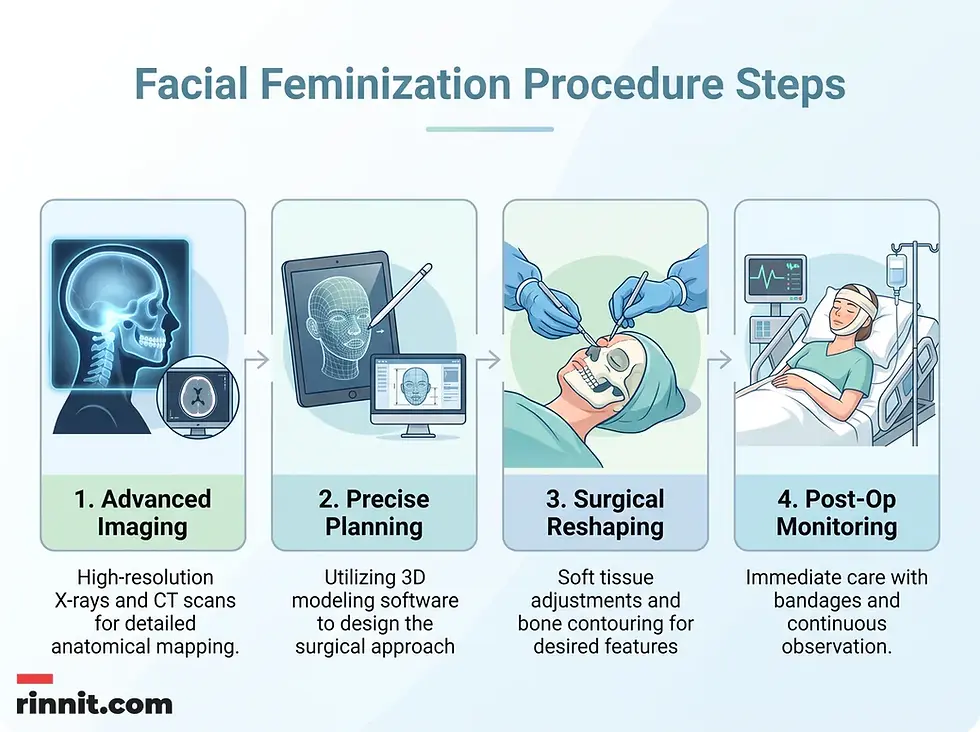
You may also have imaging scans, such as X-rays or CT scans, that show the bones and soft tissues of your face and skull. Your surgeon may measure your face, take photographs, and assess your skin quality, and all of this helps them plan your treatment [3].
The surgical experience
FFS is a major undertaking. If everything is done in one surgery, it can take up to eight or nine hours. Some surgeons recommend splitting the work into two surgeries separated by about seven to 10 days or longer, which gives the face more time to heal [3].
Incisions are often placed in discreet locations. For example, jaw reduction is done through an incision inside the mouth, so there is no visible scar, and hairline lowering uses an incision along the hairline [3].
Recovery and long-term outlook
After surgery you will have gauze or bandages over your incisions for several days. You may wear compression wraps around your forehead or jaw to reduce swelling, and you may go home with a surgical drain that helps remove blood and fluid. Most people report minimal pain, and discomfort should improve with medication [3].
Recovery milestone | Expected timeline | Typical experience |
Immediate post-op | About 1 week | Nonabsorbable stitches are usually removed (absorbable stitches do not need removal); swelling and bruising are present |
Major healing | 2 to 6 weeks | Bruising and swelling decrease significantly and healing continues over the following months |
Final results | About 1 year | Residual swelling resolves and facial contours settle |

FFS results should last the rest of your life. The only exception is dermal fillers, which may be used to plump the lips or cheeks and will need retreatment at some point; some last a few months and others up to five years [3].
Risks and when to call your provider
Risks of facial feminization surgery include bleeding, bruising, swelling from fluid buildup, hair loss after hairline lowering or forehead contouring, infection, numbness in parts of the face, poor healing of incisions, and a reaction to anesthesia [3].
Contact your healthcare provider right away if you have abnormal heartbeats, chest pain, shortness of breath, or signs of infection such as increased redness, pain, drainage, or swelling [3].
Conclusion
Facial feminization surgery combines surgical precision with a deep understanding of facial aesthetics. By addressing the features that most affect how a face is perceived, it can help people feel more confident and secure and improve their quality of life. Everyone has their own idea of femininity, so the best results come from a surgeon who understands your goals and whom you trust to achieve them [3].
If you are considering these procedures, consult a plastic surgeon who specializes in the face, head, and neck to develop a personalized plan that fits your goals.
Frequently Asked Questions
What is facial feminization surgery?
Facial feminization surgery (FFS) is a group of procedures used to make facial features look more traditionally feminine through bone, cartilage, and soft tissue reshaping.
Who is a good candidate for FFS?
Healthy adults over 18 with realistic expectations are typically good candidates. People with heart disease, bleeding disorders, or an allergy to general anesthesia may be excluded for safety reasons.
How long does the surgery take?
A comprehensive FFS operation can take up to eight or nine hours. Surgeons may split the procedures into two surgeries to give the face more time to heal.
Is facial feminization surgery painful?
Most people report minimal pain, which is managed with prescribed medication. Some discomfort, swelling, and bruising are normal during the first few weeks.
Are the results of FFS permanent?
Yes. Results should last the rest of your life because they involve reshaping the facial bones and tissues. Dermal fillers are the only exception and need retreatment.
Where are the incisions usually made?
Incisions are often hidden along the hairline, under the chin, or inside the mouth to minimize visible scarring.
How long is the total recovery time?
Most healing happens within two to six weeks, and it generally takes about one year to see the final, settled results.
Can FFS be combined with other procedures?
Yes. FFS is often a set of procedures, such as rhinoplasty, jaw reduction, and forehead contouring, done together or in stages.
What imaging is needed before surgery?
Surgeons may use X-rays and CT scans to image the bones and soft tissues of the face and skull for precise surgical planning.
What are the main benefits of FFS?
The main benefits include greater confidence, improved self-esteem, and a better quality of life.
Related Reading
Voice Feminization Surgery: Benefits, Risks, Procedure and Recovery describes surgery that raises voice pitch for a more feminine sound.
Rhinoplasty: Reshaping and Restoring Nasal Function explains nose reshaping surgery, often part of facial feminization.
Gender Dysphoria: What It Is, Diagnosis & Treatment covers gender dysphoria and the range of gender-affirming care.
Vaginoplasty: Procedure Details, Risks, Benefits and Recovery describes gender-affirming genital surgery and recovery.
References
Chou DW, Bruss D, Tejani N, et al. Quality of life outcomes after facial feminization surgery. Facial Plastic Surgery & Aesthetic Medicine. 2022;24(S2):S44-S46. PMID 35128937. https://doi.org/10.1089/fpsam.2021.0373
Uhlman K, Gormley J, Churchill I, et al. Outcomes in facial feminization surgery: a systematic review. Facial Plastic Surgery & Aesthetic Medicine. 2022;26(2):236-244. PMID 35486849. https://doi.org/10.1089/fpsam.2021.0293
Cleveland Clinic. Facial feminization surgery. Cleveland Clinic. August 1, 2023. https://my.clevelandclinic.org/health/treatments/21574-facial-feminization-surgery
Medical disclaimer
This article was prepared for general information only and is not a substitute for professional medical advice.



Comments