Gender Dysphoria: What It Is, Diagnosis & Treatment

Updated: 2 days ago
Medically reviewed by Dr. Baraa Alnahhal, MD · Last reviewed: September 2026
Gender dysphoria is a feeling of distress that can happen when a person's gender identity differs from the sex assigned at birth. Not every transgender or gender-diverse person experiences it — some feel at ease with their bodies and gender identities and never have it. This guide covers what gender dysphoria is, how it's diagnosed, and the treatment options — from changes in gender expression to therapy, hormone therapy, and surgery — that can ease the distress.
If you or someone you know is thinking about suicide or is in crisis, call or text 988 to reach the Suicide & Crisis Lifeline, available 24/7. In an immediate emergency, call 911.
Quick Answer
What is it? A feeling of distress that can happen when a person's gender identity differs from the sex assigned at birth.
Who gets it? Some transgender and gender-diverse people experience it at some point in their lives; others never do and feel at ease with their bodies and identities.
How is it diagnosed? Distress lasting at least 6 months that involves two or more of five criteria, plus distress that makes work, school, social situations, or daily life hard to manage.
What does treatment aim to do? Ease gender dysphoria. Specific goals depend on the person — treatment is not intended to change gender identity.
What are the treatment options? Changes in gender expression, behavioral health therapy, gender-affirming hormone therapy, gender-affirming surgery, and other supportive steps.
In crisis? Call or text 988 (Suicide & Crisis Lifeline), available 24/7. In an immediate emergency, call 911.
What Is Gender Dysphoria?
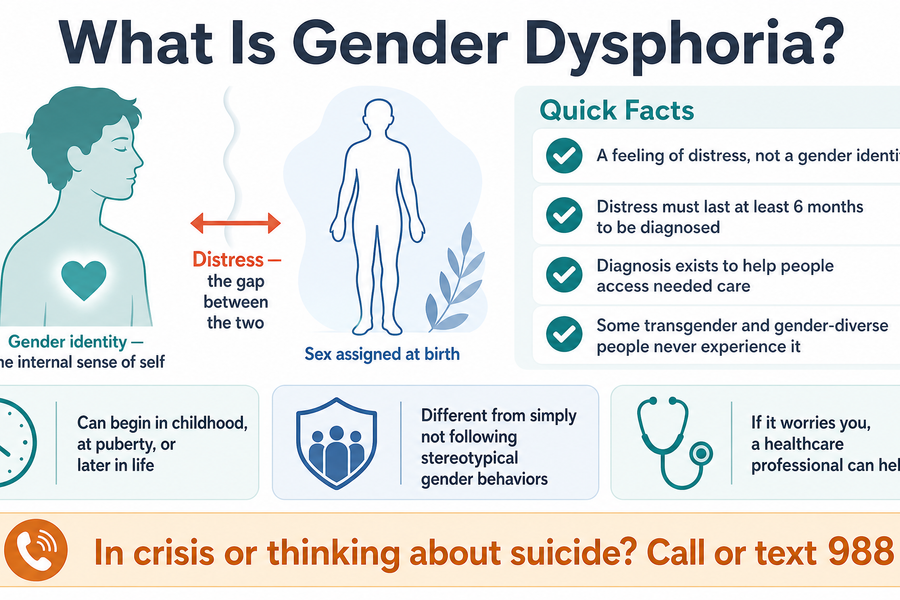
Gender dysphoria is the distress that can come from a gap between gender identity (the internal sense of self) and sex assigned at birth.
Gender dysphoria is a feeling of distress that can happen when a person's gender identity differs from the sex assigned at birth. Gender identity is the internal sense of being male or female or being somewhere along the gender spectrum, or having an internal sense of gender that is beyond male and female. People who have gender dysphoria feel a big difference between their gender identity and their sex assigned at birth.
A few points are important to understand about what gender dysphoria is — and what it is not. It is different from simply not following stereotypical gender behaviors. It involves feelings of distress due to a strong, lasting desire to be another gender.
Not every transgender or gender-diverse person has gender dysphoria. Some have it at some point in their lives; others feel at ease with their bodies and gender identities, and they don't have it.
A diagnosis for gender dysphoria is included in the DSM-5 — the Diagnostic and Statistical Manual of Mental Disorders. The diagnosis was created to help people with gender dysphoria get access to the healthcare and treatment that they need. It focuses on the feeling of distress as the issue, not gender identity.
When Does It Start? The Timing Varies
Childhood onset: Gender dysphoria might start in childhood and continue into the teen years and adulthood
At puberty: Some people have gender dysphoria when puberty starts
Later in life: In others, it may not develop until later in life
Comes and goes: Some people may have periods where they don't notice gender dysphoria, or the feelings may seem to come and go
How it shows up also varies. Some teens might express their feelings of gender dysphoria to their parents or a healthcare professional. But others might have symptoms of a mood disorder, anxiety or depression instead — or social difficulties or problems in school.

Signs that may suggest gender dysphoria, complications that can develop without support, and the 988 Suicide & Crisis Lifeline for anyone in crisis.
When to See a Doctor
If you are experiencing distress about your gender identity — or if anxiety, depression, or difficulties at school or work are worrying you — the first step is to connect with a healthcare professional. If your gender-related feelings are distressing you or affecting your daily life, that is a reason to seek support.
If you or someone you know is thinking about suicide or is in crisis, call or text 988 to reach the Suicide & Crisis Lifeline, available 24/7. In an immediate emergency, call 911.
What Are the Complications? Why Support Matters
Gender dysphoria can affect many parts of life, including daily activities. School might be hard for people with gender dysphoria — that may be due to pressure to dress or act in a way that's linked to their sex assigned at birth. Being harassed, teased or bullied due to gender identity also can make it very challenging to do well in school.
School and work struggles: If gender dysphoria makes school or work very hard, the result may be dropping out of school or not being able to find a job
Relationship strain: Gender dysphoria can pose problems within relationships
Mental health concerns: Anxiety, depression, self-harm, eating disorders, substance misuse and other mental health concerns can happen too
Gender minority stress: People with gender dysphoria often are the targets of discrimination and prejudice, which can lead to ongoing stress and fear
Barriers to care: Accessing healthcare and mental health services may be hard — due to a lack of insurance coverage, being refused care, trouble finding a healthcare professional with expertise in transgender care, or fear of discrimination
People with gender dysphoria who don't receive the support and treatment they need are at higher risk of thinking about or attempting suicide. That is why connecting with a supportive healthcare professional — and knowing crisis resources like 988 — matters so much.
How Is Gender Dysphoria Diagnosed? The 6-Month Rule
A diagnosis of gender dysphoria includes distress due to gender identity differing from sex assigned at birth that lasts at least six months and involves two or more of the following:
A difference between gender identity and genitals or secondary sex characteristics (such as breasts and facial hair); in young teens who haven't started puberty, the distress may be caused by a difference between gender identity and the secondary sex characteristics they expect will develop
A strong desire to be rid of genitals or secondary sex characteristics, or to prevent the development of secondary sex characteristics
A strong desire to have the genitals and secondary sex characteristics of another gender
A strong desire to be or to be treated as another gender
A strong belief of having the typical feelings and behaviors of another gender
The diagnosis also includes distress that makes it hard to handle work, school, social situations and other parts of daily life. In other words: six months of qualifying distress, two or more criteria, and a real impact on daily functioning.
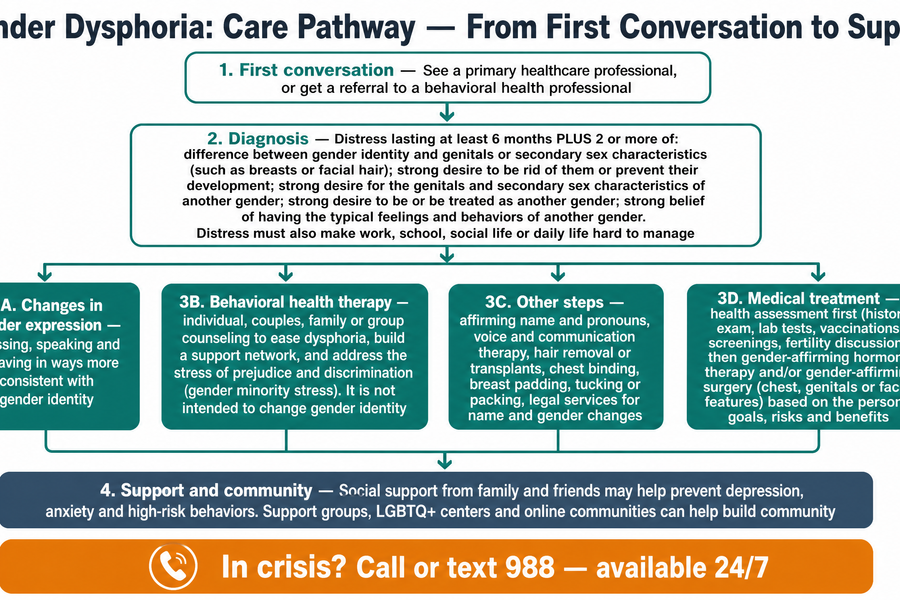
The care pathway for gender dysphoria — first conversation, the 6-month diagnostic criteria, four branches of treatment, and community support.
How Is Gender Dysphoria Treated?
The purpose of treatment is to ease gender dysphoria. Specific goals for treatment depend on the person. One practical first step: find a healthcare professional who has expertise in the care of gender-diverse people. Organizations such as WPATH — the World Professional Association for Transgender Health — offer a search tool that can find healthcare professionals in your area who work with transgender and gender-diverse people.
Treatment for gender dysphoria can include changes in gender expression, hormone therapy, surgery and supportive behavioral health therapy.
Changes in Gender Expression
Gender expression involves how gender is shown to the world through the way a person looks or acts — it may include clothing, mannerisms, communication style and interests, among other things. Changes in gender expression to ease gender dysphoria can involve dressing, speaking and behaving in ways that are more consistent with a person's gender identity.
Medical Treatment: Hormone Therapy and Surgery
Medical treatment of gender dysphoria might include gender-affirming hormone therapy to better align the body with gender identity, and gender-affirming surgery, such as procedures that make changes to the chest, genitals or facial features. Specific medical treatment is based on a person's goals, along with an evaluation of the risks and benefits, other conditions a person has, and social and economic factors.
Before someone has hormone therapy or surgery, a healthcare professional does a health assessment to address any medical conditions that might affect gender dysphoria treatment:
Medical history: A review of personal and family medical history
Physical exam: A standard physical examination
Lab tests: Routine laboratory testing
Vaccinations: A review of vaccinations
Screenings: Screening tests for some conditions and diseases
Health-risk review: Identification and management, if needed, of tobacco use, drug use, alcohol use disorder, and HIV or other sexually transmitted infections
Fertility: Discussion about fertility and procedures that may be needed to preserve fertility
A behavioral health evaluation also may be done by a healthcare professional with expertise in transgender health. It may assess gender health goals; mental health and sexual health concerns; the impact of gender dysphoria at work, school, home and in social settings; substance use or unsupervised hormone use; support from family, friends and other loved ones; and goals, risks and expectations of treatment.
Behavioral Health Therapy
The goal of behavioral health therapy is to improve mental well-being and quality of life. It isn't intended to change gender identity. Instead, this therapy can help people explore gender concerns and find ways to ease gender dysphoria — which may help improve daily life, including school, work and relationships, and can also address other mental health concerns.
It might include individual, couples, family and group counseling to help people:
Gender minority stress: Address the mental and emotional impact of the stress that results from prejudice and discrimination because of gender identity
Support network: Build a support network
Coming out planning: Develop a plan to address issues related to sharing gender identity with family, friends, colleagues and others
Comfort in expression: Become comfortable expressing gender identity
Healthy sexuality: Explore healthy sexuality
Treatment decisions: Make decisions about medical treatment options
Other Steps That Can Ease Gender Dysphoria
Affirming name and pronouns: Using the name and pronouns that fit your identity
Voice and communication therapy: Developing vocal characteristics that better align with gender identity
Hair removal or hair transplants: Modifying hair to align appearance with identity
Chest binding or breast padding: Flattening or adding volume to chest appearance
Genital tucking or packing: Tucking to flatten, or packing to add, the appearance of genitals
Legal services: Help with name and gender changes on legal documents
Appearance services: Services such as makeup or clothing assistance
Social and community services: Help with workplace, family or parenting concerns
Talk with your healthcare professional about whether these steps may be helpful for you.
Coping and Support
Gender dysphoria often can be eased by being in a supportive environment. Social support from family, friends and other loved ones may help prevent depression, suicidal thoughts, suicide attempts, anxiety or high-risk behaviors.
Talking to other transgender or gender-diverse people also may help. Ask your healthcare professional about support groups in your area — some community centers or LGBTQ+ centers have support groups, and online support groups are available too.
Joining an LGBTQ+ organization can help you build community and may offer useful support. Or consider getting involved in other community organizations where you feel comfortable and supported expressing your gender identity.
How to Prepare for Your Appointment
You may start by seeing your primary healthcare professional. Or you may be referred to a behavioral health professional. Before your appointment, make a list of:
Your symptoms: Including any that seem unrelated to the reason for your appointment
Key personal information: Major stresses, recent life changes and family medical history
All medicines, vitamins or supplements: Including the doses you take
Questions to ask: Your own list of questions for the healthcare professional
Bottom Line
If you are experiencing distress because your gender identity differs from your sex assigned at birth, the most important thing to know is that help exists and you don't have to navigate it alone. Gender dysphoria is a recognized, diagnosable experience — and the diagnosis exists so that people can access the healthcare and treatment they need, with the focus on relieving the distress, not on who you are.
The first step can be as simple as a conversation with a primary healthcare professional, or a referral to a behavioral health professional with expertise in transgender care. Treatment goals are personal — they might include changes in expression, therapy, hormone therapy, surgery, or simply a stronger support network.
Your next step: if the distress is affecting your daily life, book time with a primary care or behavioral health professional — the care from there is yours to shape.
If you or someone you know is thinking about suicide or is in crisis, call or text 988 to reach the Suicide & Crisis Lifeline, available 24/7. In an immediate emergency, call 911.
Frequently Asked Questions
What is gender dysphoria?
Gender dysphoria is a feeling of distress that can happen when a person's gender identity differs from the sex assigned at birth. Gender identity is the internal sense of being male or female, of being somewhere along the gender spectrum, or beyond male and female.
Does every transgender person have gender dysphoria?
No. Some transgender and gender-diverse people have gender dysphoria at some point in their lives. Others feel at ease with their bodies and gender identities, and they don't have it.
How is gender dysphoria diagnosed?
A diagnosis requires distress due to gender identity differing from sex assigned at birth that lasts at least six months and involves two or more of five specific criteria, plus distress that makes work, school, social situations, or daily life hard to manage.
Is gender dysphoria just not following gender stereotypes?
No. Gender dysphoria is different from simply not following stereotypical gender behaviors. It involves feelings of distress due to a strong, lasting desire to be another gender.
What does treatment for gender dysphoria aim to do?
The purpose of treatment is to ease gender dysphoria. Specific goals depend on the person. Behavioral health therapy is not intended to change gender identity — it helps people explore gender concerns, build support, and find ways to ease the distress.
What are the treatment options?
Treatment can include changes in gender expression, behavioral health therapy, gender-affirming hormone therapy, gender-affirming surgery, and other steps such as affirming names and pronouns, voice therapy, and legal services for name and gender changes.
Can support from family and friends really help?
Yes. Social support from family, friends and other loved ones may help prevent depression, suicidal thoughts, suicide attempts, anxiety or high-risk behaviors. Support groups, LGBTQ+ centers, online groups, and community organizations can also help you build community.
What should I do if I'm in crisis or thinking about suicide?
Call or text 988 to reach the Suicide & Crisis Lifeline, available 24/7, free and confidential. If you or someone else is in immediate danger, call 911.
References
Clinical content reviewed through January 1, 2025, based on the reference sources listed above. This article is for general information only and is not a substitute for professional medical advice, diagnosis, or treatment.
Comments