Exostosis: What a Benign Bone Tumor Is, Where It Grows, and How It's Treated

Updated: 2 days ago
Medically reviewed by Dr. Baraa Alnahhal, MD · Last reviewed: October 17, 2026
Quick Answer
An exostosis is a bump of bone growing out of existing bone [1]. It is benign and doesn't spread, although rarely a cartilage-capped type (osteochondroma) can turn cancerous [1]. It most often appears on the ankles and feet, in ear canals, sinuses, the jaw, fingers and toes [1]. Many cause no symptoms, and treatment depends on the bone involved and pain [1].
What the research says
For surfer's ear, the surgical tool changes which complications are more likely. A systematic review and meta-analysis of 15 studies (1,399 patients, 1,788 ears) of surgery for ear canal exostoses compared osteotome and drill techniques: eardrum perforation occurred in 5.3% (osteotome) versus 3.8% (drill), sensorineural hearing loss in 0.69% versus 4.3%, and post-operative narrowing in 1.1% versus 4.1%. The authors note that randomized trials are still needed (PubMed: Swisher et al., Ann Otol Rhinol Laryngol, 2023 [2]).
Cancerous change is rare, and it is a concern mainly in the hereditary multiple form. A systematic review of hereditary multiple cartilaginous exostoses found estimates of malignant transformation into chondrosarcoma ranging from under 1% to 25%, with 1–2% the most reliable figure, and exostoses in the central skeleton were more prone to change than those in the limbs. This applies to the multiple hereditary condition, not to a single exostosis (PubMed: Sonne-Holm et al., Dan Med J, 2014 [3]).
What Is an Exostosis?
An exostosis is a benign (noncancerous) bone tumor. The plural form of exostosis is exostoses. Exostoses are benign bone tumors that form on top of your existing bone tissue [1]. In other words, they're bumps of bone that grow out of one of your bones. They're not cancerous. This means they're not a symptom of cancer, and they don't cause it [1]. An exostosis also won't spread to other parts of your body (metastasize) [1].
Many exostoses don't cause symptoms, and you might never know you have one [1]. But depending on where an exostosis develops, it might be painful when you move or use the affected bone [1]. Which treatments you'll need depends on where it forms [1]. Which bone it's on will affect which symptoms you'll experience and how a healthcare provider will treat the exostosis.
Key point | What it means |
Definition | A benign (noncancerous) bone tumor that grows out of existing bone [1] |
Is it cancer? | Benign — rarely, an osteochondroma can turn cancerous; doesn't spread [1] |
Common locations | Ankles/feet, ear canals, sinus cavities, jaw, fingers, toes [1] |
Symptoms | Often none; can cause pain, stiffness, blocked nose, hearing difficulty [1] |
Who it affects | Anyone; more common in children and teens [1] |
Treatment | Depends on location — none needed, NSAIDs, shoe changes, or surgery [1] |
Outlook | Full recovery expected; no long-term effects after surgery [1] |

Which bones do exostoses grow on?
An exostosis can form on any bone in your body [1]. Some of the most common types of exostoses form on bones in your ankles and feet, ear canals, sinus cavities, jaw, fingers, and toes [1].
Who is affected by exostoses?
Anyone can develop an exostosis. They're more common in children and teens because their bones are still rapidly growing and developing.
Named types of exostoses
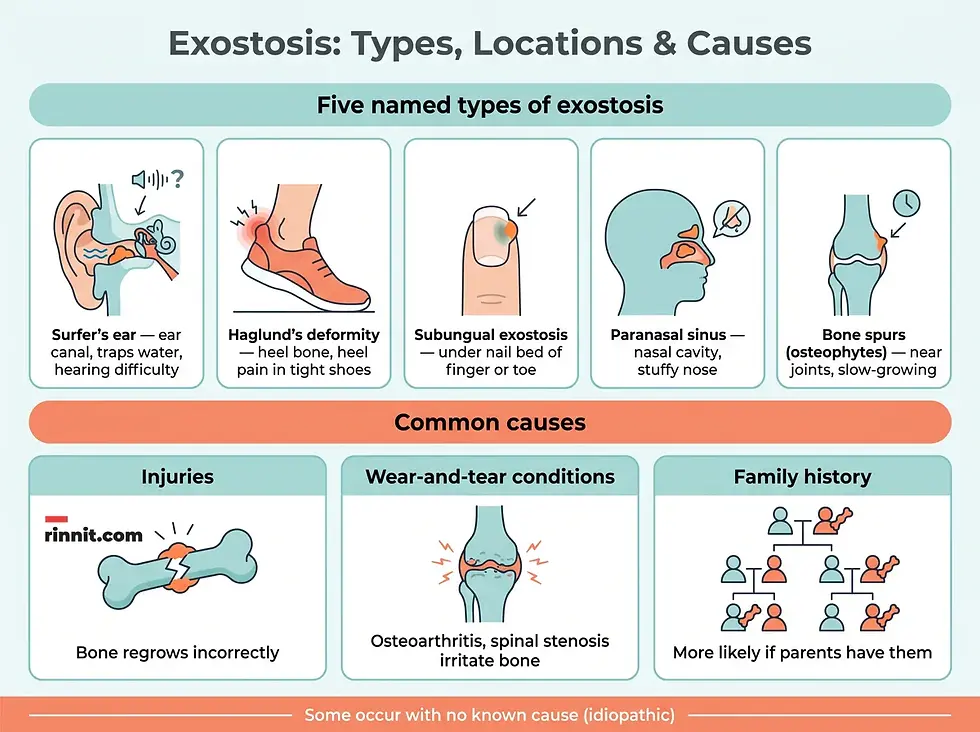
A healthcare provider might diagnose some types of exostoses with a specific name, including surfer's ear, Haglund's deformity, subungual exostosis, paranasal sinus exostosis, and bone spurs [1].
Named type | Where it forms | What it can cause |
Surfer's ear | Bones in the ear canal [1] | More likely ear infections; sometimes hearing loss [1] |
Haglund's deformity | Heel bone (calcaneus) where the Achilles tendon connects [1] | Heel pain, especially in tight shoes pressing on the heel [1] |
Subungual exostosis | Finger or toe bones under the nail bed [1] | Growth under the fingernail or toenail [1] |
Paranasal sinus exostosis | Bones in the nasal cavities [1] | Stuffy or blocked nose |
Bone spurs (osteophytes) | Usually near joints [1] | Develop over long periods near where bones meet [1] |
Symptoms of an Exostosis
Some exostoses hurt. Many don't cause symptoms. You might never know you have an exostosis until a healthcare provider discovers it accidentally during an imaging test or physical examination [1].
Symptoms of an exostosis can include pain in the area around the exostosis, and stiffness or pain when you move caused by exostoses that form on or near a joint — like your hip, knee, ankle, finger, or toe [1]. An exostosis in your sinus cavities can cause a stuffy or blocked nose [1]. If you have surfer's ear, you may experience difficulty hearing and be more likely to experience ear infections because the exostosis makes it easier for water to get trapped inside your ear canal [1].
Symptom | When it happens |
Pain around the growth | In the area around the exostosis [1] |
Stiffness or pain with movement | When the exostosis forms on or near a joint (hip, knee, ankle, finger, toe) [1] |
Stuffy or blocked nose | When it forms in the sinus cavities [1] |
Hearing difficulty | With surfer's ear |
Ear infections | With surfer's ear — the growth traps water in the ear canal [1] |
What Causes Exostoses?
Some exostoses occur with no known cause (idiopathically) [1]. The most common causes of exostoses include injuries, health conditions, and family history. Damage to a bone can make it regrow incorrectly and form an exostosis [1]. Some conditions like osteoarthritis and spinal stenosis cause extra wear and tear on your bones, and this stress can lead to an exostosis growing near that irritation [1]. You might also be more likely to develop exostoses if your biological parents have them [1].
Cause | How it leads to an exostosis |
Injuries | Damage to a bone can make it regrow incorrectly and form an exostosis |
Health conditions | Osteoarthritis and spinal stenosis cause extra wear and tear; stress near the irritation can trigger growth [1] |
Family history | More likely if your biological parents have exostoses [1] |
Unknown (idiopathic) | Some exostoses occur with no known cause |
How Is an Exostosis Diagnosed?
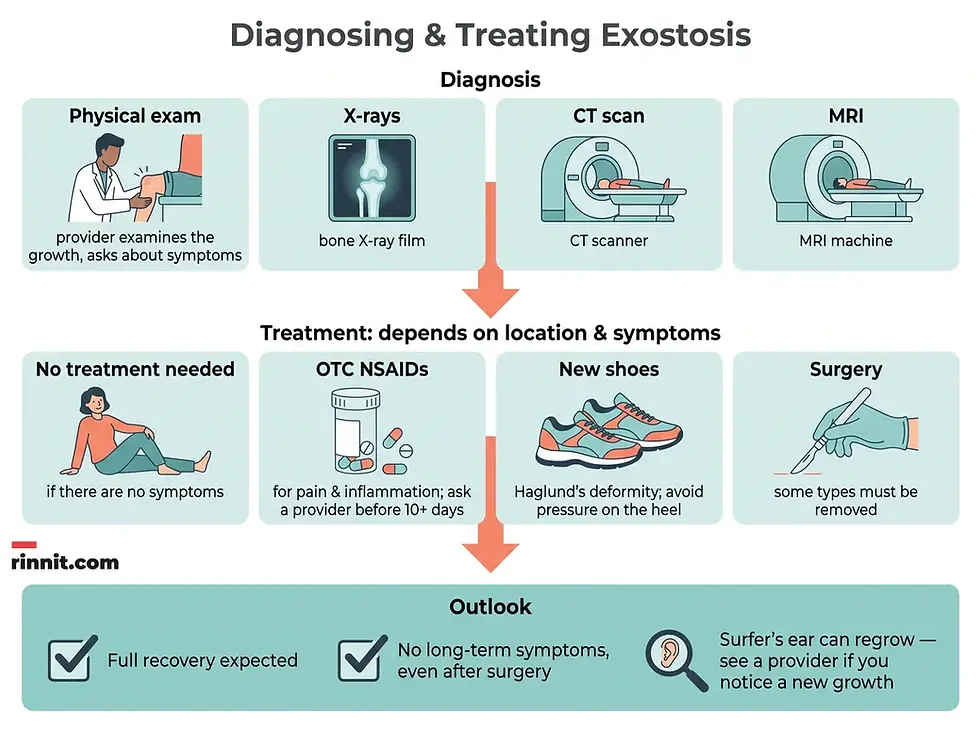
A healthcare provider will diagnose an exostosis with a physical exam and imaging tests [1]. They'll look at the growth and ask you about any symptoms you're experiencing [1]. You'll need one of a few types of imaging test to take pictures of your bone and the area around it, including X-rays, a computed tomography (CT) scan, or magnetic resonance imaging (MRI) [1].
Treatment for Exostoses
Treatment for an exostosis depends on where in your body it forms and if it's causing you any symptoms [1]. Some exostoses don't need any treatment [1]. You might be able to relieve symptoms like pain and inflammation with over-the-counter (OTC) NSAIDs [1]. Talk to a healthcare provider before taking NSAIDs for more than 10 days in a row [1].
Exostoses like Haglund's deformity can be treated by wearing different shoes that don't put as much pressure on your heel [1]. Some types of exostoses must be surgically removed [1]. Your provider or surgeon will tell you what to expect and how long it will take to recover [1].
Treatment approach | For whom | Key notes |
No treatment | Exostoses causing no symptoms | Many never need treatment |
OTC NSAIDs | Pain and inflammation | Talk to a provider before taking NSAIDs more than 10 days in a row [1] |
Shoe changes | Haglund's deformity | Wear shoes that don't press tightly on the heel [1] |
Surgery | Types that must be removed | Provider explains what to expect and recovery time [1] |
Outlook: What to Expect
You should expect to make a full recovery after having an exostosis [1]. Even if you need surgery to remove it, you shouldn't experience any long-term symptoms [1]. Some types of exostoses — especially surfer's ear — can regrow after they're removed [1]. Visit a healthcare provider if you notice another growth.
Can I prevent an exostosis?
You can't prevent an exostosis from forming [1]. Talk to a healthcare provider if you have arthritis or spinal stenosis — managing your symptoms might reduce the chances that your bones are irritated enough to form an exostosis [1].
Living With Exostosis: When to See Your Provider
Visit a healthcare provider as soon as you notice a new growth or bump on or near a bone [1]. A provider needs to examine the growth to make sure it's an exostosis and not something more serious (like a sarcoma) [1]. Even though exostoses aren't cancerous, you should get any new growth examined as soon as possible.
Questions to ask your doctor
Question | Why it matters |
Do I have an exostosis or another type of growth? | Rules out more serious tumors |
Which type of exostosis do I have? | Determines treatment approach |
What caused the exostosis? | Helps with management and prevention of recurrence |
Will I need surgery to remove it? | Planning and expectations |
What can I do to treat symptoms at home? | Day-to-day symptom relief |
Exostosis vs. sarcoma, osteoid osteoma, and osteochondroma
Your provider may compare an exostosis to similar-looking bone tumors. Here is how they differ:
Tumor | Cancerous? | Key distinguishing features |
Exostosis | Never | Benign bump growing out of an existing bone [1] |
Yes — malignant | Rare cancerous tumor in bones/connective tissue; forms from DNA mutations in immature cells [1] | |
Osteoid osteoma | No — benign | Typically grows on long bones in people aged 5–25; aching, dull pain that worsens at night [1] |
No — benign | An exostosis on bone covered by cartilage; grows from the end of long bones in kids/teens, often at growth plates [1] |
Osteochondromas that develop one at a time are called solitary osteochondroma [1]. Some children develop multiple osteochondromas at the same time — usually caused by a condition called multiple hereditary osteochondroma [1] [3]. Visit a healthcare provider right away if you notice a new growth on or near one of your bones, especially if it's painful, and if your child has a new bump on or near one of their bones [1].
Key Takeaways
Finding out you have a tumor is always scary. Fortunately, exostoses aren't cancerous. In fact, you might not need any treatment at all if the exostosis isn't causing pain or making it difficult to move. Even if you do need an exostosis surgically removed, you should make a full recovery with no long-term effects.
Visit a healthcare provider as soon as you notice a new bump on or near a bone. It's important to have a provider diagnose a growth as soon as possible to make sure it's an exostosis and not a different, more dangerous type of tumor.
Take the Next Step
If you or your child has a new bump on or near a bone, book an exam and imaging as soon as you can. Don't panic — but do get it checked.
Further reading: AAOS OrthoInfo — Osteoid Osteoma · Radiopaedia — Exostosis · Merck Manual — Benign Bone Tumors and Cysts
Frequently Asked Questions
1. What is an exostosis?
An exostosis is a benign (noncancerous) bone tumor that forms on top of existing bone tissue — a bump of bone that grows out of one of your bones. It's benign and won't spread, although in rare cases an osteochondroma can turn cancerous.
2. Is an exostosis cancerous?
No. Exostoses are benign bone tumors. They're not a symptom of cancer, they don't cause cancer, and they won't metastasize (spread) to other parts of your body.
3. Where do exostoses most commonly form?
An exostosis can form on any bone, but the most common types grow on bones in the ankles and feet, ear canals, sinus cavities, jaw, fingers, and toes.
4. What is surfer's ear?
Surfer's ear is an exostosis that forms on the bones in the ear canal. It can make you more likely to experience ear infections because it traps water in the ear, and it can sometimes lead to hearing loss.
5. What causes exostoses?
The most common causes are injuries (a bone regrowing incorrectly), health conditions like osteoarthritis and spinal stenosis that cause extra wear and tear, and family history. Some occur with no known cause (idiopathically).
6. Who gets exostoses?
Anyone can develop an exostosis. They're more common in children and teens because their bones are still rapidly growing and developing.
7. How is an exostosis diagnosed?
A provider diagnoses it with a physical exam — looking at the growth and asking about symptoms — plus imaging tests such as X-rays, a CT scan, or an MRI to picture the bone and surrounding area.
8. Do I need surgery to remove an exostosis?
It depends on the location and symptoms. Some need no treatment, some respond to OTC NSAIDs or shoe changes (for Haglund's deformity), and some types must be surgically removed. Your provider or surgeon will explain what to expect.
9. What's the difference between an exostosis and an osteochondroma?
If an exostosis forms on an area of bone covered by cartilage, it's called an osteochondroma. Both are benign bone tumors. Osteochondromas usually grow out of the end of long bones in kids and teens, often affecting growth plates.
10. What's the difference between an exostosis and a sarcoma?
Both are tumors, but exostoses are benign (rarely, an osteochondroma turns cancerous) while sarcomas are rare cancerous (malignant) tumors that develop in bones and surrounding connective tissue. Because they can appear in similar locations with similar early symptoms, any new painful growth needs prompt medical evaluation.
Related Reading
References
Cleveland Clinic. Exostosis. Cleveland Clinic. Last updated June 30, 2023. https://my.clevelandclinic.org/health/diseases/25114-exostosis
Swisher AR, Singh P, Debbaneh P, Rivero A. Complication rates in osteotome and drill techniques in external auditory canal exostoses: a systematic review and meta-analysis. Ann Otol Rhinol Laryngol. 2023;132(10):1249-1260. doi:10.1177/00034894221147804. PMID: 36635864.
Sonne-Holm E, Wong C, Sonne-Holm S. Multiple cartilaginous exostoses and development of chondrosarcomas — a systematic review. Dan Med J. 2014;61(9):A4895. PMID: 25186537. https://pubmed.ncbi.nlm.nih.gov/25186537/
Medical Disclaimer
This article is for informational purposes only and does not constitute medical advice. Always seek the advice of your physician or other qualified health provider with any questions you may have regarding a medical condition. Never disregard professional medical advice or delay in seeking it because of something you have read here.



Comments