Osteochondroma: Symptoms, Causes, Diagnosis, Treatment, and Outlook — What You Need to Know

Updated: 2 days ago
Medically reviewed by Dr. Baraa Alnahhal, MD · Last reviewed: September 2026
TL;DR
Osteochondroma is the most common type of noncancerous (benign) bone tumor, primarily affecting children and adolescents during their growth years. These growths emerge from the growth plate, the area of developing cartilage at the ends of long bones. While most cases involve a single, painless tumor that requires no treatment, some individuals develop multiple growths due to a genetic condition. Although typically benign, osteochondromas can cause complications by pressing on nerves or blood vessels and, in rare cases, may become malignant. Management usually involves periodic monitoring or surgical removal if symptoms arise.
Quick Answer: What is Osteochondroma?
Osteochondroma is a benign outgrowth consisting of both bone and cartilage that develops near the growth plates of long bones, such as the knee, hip, or shoulder. It is classified as a developmental irregularity rather than a result of injury. Most osteochondromas are solitary and asymptomatic, often discovered incidentally during imaging for unrelated issues. However, approximately 15% of cases involve multiple tumors, a condition often linked to a hereditary genetic mutation known as Hereditary Multiple Osteochondromas (HMO). While solitary tumors have a malignancy risk of about 1%, multiple tumors carry a slightly higher risk of approximately 5%. Treatment is generally conservative, focusing on observation ("watch and wait") unless the tumor causes pain, inhibits movement, or interferes with normal bone growth, in which case surgical excision is highly effective with an excellent prognosis.
Understanding Osteochondroma
Osteochondroma represents an abnormal outgrowth of the growth plate, which is the disk of developing cartilage tissue that eventually hardens into adult bone. Because these tumors are linked to skeletal development, they typically appear in childhood or adolescence and cease growing once the individual reaches skeletal maturity.
"Osteochondroma is a noncancerous growth of cartilage and bone... It usually appears near the ends of long bones, where new bone growth occurs in children and teens." (Cleveland Clinic)
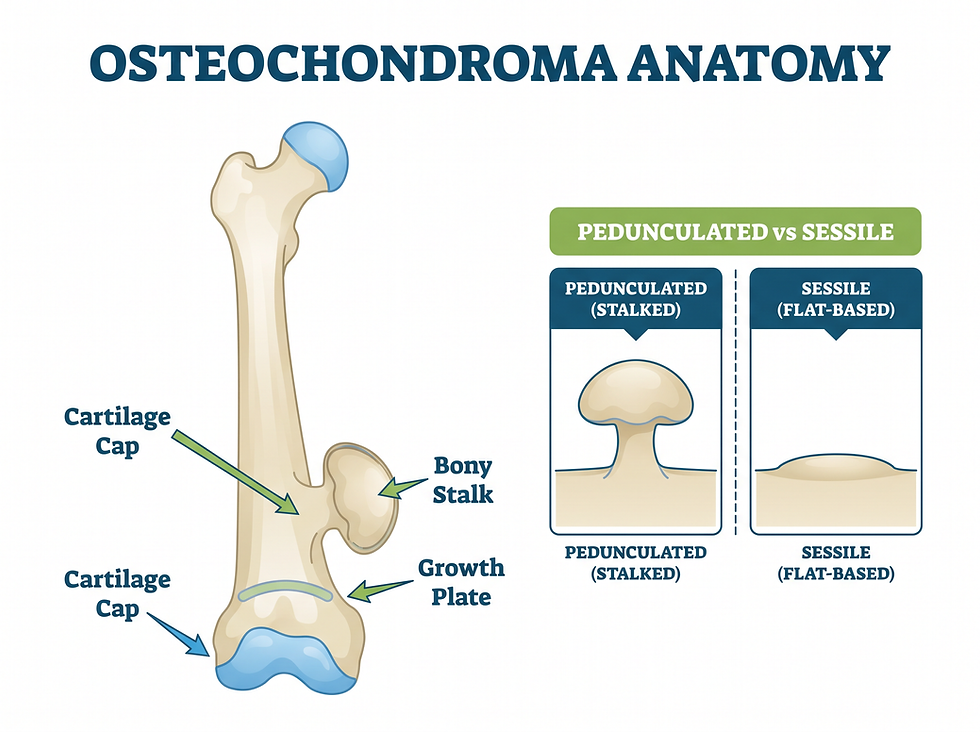
Types of Osteochondroma
There are two primary forms of this condition, distinguished by the number of growths and their underlying causes.
Feature | Solitary Osteochondroma | Multiple Osteochondromas (HMO) |
Prevalence | Most common form (85% of cases) | Less common (15% of cases) |
Cause | Unknown; suspected genetic link | Usually inherited gene mutation |
Symptoms | Often none (asymptomatic) | Higher risk of bone deformities |
Malignancy Risk | Approximately 1% | Approximately 5% |
Growth Pattern | Single isolated tumor | Multiple tumors in various locations |
Common Locations
These tumors typically develop at the ends of long bones, particularly near joints where growth is most active.
Bone Location | Frequency/Note |
Knee | Approximately 40% of all cases |
Hip | Common site near the joint |
Shoulder | Frequently affected long bone end |
Other | Any bone with cartilage growth |
Symptoms and Physical Characteristics
Many individuals with osteochondroma experience no symptoms at all. The tumor is often found by accident during an X-ray or MRI for a different condition. However, when symptoms do occur, they are typically related to the tumor's size or its physical impact on surrounding structures.
Visual and Physical Signs
Hard Bump: A small, painless, hard lump may be felt under the skin near a bone.
Shape: Tumors can be "pedunculated" (mushroom-like with a stalk) or "sessile" (flat with a broad base).
Size: Most growths range between 1 cm and 10 cm in size.

Symptomatic Complications
If the tumor grows large enough to interfere with nearby tissues, the following symptoms may arise:
Symptom Type | Physical Cause |
Movement Pain | Tumor rubbing against a nearby tendon |
Numbness/Tingling | Pressure exerted on a neighboring nerve |
Circulation Issues | Inhibition of a nearby blood vessel |
Limb Discrepancy | Interference with normal growth plate function |
Causes and Risk Factors
The exact cause of solitary osteochondroma remains unknown, though researchers suspect a potential genetic inheritance that is not yet fully understood. It is not caused by physical injury or trauma.
Genetic Factors
In cases of multiple osteochondromas, the condition is frequently hereditary.
Hereditary Multiple Osteochondromas (HMO): An inherited condition caused by specific gene mutations.
Random Occurrence: Approximately 30% of multiple osteochondroma cases occur randomly without a family history.
Risk of Malignancy
While osteochondromas are benign, they can rarely transform into a cancerous tumor called chondrosarcoma.
Condition | Malignancy Risk |
Solitary Osteochondroma | ~1% |
Multiple Osteochondromas | ~5% |
Diagnosis and Clinical Evaluation
Healthcare providers typically begin with a thorough medical history and physical examination. Because these tumors are composed of bone and cartilage, they are highly visible on standard imaging tests.
Imaging Tests
X-ray: The primary tool for diagnosis; most tumors show up clearly.
MRI: Used to provide detailed images of the cartilage cap and surrounding soft tissues.
CT Scan: Helpful for visualizing the bone structure and tumor location in complex areas.
Indicators of Malignancy
Doctors monitor for specific "red flags" that might suggest the tumor has become cancerous:
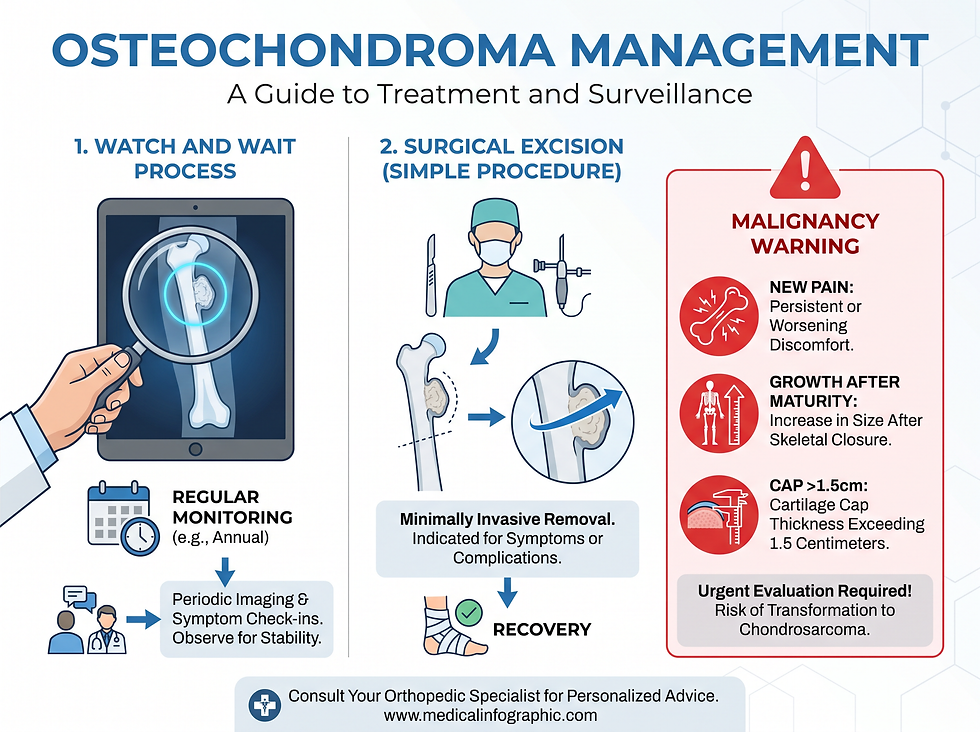
Unexplained or new pain at the tumor site.
Continued growth after the skeleton has stopped growing.
A cartilage cap thickness exceeding 1.5 cm in an adult patient.
Treatment and Management Strategies
Most solitary osteochondromas do not require active treatment. Instead, providers recommend a "watch and wait" approach, involving periodic check-ups to ensure the tumor is not causing complications.
Conservative Management
Observation: Periodic X-rays to monitor the size and shape of the tumor.
Symptom Tracking: Patients are advised to report any new pain, numbness, or changes in the lump.
Surgical Intervention
Surgery may be necessary if the tumor interferes with daily life or poses a health risk.
Reason for Surgery | Clinical Goal |
Functional Problems | Relieve pressure on nerves, vessels, or tendons |
Growth Interference | Prevent or correct limb deformities in children |
Suspected Malignancy | Remove potentially cancerous tissue |
Recovery and Outlook
The prognosis for individuals with osteochondroma is excellent. For those who undergo surgery, the procedure is typically straightforward and often performed on an outpatient basis.
Post-Surgical Recovery
Activity: Many patients can resume normal activities shortly after the procedure.
Support: Slings or crutches may be used for a few weeks to protect the limb during healing.
Recurrence: If the tumor is completely removed, it rarely grows back. However, in young children with multiple tumors, there is a 5% chance of a new growth at the same site.
Long-Term Outlook
Solitary tumors often remain stable for life once growth stops. In rare cases, some tumors have been known to spontaneously regress or reabsorb into the bone, though the reason for this remains a scientific mystery.
Frequently Asked Questions
Is osteochondroma a type of cancer?
No, osteochondroma is a benign (noncancerous) bone tumor. While there is a very small risk (1-5%) that it could become cancerous (chondrosarcoma), the vast majority of these growths remain benign throughout a person's life.
Can an osteochondroma disappear on its own?
It is rare, but some solitary osteochondromas have been documented to spontaneously regress and reabsorb into the bone. Doctors do not yet fully understand why this happens.
Does every osteochondroma need to be removed?
No. Most solitary osteochondromas do not cause symptoms and are left alone. Surgery is only recommended if the tumor causes pain, presses on nerves or blood vessels, or interferes with bone growth.
At what age do these tumors usually appear?
They typically develop during childhood or adolescence, coinciding with the years of active bone growth. They usually stop growing once the skeleton reaches maturity.
What is the difference between pedunculated and sessile tumors?
Pedunculated tumors have a stalk and a bulbous cap (like a mushroom), while sessile tumors are flatter with a broad base. Pedunculated types are more common in solitary cases.
Can an injury cause an osteochondroma?
No, osteochondromas are not caused by injuries or trauma. They are considered irregularities in the way bones grow from the growth plate.
How common are these tumors?
Osteochondroma is the most common type of benign bone tumor, accounting for a significant portion of all noncancerous bone growths diagnosed in children.
What happens if the tumor presses on a nerve?
It can cause symptoms like numbness, tingling, or a "pins and needles" sensation in the affected limb. This is often a reason for surgical removal.
Can multiple osteochondromas cause physical deformities?
Yes, in more severe cases of Hereditary Multiple Osteochondromas (HMO), the tumors can lead to shorter stature, crooked limbs, or hip dysplasia.
Is surgery for osteochondroma dangerous?
Generally, the surgery is a simple and low-risk procedure. It becomes more complex only if the tumor is located very close to major blood vessels or nerves.
Will my child need frequent X-rays?
If the tumor is being monitored, your doctor may recommend periodic X-rays (e.g., once a year) to track its size until bone growth is complete.
Can osteochondroma affect the spine?
While they most commonly affect the long bones of the arms and legs, they can technically develop on any bone that has cartilage growth, including the vertebrae.
Is the condition hereditary?
Solitary osteochondromas are usually not hereditary. However, multiple osteochondromas are often caused by a genetic mutation passed down through families.
What is the "cartilage cap"?
It is the layer of cartilage that covers the bony outgrowth. Doctors measure the thickness of this cap, as a very thick cap in an adult can be a sign of malignancy.
Can I exercise with an osteochondroma?
In most cases, yes. However, if the tumor rubs against a tendon during specific movements, it may cause pain, in which case you should consult your doctor about activity modifications.
External Resources
Medical Disclaimer
The information provided in this article is for educational purposes only and should not be considered medical advice. Always consult with a qualified healthcare professional for diagnosis and treatment of any bone-related condition.
Comments