Jaw Tumors and Cysts: Symptoms, Causes & Treatment Guide

Updated: 2 days ago
Medically reviewed by Dr. Baraa Alnahhal, MD · Last reviewed: September 2026
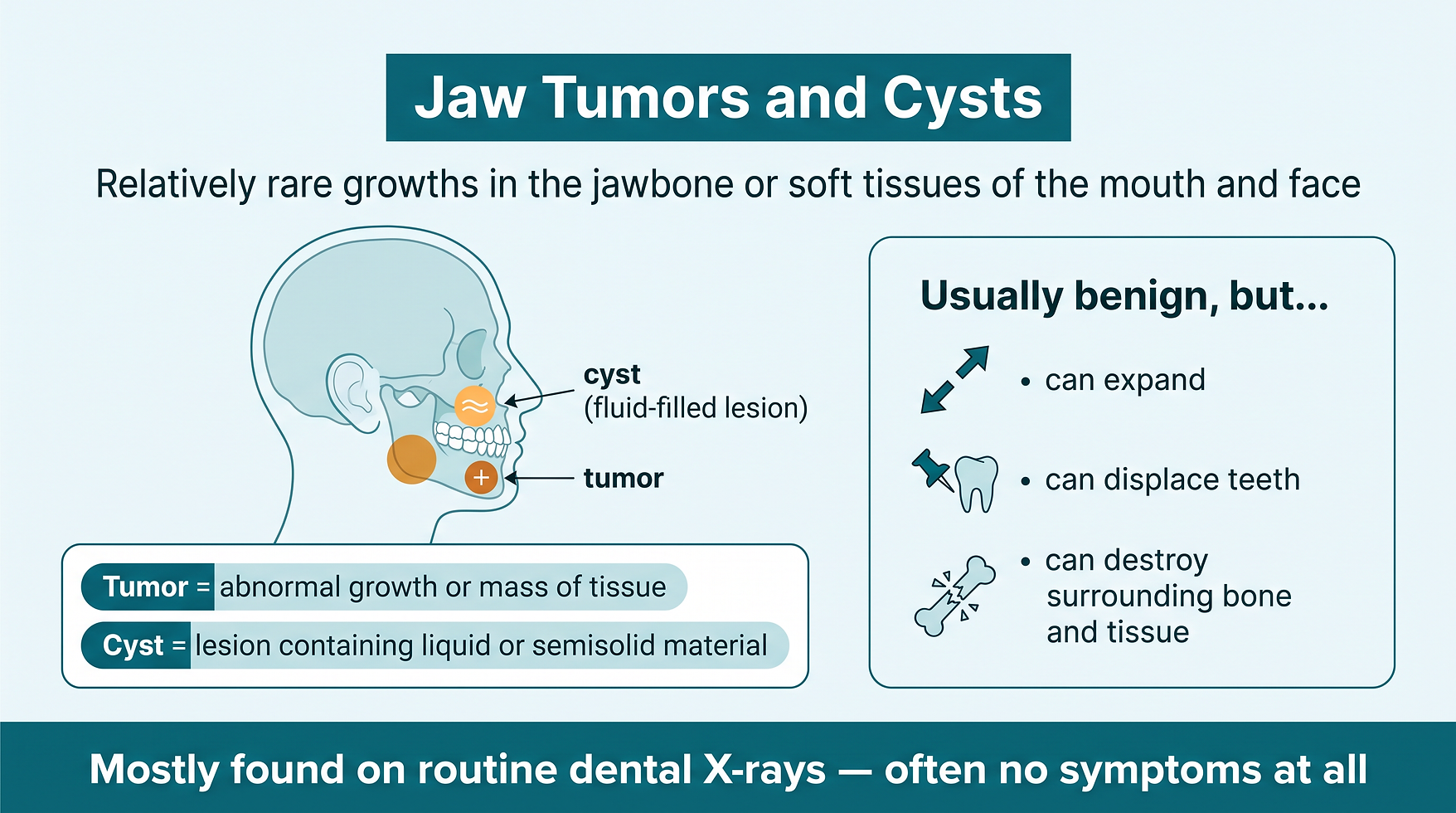
Jaw tumors and cysts are relatively rare growths or lesions that develop in the jawbone or the soft tissues of the mouth and face. They are usually classified as odontogenic (originating from tooth-forming cells) or nonodontogenic (arising from other jaw tissues such as bone). Most are noncancerous (benign), but they can be aggressive — expanding, displacing or destroying surrounding bone, tissue, and teeth. Notably, they often cause no symptoms and are frequently discovered on routine screening X-rays done for other reasons. When found, diagnosis involves imaging (X-ray, CT or MRI) and a biopsy, and treatment usually involves surgery — sometimes with medical therapy or a combination. Because some types can recur, long-term follow-up exams are an essential part of care.
Quick Answer
What are jaw tumors and cysts? Relatively rare growths or lesions in the jawbone or the soft tissues of the mouth and face. A tumor is an abnormal mass of tissue; a cyst is a fluid-filled or semisolid lesion.
Are they cancerous? Usually noncancerous (benign), but they can be aggressive — expanding, displacing teeth, or destroying surrounding bone and tissue.
What are the symptoms? Many have no symptoms at all and are found on routine screening X-rays done for other reasons.
What causes them? Generally the cause is not known. Odontogenic types originate from cells involved in tooth development; nonodontogenic types arise from other jaw tissues. Some are linked to gene mutations or inherited syndromes.
How are they diagnosed? Imaging studies (X-ray, CT or MRI) plus a biopsy, in which a sample of the lesion's cells is examined in a laboratory.
How are they treated? Usually by surgery — often removing nearby teeth, tissue, and jawbone along with the lesion. Some cases use medical therapy or both. Reconstruction, supportive care, and missing-tooth replacement may follow.
Can they come back? Some types can recur, which is why long-term follow-up exams are important — catching recurrence early allows it to be treated appropriately.
What Are Jaw Tumors and Cysts?
A tumor is an abnormal growth or mass of tissue. A cyst is a lesion that contains liquid or semisolid material.
Jaw tumors and cysts are relatively rare growths or lesions that develop in the jawbone or the soft tissues in the mouth and face. Depending on their origin, they are sometimes referred to as odontogenic or nonodontogenic, and they can vary greatly in size and severity.
Here is the key point that surprises most people: most jaw tumors and cysts cause no symptoms at all. They are often discovered by chance on routine screening X-rays done for other reasons.
These growths are usually noncancerous (benign). But “benign” does not mean harmless. They can be aggressive — expanding, displacing or destroying the surrounding bone, tissue, and teeth. That is why finding and treating them matters.
Treatment options vary depending on the type of growth or lesion you have, the stage of growth, and your symptoms. Mouth, jaw and face (oral and maxillofacial) surgeons can treat your jaw tumor or cyst, usually by surgery, or in some cases by medical therapy or a combination of surgery and medical therapy.

What Are the Types of Jaw Tumors and Cysts?
There are several named types of jaw tumors and cysts, each with its own behavior. Understanding which type you have matters, because aggressiveness, recurrence risk, and treatment approach all differ.
Ameloblastoma: A rare, usually benign tumor that begins in the cells that form the protective enamel lining on the teeth, developing most often in the jaw near the molars. The most common type is aggressive — forming large tumors and growing into the jawbone. It can recur after treatment, but aggressive surgical treatment typically reduces the chance of recurrence.
Central giant cell granuloma: Benign lesions that grow from bone cells, most often in the front portion of the lower jaw. One type grows rapidly, causes pain, destroys bone, and tends to recur after surgery. The other type is less aggressive and may have no symptoms. Rarely, a tumor may shrink or resolve on its own, but typically these require surgical treatment.
Dentigerous cyst: A cyst that originates from tissue surrounding a tooth before it erupts into the mouth. It is the most common form of cyst affecting the jaws, most often occurring around wisdom teeth that are not fully erupted, but it can involve other teeth.
Odontogenic keratocyst: Also called a keratocystic odontogenic tumor because of its tumorlike tendency to recur after surgery. Typically slow growing, but can still be destructive to the jaw and teeth if left untreated over a long period. Most often develops in the lower jaw near the third molars.
Odontogenic myxoma: A rare, slow-growing, benign tumor that occurs most often in the lower jaw. Can be large and aggressively invade the jaw and surrounding tissue, displacing teeth. Known to recur after surgery; more-aggressive surgical treatment typically lessens the chance of recurrence.
Odontoma: A benign tumor made up of dental tissue growing around a tooth in the jaw — the most common odontogenic tumor. Often has no symptoms, but may interfere with tooth development or eruption. Can resemble an oddly shaped tooth or be a small or large calcified tumor, and may be part of some genetic syndromes.
Other types: Adenomatoid odontogenic tumor, calcifying epithelial odontogenic tumor, glandular odontogenic cyst, squamous odontogenic tumor, calcifying odontogenic cyst, cementoblastoma, aneurysmal bone cyst, ossifying fibroma, osteoblastoma, central odontogenic fibroma, and others — less common variants your care team may identify through biopsy.
Two takeaways here: first, even the “benign” types can be locally destructive; second, several types — ameloblastoma, central giant cell granuloma, odontogenic keratocyst, and odontogenic myxoma — share a tendency to recur, which shapes both the surgery and the follow-up plan.
What Are the Symptoms of a Jaw Tumor or Cyst?
The most important thing to know about symptoms is also the most counterintuitive: many jaw cysts and tumors have no symptoms. They are often discovered on routine screening X-rays done for other reasons.
If you are concerned that you may have symptoms of a jaw tumor or cyst, talk with your primary care provider or dentist.
No symptoms at all (most common presentation): the growth is small, slow, or located where it does not press on nerves or teeth.
Jaw pain: a rapidly growing lesion such as aggressive central giant cell granuloma can cause pain and destroy bone.
Changes noticed on dental X-rays: the growth displaces teeth, affects tooth eruption, or shows as an abnormal area in the jawbone.
Swelling or changes in the mouth or face: larger lesions can expand the jaw and displace teeth or tissue.
When to see a doctor: If you are concerned about symptoms of a jaw tumor or cyst, talk with your primary care provider or dentist. If you are diagnosed with or suspected of having a jaw tumor or cyst, your primary care provider can refer you to a specialist for diagnosis and treatment.
What Causes Jaw Tumors and Cysts?
Generally, the cause of jaw tumors and cysts is not known. What is known is where different types originate.
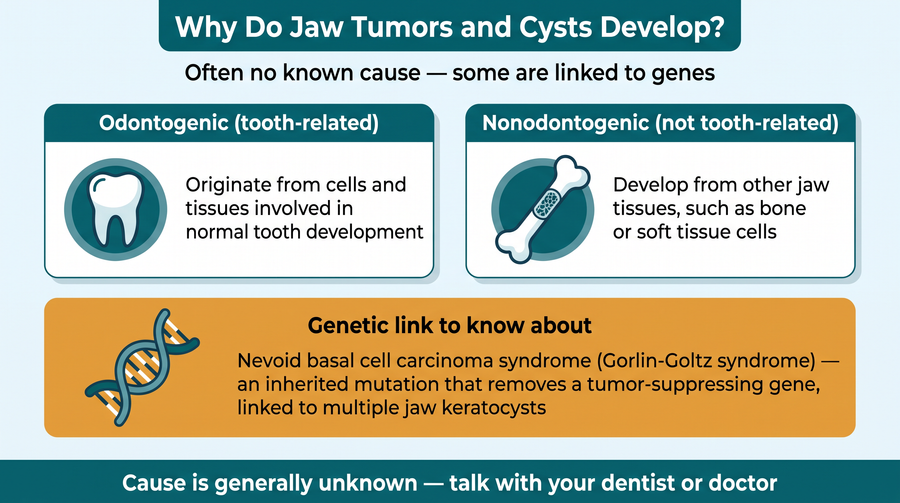
Odontogenic: These jaw tumors and cysts originate from cells and tissues that are involved in normal tooth development.
Nonodontogenic: These can develop from other tissues within the jaws that are not related to the teeth, such as bone or soft tissue cells.
The genetic link to know about: Some jaw tumors and cysts are associated with gene changes (mutations) or genetic syndromes. People with nevoid basal cell carcinoma syndrome — also called Gorlin-Goltz syndrome — lack a gene that suppresses tumors. The genetic mutation that causes the syndrome is inherited. This syndrome results in the development of multiple odontogenic keratocysts within the jaws, multiple basal cell skin cancers, and other characteristics.
How Are Jaw Tumors and Cysts Diagnosed?
To gather more information about your jaw tumor or cyst, your health care provider may recommend tests prior to treatment.

X-ray: A standard imaging picture of the jaw, showing abnormal areas, displaced teeth, or bone changes — often how the lesion is first found.
CT scan: Cross-sectional X-ray imaging of the jaw and face, showing the size, location, and effect of the lesion on surrounding bone and tissue.
MRI: Detailed images using magnetic fields and radio waves, showing soft-tissue detail, including how the lesion affects nearby structures.
Biopsy: A sample of tumor or cyst cells is removed and sent for laboratory analysis, confirming exactly which type of lesion you have — which drives the treatment plan.
Your health care provider uses this information to put together a treatment plan that is best for you and the most effective option for treating your tumor or cyst.
How Are Jaw Tumors and Cysts Treated?
Treatment options vary depending on the type of lesion you have, the lesion's stage of growth, and your symptoms. Your treatment team also considers your treatment goals and your personal preferences when making a recommendation.
Surgery (most common): During surgery, your surgeon removes the jaw tumor or cyst, which may include removing nearby teeth, tissue, and jawbone. The tissue is sent to the lab for examination, and a pathologist examines it and reports a diagnosis during the procedure so the surgeon can act on this information immediately.
Medical therapy: Used for certain types of jaw tumors and cysts — either alone or combined with surgery.
Reconstruction: Reconstruction of the jawbone or other structures may follow removal.
Supportive care: Care to help maintain your quality of life, including assistance with nutrition, speech and swallowing, and replacements for missing teeth.
Why follow-up matters so much: Several of these lesions can recur after treatment. Long-term follow-up exams after treatment can address any recurrence of jaw tumors and cysts. Identifying recurrence early is important so it can be treated appropriately.
How Should You Prepare for Your Appointment?
If a jaw tumor or cyst is suspected, your primary care provider or dentist will typically refer you to a specialist — an oral and maxillofacial surgeon or another appropriate expert — for diagnosis and treatment.
Questions worth bringing with you:
What type of tumor or cyst do I have? Determines aggressiveness and recurrence risk.
How large is it, and what structures does it affect? Shapes the surgical approach.
Do I need surgery, medical therapy, or both? Clarifies the treatment plan.
Will any of my teeth, tissue, or jawbone be removed? Prepares you for what surgery involves.
Will I need reconstruction or replacement of missing teeth? Addresses appearance and function afterward.
What is the risk of recurrence for my type? Sets expectations for follow-up.
How long will I need follow-up exams, and how often? Establishes your long-term care schedule.
Conclusion
Jaw tumors and cysts may sound alarming, but most are benign — and many are found by chance on routine dental X-rays before they ever cause a symptom. The important part of the story is what happens next: imaging and biopsy identify exactly what you have, surgery removes it (often with reconstruction and supportive care alongside), and long-term follow-up watches for recurrence. If a routine X-ray has flagged something in your jaw, or if you have jaw pain or swelling you cannot explain, the best next step is a conversation with your dentist or doctor.
Ready to talk it through? If you have been told you have a jaw tumor or cyst — or suspect you might — book an appointment with your dentist or primary care provider, and bring this guide's question list with you.
Frequently Asked Questions
What is the difference between a jaw tumor and a jaw cyst?
A tumor is an abnormal growth or mass of tissue, while a cyst is a lesion that contains liquid or semisolid material. Both can develop in the jawbone or the soft tissues of the mouth and face.
Are jaw tumors and cysts cancerous?
They are usually noncancerous (benign). However, they can be aggressive — expanding, displacing or destroying the surrounding bone, tissue, and teeth — so they still require proper diagnosis and treatment.
What are the symptoms of a jaw tumor or cyst?
Many have no symptoms at all and are discovered on routine screening X-rays done for other reasons. When symptoms do occur, they may include jaw pain, swelling, or changes seen on dental X-rays such as displaced teeth.
What causes jaw tumors and cysts?
Generally the cause is not known. Odontogenic types originate from cells involved in normal tooth development; nonodontogenic types develop from other jaw tissues such as bone or soft tissue cells. Some are associated with gene mutations or inherited genetic syndromes.
Can jaw cysts go away on their own?
Rarely, a tumor such as a central giant cell granuloma may shrink or resolve on its own — but typically these tumors require surgical treatment.
What is Gorlin-Goltz syndrome and how is it related to jaw cysts?
Nevoid basal cell carcinoma syndrome (Gorlin-Goltz syndrome) is an inherited condition caused by a mutation that removes a tumor-suppressing gene. It can result in multiple odontogenic keratocysts in the jaws, along with multiple basal cell skin cancers and other characteristics.
How are jaw tumors and cysts treated?
Treatment generally involves surgery — removing the lesion, which may include nearby teeth, tissue, and jawbone — with the tissue examined by a pathologist during the procedure. Some cases use medical therapy or a combination, and reconstruction and supportive care may follow.
Can jaw tumors and cysts come back after treatment?
Some types can recur after treatment. Long-term follow-up exams are important so that any recurrence can be identified early and treated appropriately.
References
Jaw tumors and cysts — Symptoms and causes (Published Jan. 12, 2022)
Jaw tumors and cysts — Diagnosis and treatment (Published Jan. 12, 2022)
Rinnit.com provides general health information for educational purposes. This content does not replace professional medical advice — always consult a qualified healthcare provider for diagnosis and treatment.
Health information, not medical advice. This article is for general education and is not a substitute for professional diagnosis or treatment. Always consult a qualified healthcare provider about your own health, and seek emergency care for urgent symptoms.
Comments