Jaw Cancer: Symptoms, Types, Causes, and Treatment

Updated: 3 days ago
Medically reviewed by Dr. Baraa Alnahhal, MD · Last reviewed: October 2026
Quick Answer: Key Facts About Jaw Cancer
Jaw cancer is cancer affecting the jawbone, often spreading from the tongue, salivary glands or palate, with types including squamous cell carcinoma and osteosarcoma. Symptoms include jaw lumps, non-healing mouth sores, loose teeth and facial changes. Tobacco, heavy alcohol use and HPV are main risk factors. Diagnosis uses imaging and biopsy, and treatment centers on surgery and reconstruction.
Feature | Details |
Common Origin | Often spreads from the tongue, salivary glands, or palate. |
Primary Types | Squamous cell carcinoma, Ameloblastic carcinoma, Osteosarcoma. |
Key Symptoms | Jaw lumps, non-healing mouth sores, loose teeth, facial changes. |
Main Risk Factors | Tobacco use, excessive alcohol consumption, and HPV infection. |
Diagnosis Tools | Physical exam, X-rays, CT/MRI scans, and tissue biopsy. |
Primary Treatment | Surgery (Mandibulectomy or Maxillectomy) and Reconstruction. |
What the research says
Tobacco and alcohol together raise the risk far more than either one alone. In a pooled analysis of 17 case-control studies (11,221 people with head and neck cancer and 16,168 without), the combined effect of tobacco and alcohol was greater than multiplying their separate risks, and tobacco or alcohol use accounted for an estimated 72% of head and neck cancers overall and 64% of mouth (oral cavity) cancers. (Hashibe et al., Cancer Epidemiol Biomarkers Prev, 2009) [2]
Ameloblastic carcinoma is the most common cancer that starts in tooth-forming tissue. A systematic review of 285 cases from 126 studies found that it makes up about 30% of odontogenic cancers, appears at a median age of 45 years, and most often involves the lower jaw (mandible). (Robinson et al., J Oral Pathol Med, 2024) [3]
Limited first surgery is linked to the tumor coming back. In a systematic review of 85 ameloblastic carcinomas and 43 metastasizing ameloblastomas from 77 publications, recurrence was associated with conservative (limited) primary treatment for both tumor types, and the authors advise avoiding that approach. (Chrcanovic et al., J Oral Pathol Med, 2022) [4]
What is Jaw Cancer?
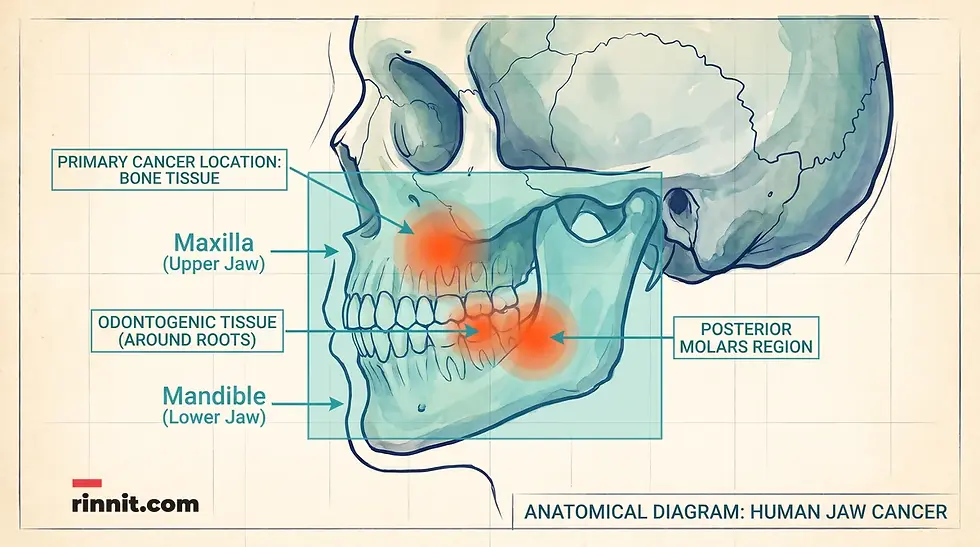
Jaw cancer is a highly uncommon category of oral cancer. In the majority of clinical cases, cancer found in the jaw has actually metastasized, or spread, from another primary site within the mouth, such as the tongue or salivary glands. However, primary jaw cancer can occur when malignant cells originate within the jawbone itself or from the specialized odontogenic tissue that facilitates tooth development. Unlike benign jaw cysts, these malignant tumors have the potential to spread to other regions of the body, making prompt medical evaluation essential [1].
There are several distinct types of jaw cancer, classified by the specific tissue where the cancer begins. Squamous cell carcinoma is the most prevalent form, accounting for more than 90% of oral cancer diagnoses. Other rarer forms include ameloblastic carcinoma, which targets tooth enamel tissue, and osteosarcoma, which forms directly from bone cells. Because these conditions are rare—representing only a small fraction of all head and neck cancers—early diagnosis through professional screening is the most effective way to ensure a successful outcome [1].
What are the symptoms of jaw cancer?
In its earliest stages, jaw cancer often presents no noticeable symptoms, which is why regular dental and medical checkups are vital. As a tumor grows, however, physical changes become more apparent. The most common sign is a lump or swelling in the jaw, which may or may not be accompanied by pain. Patients might also notice persistent mouth sores that bleed easily or fail to heal over time, as well as red or white patches on the gums or inner cheeks [1].
As the condition progresses, it can affect the mechanical function of the mouth and the structural integrity of the face. Symptoms related to these changes include:
Functional Impairment: Difficulty swallowing (dysphagia) or trouble opening the mouth fully.
Dental Issues: Teeth that become loose, displaced, or a sudden change in how the upper and lower teeth fit together (misaligned bite).
Structural Changes: Visible alterations in facial symmetry or appearance.
Systemic Signs: Unexplained fever may also occur as the body reacts to the malignancy [1].
What causes jaw cancer and who is at risk?
Jaw cancer is primarily driven by genetic mutations that disrupt the normal cycle of cell growth and division. When the DNA code that instructs cells to stop growing becomes damaged, cells can multiply uncontrollably, forming a tumor. While scientists are still researching the specific triggers for these mutations, they have identified several clear risk factors that significantly increase the likelihood of developing the disease [1].
Lifestyle choices play a dominant role in the risk profile for jaw cancer. Tobacco use is the single largest risk factor, as tobacco contains over 60 toxic chemicals known to be carcinogenic. When combined with excessive alcohol consumption, the risk of developing oral cancer increases by as much as 30 times. Other contributing factors include infection with certain strains of the human papillomavirus (HPV-16), a family history of oral cancer, and the cultural practice of betel nut chewing, which is common in parts of Asia [1].
How is jaw cancer diagnosed and treated?
The diagnostic process begins with a comprehensive physical examination where a healthcare provider checks for unusual lumps or swelling. If a tumor is suspected, imaging tests such as X-rays, CT scans, or MRIs are used to visualize the extent of the growth. A biopsy, where a small sample of tissue is removed and examined in a laboratory, is the only definitive way to confirm a cancer diagnosis and determine the aggressiveness of the tumor [1].
Surgery is the primary treatment for most jaw cancers. The goal is to remove the entire tumor while preserving as much healthy tissue as possible. Common procedures include a mandibulectomy (removal of part of the lower jaw) or a maxillectomy (removal of part of the upper jaw). Following the removal of cancerous tissue, patients often undergo reconstructive surgery or receive dental implants to restore their appearance and the ability to eat and speak properly. Depending on the stage and type of cancer, additional treatments like radiation or chemotherapy may be recommended [1].


Frequently Asked Questions
Is every lump in the jaw cancerous?
No. Most jaw cysts and tumors are benign (noncancerous). However, any new growth should be evaluated by a professional to rule out malignancy.
Can jaw cancer be cured?
Yes, many types of jaw cancer are curable, especially when they are detected early and removed surgically before they spread.
Does smoking really cause jaw cancer?
Yes. Tobacco use is the most significant risk factor for all oral cancers, including those affecting the jaw.
How common is jaw cancer compared to other cancers?
Jaw cancer is very rare. Head and neck cancers make up about 4.5% of all cancers diagnosed worldwide, and jaw cancer is a small subset of that group.
Will surgery change how I look?
Depending on the size of the tumor, surgery can affect facial appearance. However, modern reconstructive techniques are highly effective at restoring structure and function.
What is odontogenic tissue?
Odontogenic tissue is the specialized tissue in the jaw that is responsible for the formation and development of your teeth.
Can HPV cause jaw cancer?
Yes, certain strains of HPV, particularly HPV-16, are known to increase the risk of oral and jaw cancers.
What is a mandibulectomy?
A mandibulectomy is a surgical procedure to remove part or all of the mandible, which is your lower jawbone.
Are mouth sores always a sign of cancer?
Not always, but a sore that does not heal within two weeks, bleeds easily, or is unusually painful should be checked by a dentist or doctor.
Can benign jaw cysts turn into cancer?
While it is rare, some benign cysts or tumors can undergo malignant transformation over time.
Is jaw cancer more common in men or women?
Statistically, males have a higher risk of developing jaw cancer than females.
Does family history matter?
Yes, having a close biological relative with oral cancer can increase your personal risk.
What is the difference between a carcinoma and a sarcoma?
The terms carcinoma and sarcoma describe where the cancer starts. Carcinomas start in the tissue covering body surfaces, while sarcomas start in connective tissues like bone.
Can I still eat normally after jaw surgery?
Most patients can return to normal eating habits after a period of recovery and, if necessary, reconstructive work or dental implants.
How often should I be screened for oral cancer?
Regular dental checkups usually include an oral cancer screening. If you are at high risk, you should discuss a more frequent schedule with your provider.
Conclusion
A diagnosis of jaw cancer can be daunting, but advancements in surgical techniques and reconstructive medicine have significantly improved outcomes for patients. By understanding the risk factors and staying vigilant for early symptoms, individuals can take proactive steps toward maintaining their oral health. Early intervention remains the most powerful tool in the fight against this rare but serious condition.
Related Reading
Oral Cancer: Symptoms, Risk Factors, and Treatment Pathways explains mouth cancers that often spread into the jawbone.
Mandibulectomy: Types, Procedure, Recovery, and What to Expect describes surgery to remove part of the lower jaw.
Jaw Tumors and Cysts: Symptoms, Causes & Treatment Guide covers benign and cancerous growths that can form in the jaw.
Osteosarcoma: Symptoms, Causes, Diagnosis, Treatment, and What to Expect explains the bone cancer that can arise in the jaw.
References
Cleveland Clinic. Jaw Cancer. Cleveland Clinic. Last updated May 13, 2024. https://my.clevelandclinic.org/health/diseases/jaw-cancer
Hashibe M, Brennan P, Chuang SC, et al. Interaction between tobacco and alcohol use and the risk of head and neck cancer: pooled analysis in the International Head and Neck Cancer Epidemiology Consortium. Cancer Epidemiol Biomarkers Prev. 2009;18(2):541-550. PMID 19190158. https://doi.org/10.1158/1055-9965.EPI-08-0347
Robinson L, Abreu LG, Fonseca FP, et al. Ameloblastic carcinoma: a systematic review. J Oral Pathol Med. 2024;53(3):174-181. PMID 38368851. https://doi.org/10.1111/jop.13517
Chrcanovic BR, Martins-Chaves RR, Pontes FSC, et al. Comparison of survival outcomes between ameloblastic carcinoma and metastasizing ameloblastoma: a systematic review. J Oral Pathol Med. 2022;51(7):603-610. PMID 35822408. https://doi.org/10.1111/jop.13334
Medical disclaimer
The information provided in this article is for educational purposes only and is not intended as medical advice. Always seek the advice of your physician, dentist, or other qualified health provider with any questions you may have regarding a medical condition or new symptoms.



Comments