Existential Therapy: What It Is, How It Works, Benefits & Limitations

Updated: 6 days ago
Written and medically reviewed by Dr. Baraa Alnahhal, MD · Last reviewed: October 2026 · How we review
Quick Answer: What is existential therapy?
Existential therapy is a form of talk therapy that uses ideas from philosophy to help you explore meaning, purpose, and personal responsibility for your choices. It works through four core concerns — death, isolation, meaning, and freedom — and may help with anxiety, depression, addiction, and PTSD. Sessions are usually weekly, about an hour, for several months. [1]
What the research says
Meaning-focused existential therapies show the clearest benefit. A meta-analysis of 15 randomized trials with 1,792 adults found that meaning therapies had a large effect on meaning in life (d = 0.65) and a moderate effect on anxiety and depression (d = 0.47) right after treatment. Other existential styles showed small or no significant effects, and the authors noted the studies were few and of low quality. (Vos et al., J Consult Clin Psychol, 2015) [2]
Meaning-centered therapy improved quality of life and lowered stress. Across 60 trials with 3,713 people, controlled trials showed large improvements versus control groups in quality of life (g = 1.02) and psychological stress (g = 0.94) immediately after treatment, and the gains held at follow-up. (Vos & Vitali, Palliat Support Care, 2018) [3]
Adults with cancer gained existential well-being and hope. A review of 30 randomized trials with 3,511 participants found existential interventions improved existential well-being (g = 0.52), hope (g = 0.43), and quality of life (g = 0.21) after treatment. (Bauereiß et al., Psychooncology, 2018) [4]
Key takeaways
Existential therapy is talk therapy grounded in philosophy and focused on the present. [1]
It centers on four pillars: death, isolation, meaning, and responsibility (freedom). [1]
It may help people with anxiety, depression, addiction, PTSD, or a chronic illness. [1]
Sessions usually run once a week for about an hour; treatment often lasts several months. [1]
It is not a cure-all: it can feel abstract, bring up painful memories, and may clash with some religious beliefs. [1]
What is existential therapy?
Existential therapy is a type of psychotherapy that uses the theories and practices of philosophy to address the challenges of being human. [1]
It helps you see how you are personally responsible for your behaviors. It also helps you name your true beliefs and discover what gives your life meaning and purpose. [1]
In short, it asks a simple but deep question: given the life you have, what will you choose to do with it?
How is existential therapy different from cognitive behavioral therapy?
Existential therapy differs from cognitive behavioral therapy mainly in its direction of focus. [1]
Existential therapy | Cognitive behavioral therapy (CBT) | |
Main focus | How you shape your experiences | How past experiences shape your actions |
Time frame | Grounded in the present | Looks at past patterns and current thoughts |
Core tools | Dialogue about meaning, choice, and responsibility | Identifying and changing thought patterns |
Your therapist may still ask about your past. The goal is to understand the decisions that led you to where you are now — not to stay in the past. [1]
Who can existential therapy help?
Existential therapy can help anyone who wants to understand who they are and how they fit into the world. [1]
It may be especially useful for people living with:
Substance or behavioral addictions
Anxiety and fear
Depression
A chronic physical or mental health condition [1]
It helps you see how your decisions lead to specific outcomes. Over time, you learn to make personal choices that feel meaningful to you and to recognize what makes you feel fulfilled. [1]
What are the four pillars of existential therapy?
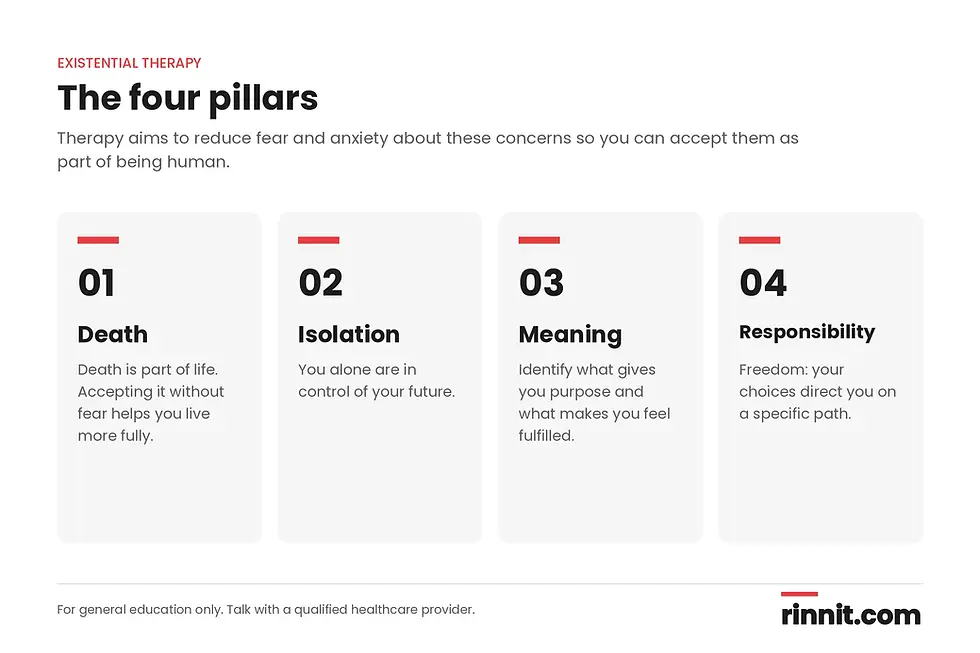
The four pillars of existential therapy are death, isolation, meaning, and responsibility (freedom) — concerns every person faces as part of being human. [1]
Pillar | What it means | What therapy works toward |
Death | Death is part of life | Accepting it without fear so you can live more fully |
Isolation | You alone are in control of your future | Accepting that you direct your own future |
Meaning | Purpose is something you identify | Finding what truly fulfills you |
Responsibility (freedom) | Your choices set your direction | Seeing how each choice sets you on a specific path |
The aim is to lower your fear and anxiety about these pillars so you can accept them as part of the human experience. Your therapist guides you through these hard topics while helping you reach your personal goals. [1]
How does existential therapy work?
Existential therapy works through structured dialogue between you and your therapist, much like other forms of talk therapy. [1]

Here is what the process usually looks like:
First session: Your therapist asks about your goals for therapy. [1]
Ongoing sessions: Your therapist shapes the conversation to move you toward those goals while exploring what makes you human and how your choices shape who you are. [1]
Present focus: Talk stays rooted in the here and now. Past events come up only to explain the choices that brought you here. [1]
Working toward acceptance: Each session aims to help you accept the four pillars. [1]
The therapy room is meant to be a safe, judgment-free space. It is normal to feel strong emotions or recall difficult memories along the way. [1]
How long does existential therapy take?
Existential therapy is not a long-term therapy; most people continue until they reach their goals, which can take several months. [1]
Existential therapy at a glance | Typical detail |
Format | Talk therapy based on theory and dialogue |
Session length | About 1 hour |
Frequency | Usually once a week |
Total duration | Varies by person; often several months |
Ends when | You reach the goals you set with your therapist |
[1]
What are the benefits and limitations of existential therapy?
Existential therapy can build self-knowledge and a sense of control, but it is not a cure-all and has real limits. [1]

Potential benefits | Possible limitations |
Learn more about yourself | Highly philosophical; some ideas are complex or hard to grasp |
Strengthen personal responsibility | Can conflict with some religious beliefs |
Reduce fear and anxiety | May reopen painful memories or experiences |
Understand how your actions affect you | Some topics are uncomfortable and hard to face |
Feel more in control of your life | Not a cure-all form of therapy |
[1]
How can you get the most out of existential therapy?
Getting the most out of existential therapy starts with patience: it can take several sessions before you feel comfortable opening up to a new therapist. [1]
Keep an open mind. Go into each session remembering your therapist is there to help you reach your goals. [1]
Speak up. If you feel uncomfortable or stuck, tell your therapist or another member of your care team. They can help you get back on track. [1]
Expect some discomfort. Feeling nervous or vulnerable at the start is a normal part of the process. [1]
When should you call a healthcare provider about existential therapy?
You should contact your therapist or a healthcare provider if your fear or anxiety gets worse after starting existential therapy. [1]
Therapy can be challenging because it deals with hard topics. If you are having thoughts of suicide, get help right away. In the U.S., call or text 988 to reach the 988 Suicide & Crisis Lifeline, available 24/7. Outside the U.S., call your local emergency number or crisis line. [1]
Conclusion
Existential therapy offers a different way to work through anxiety, depression, addiction, and life's hardest questions. Instead of focusing mainly on what happened to you, it focuses on what you choose to do now — and what gives your life meaning. [1]
It asks a lot: openness, patience, and a willingness to sit with uncomfortable topics like death and isolation. For many people, that effort brings a clearer sense of self, more control, and less fear. Research supports meaning-focused versions most strongly, though more high-quality studies are needed. [2][3][4]
Your next step: If existential therapy sounds right for you, bring this guide to your doctor or a licensed mental health professional and ask whether it fits your goals. To understand the conditions it can help with, read our guides on generalized anxiety disorder, PTSD, and the role of an addiction counselor.
FAQ
What is existential therapy?
Existential therapy is a form of talk therapy that uses philosophy to help you understand how you fit into the world and how your choices shape your future. It focuses on meaning, purpose, and personal responsibility. [1]
Who is existential therapy best for?
Existential therapy may help people with substance or alcohol use disorder, behavioral addictions, anxiety and fear, depression, PTSD, or a chronic physical or mental health condition. It can also help anyone who wants to understand themselves better. [1]
What are the four pillars of existential therapy?
The four pillars of existential therapy are death, isolation, meaning, and responsibility (freedom). Therapy aims to reduce fear and anxiety about them so you can accept them as part of being human. [1]
How long is an existential therapy session?
An existential therapy session usually lasts about one hour and typically happens once a week. [1]
How long does existential therapy last?
Existential therapy is not long-term; you usually continue until you reach your goals. The time frame varies, but it often takes several months. [1]
How is existential therapy different from CBT?
Existential therapy focuses on how you personally influence your experiences, while cognitive behavioral therapy focuses on how past experiences influence your actions. Existential therapy also stays grounded in the present. [1]
Can existential therapy conflict with religious beliefs?
Yes, existential therapy can conflict with some religious beliefs because it is highly philosophical. If this concerns you, raise it with your therapist early so you can decide together whether it is a good fit. [1]
When should I get urgent help during therapy?
Get urgent help if you have thoughts of suicide: in the U.S., call or text 988 for the Suicide & Crisis Lifeline, available 24/7, or call your local emergency number elsewhere. Contact your therapist if your fear or anxiety gets worse. [1]
Can existential therapy help with grief?
Yes. Existential therapy can help you cope with loss by exploring meaning, life changes and your own sense of purpose. If grief makes daily life very hard, let your therapist or doctor know.
Who developed existential therapy?
Existential therapy grew from the work of several thinkers, including Viktor Frankl, Rollo May and Irvin Yalom. Each built on ideas from existential philosophy.
Related Reading
Acceptance and Commitment Therapy (ACT) explains a therapy focused on values and accepting difficult feelings.
Exploring Psychodynamic Therapy: Understanding Your Past to Shape Your Future describes how exploring past patterns can ease present problems.
Cognitive Behavioral Therapy (CBT): What It Is, What It Treats and What to Expect explains how CBT changes unhelpful thoughts and behaviors.
Understanding Grief: A Comprehensive Guide to Coping with Loss covers the grieving process and healthy ways to cope.
References
Cleveland Clinic. Existential Therapy: What It Is, What It Treats & Limitations. Cleveland Clinic. Last updated June 21, 2023. https://my.clevelandclinic.org/health/treatments/25089-existential-therapy
Vos J, Craig M, Cooper M. Existential therapies: a meta-analysis of their effects on psychological outcomes. J Consult Clin Psychol. 2015;83(1):115-128. PMID 25045907. https://doi.org/10.1037/a0037167
Vos J, Vitali D. The effects of psychological meaning-centered therapies on quality of life and psychological stress: a metaanalysis. Palliat Support Care. 2018;16(5):608-632. PMID 30246682. https://doi.org/10.1017/S1478951517000931
Bauereiß N, Obermaier S, Özünal SE, et al. Effects of existential interventions on spiritual, psychological, and physical well-being in adult patients with cancer: systematic review and meta-analysis of randomized controlled trials. Psychooncology. 2018;27(11):2531-2545. PMID 29958339. https://doi.org/10.1002/pon.4829
Medical disclaimer
This article is for general education only and is not a substitute for professional medical or mental health advice, diagnosis, or treatment. Always talk with a qualified healthcare provider about your symptoms and treatment options. If you are in crisis, contact your local emergency number right away.



Comments