Excess Skin Removal Surgery: Types, Candidates, Recovery and Risks

Updated: 6 days ago
Written and medically reviewed by Dr. Baraa Alnahhal, MD · Last reviewed: October 2026 · How we review
Quick Answer: What is excess skin removal?
Excess skin removal is a group of plastic surgery procedures, such as panniculectomy, tummy tuck and arm lift, that remove loose, sagging skin after major weight loss. It can improve comfort, clothing fit and appearance. Good candidates keep a stable weight for at least six months, don't smoke and are in generally good health. [1]
What the research says
Skin removal after weight-loss surgery is linked to better quality of life. A 2025 review of 15 studies with 7,339 patients found that people who had body contouring after bariatric surgery scored about 16 points higher on a body image and quality-of-life scale (BODY-Q) and lost about 4.4% more of their total body weight than people who had bariatric surgery alone. (Mokhtar et al., Plast Reconstr Surg, 2026) [3]
Complications are common, but most are minor. A review of 25 studies found an overall complication rate of 31.5% after skin removal in people who had weight-loss surgery; fluid collection under the skin (seroma) was the most frequent problem at about 13%. A BMI of 30 or higher before surgery raised the complication risk by 37%. (Marouf & Mortada, Aesthetic Plast Surg, 2021) [4]
A tummy tuck after weight-loss surgery carries similar serious risks. A 2026 review of 27 studies including 6,328 people with past bariatric surgery found no difference in wound breakdown, infection, tissue death, blood clots or repeat surgery compared with people without bariatric surgery, though seroma and blood collection (hematoma) were more common. (Esparham et al., Surg Obes Relat Dis, 2026) [5]
Key takeaways
Excess skin removal (body contouring) reshapes the body after significant weight loss, typically 100 pounds or more. [1][2]
Most people need a combination of procedures, often spread over several surgeries. [1]
Surgery is done only after you reach your goal weight and hold it for at least six months. [1]
Expect scars, a few weeks of pain and a full recovery that can take several months. [1]
Results last best when you keep the weight off. [1]
What is excess skin removal surgery?
Excess skin removal surgery is a set of plastic (cosmetic) surgery procedures that remove sagging skin and reshape the body after major weight loss. [1] This type of surgery is also called body contouring. [1]
Most people who need it have lost a significant amount of weight, typically 100 pounds or more. [1][2] The weight loss may come from bariatric (weight loss) surgery or from diet and exercise. [1]
Why does skin sag after major weight loss?
Skin sags after major weight loss because it stretched to fit a larger body and lost its elasticity. [1] When the weight comes off, the stretched skin can't shrink back to your new shape. [1]
The result is loose skin that can sag and hang from the body. [1] If your weight loss started from severe obesity, our guide to class III obesity covers the condition and its treatment options.
Why do people choose excess skin removal?
People choose excess skin removal because loose skin can cause physical problems, not just appearance concerns. [1] Common reasons include:
Comfort: heavy skin can be painful. [1]
Skin health: skin folds raise the risk of rashes, skin infections and skin fungus. [1] (Learn more about intertrigo, the rash that forms in skin folds.)
Clothing fit: it can be hard to find clothes that fit well. [1]
Self-confidence: sagging skin can affect how you feel about your body. [1]
What are the types of excess skin removal procedures?
Excess skin removal includes seven main procedures, each targeting a different body area. [1] Most people need more than one to reach the look they want, and a surgeon helps decide which will help most. [1]

Procedure | Medical name | Body area | What it does |
Arm lift | Brachioplasty | Upper arms | Removes skin that hangs down from the upper arm |
Breast lift | Mastopexy | Breasts | Firms the breasts by tightening tissue and removing skin |
Facelift | Rhytidectomy | Face and neck | Smooths the face and removes loose neck skin |
Lower body lift | — | Stomach, buttocks, outer thighs | Removes excess skin and fat from these areas |
Panniculectomy | — | Below the belly button | Removes the hanging apron of skin (pannus) |
Thigh lift | Thighplasty | Inner thighs | Gives the inner thighs a sleeker shape |
Tummy tuck | Abdominoplasty | Abdomen | Removes skin and tightens weak or separated abdominal muscles |
Source: [1]
The American Society of Plastic Surgeons' panniculectomy guide explains the difference between removing the skin apron and a full tummy tuck in more detail.
Who is a good candidate for excess skin removal surgery?
A good candidate for excess skin removal surgery is someone who has kept a stable goal weight for at least six months after major weight loss. [1] A plastic surgeon does a physical exam and other checks to decide whether surgery is right for you. [1]
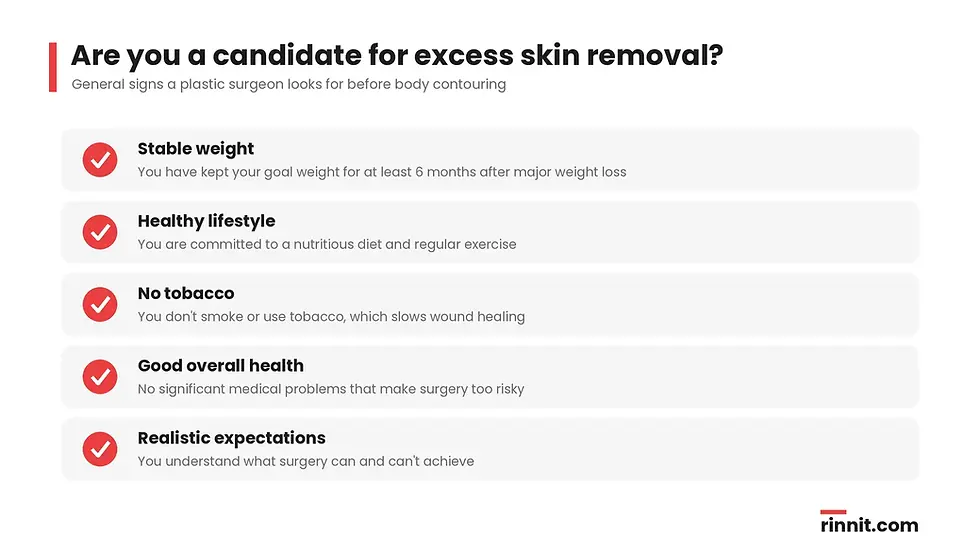
In general, you may be a good candidate if you: [1]
Have maintained your goal weight for at least six months after major weight loss.
Are committed to a healthy diet and exercise to keep the weight off.
Don't smoke or use tobacco, because smoking slows wound healing and raises the risk of complications.
Are in generally good health, without medical problems that make surgery too risky.
Have realistic expectations about what surgery can achieve.
Can excess skin removal be done at the same time as weight loss surgery?
Excess skin removal can't be done at the same time as bariatric surgery; it only happens after the weight is lost. [1] A plastic surgeon can't remove extra skin until you reach your goal weight. [1]
Step | Typical timing |
Reach your goal weight after bariatric surgery | About 1 to 2 years |
Hold that weight steady | At least 6 months |
Start body contouring | After both steps above |
Source: [1]
Two different surgeons are usually involved. [1] Bariatric surgeons perform weight loss operations like gastric bypass and gastric sleeve, while plastic surgeons perform body contouring. [1]
Liposuction is sometimes combined with a tummy tuck to remove stubborn fat, but it isn't a weight loss surgery. [1] Your surgeon can tell you whether a combined procedure suits you. [1]
How do you prepare for excess skin removal surgery?
You prepare for excess skin removal surgery by following your surgeon's instructions, which often include tests and medication changes. [1] You may need to: [1]
Get blood work (lab tests).
Stop medicines that raise bleeding risk, such as aspirin or nonsteroidal anti-inflammatory drugs (NSAIDs).
Stop taking vitamins and herbal supplements.
Quit smoking or using any tobacco products.
What happens during excess skin removal surgery?
Excess skin removal surgery often happens in stages, so you may need several operations. [1] Depending on the procedure, you may stay overnight in a hospital or go home the same day from a surgical facility. [1]
Some procedures can be done during the same operation. [1] Examples include a lower body lift, or a panniculectomy combined with a tummy tuck. [1]
Does excess skin removal leave scars?
Excess skin removal does leave scars where the incisions were made. [1] Surgeons place incisions in less noticeable spots when possible, such as the hairline, natural skin creases or areas covered by clothing. [1] For example, panniculectomy and tummy tuck incisions are usually made low, along the bikini line. [1]
Some people form thick, raised scars as they heal. Our guide to hypertrophic scars explains how they form and how they're treated.
How painful is excess skin removal surgery?
Excess skin removal is major surgery, and you can expect pain for a few weeks. [1] Your care team will prescribe pain medicine and share tips to ease discomfort. [1]
Pain is often worse when moving around, climbing stairs or getting up from a couch. [1] Having a loved one stay with you during the first week can help. [1]
What are the risks of excess skin removal surgery?
The main risks of excess skin removal surgery are bleeding, blood clots, infection and scarring. [1] Like all surgery, body contouring carries some risk. [1]
Risk | What it means |
Bleeding | Blood loss during or after surgery |
Blood clots | Clots such as deep vein thrombosis (DVT) in the legs |
Bruising and swelling | Common around the treated areas |
Numbness or skin sensation changes | Caused by nerve damage |
Infection | At the incision sites |
Scarring | Permanent marks where incisions were made |
Source: [1]
Surgery can improve your shape, but it can't create a perfect body. [1] It also won't help you lose more weight beyond the weight of the skin removed. [1] If you have a history of clotting problems, read about blood clotting disorders and discuss them with your surgeon.
What is recovery like after excess skin removal surgery?
Recovery after excess skin removal surgery depends on the procedure, and a full recovery can take several months. [1]
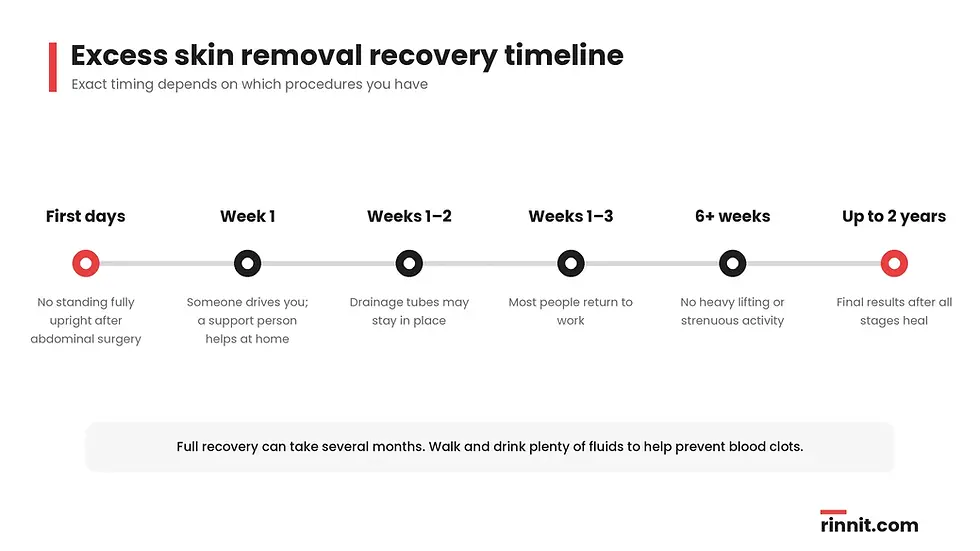
Recovery milestone | Typical timing |
Avoid standing fully upright (after abdominal surgery) | A few days |
Need someone to drive you | At least the first week |
Drainage tubes may stay in | 1 to 2 weeks |
Return to work | 1 to 3 weeks, depending on the procedure |
No heavy lifting or strenuous activity | At least 6 weeks |
Full recovery | Several months |
Source: [1]
During recovery, you may also need to: [1]
Take pain relievers or NSAIDs.
Change bandages and apply ointments often.
Sleep with pillows under your knees after lower body procedures.
Drink plenty of fluids and walk regularly to help prevent blood clots.
How long until you see results from excess skin removal?
Final results from excess skin removal can take up to two years. [1] Your body needs time to heal between procedures and after the last surgery. [1]
How long do results from excess skin removal last?
Results from excess skin removal last as long as you keep the weight off. [1] Small weight changes are normal throughout life. [1] But if you regain a lot of weight, your skin will stretch again, and if you lose that weight again, the skin will sag again. [1]
When should you call a doctor after excess skin removal surgery?
You should call your healthcare provider right away if you notice any of these warning signs after excess skin removal surgery: [1]
Chest pain or shortness of breath.
Dizziness or fainting.
Nausea and vomiting.
Signs of infection, such as fever, redness or yellow discharge at the incision sites.
Severe pain.
Swelling in your arms or legs.
Chest pain, sudden shortness of breath or a swollen leg can signal a blood clot. Seek emergency care immediately if these appear.
Conclusion
Excess skin removal can relieve the pain, rashes and clothing problems that loose skin causes after major weight loss. [1] The best results come when you reach a stable weight first, stop smoking, plan for staged surgeries and a recovery of several months, and keep the weight off afterward. [1] Research also links these procedures to better body image and quality of life after weight-loss surgery. [3]
Ready for your next step? Bring the candidate checklist above to a consultation with a board-certified plastic surgeon, and keep learning with our bariatric surgery guide and the body contouring overview from the American Society of Plastic Surgeons.
FAQ
What is excess skin removal surgery?
Excess skin removal surgery is a group of plastic surgery procedures that remove loose, sagging skin after major weight loss. Examples include panniculectomy, tummy tuck, arm lift, thigh lift and lower body lift.
How much weight loss usually leads to excess skin removal?
Excess skin removal is usually considered after a significant weight loss, typically 100 pounds or more. A plastic surgeon decides based on your exam, not weight alone.
How long after bariatric surgery can I have excess skin removed?
You can have excess skin removed only after you reach your goal weight and keep it stable for at least six months. Reaching goal weight after bariatric surgery can take about one to two years.
What is the difference between a panniculectomy and a tummy tuck?
A panniculectomy removes the apron of skin that hangs below the belly button. A tummy tuck also removes excess skin but additionally tightens weak or separated abdominal muscles.
How long is recovery after excess skin removal surgery?
Most people return to work in one to three weeks and avoid heavy lifting for at least six weeks. A full recovery can take several months, and final results can take up to two years.
Will excess skin removal leave scars?
Yes, excess skin removal leaves scars where the incisions are made. Surgeons place them in less visible areas when possible, such as the bikini line or natural skin creases.
What are the main risks of excess skin removal surgery?
The main risks are bleeding, blood clots such as deep vein thrombosis, bruising and swelling, numbness, infection and scarring.
When should I seek emergency care after surgery?
Seek emergency care right away for chest pain, shortness of breath, fainting or a swollen arm or leg after surgery. Also call your provider for fever, redness, yellow discharge or severe pain.
Does insurance cover excess skin removal surgery?
Insurance may cover some procedures, such as a panniculectomy, when excess skin causes medical problems like rashes or infections. Surgery done mainly to improve appearance is usually not covered. Check with your insurer before surgery.
Can several areas be treated in one surgery?
Sometimes, but many people have several surgeries spread out over time. Your surgeon will plan the safest order based on your health and the areas being treated.
Related Reading
Panniculectomy: Removing Excess Abdominal Skin explains surgery that removes a hanging apron of belly skin.
Tummy Tuck (Abdominoplasty): A Guide to Procedure, Recovery, and Results describes how a tummy tuck tightens skin and muscles.
Lower Body Lift (Belt Lipectomy): Surgery, Recovery, Risks and Results covers surgery that lifts the belly, hips, thighs and buttocks.
Bariatric Surgery: Types, Requirements, Risks, and Recovery explains weight loss surgery types and who qualifies.
References
Cleveland Clinic. Excess Skin Removal: What It Is, Surgery, Procedures & Recovery. Cleveland Clinic. Last updated November 1, 2021. https://my.clevelandclinic.org/health/treatments/22017-excess-skin-removal
Boswell CB. Body contouring following massive weight loss. Mo Med. 2010;107(3):189-194. PMID 20629287. https://pubmed.ncbi.nlm.nih.gov/20629287/
Mokhtar J, Akbarpoor F, Hadi M, et al. Patient-reported outcome measures following postbariatric body contouring: a systematic review and meta-analysis. Plast Reconstr Surg. 2026;157(5):698e-711e. PMID 41115286. https://doi.org/10.1097/PRS.0000000000012544
Marouf A, Mortada H. Complications of body contouring surgery in postbariatric patients: a systematic review and meta-analysis. Aesthetic Plast Surg. 2021;45(6):2810-2820. PMID 34018015. https://doi.org/10.1007/s00266-021-02315-2 Erratum in: Aesthetic Plast Surg. 2022;46(1):594. PMID 34870724. https://doi.org/10.1007/s00266-021-02690-w
Esparham A, Safieddine M, Ahmadyar S, et al. The association of metabolic and bariatric surgery and postabdominoplasty complications: a systematic review and meta-analysis. Surg Obes Relat Dis. 2026;22(8):930-941. PMID 42150971. https://doi.org/10.1016/j.soard.2026.03.032
Medical disclaimer
This article is for general education only and is not a substitute for professional medical advice, diagnosis or treatment. Always talk with a qualified healthcare provider or board-certified plastic surgeon about your own situation before making decisions about surgery.



Comments