Understanding Your Eustachian Tubes: Balance, Drainage, and Protection

Updated: 3 days ago
Medically reviewed by Dr. Baraa Alnahhal, MD · Last reviewed: October 17, 2026
Quick Answer: What are eustachian tubes?
Eustachian tubes are small passages of bone and cartilage that connect each middle ear to the back of the throat. They balance air pressure and drain fluid, opening when you yawn or swallow so the eardrum can vibrate properly. When swollen, they can cause discomfort, muffled sound and balance problems, which usually resolve with home remedies.
What the research says
Common medical treatments for chronic eustachian tube dysfunction have limited proof. A systematic review and meta-analysis of 12 studies (adults treated without surgery) found that 50.3% of patients (95% CI 41.7–59.0) improved with medical management, but symptom scores improved by an amount the authors judged not clinically significant. Intranasal steroid sprays improved only 11% to 18% of chronic cases, and Politzer devices and Valsalva therapy had minimally beneficial results; no top-level (level 1) evidence was found (PubMed: Mehta et al., Laryngoscope, 2022 [1]).
Balloon dilation shows promise for people who do not respond to medicine. In a meta-analysis of 12 studies (448 patients), mean ETDQ-7 symptom scores fell by 2.13 points at 6 weeks (95% CI −3.02 to −1.24), and the proportion able to perform a Valsalva maneuver rose by 67.8% in the long term. The authors concluded that patients with medication-refractory disease are likely to benefit (PubMed: Froehlich et al., Otolaryngol Head Neck Surg, 2020 [2]).
Pressure-related problems can respond to tube procedures too. In a systematic review of 11 articles (81 patients) with eustachian tube dysfunction triggered by pressure changes (such as diving or flying), 84.3% had improvement in at least one symptom after balloon dilation, and 79.1% were able to return to work. The authors noted that higher-quality evidence is still needed (PubMed: Raymond et al., Laryngoscope, 2022 [3]).
The Function of Eustachian Tubes
Your eustachian tubes are active regulators that maintain the health and functionality of your auditory system.
Primary roles
The eustachian tubes perform three essential tasks to ensure your ears work properly [4]:
Pressure equalization. By opening during a swallow or yawn, they allow air to enter the middle ear, matching it to the surrounding environmental pressure [4].
Fluid drainage. They provide a path for fluid to move out of the middle ear, significantly reducing the risk of developing painful ear infections [4].
Infection protection. When you are not swallowing or yawning, the tubes remain closed to prevent bacteria and viruses from the nose and throat from entering the middle ear [4].
Why pressure matters
If the air pressure in your middle ear does not match the outside environment, your eardrum cannot vibrate as it should [4]. This can lead to the "clogged" feeling often experienced during flights (airplane ear) or when driving through mountains.
Feature | Description |
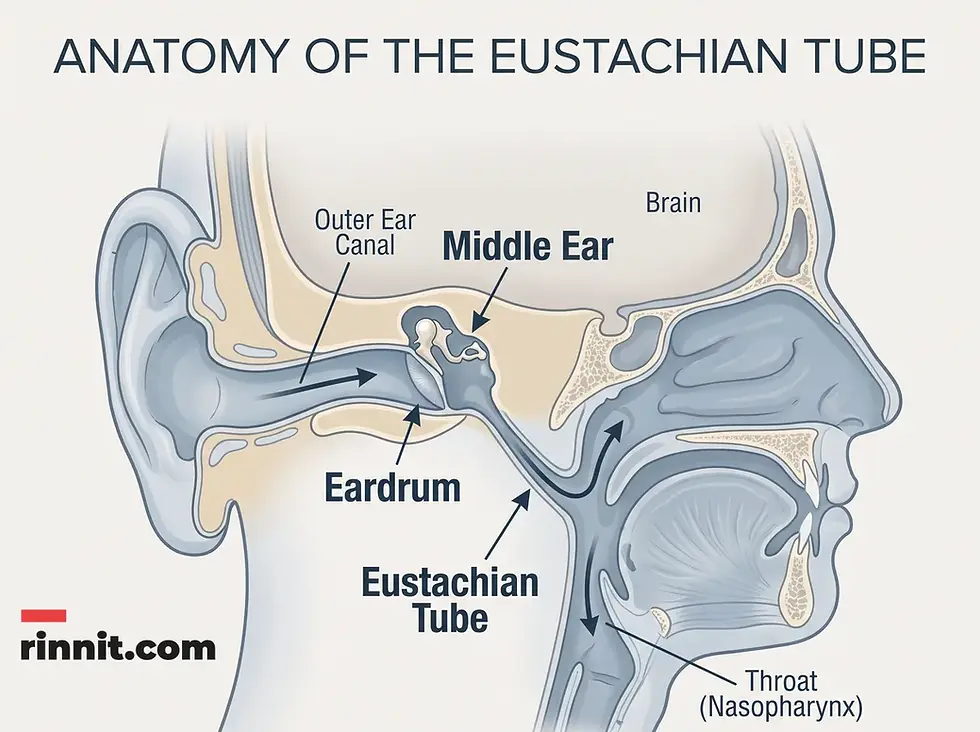
Bony section | Located near the middle ear; 12 mm long |
Cartilage section | Located near the nose and throat; 24 mm long |
Total length | Approximately 36 mm (just under 1.5 inches) |
Normal state | Closed (opens only during swallowing or yawning) |
Anatomy and Location
Every individual has two eustachian tubes, one on each side of the face. These tubes connect the middle ear — the area between the eardrum and the cochlea — to the nasopharynx at the back of the nose and throat [4]. (For the bigger picture, see our guide to ear anatomy, function, and care.)
Eustachian Tube Dysfunction (ETD)
ETD is a broad term for any condition that prevents the eustachian tubes from opening or closing normally [4]. (Read the full guide to eustachian tube dysfunction.)
Common causes
Several factors can cause the tubes to swell or become blocked [4]:
Illness. Colds, sinusitis, and infections are frequent triggers [4].
Environment. Changes in altitude (barotrauma) can strain the tubes [4].
Other factors. Allergies, GERD (acid reflux), and occasionally ear tumors can contribute to dysfunction [4].
Symptoms to watch for
When the eustachian tubes are not functioning correctly, you may experience [4]:
A feeling of "fullness" or pressure in the ears.
Muffled or distorted hearing.
Clicking, popping, or tickling sensations.
Tinnitus (ringing in the ears) or balance problems (see dizziness and vertigo).

Care and Home Remedies
Most eustachian tube issues are temporary and can be managed with simple techniques at home [4].
Self-care strategies
Active opening. Chewing gum, yawning, or swallowing frequently can help force the tubes to open [4].
The Valsalva maneuver. Close your mouth, pinch your nostrils, and breathe out gently to pop the ears.
Eustachian massage. Firmly tracing the groove behind the earlobe down to the collarbone can help encourage drainage [4].
Medication. Saline sprays, decongestants, or antihistamines may be used to reduce swelling [4].
Technique | How it helps |
Yawn, swallow, or chew gum | Encourages the tubes to open and balance pressure |
Valsalva maneuver | Close your mouth, pinch your nostrils, and breathe out gently to pop the ears |
Eustachian massage | Tracing the groove behind the earlobe down to the collarbone to encourage drainage |
Saline sprays, decongestants, or antihistamines | May reduce swelling |

When to see a doctor
If symptoms persist for more than two weeks, you should consult a healthcare provider [4]. Persistent cases may require medical procedures like tympanostomy (ear tubes) or eustachian tuboplasty, which uses a balloon to expand the passage [4] (see balloon dilation).
Key Takeaways
The eustachian tubes are remarkable anatomical features that quietly protect our hearing and maintain internal balance. While they are susceptible to common illnesses and environmental changes, understanding their function and practicing simple care techniques can prevent most discomfort. By paying attention to symptoms like ear fullness or muffled sound, you can ensure these vital passages remain clear and functional.
Take the Next Step
If you are experiencing persistent ear pressure or muffled hearing that lasts longer than two weeks, schedule an appointment with an ear, nose, and throat specialist.
Related reading: Eustachian Tube Dysfunction · Eustachian Tube Balloon Dilation · Understanding the Ear · Airplane Ear
Frequently Asked Questions
1. What are eustachian tubes?
Eustachian tubes are small tubes made of bone and cartilage that connect your middle ears to the back of your throat.
2. What is the main job of the eustachian tubes?
The eustachian tubes' main jobs are to drain fluid, equalize air pressure, and protect the middle ear from infection.
3. Why do my ears pop when I yawn?
Yawning causes the eustachian tubes to open, which lets in air to balance the pressure in your middle ear.
4. What is eustachian tube dysfunction (ETD)?
ETD is when the tubes don't open or close normally, often due to swelling from a cold or allergies.
5. What does ETD feel like?
Common feelings include ear fullness, muffled hearing, popping sounds, and sometimes dizziness or balance issues.
6. Can allergies cause ear problems?
Yes, allergies can cause the eustachian tubes to swell, leading to pressure and fluid buildup in the ear.
7. How can I open my clogged ears at home?
You can try yawning, swallowing, chewing gum, or performing the Valsalva maneuver gently.
8. What is a eustachian tube massage?
A eustachian tube massage is a technique where you trace the groove behind your ear down to your collarbone to encourage fluid drainage.
9. When should I see a doctor for ear pressure?
You should see a provider if your ear symptoms last for more than two weeks without improvement.
10. What are ear tubes (tympanostomy)?
Ear tubes are small tubes placed in the eardrum to help drain fluid and balance pressure when the eustachian tubes aren't working.
References
Mehta NK, Ma C, Nguyen SA, et al. Medical management for eustachian tube dysfunction in adults: a systematic review and meta-analysis. Laryngoscope. 2022;132(4):849-856. doi:10.1002/lary.29878. PMID: 34606099.
Froehlich MH, Le PT, Nguyen SA, McRackan TR, Rizk HG, Meyer TA. Eustachian tube balloon dilation: a systematic review and meta-analysis of treatment outcomes. Otolaryngol Head Neck Surg. 2020;163(5):870-882. doi:10.1177/0194599820924322. PMID: 32482125.
Raymond MJ, Shih MC, Elvis PR, et al. A systematic review of eustachian tube procedures for baro-challenge eustachian tube dysfunction. Laryngoscope. 2022;132(12):2473-2483. doi:10.1002/lary.30132. PMID: 35442523.
Cleveland Clinic. Eustachian tubes. Cleveland Clinic Health Library. Medically reviewed; last updated April 2, 2024. https://my.clevelandclinic.org/health/body/22072-eustachian-tubes
Medical Disclaimer
This article is for informational purposes only and does not constitute medical advice. Always seek the advice of your physician or other qualified health provider with any questions you may have regarding a medical condition. Never disregard professional medical advice or delay in seeking it because of something you have read here.



Comments