DRG Stimulator: How Dorsal Root Ganglion Stimulation Eases Chronic Nerve Pain

Updated: 6 days ago
Written and medically reviewed by Dr. Baraa Alnahhal, MD · Last reviewed: October 2026 · How we review
Quick Answer: What is a DRG stimulator?
Dorsal root ganglion (DRG) stimulation is a chronic pain treatment in which a surgically implanted device sends small electrical pulses to overactive sensory nerve cells beside the spine. It is approved for complex regional pain syndrome and causalgia in the legs, starts with a trial of several days, and may reduce pain significantly without eliminating it. [1]
What the research says
DRG stimulation outperformed traditional spinal cord stimulation for leg CRPS and causalgia. In a randomized trial of 152 people, 81.2% of those treated with DRG stimulation reached 50% or greater pain relief and treatment success at 3 months, compared with 55.7% treated with spinal cord stimulation; device-related and serious side effects did not differ between groups. (Deer et al., Pain, 2017) [2]
About 6 in 10 people kept major relief at one year. A pooled analysis of 217 people with a permanent implant found that 63% reported 50% or greater pain relief at 12 months, with an average pain score of 3.4; the most common problems were pain at the device pocket, lead fracture, lead migration and infection. (Huygen et al., Neuromodulation, 2020) [3]
Evidence beyond CRPS is still growing. A review of 1 randomized trial and 39 observational studies found DRG stimulation is increasingly used for other leg nerve pain, including diabetic neuropathy, mononeuropathy and polyneuropathy, and called for larger randomized trials. (D'Souza et al., Advances in Therapy, 2022) [4]
Key takeaways
A DRG stimulator targets one small cluster of sensory nerve cells, so it can cover pain in a focused area. [1]
It is approved for complex regional pain syndrome (CRPS) and causalgia in the lower limbs. [1]
You test it first: you move to a permanent implant only if the trial cuts your pain by more than 50%. [1]
At one year, studies report more than 50% pain relief in 63% to 74% of people. [1][2][3]
The device is reversible, and its battery usually lasts about six to seven years. [1]
What is dorsal root ganglion stimulation?
Dorsal root ganglion stimulation is a treatment that uses small electrical signals from an implanted device to calm the dorsal root ganglion, a cluster of sensory nerve cells next to the spinal cord. [1]
When this cluster becomes overactive after an illness or injury, it can keep sending pain signals long after the body has healed. The stimulator's pulses aim to change those signals before they reach the brain. [1]
It may not remove all pain. For many people, though, it can reduce pain significantly. [1]

What is the dorsal root ganglion?
The dorsal root ganglion is a group of sensory nerve cells that sits just outside the spinal cord, in a small opening in the spine. [1][6]
These cells carry information about:
Touch
Temperature
Pain
The ganglion passes this information to the spinal cord and brain, which is where you actually feel it. Normally, it helps you sense heat, cold and pressure. [1]
How does a DRG stimulator reduce chronic pain?
A DRG stimulator reduces chronic pain by sending electrical pulses to an overactive dorsal root ganglion, which changes pain signals before they reach the brain. [1]
Chronic pain is pain that lasts for months or longer. In some nerve-related conditions, the ganglion stays "switched on" and keeps firing pain signals even after the original injury heals. Calming that activity at its source is the goal of the therapy. [1][5]
Part | What it does |
Dorsal root ganglion | Relays touch, temperature and pain signals to the spinal cord |
Lead (thin wire) | Delivers electrical pulses directly to the ganglion |
Stimulator (about matchbox size) | Sits under the skin and powers the lead |
Handheld remote | Lets you adjust settings under your provider's guidance |
Sources: [1]
What conditions does a DRG stimulator treat?
A DRG stimulator is approved to treat complex regional pain syndrome (CRPS) and causalgia in the lower limbs, which are both nerve-related pain conditions. [1]
Researchers are also studying it for: [1][4]
Focal neuropathy
Polyneuropathy
If you live with CRPS, our guide to complex regional pain syndrome explains its symptoms and other treatment options.
How does DRG stimulation surgery work?
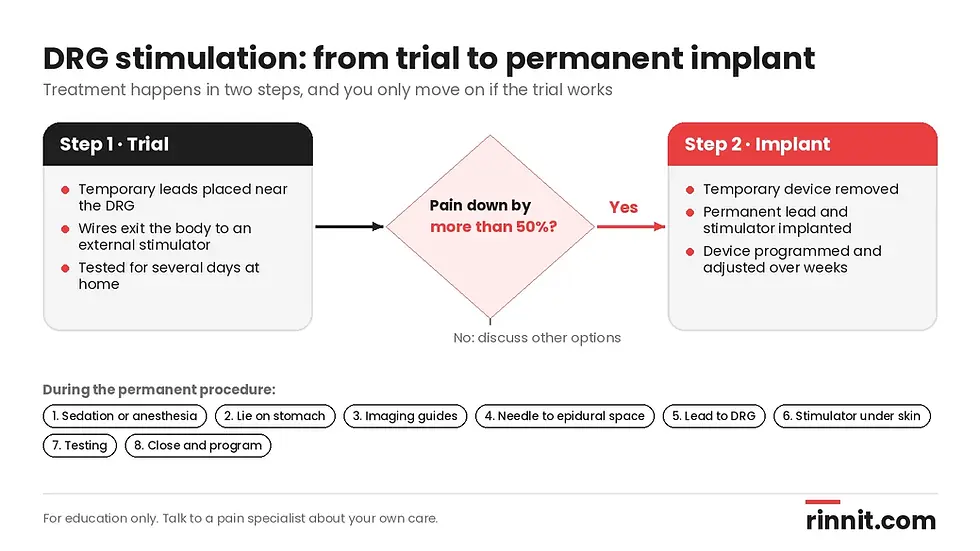
DRG stimulation surgery works in two steps: a short trial with a temporary device, followed by a permanent implant only if the trial clearly helps. [1]
Trial procedure. A surgeon places temporary leads near your dorsal root ganglion. The wires exit your body and connect to an external stimulator. You use it for several days. If your pain drops by more than 50%, you move on to the permanent implant. [1]
Permanent procedure. Your provider removes the temporary device and implants a permanent one. [1]
What happens during the permanent procedure?
The permanent procedure follows eight main steps. [1]
Step | What happens |
1. Anesthesia | You receive deep sedation or general anesthesia |
2. Positioning | You lie on your stomach |
3. Imaging | Scans guide the surgeon to the right spot |
4. Needle placement | A special needle enters the epidural space, just outside the spinal cord |
5. Lead placement | A thin wire passes through the needle to the target ganglion |
6. Stimulator implant | A matchbox-sized device goes under the skin and connects to the lead |
7. Testing | The surgeon checks that the device works properly |
8. Closing and programming | The incision is stitched closed and the device is programmed |
Source: [1]
How do you prepare for DRG stimulation surgery?
Preparing for DRG stimulation surgery usually involves a physical exam, possible imaging tests and specific instructions from your provider. [1]
One common instruction is to stop blood thinners before surgery, because they can raise the risk of bleeding. Only stop a medicine when your care team tells you how and when. [1]
What is the success rate of DRG stimulation?
Many people get more than 50% pain relief with DRG stimulation, with studies reporting this level of relief in 63% to 74% of people at one year. [1][2][3]
Study finding | Result |
People with more than 50% pain relief at 1 year (pooled analysis) | 63% [3] |
People with similar relief at 1 year (randomized trial) | 74% [1][2] |
Relief plus treatment success at 3 months, DRG vs spinal cord stimulation | 81.2% vs 55.7% [2] |
Results vary from person to person. Your surgeon can give you a clearer idea of what to expect in your situation. [1]
What are the benefits of DRG stimulation?
The main benefits of DRG stimulation are focused pain coverage, better ability to do daily activities and an option beyond pain medicines. [1]
Focal coverage. The pulses target the specific area of pain. [1]
Daily function. Many people find everyday activities easier. [1]
Another option. It offers a path besides pain medicines. [1]
Reversible. Your surgeon can remove the device at any time if needed. [1]
For other targeted options, see our guides to nerve blocks and radiofrequency ablation.
What are the side effects and risks of a DRG stimulator?
The possible side effects of a DRG stimulator include lead breakage or movement, discomfort at the device site, infection, device malfunction and unusual tingling. [1]
Side effect | What it means |
Broken lead or lead movement | The thin wire can fracture or shift from its spot |
Device site discomfort | Soreness where the stimulator sits under the skin |
Infection after surgery | Bacteria can infect the incision or device area |
Device problems | The stimulator may not work correctly |
Unusual sensations | Odd tingling or other new feelings |
Sources: [1][3]
Your surgical team takes steps to lower the risk of these problems. [1]
What is recovery like after a DRG stimulator implant?
Recovery after a DRG stimulator implant usually involves a few days of bandages, some soreness at the site, and a period of light activity while the device settings are fine-tuned. [1]
Bandages usually stay on for a few days. Your care team will show you how to clean and care for the site at home. [1]
Pain, soreness, swelling or bruising at the stimulator site is normal. Your team will give you pain medicine, and an ice pack wrapped in a towel can ease swelling. [1]
Hospital stay varies. Some people stay in the hospital after surgery, while others go home the same day. [1]
Activity: avoid rapid twisting, excessive bending and anything strenuous. Normal, light activities are usually fine. Ask your provider before doing anything new. [1]
Device settings: you'll learn to use a handheld remote, much like a TV remote. Your provider starts with general settings and may adjust them over the next few weeks. [1]

How long does a DRG stimulator battery last?
Most DRG stimulator batteries last about six to seven years, depending on the type of device. [1]
When the battery runs down, a minor outpatient procedure lets your surgeon swap the implanted device for a new one. The lead wires usually stay in place. [1]
The remote's batteries need recharging much sooner, but you can easily do this at home. [1]
When should you call a doctor after DRG stimulator surgery?
You should call your care team after DRG stimulator surgery if the incision site looks or feels unusual, because these changes can be signs of infection. [1]
Watch for:
Fever
Sharp, sudden or severe pain
Skin discoloration
Swelling that doesn't go down
Warmth
DRG stimulation at a glance
Question | Short answer |
What it targets | The dorsal root ganglion, beside the spinal cord |
Approved uses | CRPS and causalgia in the lower limbs |
Under study for | Diabetes-related neuropathy, focal neuropathy, polyneuropathy |
First step | Trial of several days with temporary leads |
Go-ahead threshold | More than 50% pain reduction during the trial |
Anesthesia | Deep sedation or general anesthesia |
Device size | About the size of a matchbox |
Battery life | About 6 to 7 years |
Reversible? | Yes, it can be removed |
Source: [1]
Conclusion
A DRG stimulator offers a targeted way to calm overactive nerve cells beside the spine when nerve pain, especially CRPS or causalgia in the legs, has not responded well to other treatments. The trial step lets you test the therapy before committing, and results at one year show meaningful relief for many people. Recovery takes patience, and the device needs follow-up adjustments, but it can bring real relief. [1][2][3]
Living with long-term nerve pain? Learn more about chronic pain and its management options and neuropathic pain relief strategies, then bring your questions to a pain specialist to see whether a DRG stimulator trial fits your situation.
FAQ
What is a DRG stimulator?
A DRG stimulator is an implanted device that sends small electrical pulses to the dorsal root ganglion, a cluster of sensory nerve cells beside the spinal cord. It is used to reduce chronic nerve pain. [1]
What conditions is DRG stimulation used for?
DRG stimulation is approved for complex regional pain syndrome (CRPS) and causalgia in the lower limbs. Researchers are also studying it for diabetes-related neuropathy, focal neuropathy and polyneuropathy. [1]
How long is the DRG stimulator trial?
The DRG stimulator trial usually lasts several days. If it reduces your pain by more than 50%, you can move on to the permanent implant. [1]
Is DRG stimulation surgery done under anesthesia?
Yes, DRG stimulation surgery is done under deep sedation or general anesthesia. You lie on your stomach while imaging guides the surgeon. [1]
How successful is DRG stimulation?
Studies report that 63% to 74% of people have more than 50% pain relief at one year. Results vary from person to person. [1][2][3]
What are the side effects of a DRG stimulator?
Possible side effects include a broken or shifted lead, discomfort at the device site, infection, device malfunction and unusual tingling. Your surgical team takes steps to lower these risks. [1]
How long does a DRG stimulator battery last?
Most DRG stimulator batteries last about six to seven years. A minor outpatient procedure replaces the device, and the leads usually stay in place. [1]
When should I call my doctor after DRG stimulator surgery?
Call your care team if the incision has drainage, bleeding, warmth, skin discoloration or swelling that doesn't go down, or if you develop a fever or sharp, severe pain. These can be signs of infection. [1]
Can a DRG stimulator be removed?
Yes. DRG stimulation is reversible, and your surgeon can remove the device if it doesn't help or causes problems.
What does DRG stimulation feel like?
Many people feel little or a mild tingling in the painful area, and some feel nothing at all. Your care team can adjust the settings to make it comfortable.
Related Reading
Spinal Cord Stimulator (SCS): How It Works, Surgery, Recovery and Risks explains how spinal cord stimulators ease chronic pain and their risks.
What Is Complex Regional Pain Syndrome (CRPS)? Symptoms, Causes, Diagnosis, Treatment & Outlook explains the symptoms, causes and treatment of CRPS.
Neuropathic Pain: Symptoms, Causes, and Relief Strategies explains what causes nerve pain and how it is managed.
What Is Chronic Pain? Causes, Types, and Management Options explains chronic pain and the main ways to treat it.
References
Cleveland Clinic. Dorsal Ganglion Root (DRG) Stimulator: What It Is & Side Effects. Cleveland Clinic. Last updated August 10, 2026. https://my.clevelandclinic.org/health/treatments/dorsal-root-ganglion-stimulator-drg
Deer TR, Levy RM, Kramer J, et al. Dorsal root ganglion stimulation yielded higher treatment success rate for complex regional pain syndrome and causalgia at 3 and 12 months: a randomized comparative trial. Pain. 2017;158(4):669-681. PMID: 28030470. https://doi.org/10.1097/j.pain.0000000000000814
Huygen FJPM, Kallewaard JW, Nijhuis H, et al. Effectiveness and Safety of Dorsal Root Ganglion Stimulation for the Treatment of Chronic Pain: A Pooled Analysis. Neuromodulation. 2020;23(2):213-221. PMID: 31730273. https://doi.org/10.1111/ner.13074
D'Souza RS, Kubrova E, Her YF, et al. Dorsal Root Ganglion Stimulation for Lower Extremity Neuropathic Pain Syndromes: An Evidence-Based Literature Review. Adv Ther. 2022;39(10):4440-4473. PMID: 35994195. https://doi.org/10.1007/s12325-022-02244-9
Abd-Elsayed A, Vardhan S, Aggarwal A, et al. Mechanisms of Action of Dorsal Root Ganglion Stimulation. Int J Mol Sci. 2024;25(7):3591. PMID: 38612402. https://doi.org/10.3390/ijms25073591
Ahimsadasan N, Reddy V, Khan Suheb MZ, et al. Neuroanatomy, Dorsal Root Ganglion. In: StatPearls [Internet]. Treasure Island (FL): StatPearls Publishing; 2026 Jan-. Updated September 21, 2022. https://www.ncbi.nlm.nih.gov/books/NBK532291/
Hagedorn JM, Misercola B, Comer A, et al. The Team Approach to Spinal Cord and Dorsal Root Ganglion Stimulation: A Guide for the Advanced Practice Provider. Mayo Clin Proc Innov Qual Outcomes. 2021;5(3):663-669. PMID: 34195557. https://doi.org/10.1016/j.mayocpiqo.2021.05.002
Further reading: National Institute of Neurological Disorders and Stroke. Complex Regional Pain Syndrome. NINDS Publications. Published September 2020. https://www.ninds.nih.gov/publications/complex-regional-pain-syndrome
Medical disclaimer
This article is for general education and does not replace advice from a qualified healthcare professional. Talk with your doctor or a pain specialist before making decisions about any treatment, including DRG stimulation.



Comments