Diffuse Midline Glioma (DMG): Symptoms, Causes, Diagnosis & Treatment — Complete Guide

Updated: 2 days ago
Medically reviewed by Dr. Baraa Alnahhal, MD · Last reviewed: October 2026
Quick Answer
Diffuse midline glioma (DMG) is a rare, aggressive cancerous brain tumor that most commonly affects children between ages 5 and 10. It grows in the middle of the brain or spinal cord, often the brainstem or thalamus, and spreads into healthy tissue. Surgery is usually not possible, so treatment focuses on radiation and comfort care. There is currently no cure.
What the research says
Shorter radiation courses appear to work about as well as the conventional course. A systematic review and meta-analysis of 4 studies (88 patients treated with hypofractionated radiotherapy and 96 with conventional radiotherapy) found comparable overall survival (hazard ratio 1.07, 95% CI 0.77–1.47) and progression-free survival (hazard ratio 1.04, 95% CI 0.75–1.45); the authors noted that a shorter course may cut treatment time and costs in what is usually palliative care. (Park et al., Medicine, 2020) [3]
Radiation is still the only standard of care, and new treatments are in trials. A 2024 semi-systematic review in Neuro-Oncology concluded that radiation remains the sole standard of care for H3 K27M-altered glioma and that no effective systemic therapies are available; it identified 41 active or ongoing interventional trials in these patients, including H3 K27M vaccines, CAR T-cell therapy, and small-molecule inhibitors. (van den Bent et al., Neuro Oncol, 2024) [4]
Re-irradiation may help when the tumor progresses. A systematic review of 22 clinical trials of emerging therapies for diffuse intrinsic pontine glioma found no established curative option, and reported that re-irradiation may prolong survival in progressive disease while palliative radiotherapy remains a key treatment choice. (Farrukh et al., Healthcare, 2023) [5]
At a Glance
Topic | Summary |
Definition | A rare, aggressive cancerous brain tumor growing in the midline of the brain or spinal cord |
Most common in | Children ages 5–10, though adults can also develop it |
Typical locations | Brainstem (pons), thalamus, or spinal cord |
Main cause | A random change in the H3K27 histone gene that makes cells multiply out of control |
Key warning signs | Morning headaches, weakness on one side, facial drooping, trouble walking, balance problems, speech issues |
Main diagnostic test | Brain MRI (dye usually not needed); biopsy confirms the gene mutation |
Most common treatment | Radiation therapy over about 6 weeks |
Surgery | Usually not an option due to the tumor's location and poorly defined edges |
Outlook | No cure yet; treatments aim to extend life and ease discomfort; research is advancing |
What Is Diffuse Midline Glioma?
The name itself explains a lot about this tumor. Diffuse means the cancer cells spread beyond the tumor into healthy brain tissue. Midline means the tumor sits in the middle of the central nervous system — most often the thalamus, the spinal cord, or the brainstem (specifically an area called the pons). Glioma means it grew from glial cells, the "helper" cells found in the white matter of the brain that support and protect nerve cells.
You may also see the older name diffuse intrinsic pontine glioma (DIPG) — this is now grouped under the DMG label for tumors in the pons. The word intrinsic means the tumor grew from inside the brain tissue itself, and pontine refers to the pons, the part of the brainstem that controls essential functions like breathing and heartbeats.
DMG is a serious, aggressive cancer. Symptoms can start suddenly and get worse quickly, which makes early diagnosis challenging.
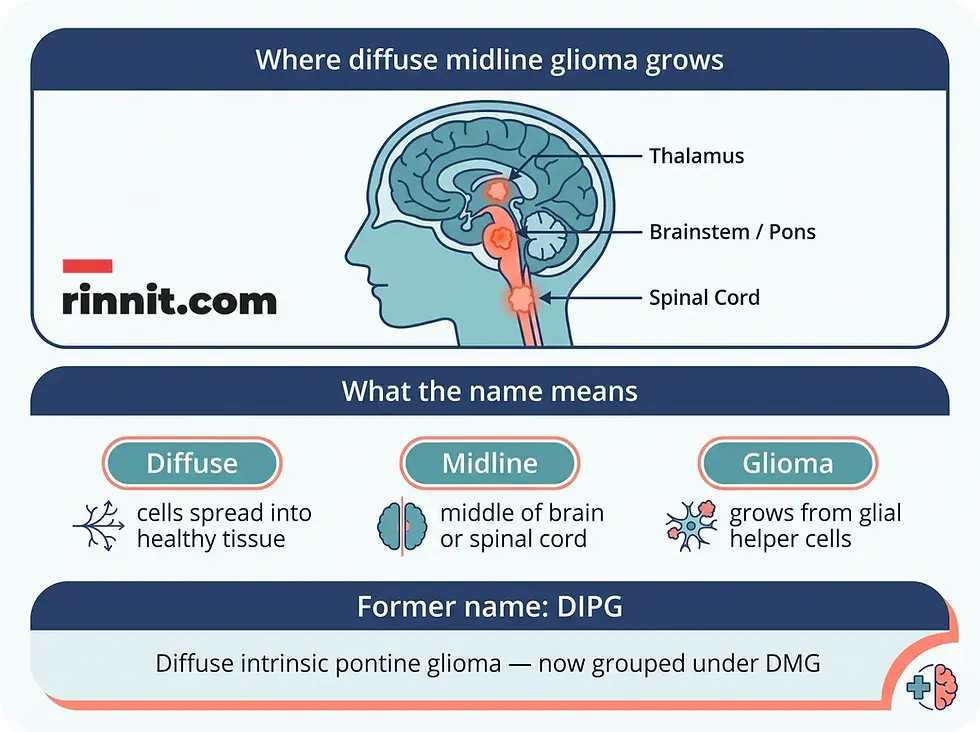
DMG is diagnosed through a review of symptoms, a brain MRI, and sometimes additional tests. It's important to understand upfront: there is currently no cure for DMG. The most common treatments — radiation therapy and chemotherapy — aim to ease discomfort and extend life. This guide explains the warning signs, the science behind it, and the research that is working toward better options.
Warning Signs to Watch For
Symptoms depend on exactly where the tumor grows. At first they tend to be mild and easy to overlook — then they worsen over weeks or months.
Symptom | What it may look like |
Facial drooping | One side of the face droops |
Facial muscle weakness | Weakness or poor control of face muscles |
Arm or leg weakness | Especially on one side of the body |
Clumsiness | Bumping into things, dropping objects |
Fatigue | Unusual tiredness |
Morning headaches | Headaches that are worse when waking up |
Nausea and vomiting | Often paired with morning headaches |
Speech or swallowing problems | Slurred speech, trouble swallowing food |
Balance problems | Unsteadiness, difficulty staying upright |
Difficulty walking | Changes in gait or a new limp |
Tingling or numbness | In the face, arms, hands, or legs |
Difficulty concentrating | Trouble focusing, especially at school |
Seizures | Seizure activity |
Back pain | New or worsening back pain |
Bladder or bowel changes | New difficulty controlling bladder or bowels |
Vision problems | Blurry vision or double vision |
Hearing problems | Hearing difficulty or hearing loss |
Behavior changes | Irritability, trouble at school |
Weight gain | Unexplained weight gain |
Because the earliest symptoms are subtle, any of these signs — especially several appearing together in a child — deserve prompt medical attention. See a healthcare provider if any symptom worries you. Early evaluation is the best protection.
What Causes Diffuse Midline Glioma?
The exact cause is not completely understood, but experts believe DMG starts with an unexpected gene change — essentially a random mistake. Genes are the instruction manuals for every cell, and in DMG, those instructions go wrong.
The mutation most often affects the H3K27-altered gene, a histone gene. Histone genes package the DNA inside cells and manage which genes are switched on or off. When they change, cells lose their ability to regulate growth properly — they don't stop multiplying, and they multiply very quickly. That is how the tumor forms.
A second mechanism involves the healthy growth of glial cells being disrupted — also caused by a histone gene mutation — which makes glial cells grow out of control.
There is also a possible reason this tumor targets children. The brain undergoes rapid growth between ages 5 and 10, the very years when DMG is most often diagnosed. Scientists think this period of fast growth may make the young brain more vulnerable to these gene changes.
Risk Factors and Prevention
Here is the honest truth: there are no known risk factors and no known way to prevent DMG. It is not caused by anything a parent did or didn't do. Nothing about diet, screen time, household chemicals, or family choices has been linked to this tumor. It occurs randomly.
This matters for families: DMG is no one's fault. If your child is diagnosed, the best step is to focus on expert medical care and support.
How Diffuse Midline Glioma Is Diagnosed
Diagnosis combines a careful review of symptoms with specialized imaging. Because DMG grows in deep, critical areas of the brain, getting the diagnosis right matters — and it can be challenging.
Step | What happens |
Symptom review | Healthcare provider reviews all symptoms, a physical exam, and medical history |
Brain MRI | The main diagnostic tool; finds tumors based on location and features such as poorly defined borders; a dye is usually not needed |
Biopsy (when needed) | If the MRI can't distinguish DMG from other gliomas, a small tissue sample is studied under a microscope |
Gene testing | The tissue is tested for the H3K27-altered gene mutation, which confirms the DMG diagnosis |
Because DMG grows in the brainstem — an area that controls breathing and heartbeat — surgery to remove the tumor is typically impossible. That makes accurate imaging and, when necessary, biopsy the cornerstone of diagnosis.
Treatment Options
DMG is very aggressive and spreads quickly. There is no cure, so treatments are designed to manage symptoms so people can live longer and more comfortably. Here is what the treatment landscape looks like today.
1. Radiation Therapy — The Most Common Treatment
Radiation therapy is the standard treatment for DMG. It uses precise, concentrated energy beams to destroy tumor cells. Treatment typically involves multiple sessions over about 6 weeks. Radiation can slow the tumor's growth and reduce symptoms, though tumors often grow back after treatment ends.
2. Surgery — Usually Not an Option
Surgery is generally not possible for two reasons: the tumor's location deep in essential brain regions (removing it would damage tissue that controls breathing, movement, and other vital functions), and its poorly defined edges — the diffuse cells blend into healthy tissue, making clean removal impossible.
3. Medicines and Chemotherapy
Chemotherapy is usually not effective against DMG, but it is sometimes used alongside radiation in specific situations.
4. Palliative Treatment — Comfort and Quality of Life
Palliative care is not about curing — it is about improving life and managing symptoms. The palliative toolkit for DMG includes:
Steroid medicines to reduce brain swelling
Feeding and nutrition support
Speech therapy for speech and swallowing problems
Occupational therapy to help with daily activities
Physical therapy to support movement and mobility
Seizure-prevention medicines
Pain medicine for comfort
Procedures to drain fluid buildup in or around the brain
Counseling and therapy for emotional support
5. Potential Future Treatments — Where the Research Is Heading
Science is moving fast, and several experimental approaches are being studied:
New chemotherapy drugs designed to target the specific changed genes
Catheter delivery of medicine directly to the tumor
Immunotherapy, including immune checkpoint inhibitors, monoclonal antibodies, and vaccines that teach the immune system to attack the tumor
CAR-T cell therapy — a breakthrough approach where a patient's own T cells (immune cells) are removed, modified in a lab with a special CAR receptor that helps them track and find cancer cells, multiplied, and returned to the body through an IV. Researchers sometimes call this a "living drug" because the cells keep working inside the body.
What Is the Outlook?
Every person and every diagnosis is different, but it is important to be honest: DMG is usually fatal. Life expectancy is generally 9 to 12 months after diagnosis, and most people survive less than a year. Some people live longer, depending on how the tumor responds to treatment and its grade at diagnosis.
Clinical trials can help people live longer. If a clinical trial is available, it may be worth discussing with the care team. The healthcare team also provides essential support and guidance for end-of-life care when the time comes.
Coping and Support
A DMG diagnosis affects the entire family. Here are three things that genuinely help:
Learn all you can. Write down questions before appointments, take notes during them, and bring a family member along to help listen.
Get support. Lean on a trusted friend or family member, a clergy member, a counselor, or a support group — both online and local options exist.
Take care of yourself. Check with the healthcare team about safe exercise, protect your sleep, and reduce stress through music, journaling, or whatever brings you calm.

Preparing for Your Appointment
After initial evaluation, patients are typically referred to a team of specialists — neurologists, medical oncologists, radiation oncologists, neuro-oncologists, neurosurgeons, and rehabilitation specialists.
What you can do before the visit:
Find out if there is anything you need to do in advance (some tests require preparation).
Write down all symptoms, including any that seem unrelated.
List key medical information, conditions, and all medicines.
Bring a family member or friend to help remember what the provider says.
Write down your questions, ordered from most to least important.
Questions for the first appointment:
What is likely causing these symptoms?
Are there other possible causes?
What tests are needed, and do they require preparation?
What are the next steps?
Should we see a specialist?
Questions for the oncologist or neurologist:
Do I (or does my child) have diffuse midline glioma?
How will the tumor grow?
Where is it, and how large is it?
What might happen as it grows?
What are the treatment goals?
Is surgery an option? What are its risks?
Is radiation therapy an option? What are its risks?
Is chemotherapy an option?
What approach do you recommend, and why?
If the first treatment doesn't work, what comes next?
What is the prognosis?
Is a second opinion a good idea?
Is a clinical trial available — and is it right for me?
Questions your healthcare provider may ask you:
What are your symptoms, and when did you first notice them?
Have they been getting worse?
Where is the pain, and has it spread?
What daily activities are affected?
Is there weakness or numbness in the legs?
Is there difficulty walking?
Have bladder or bowel habits changed?
Do you have other medical conditions?
What medicines are being taken?
Is there a family history of tumors — cancerous or not?
Frequently Asked Questions (FAQ)
What is diffuse midline glioma?
Diffuse midline glioma (DMG) is a rare, aggressive cancerous brain tumor that grows in the middle of the brain or spinal cord — most often the brainstem, thalamus, or spinal cord. It is most common in children ages 5 to 10, though adults can also develop it. The cancer cells spread beyond the tumor into surrounding healthy tissue, which is why it is called "diffuse."
What causes diffuse midline glioma?
DMG is thought to be caused by a random change in a gene — most often the H3K27 histone gene — that manages how DNA is packaged and which genes are switched on or off. When this gene changes, cells lose their ability to regulate growth and multiply very quickly, forming a tumor. The rapid brain growth of children ages 5 to 10 may make young brains more vulnerable to these changes.
What are the first signs of diffuse midline glioma in children?
Early signs often include morning headaches, nausea and vomiting, difficulty walking, balance problems, clumsiness, and weakness — especially on one side of the body. Facial drooping, speech or swallowing problems, and behavior changes such as irritability or trouble at school are also common. Symptoms start mild and worsen over weeks or months, so any combination of these signs deserves prompt medical evaluation.
Why can't surgery remove diffuse midline glioma?
Surgery is usually not possible because of where the tumor grows. The midline of the brain — particularly the pons in the brainstem — controls vital functions like breathing and heartbeat, so removing tumor tissue would damage essential areas. The tumor's diffuse, poorly defined edges also make clean surgical removal impossible.
How is diffuse midline glioma treated?
Radiation therapy is the most common treatment, using precise energy beams over about 6 weeks to destroy tumor cells, slow growth, and reduce symptoms. Chemotherapy is usually not effective but is sometimes used with radiation. Palliative care — steroids to reduce brain swelling, therapies for speech and mobility, pain medicine, and emotional support — focuses on comfort and quality of life.
Is there a cure for diffuse midline glioma?
There is currently no cure for DMG. Life expectancy is generally 9 to 12 months after diagnosis, though some people live longer depending on tumor grade and treatment response. Research is advancing quickly — gene-targeted chemotherapy, immunotherapy, and CAR-T cell therapy (a "living drug" approach) are all being studied in clinical trials, which may offer longer survival.
How do doctors confirm a diagnosis of diffuse midline glioma?
The main diagnostic tool is a brain MRI, which identifies tumors by location and features such as poorly defined borders — usually without the need for dye. If the MRI cannot distinguish DMG from other gliomas, a biopsy takes a small tissue sample that is studied under a microscope and tested for the H3K27-altered gene mutation, which confirms the diagnosis.
What is the life expectancy with diffuse midline glioma?
Every child is different, but DMG is usually fatal, and life expectancy is generally 9 to 12 months after diagnosis. Some people live longer depending on how the tumor responds to treatment.
Is DIPG the same as diffuse midline glioma?
DIPG (diffuse intrinsic pontine glioma) is the older name for these tumors when they grow in the pons, part of the brainstem. Today they are grouped under the diffuse midline glioma name.
Can adults get diffuse midline glioma?
Yes. It is most common in children ages 5 to 10, but adults can also develop it.
Conclusion
This guide has walked you through what diffuse midline glioma is, why it happens, and how families can respond:
DMG is a rare, aggressive brain tumor that grows in the brainstem, thalamus, or spinal cord — most often in children ages 5 to 10.
Early, subtle symptoms matter — morning headaches, one-sided weakness, facial drooping, and trouble walking all deserve prompt medical attention.
While there is no cure today, radiation therapy, palliative care, and rapidly advancing research (including CAR-T "living drug" therapy and clinical trials) offer real avenues for longer, more comfortable life.
Understanding this condition — even in its hardest moments — helps families ask better questions, make informed decisions, and find the right specialists. For families navigating pediatric brain tumors, our guide on atypical teratoid/rhabdoid tumor (ATRT) covers another rare childhood brain tumor, and our astrocytoma complete guide explores gliomas that grow from the same glial cells.
Your Next Steps
Share your thoughts — Leave a comment below; your experience may help another family.
Stay updated — Sign up on rinnit.com for new health guides and updates.
Disclaimer: This article is provided for general informational purposes only and is not a substitute for professional medical advice, diagnosis, or treatment. Always consult a qualified healthcare provider with any questions about a medical condition.
Related Reading
Diffuse Intrinsic Pontine Glioma (DIPG): A Rare Childhood Brainstem Tumor — Symptoms, Causes, Diagnosis, Treatment and Outlook — What You Need to Know explains DIPG, the brainstem form of diffuse midline glioma.
Brainstem Tumor: Symptoms, Causes, and Treatment covers tumors in the brainstem and why they are hard to treat.
Childhood Brain Tumors: Types, Symptoms, and Treatment Explained reviews the main brain tumor types in children and their care.
Radiation Therapy: Types, How It Works and Side Effects explains how radiation treatment works and its common side effects.
References
Mayo Clinic Staff. Diffuse midline glioma - Symptoms and causes. Mayo Clinic. June 13, 2025. https://www.mayoclinic.org/diseases-conditions/diffuse-midline-glioma/symptoms-causes/syc-20584386
Mayo Clinic Staff. Diffuse midline glioma - Diagnosis and treatment. Mayo Clinic. June 13, 2025. https://www.mayoclinic.org/diseases-conditions/diffuse-midline-glioma/diagnosis-treatment/drc-20584427
Park J, et al. Hypofractionated radiotherapy versus conventional radiotherapy for diffuse intrinsic pontine glioma: A systematic review and meta-analysis. Medicine (Baltimore). 2020;99(42):e22721. PMID 33080729. https://doi.org/10.1097/MD.0000000000022721
van den Bent M, et al. H3 K27M-altered glioma and diffuse intrinsic pontine glioma: Semi-systematic review of treatment landscape and future directions. Neuro Oncol. 2024;26(Supplement_2):S110-S124. PMID 38102230. https://doi.org/10.1093/neuonc/noad220
Farrukh S, et al. Emerging Therapeutic Strategies for Diffuse Intrinsic Pontine Glioma: A Systematic Review. Healthcare (Basel). 2023;11(4). PMID 36833093. https://doi.org/10.3390/healthcare11040559



Comments