Diffuse Intrinsic Pontine Glioma (DIPG): A Rare Childhood Brainstem Tumor — Symptoms, Causes, Diagnosis, Treatment and Outlook — What You Need to Know

Updated: 3 days ago
Medically reviewed by Dr. Baraa Alnahhal, MD | Last reviewed: October 7, 2026
Quick Answer
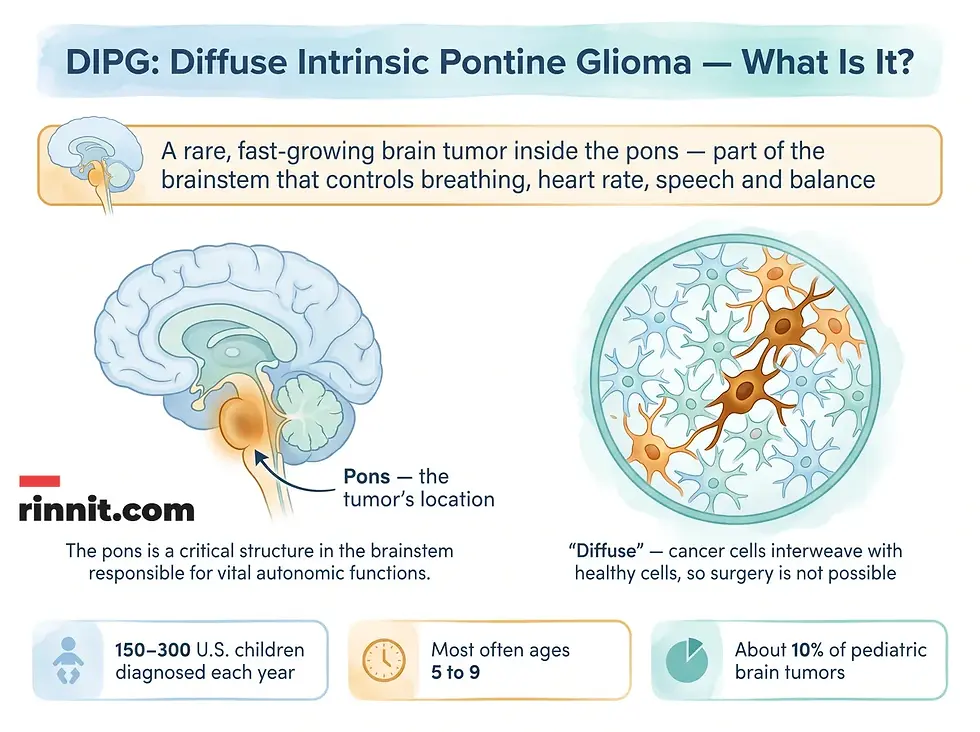
Diffuse intrinsic pontine glioma (DIPG) is a rare, incurable, fast-growing childhood brain tumor in the pons, the part of the brainstem controlling breathing, heart rate and other vital functions. [1] It is most often diagnosed in children ages 5 to 9. [1] Surgery is not possible; radiation extends average survival from about six months to nine to eleven months. [1]
What the research says
Radiation is the mainstay, and shorter courses appear to work about as well as longer ones. A systematic review and meta-analysis of five studies with 518 patients found no significant difference between hypofractionated (shorter) and conventionally fractionated radiotherapy in one-year overall survival or progression-free survival; median overall survival was similar (about 9.7 and 9.3 months in the two groups, p = 0.324) and treatment-related toxicity did not differ significantly (Viani et al., Reports of Practical Oncology and Radiotherapy, 2024) [2].
The H3K27M mutation signals a harder course. In a meta-analysis of six observational studies covering 474 patients with pediatric high-grade glioma (a group that includes DIPG), 258 (54%) had the H3K27M mutation; carrying it was independently linked to a worse prognosis (hazard ratio 3.63, p < 0.001) and to overall survival that was shorter by about 2.3 years (Lu et al., Journal of Neurosurgery: Pediatrics, 2019) [3].
The first drug approved for H3 K27M disease has not yet been shown to help classic DIPG. A 2026 critical review puts median overall survival at about 11 months and reports that dordaviprone became the first systemic therapy to receive FDA accelerated approval for H3 K27M-mutant diffuse midline glioma that has progressed after prior therapy; however, the population used for that approval excluded DIPG, so it does not establish benefit in classic pediatric pontine disease, and radiotherapy remains the only treatment with reproducible, though temporary, benefit (Wei et al., Critical Reviews in Oncology/Hematology, 2026) [4].
What is diffuse intrinsic pontine glioma (DIPG)?
Diffuse intrinsic pontine glioma (DIPG) is a malignant (cancerous) tumor that forms in a child's brainstem. It is considered an incurable, high-grade glioma. [1] High-grade gliomas are tumors that begin in cells in the central nervous system (CNS), including cells in the brain and spinal cord. These tumors grow fast and spread rapidly throughout the CNS.
The condition's name provides clues about the type of tumor, including why it is so difficult to treat.
Word in the name | What it means |
Diffuse | The tumor is not a single mass of cells. The cancer cells are spread out alongside healthy cells, making surgery impossible without harming healthy tissue |
Intrinsic | The tumor is inside the pons, a part of the brainstem |
Pontine | It affects the pons, an essential brainstem structure that controls blood pressure, heart rate and breathing, as well as vision, hearing, speech, muscle coordination and balance |
Glioma | A tumor made of glial cells — the cells that protect neurons in the central nervous system — that turned into cancer cells |
How is DIPG different from a diffuse midline glioma (DMG)?
DIPG is a type of diffuse midline glioma (DMG), and in the past the terms were used interchangeably. Diffuse midline glioma forms in the middle part of the brain, including the pons, thalamus and spinal cord, while DIPG forms specifically in the pons. [1] Both are high-grade gliomas, but differences between the two shape which treatments a provider may recommend.
Who is affected by DIPG?
Children of any age or sex may develop these tumors. They are most commonly diagnosed in children ages 5 to 9. [1]
Adults can also get diffuse intrinsic pontine glioma, but this is rare. [1]
How common is DIPG?
It is rare. Between 150 and 300 children in the U.S. are diagnosed with these tumors each year. Most gliomas that affect children are low-grade and treatable. Only about 10% of pediatric brain tumors are DIPG. [1]
Statistic | Value |
U.S. children diagnosed each year | 150 to 300 |
Share of pediatric brain tumors that are DIPG | About 10% |
Most common age at diagnosis | Ages 5 to 9 |
Adults affected | Possible, but rare |
What are the symptoms of DIPG?
DIPG grows fast, and symptoms progress rapidly. Signs and symptoms to watch for in a child include eye problems (blurry vision, seeing double, uncontrollable or odd eye movements), headaches — especially morning headaches and headaches that improve after vomiting — trouble with walking, muscle coordination or balance (ataxia), droopy eyelids or drooping on one side of the face, difficulty chewing or swallowing, weakness in the arms or legs, nausea and vomiting, and slurred speech. [1]
Symptom | How it may appear in a child |
Eye problems | Blurry vision; seeing double; uncontrollable or odd eye movements |
Headaches | Especially morning headaches; headaches that improve after vomiting |
Walking and balance | Trouble walking; problems with muscle coordination or balance (ataxia) |
Face and eyelids | Droopy eyelids; drooping on one side of the face |
Chewing and swallowing | Difficulty chewing or swallowing |
Arms and legs | Weakness in the arms or legs |
Digestive | Nausea and vomiting |
Speech | Slurred speech |

What causes diffuse intrinsic pontine glioma?
With DIPG, cells that should mature into glial cells become cancer cells instead. Then the cancer cells grow out of control.
Unlike many other cancers, DIPG does not seem to be related to environmental risk factors, such as exposure to cigarette smoke or radiation. [1]
A child may be at greater risk if they have a rare disorder called Li-Fraumeni syndrome. Cell mutations, or changes, can also cause DIPG. A change in a histone protein (H3), called the H3K27M mutation, can cause glial cells to become cancer cells instead. [1]
Cause or risk factor | What is known |
Cell maturation failure | Cells that should mature into glial cells become cancer cells and grow out of control |
H3K27M protein mutation | A mutation in this protein can cause glial cells to become cancer cells |
Li-Fraumeni syndrome | A rare disorder that may raise a child's risk |
Environmental factors | Not linked to DIPG — unlike many cancers, exposure to cigarette smoke or radiation does not appear to be a factor |
How is diffuse intrinsic pontine glioma diagnosed?
Usually, a biopsy is needed to confirm a cancer diagnosis, but this is not always possible with DIPG. Instead, a provider will likely consider the child's symptoms alongside imaging studies to make the diagnosis. [1]
Magnetic resonance imaging (MRI) produces detailed images of the tumor and can show whether it has spread beyond the pons. DIPG has a distinct appearance on an MRI, and an experienced radiologist (an imaging studies expert) can distinguish it from other types of brainstem tumors. [1]
A stereotactic biopsy uses a small, hollow needle to remove parts of the tumor for testing, when it is safe to do so. Often, it is impossible to remove tissue from the pons without risking damage to the brainstem. A biopsy related to DIPG should only occur in a clinic that performs high volumes of these procedures. [1]
Diagnostic step | What it provides |
Symptom assessment | Combined with imaging to support diagnosis, since biopsy is not always possible |
MRI | Detailed tumor images; shows spread beyond the pons; DIPG has a distinct appearance on MRI |
Expert radiology review | An experienced radiologist distinguishes DIPG from other brainstem tumors |
Stereotactic biopsy | Needle tissue sampling when safe; possible damage to the brainstem limits its use; high-volume clinics should perform it |
How is diffuse intrinsic pontine glioma treated?
Current treatments for DIPG may extend a child's life for a short time, but they cannot get rid of the cancer completely. The brainstem is made of neural tissue that controls many vital functions of a child's body. Removing the tumor would damage these essential neural structures, so providers recommend non-surgical treatments instead. [1]
Radiation therapy is the primary treatment for DIPG. [1] A machine directs energy to the tumor during the procedure, sparing nearby healthy tissue. Radiation shrinks the tumor, destroys cancer cells and helps improve symptoms. A child will likely receive radiation therapy daily for six weeks. [1]
Corticosteroids — drugs that reduce inflammation — may be prescribed before or after radiation therapy. They can reduce brain swelling that is causing the child's symptoms and reduce inflammation following radiation. Corticosteroids also cause unpleasant side effects, including hunger, weight gain and mood swings, [1] so families should weigh the benefits against the risks with their provider.
Chemotherapy: Standard cancer treatments like chemotherapy do not work with DIPG. [1] A provider may still recommend that the child participate in research studies combining chemotherapy treatments with radiation therapy.
Palliative care professionals can work with the family and care team to make sure the care plan prioritizes the child's quality of life, providing medical, emotional and spiritual support to help the family navigate a DIPG diagnosis.
A provider may also recommend enrolling in a clinical trial. Researchers have identified characteristics of DIPG cancer cells that can inform new therapies — including molecular targeted therapy and immunotherapy — which may be available through a trial. For example, researchers know that many DIPG cancer cells contain the H3K27M mutation, and new experimental treatments targeting cells with this mutation are being developed and tested. [1]
Treatment | Role in DIPG care |
Radiation therapy | Primary treatment; energy directed at the tumor while sparing nearby tissue; shrinks the tumor, destroys cancer cells, improves symptoms; given daily for six weeks |
Corticosteroids | Reduce brain swelling before or after radiation and reduce post-radiation inflammation; side effects include hunger, weight gain and mood swings |
Chemotherapy | Standard chemotherapy does not work; may be used in research studies combined with radiation |
Palliative care | Prioritizes quality of life; provides medical, emotional and spiritual support |
Clinical trials | Experimental targeted therapy and immunotherapy, including treatments aimed at the H3K27M mutation |

Is DIPG curable?
Diffuse intrinsic pontine glioma is not curable. Radiation therapy is the most effective treatment currently available. Radiation for DIPG extends a child's life and temporarily improves symptoms and quality of life. [1] Newer, more effective treatments are needed to improve the prognosis of this aggressive cancer.
How long can a child live with DIPG?
Without treatment, most children survive six months following their diagnosis. On average, radiation therapy can extend the survival timeline to nine to eleven months. Less than 10% of children survive beyond two years. [1]
Survival | Timeframe |
Without treatment | Most children survive about six months after diagnosis |
With radiation therapy (average) | Survival extends to nine to eleven months |
Beyond two years | Less than 10% of children |
What questions should I ask my child's care team?
Work closely with the care team to understand the factors that will play a role in your child's care plan and prognosis. Useful questions include the following.
Question | Why it helps |
What treatments would you recommend? | Radiation is the standard; trials may add targeted therapy or immunotherapy |
How often will my child receive treatments? | Radiation is given daily for six weeks |
How often will my child need follow-up appointments to monitor their cancer? | Ongoing monitoring guides symptom management |
How can we manage the side effects of cancer treatment? | Covers corticosteroid side effects such as hunger, weight gain and mood swings |
Can you connect us with palliative care resources and support groups? | Palliative care supports quality of life, plus emotional and spiritual support |
When should I seek medical care for my child?
Because DIPG grows fast and symptoms progress rapidly, act quickly rather than waiting and watching. Seek prompt medical evaluation if your child develops new or worsening morning headaches — especially headaches that improve after vomiting — blurry or double vision, unusual eye movements, difficulty walking, new clumsiness or loss of balance, drooping on one side of the face or droopy eyelids, trouble chewing or swallowing, weakness in the arms or legs, persistent nausea and vomiting, or slurred speech. Early assessment lets the care team move quickly toward diagnosis and treatment planning, and it connects your family with specialists, clinical trials and palliative support resources.
"Learning that your child has diffuse intrinsic pontine glioma may be the most difficult news you receive as a parent. As you navigate treatment decisions in the months ahead, take advantage of every resource available. Speak openly with your child's care team about what to expect with this disease. Connect with palliative care professionals if these resources are available to you. Reach out to friends and family members for support. Most importantly, connect with your child. Communicate that you're on this journey alongside them every step of the way." — Cleveland Clinic
The Bottom Line: What You Need to Know About DIPG
DIPG is among the most difficult diagnoses a family can face: a fast-growing, incurable tumor of the pons, a small brainstem structure that controls breathing, heart rate, speech, vision and balance. It strikes mostly children between ages 5 and 9 — 150 to 300 children in the U.S. each year — and accounts for about 10% of pediatric brain tumors. [1]
The name itself explains why surgery is off the table: the tumor is diffuse (woven among healthy cells), intrinsic (inside the pons) and pontine (in one of the brain's most essential structures). Radiation therapy, given daily for six weeks, is the main treatment — it shrinks the tumor, destroys cancer cells and extends average survival from about six months to nine to eleven months, with less than 10% of children surviving beyond two years. [1]
Honesty about these numbers is the starting point, not the whole story. Corticosteroids ease symptoms from brain swelling, palliative care protects quality of life, and clinical trials are testing experimental treatments — including targeted therapy against the H3K27M mutation found in many DIPG cells. If your child develops the warning signs described here, seek prompt medical evaluation, and ask your care team about trials and palliative resources early.
Take the first step. Bring any new, unexplained neurological symptoms in your child to a pediatric care team without delay, ask what treatments are recommended and how often they will be given, ask how side effects will be managed, and ask to be connected with palliative care resources and support groups from the very first appointment.
Frequently Asked Questions
What does DIPG stand for?
Diffuse intrinsic pontine glioma. The name describes the tumor: diffuse (spread out among healthy cells), intrinsic (inside the pons), pontine (in the pons of the brainstem), and glioma (a tumor of glial cells).
What is a diffuse intrinsic pontine glioma?
A malignant (cancerous), incurable, high-grade tumor that forms in the pons of a child's brainstem. High-grade gliomas begin in cells of the central nervous system and grow fast, spreading rapidly through the brain and spinal cord.
Where in the brain is DIPG located?
In the pons, a part of the brainstem that controls blood pressure, heart rate and breathing, as well as vision, hearing, speech, muscle coordination and balance.
What is the difference between DIPG and DMG?
DIPG is a type of diffuse midline glioma (DMG). DMG forms anywhere in the midline of the brain — the pons, thalamus or spinal cord — while DIPG forms specifically in the pons. Both are high-grade gliomas, and the terms were once used interchangeably.
What is a glioma?
A tumor made of glial cells — the cells that protect neurons (nerve cells) in the central nervous system — that turned into cancer cells.
Is DIPG cancer?
Yes. It is a malignant, cancerous, high-grade brain tumor.
How common is DIPG?
Rare. Between 150 and 300 children in the U.S. are diagnosed each year, and only about 10% of pediatric brain tumors are DIPG. Most childhood gliomas are low-grade and treatable.
Who gets DIPG?
Children of any age or sex, but it is most commonly diagnosed in children ages 5 to 9. Adults can get DIPG, but it is rare.
What age is DIPG most common?
Most commonly diagnosed in children ages 5 to 9.
What are the symptoms of DIPG?
Eye problems (blurry vision, double vision, odd eye movements), morning headaches that improve after vomiting, trouble walking, poor muscle coordination or balance (ataxia), droopy eyelids or drooping on one side of the face, difficulty chewing or swallowing, weakness in the arms or legs, nausea and vomiting, and slurred speech.
How fast do DIPG symptoms progress?
DIPG grows fast, and symptoms progress rapidly.
Why does my child have morning headaches that improve after vomiting?
Morning headaches, especially ones that improve after vomiting, are a warning sign associated with DIPG and other brain tumors, and should be evaluated promptly.
What is ataxia?
Ataxia is trouble with walking, muscle coordination or balance — one of the key symptoms of DIPG.
What causes DIPG?
Cells that should mature into glial cells become cancer cells and grow out of control. A mutation in a protein called H3K27M can cause this, and a rare disorder called Li-Fraumeni syndrome may raise a child's risk.
Is DIPG caused by radiation or cigarette smoke exposure?
No. Unlike many other cancers, DIPG does not seem to be related to environmental risk factors such as exposure to cigarette smoke or radiation.
What is the H3K27M mutation?
A mutation in a protein called H3K27M that can cause glial cells to become cancer cells. Many DIPG cancer cells contain this mutation, and researchers are testing experimental treatments that target it in clinical trials.
What is Li-Fraumeni syndrome?
A rare disorder that may put a child at greater risk of DIPG.
How is DIPG diagnosed?
Usually with imaging — most often MRI — combined with the child's symptoms, since a biopsy is not always possible. A stereotactic biopsy may be used when it is safe to do so.
Why can't surgeons remove a DIPG tumor?
The tumor is diffuse, meaning the cancer cells are spread out alongside healthy cells, and it sits inside the pons, which controls vital functions. Removing it would damage essential neural structures, so non-surgical treatments are recommended instead.
What does DIPG look like on an MRI?
DIPG has a distinct appearance on MRI. An experienced radiologist can distinguish it from other types of brainstem tumors, and MRI can show whether the tumor has spread beyond the pons.
What is a stereotactic biopsy?
A biopsy using a small, hollow needle to remove parts of the tumor for testing. It is often impossible to remove tissue from the pons without risking brainstem damage, and it should only be performed at clinics that do high volumes of these procedures.
What is the primary treatment for DIPG?
Radiation therapy. A machine directs energy to the tumor while sparing nearby healthy tissue, shrinking the tumor, destroying cancer cells and improving symptoms. Treatment is typically given daily for six weeks.
Does chemotherapy work for DIPG?
Standard chemotherapy does not work with DIPG. It may still be used within research studies combined with radiation therapy.
What do corticosteroids do in DIPG treatment?
They reduce brain swelling that causes symptoms, and they reduce inflammation after radiation. Side effects include hunger, weight gain and mood swings — families should weigh benefits against risks with their provider.
What is palliative care?
Professionals who work with the family and care team to make sure the care plan prioritizes the child's quality of life, providing medical, emotional and spiritual support.
Are there clinical trials for DIPG?
Yes. Researchers have identified DIPG cell characteristics that inform new therapies, including molecular targeted therapy and immunotherapy. Many DIPG cells carry the H3K27M mutation, and experimental treatments targeting it are being developed and tested.
Is DIPG curable?
No. DIPG is considered incurable. Radiation therapy is the most effective treatment currently available; it extends life and temporarily improves symptoms and quality of life, but newer, more effective treatments are needed.
Can a child survive DIPG?
Without treatment, most children survive six months after diagnosis. With radiation therapy, average survival extends to nine to eleven months. Less than 10% of children survive beyond two years.
How long do children live with DIPG?
Most children survive about six months without treatment; radiation extends the average to nine to eleven months, and less than 10% live beyond two years.
What questions should parents ask about DIPG?
What treatments are recommended? How often will treatments be given? How often are follow-up appointments needed? How can side effects be managed? Can you connect us with palliative care resources and support groups?
Where should I start if I'm worried my child has DIPG?
See a pediatric healthcare provider promptly if your child develops new morning headaches, vision changes, balance problems, facial drooping, swallowing difficulty, limb weakness or slurred speech. Ask about imaging, specialist referral, palliative care resources and clinical trials from the first appointment.
Related reading on Rinnit
Sources
Cleveland Clinic. Diffuse Intrinsic Pontine Glioma. Cleveland Clinic. Last updated October 5, 2022. https://my.clevelandclinic.org/health/diseases/24261-diffuse-intrinsic-pontine-glioma
Viani GA, Gouveia AG, Arcidiacono F, et al. Efficacy and safety of hypofractionated radiotherapy versus conventional fractionated radiotherapy in diffuse intrinsic pontine glioma: a systematic review and meta-analysis. Rep Pract Oncol Radiother. 2024;29(3):309-317. PMID 39144263. https://doi.org/10.5603/rpor.100779
Lu VM, Alvi MA, McDonald KL, et al. Impact of the H3K27M mutation on survival in pediatric high-grade glioma: a systematic review and meta-analysis. J Neurosurg Pediatr. 2019;23(3):308-316. PMID 30544362. https://doi.org/10.3171/2018.9.PEDS18419
Wei S, Bao J, Xu X, et al. Diffuse intrinsic pontine glioma in the era of H3 K27-altered diffuse midline glioma. Crit Rev Oncol Hematol. 2026;227:105574. PMID 42692100. https://doi.org/10.1016/j.critrevonc.2026.105574
Gallitto M, Lazarev S, Wasserman I, et al. Role of radiation therapy in the management of diffuse intrinsic pontine glioma: a systematic review. Adv Radiat Oncol. 2019;4(3):520-531. PMID 31360809. https://doi.org/10.1016/j.adro.2019.03.009
Aziz-Bose R, Monje M. Diffuse intrinsic pontine glioma: molecular landscape and emerging therapeutic targets. Curr Opin Oncol. 2019;31(6):522-530. PMID 31464759. https://doi.org/10.1097/CCO.0000000000000577
El-Hashash AHK. Histone H3K27M mutation in brain tumors. Adv Exp Med Biol. 2021;1283:43-52. PMID 33155136. https://doi.org/10.1007/978-981-15-8104-5_3
Gonçalves FG, Alves CAPF, Vossough A. Updates in pediatric malignant gliomas. Top Magn Reson Imaging. 2020;29(2):83-94. PMID 32271285. https://doi.org/10.1097/RMR.0000000000000235
Partap S, Monje M. Pediatric brain tumors. Continuum (Minneap Minn). 2020;26(6):1553-1583. PMID 33273172. https://doi.org/10.1212/CON.0000000000000955
Perrone MG, Ruggiero A, Centonze A, et al. Diffuse intrinsic pontine glioma (DIPG): breakthrough and clinical perspective. Curr Med Chem. 2021;28(17):3287-3317. PMID 32767913. https://doi.org/10.2174/0929867327666200806110206
Medical disclaimer
This article is provided for general educational purposes only and is not a substitute for professional medical advice, diagnosis or treatment. Only a qualified pediatric healthcare provider and oncology team can evaluate your child, confirm a diagnosis and determine the right care plan. Because DIPG progresses rapidly, seek prompt medical evaluation for any new neurological symptoms in your child — do not wait and watch. If your child has been diagnosed with DIPG, work closely with your care team and ask about clinical trials, targeted therapy options and palliative care support.



Comments