Diastrophic Dysplasia: What It Is, Symptoms, Causes, and How It’s Treated

Updated: 3 days ago
Medically reviewed by Dr. Baraa Alnahhal, MD · Last reviewed: November 2026
Quick Answer
Diastrophic dysplasia is a rare genetic disorder caused by a change in the SLC26A2 gene that disrupts cartilage and bone formation before birth [1] [3]. Most have short stature, short limbs, joint problems and clubfoot [1], sometimes with cleft palate or breathing difficulties [1]. It is diagnosed at birth or prenatally [1], and most live into adulthood, although some babies have serious breathing problems [1].
What the research says
The spectrum runs from very severe to mild, and it follows the SLC26A2 gene. In a Finnish registry study of children born in 2000–2020 with SLC26A2-related skeletal dysplasia, 14 children were identified: 12 were classified as diastrophic dysplasia and 2 as recessive multiple epiphyseal dysplasia. Of the 12 with genetic data, 75% (9) carried two copies of the Finnish founder variant, phenotypes ranged from very severe to milder forms, and the number of new cases in Finland has fallen significantly over past decades, most likely because of increased prenatal diagnosis (PubMed: Härkönen et al., Genes, 2021 [3]).
Mental health and pain deserve routine attention. In a cross-sectional study of 142 adults with short-statured skeletal dysplasias (nine of them with diastrophic dysplasia), 23% reported clinically significant depression symptoms, 13% reported clinically significant anxiety symptoms, and 99% reported pain; the authors recommend formal assessment of mental health, pain, and daily activities as part of regular follow-up. These results cover several skeletal dysplasias, not diastrophic dysplasia alone (PubMed: Fagereng et al., Orphanet J Rare Dis, 2025 [2]).
The gene problem is about sulfate, and researchers are looking for blood and urine markers to track future treatments. DTD is a recessive chondrodysplasia caused by variants in SLC26A2, which encodes a sulfate/chloride transporter needed for sulfation of glycosaminoglycans (GAGs). Undersulfation of urinary GAGs was seen in people with DTD and related to clinical severity and the underlying variants, making urinary GAG sulfation and a blood collagen X marker promising non-invasive biomarkers (PubMed: Paganini et al., Bone, 2023 [4]).
What Is Diastrophic Dysplasia?
Diastrophic dysplasia (DTD), sometimes called diastrophic dwarfism, is a rare inherited disorder that is present at birth [1]. It affects how a fetus’s bones and cartilage form during fetal development. As a result, people with the condition are unusually short and have short arms and legs [1]. They may also have other physical differences affecting the head, joints, and spine.
The condition is very uncommon. Experts estimate that about 1 in 500,000 babies in the United States are born with diastrophic dysplasia [1]. Because it is present from birth, it is typically first noticed by healthcare providers shortly after delivery, and sometimes even before birth on routine ultrasound.
Key fact | Detail |
What it is | Rare inherited disorder affecting bone and cartilage development |
When it starts | Present at birth (develops during fetal development) |
U.S. prevalence | About 1 in 500,000 babies |
Main feature | Short stature with short arms and legs |
Average adult height | Less than 4 feet (120 centimeters) |
Inheritance | Autosomal recessive (SLC26A2 gene change) |
Life expectancy | Not affected |
DTD falls under the broader family of skeletal dysplasias — genetic conditions that change how the skeleton grows. While every person with DTD has short stature, the specific combination of other features varies widely from child to child.

Symptoms of Diastrophic Dysplasia
The most common symptom of diastrophic dysplasia is short stature. The average height for someone with DTD is less than 4 feet (120 centimeters) [1]. Beyond height, the disorder may affect many areas of a child’s head and body.
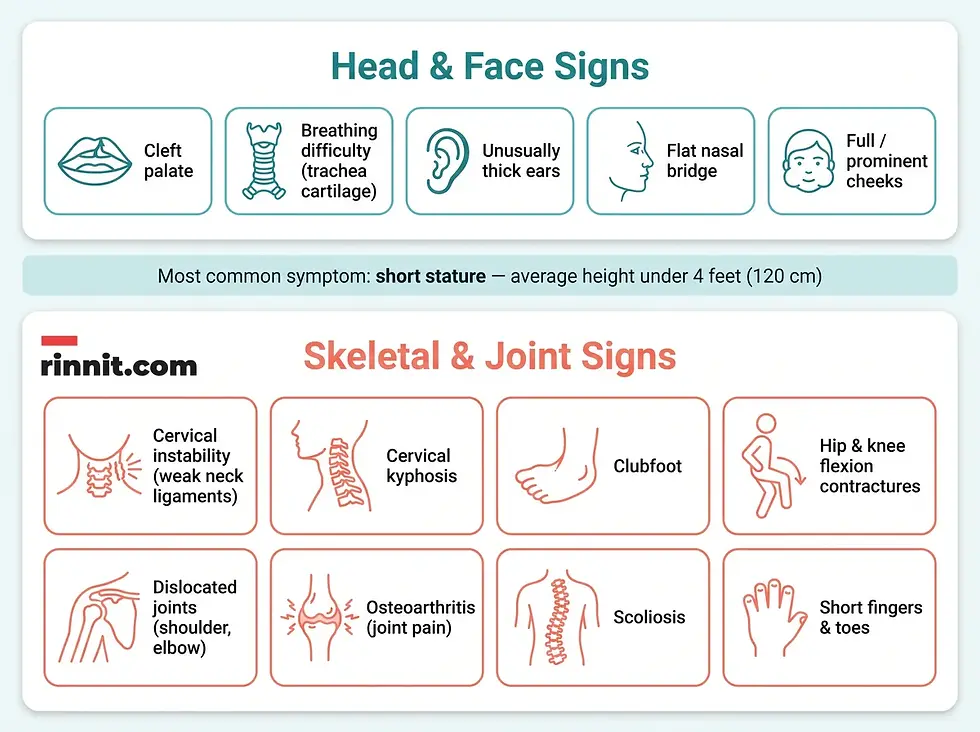
Head and Face Differences
A child with diastrophic dysplasia may have any of the following features around the head and face:
Head and face signs | What it involves |
Cleft palate | An opening in the roof of the mouth |
Difficulty breathing | Caused by cartilage in the trachea (windpipe) |
Unusual ear thickness | Ears with physical differences like unusual thickness |
Flat nasal bridge | The bony area at the top of the nose sits flat |
Prominent cheeks | Full or prominent cheeks |
Skeletal and Joint Differences
The disorder may also affect the skeletal system, including the neck, shoulders, spine, hands, hips, knees, and feet. Possible conditions and symptoms include:
Skeletal sign | What it involves |
Cervical instability | Weak ligaments and connective tissue in the neck |
Cervical kyphosis | An abnormal forward curve in the neck spine |
Clubfoot | Foot twisted inward and downward at birth |
Hip and knee flexion contractures | Joints that cannot fully straighten, causing pain and limiting movement |
Dislocated joints | Joints (such as the shoulder or elbow) that slip out of place |
Osteoarthritis | Joint wear that causes pain |
Scoliosis | An abnormal sideways curve of the spine |
Short fingers and toes | Digits that are shorter than typical |
Because joint problems can cause pain and affect a child’s ability to move around, mobility support and pain management often become part of ongoing care.
What Causes Diastrophic Dysplasia?
DTD happens when the SLC26A2 gene changes [1] [4]. This gene makes a protein that helps the body form cartilage and convert it to bone [1]. When the gene is altered, cartilage and bone do not develop the usual way before birth.
Children may inherit this condition only if both parents are carriers [1]. Carriers themselves stay healthy [1]. But when two carriers have a child together, there is a 25% chance the child will be affected [1]. Healthcare providers call this an autosomal recessive inheritance pattern [1].
Inheritance question | Answer |
Which gene is involved? | SLC26A2 |
What does the gene do? | Makes a protein that forms cartilage and converts it to bone |
Who must carry the change? | Both parents |
Are carriers affected? | No — carriers stay healthy |
Chance of an affected child (two carriers) | 25% |
Inheritance pattern name | Autosomal recessive |
Many cases occur in families with no prior history, because healthy carriers have no symptoms themselves. Only when two carriers have a child together does the condition have a chance of appearing.
How Is Diastrophic Dysplasia Diagnosed?
Typically, an obstetrician diagnoses this condition at birth [1]. To confirm the diagnosis, providers may order imaging tests that look closely at the bones in a baby’s arms and legs [1].
Sometimes, prenatal ultrasounds detect signs of diastrophic dysplasia before the baby is born [1]. When DTD is suspected — prenatally or after delivery — an obstetrician may recommend genetic testing to confirm the diagnosis [1].
Diagnostic step | What it involves |
Birth evaluation | Typically diagnosed at birth by an obstetrician |
X-rays | Imaging to examine the bones in the arms and legs |
CT scans | Detailed cross-sectional imaging of the skeleton |
Prenatal ultrasound | Sometimes detects signs before birth |
Genetic testing | Confirms the SLC26A2 gene change |

How Is Diastrophic Dysplasia Treated?
There is no set treatment for diastrophic dysplasia [1]. Instead, a child’s healthcare team develops treatment plans for specific health issues [1]. Care is individualized because every child’s combination of features is different.
Possible treatments include:
Treatment | Purpose |
Braces | Support the spine and joints |
Medication | Manage pain and inflammation |
Orthodontic treatment | Fix issues with the jaw and teeth |
Physical therapy | Support movement, strength, and joint function |
Occupational therapy | Help with daily activities and fine motor skills |
Surgery | Correct physical differences |
In addition to physical care, research shows that people with diastrophic dysplasia may have anxiety and depression [1] [2]. A child may benefit from mental health support as part of the overall care plan [1] [2].
When to Contact the Care Team
Children with DTD will have regular checkups with their pediatrician and other caregivers. However, caregivers should be contacted if you notice changes in your child — like new symptoms or worsening pain [1] — so the team can act quickly to help.
Outlook and Prognosis
What can you expect if a child has diastrophic dysplasia? The condition is a chronic disease that affects people in different ways [1]. It causes medical challenges, and some babies have serious breathing problems, but most people with it live into adulthood [1].
A child may need surgery while still very young [1]. Surgery and hospital stays can be hard on little ones and their families. Working with a child life specialist may help make these experiences easier [1].
Outlook question | Answer |
Is DTD curable? | No, but each health issue can be treated |
Is it life-threatening? | No |
Does it affect life expectancy? | No |
Does it vary person to person? | Yes — affects people in different ways |
What helps with hospital stays? | A child life specialist |
Can Diastrophic Dysplasia Be Prevented?
There is no way to prevent diastrophic dysplasia [1]. Because it is genetic, prevention efforts focus on understanding family risk before pregnancy.
If someone in your family has this condition, consider talking to your healthcare provider about genetic testing before pregnancy [1]. These tests will show whether you carry the genetic variation that causes the condition. If you do, a genetic counselor will help you understand what the test results mean for your family planning [1].
Prevention question | Answer |
Can DTD be prevented? | No |
What can prospective parents do? | Genetic testing before pregnancy if there is family history |
Who helps interpret results? | A genetic counselor |
Key Takeaways
Diastrophic dysplasia is a rare, inherited condition present at birth that changes how bones and cartilage form. About 1 in 500,000 U.S. babies are affected. The average adult height is under 4 feet, and joint, spine, and facial differences vary widely. It is caused by an SLC26A2 gene change passed on when both parents are carriers. There is no cure and no prevention, but individualized treatment — braces, therapy, medication, and surgery when needed — supports a full, healthy life. Some babies have serious breathing problems, but most people with the condition live into adulthood.
Take the Next Step
If your baby is born with physical differences that may suggest DTD, talk to a pediatric genetics specialist early. Early diagnosis, individualized treatment planning, and supportive care make a meaningful difference — and your care team will be there to help you and your child every step of the way.
Frequently Asked Questions
1. What is diastrophic dysplasia?
Diastrophic dysplasia (DTD) is a rare inherited disorder present at birth that affects how bones and cartilage form during fetal development. People with DTD have short stature, short arms and legs, and may have joint, spine, and facial differences. It affects about 1 in 500,000 U.S. babies, and most people with it live into adulthood.
2. What is the average height of someone with diastrophic dysplasia?
The average height for someone with DTD is less than 4 feet (120 centimeters). Short stature is the most common symptom, and arms and legs are proportionally short as well.
3. What causes diastrophic dysplasia?
DTD happens when the SLC26A2 gene changes. This gene makes a protein that helps the body form cartilage and convert it to bone. When the gene is altered, bones and cartilage do not develop the usual way before birth.
4. How is diastrophic dysplasia inherited?
The condition follows an autosomal recessive pattern. Both parents must be carriers, and carriers stay healthy. When two carriers have a child together, there is a 25% chance the child will be affected.
5. What are the symptoms of diastrophic dysplasia?
The most common symptom is short stature. Other possible signs include clubfoot, short fingers and toes, scoliosis, cervical kyphosis, cervical instability, hip and knee flexion contractures, dislocated joints, osteoarthritis, cleft palate, flat nasal bridge, prominent cheeks, unusual ear thickness, and breathing difficulty from trachea cartilage.
6. How is diastrophic dysplasia diagnosed?
An obstetrician typically diagnoses the condition at birth using X-rays or CT scans to look at the bones in the baby’s arms and legs. Sometimes prenatal ultrasounds detect signs before birth, and genetic testing may be recommended to confirm the diagnosis.
7. Is there a cure for diastrophic dysplasia?
There is no cure and no set treatment. Instead, a healthcare team develops treatment plans for each specific health issue, which may include braces, medication for pain and inflammation, orthodontic treatment, physical and occupational therapy, and surgery.
8. Does diastrophic dysplasia affect life expectancy?
Usually not. Some babies with diastrophic dysplasia have serious breathing problems, but most people with it live into adulthood. It is a chronic condition that affects people in different ways.
9. Can diastrophic dysplasia be prevented?
No. There is no way to prevent DTD. If it runs in the family, prospective parents can consider genetic testing before pregnancy, and a genetic counselor can help explain what the results mean.
10. Can someone with diastrophic dysplasia live a normal life?
Yes, with individualized care. While the condition causes medical challenges and may require surgery at a young age, most people with it live into adulthood. Mental health support may also help, since research shows people with DTD may experience anxiety and depression.
11. When should I contact my child’s care team?
Contact caregivers between regular checkups if you notice changes in your child, such as new symptoms or worsening pain. Acting quickly helps the team address problems early and keep your child comfortable.
Related Reading
Achondroplasia: What It Is, How It Affects Growth, and How It Is Managed explains the most common skeletal dysplasia and how it is managed.
Dwarfism: Symptoms, Causes, Diagnosis & Treatment gives an overview of conditions that cause short stature and their care.
Congenital Scoliosis: What It Is, How It's Treated, and What to Expect explains spine curves present at birth, a concern in skeletal dysplasias.
What Is Cleft Lip and Cleft Palate? Symptoms, Causes, Diagnosis and Treatment covers cleft palate, which often occurs with diastrophic dysplasia.
References
Cleveland Clinic. Diastrophic Dysplasia. Cleveland Clinic. Jul. 22, 2025. https://my.clevelandclinic.org/health/diseases/22478-diastrophic-dysplasia
Fagereng E, Htwe S, McDonald S, et al. Mental health conditions, physical functioning, and health-related quality of life in adults with a skeletal dysplasia: a cross-sectional multinational study. Orphanet J Rare Dis. 2025;20(1):116. doi:10.1186/s13023-025-03610-w. PMID: 40069831.
Härkönen H, Loid P, Mäkitie O. SLC26A2-associated diastrophic dysplasia and rMED—clinical features in affected Finnish children and review of the literature. Genes (Basel). 2021;12(5):714. doi:10.3390/genes12050714. PMID: 34064542.
Paganini C, Carroll RS, Gramegna Tota C, et al. Identification of potential non-invasive biomarkers in diastrophic dysplasia. Bone. 2023;175:116838. doi:10.1016/j.bone.2023.116838. PMID: 37454964.
Medical Disclaimer
This article is for informational purposes only and does not constitute medical advice. Always seek the advice of your physician or other qualified health provider with any questions you may have regarding a medical condition. Never disregard professional medical advice or delay in seeking it because of something you have read here.



Comments