Cold Agglutinin Disease: What It Is, Why It Happens, and How It's Treated

Updated: 2 days ago
Medically reviewed by Dr. Baraa Alnahhal, MD · Last reviewed: October 2026
Quick Answer
Cold agglutinin disease is a rare type of autoimmune hemolytic anemia in which cold temperatures activate the immune system to destroy red blood cells [5] [7]. Symptoms include fatigue, pale skin, bluish fingers in the cold, dark urine and jaundice [7]. Blood tests confirm it. Treatment includes avoiding cold, medications such as rituximab or sutimlimab, and transfusions or plasma exchange if severe [2] [3] [6] [7].

What the research says
According to PubMed, studies of cold agglutinin disease report the following:
CAD is rare and more common in colder climates. In a multinational study of 232 patients at 24 centers in 5 countries, prevalence was fourfold higher in a cold than in a warmer climate (20 vs 5 cases per million), and incidence was 1.9 vs 0.48 cases per million per year. Mean baseline hemoglobin was 9.3 g/dL, and 27% of patients had a hemoglobin below 8 g/dL. In a follow-up of rituximab plus bendamustine, 35 of 45 patients (78%) responded and 24 (53%) had a complete response. (Berentsen et al., Blood, 2020) 1
Blocking complement halted hemolysis in recently transfused patients. In the 26-week single-group CARDINAL study of 24 patients who received sutimlimab, 13 (54%) met the primary endpoint (hemoglobin of 12 g/dL or more, or a rise of 2 g/dL or more, without transfusion). Mean hemoglobin rose by 2.6 g/dL, and 17 patients (71%) did not need a transfusion from week 5 through week 26. (Röth et al., N Engl J Med, 2021) 2
Sutimlimab also beat placebo in patients without recent transfusion. In the randomized phase 3 CADENZA trial of 42 patients (22 on sutimlimab, 20 on placebo), the composite primary endpoint was met by 73% on sutimlimab versus 15% on placebo (odds ratio 15.9; 95% CI 2.9-88.0). (Röth et al., Blood, 2022) 3
Study details are from PubMed abstracts.
What Is Cold Agglutinin Disease?
Cold agglutinin disease (CAD) is a rare blood condition that occurs when your immune system attacks your red blood cells. Your immune system makes proteins called antibodies that destroy harmful germs that enter your body. With CAD, your immune system releases an autoantibody, or "cold agglutinin," that attacks healthy red blood cells [4] [7].
CAD causes you to have too few red blood cells. Having enough red blood cells is essential because these cells carry oxygen throughout your body. The oxygen powers your cells to make the energy your body needs to function.
Cold agglutinin disease is a type of hemolytic anemia. Hemolytic anemia involves not having enough red blood cells because they break down or die faster than your body can replace them [7].
Key Term | What It Means |
Autoimmune hemolytic anemia | A condition in which your immune system attacks and destroys your own red blood cells |
Autoantibody | An antibody mistakenly produced by your immune system that targets your own healthy cells |
Cold agglutinin | The autoantibody in CAD that attacks red blood cells when temperatures drop |
Agglutinate | To clump together. CAD makes red blood cells clump, which marks them for destruction |
Hemolytic anemia | Not having enough red blood cells because they break down faster than the body can replace them |
Macrophages | A part of your immune system that destroys (eats) flagged or damaged cells |
Hemoglobin | An important protein that allows red blood cells to transport oxygen |
Idiopathic | A disease with no known underlying cause or relationship to another condition |
How Does Cold Agglutinin Disease Affect the Body?
Cold agglutinin disease can cause you to experience the symptoms of anemia, a condition involving not having enough red blood cells. Depending on what's causing your anemia, it may be a lifelong condition (chronic) or short-lived. Its impacts on your body can range from mild to severe.
With mild cases of CAD, symptoms may set in so slowly that you may have the condition for several years before receiving a diagnosis [7]. CAD can lead to severe and even life-threatening heart conditions in emergency scenarios [7].
Related to its name ("cold" agglutinin disease), CAD causes its most intense symptoms in cold climates or chilly weather.
How Common Is Cold Agglutinin Disease?
Cold agglutinin disease is rare. Approximately one in a million people get diagnosed each year [7]. In the United States, people living with CAD range from 300 to 3,000 [7].
Cold agglutinin disease is most common in women between the ages of 40 and 80 [7]. Most diagnoses occur in people in their mid to late 60s [7].
Fact | Detail |
Annual diagnosis rate | About 1 in a million people per year |
U.S. prevalence | Roughly 300 to 3,000 people living with CAD |
Most common in | Women between ages 40 and 80 |
Typical age at diagnosis | Mid to late 60s |
What Causes Cold Agglutinin Disease?
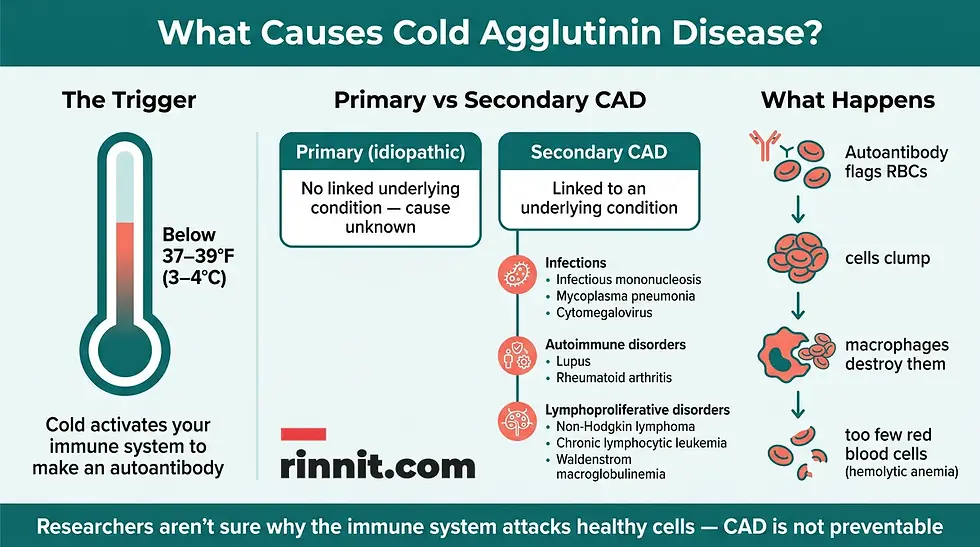
Cold agglutinin disease is a type of autoimmune hemolytic anemia. With CAD, cold conditions activate your immune system to make an autoantibody that flags your red blood cells for destruction. Your red blood cells clump together (agglutinate) in response. The clumped cells make an easy target for another part of your immune system, called macrophages, to destroy [7].
Cold agglutinins bind most strongly at about 3 to 4 degrees Celsius (37 to 39 degrees Fahrenheit), but in CAD they also act at milder temperatures of about 28 to 30 degrees Celsius (82 to 86 degrees Fahrenheit) or higher, which is why cool hands, feet and ears are affected even in mild weather [7].
CAD disrupts the regular timeline your body needs to make healthy red blood cells. Red blood cells typically live for about 120 days [7]. This period allows your bone marrow enough time to make new red blood cells to replace the dying ones.
Researchers aren't sure what causes your immune system to attack healthy cells. It's possible that CAD results from an underlying condition. This is called secondary CAD. When there doesn't seem to be a relationship between CAD and another disease, CAD is called primary, or idiopathic [7].
What Conditions Are Associated With Secondary CAD?
Secondary CAD is associated with infections, autoimmune disorders, and lymphoproliferative disorders (conditions in which certain white blood cells multiply in an abnormal way) [7], including:
Category | Associated Conditions |
Infections | Infectious mononucleosis, mycoplasma pneumonia, cytomegalovirus |
Autoimmune disorders | Lupus, rheumatoid arthritis |
Lymphoproliferative disorders | Non-Hodgkin lymphoma, chronic lymphocytic leukemia, Waldenstrom macroglobulinemia |
What Are the Symptoms of Cold Agglutinin Disease?
The symptoms of CAD are often related to anemia and problems with blood circulation throughout your body.
Symptoms related to anemia and poor circulation include fatigue, weakness, dizziness, sweating, shortness of breath (dyspnea), fast heartbeat (tachycardia), skin that appears pale or drained of blood (pallor), and bluish fingers, toes or ears after spending time in the cold (Raynaud's phenomenon) [7].
You may also experience the symptoms of jaundice. As your red blood cells get destroyed, they release a yellowish substance called bilirubin. Bilirubin build-up leads to jaundice. Symptoms of jaundice include dark brown-colored urine and a yellowish color in your skin and the whites of your eyes [7].
Symptom | What You Might Notice |
Fatigue | Ongoing tiredness |
Weakness | Reduced strength |
Dizziness | Lightheadedness |
Sweating | Excess perspiration |
Shortness of breath (dyspnea) | Trouble catching your breath |
Fast heartbeat (tachycardia) | Heart beating faster than normal |
Pallor | Skin that appears pale or drained of blood |
Raynaud's phenomenon | Bluish fingers, toes or ears after time in the cold |
Dark brown urine | Sign of jaundice from destroyed red blood cells |
Yellowish skin or eyes | Sign of jaundice (bilirubin build-up) |
What Causes the Yellowing (Jaundice)?
As your red blood cells get destroyed, they release a yellowish substance called bilirubin. Bilirubin build-up leads to jaundice, which shows up as a yellowish color in your skin and the whites of your eyes, along with dark brown-colored urine [7].
How Is Cold Agglutinin Disease Diagnosed?
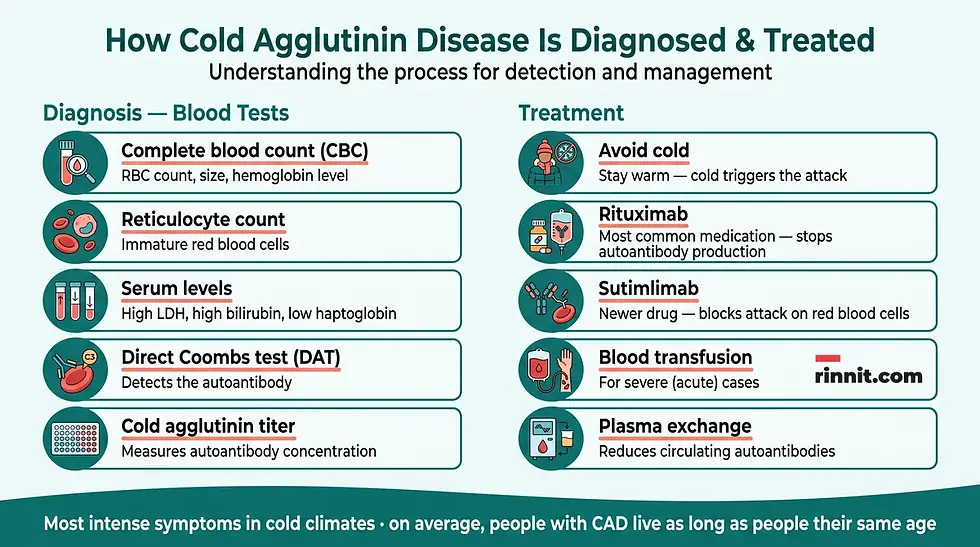
Your healthcare provider will review your medical history and symptoms. They'll run blood tests to determine whether you have hemolytic anemia and the autoantibodies associated with CAD [6] [7].
What Blood Tests Check for Hemolytic Anemia?
Blood tests for diagnosing hemolytic anemia include:
Test | What It Shows |
Complete blood count (CBC) | Detailed information about your red blood cells: how many you have, their size, and your hemoglobin level (the protein that lets red blood cells transport oxygen) |
Reticulocyte count | How many immature red blood cells (reticulocytes) you have; your body may produce higher-than-normal amounts if your immune system destroys mature red blood cells |
Serum levels tests | High levels of lactate dehydrogenase (LDH) and bilirubin, plus low levels of haptoglobin, are signs of hemolytic anemia |
What Tests Confirm Cold Agglutinin Disease?
Your healthcare provider will check for the autoantibody that attacks your red blood cells to determine if your hemolytic anemia is CAD. Tests include:
Test | How It Works |
Direct Coombs test (DAT) | Checks for autoantibodies associated with CAD. Your red blood cells are separated from the other parts of your blood and placed in a controlled environment. A special solution is added. If the cells clump together (agglutinate) with the solution, the test is positive for the autoantibody. |
Cold agglutinin titer test | Checks how concentrated the autoantibodies are, in other words, how many of them you have. A high concentration of autoantibodies is a sign of CAD. |
Once your healthcare provider confirms your diagnosis, they'll explore whether your CAD is related to an underlying condition (secondary cold agglutinin disease).
How Is Cold Agglutinin Disease Treated?
Treatment may involve managing CAD with lifestyle changes and medications, depending on how severe your symptoms are [7]. Emergencies may require blood transfusions.
Treatment | How It Works | Key Details |
Lifestyle: avoid cold | Your healthcare provider will advise you to avoid cold temperatures if you have CAD | Cold is what triggers the autoantibody process |
Rituximab | The most commonly used medication for CAD | Prevents your immune system from making the autoantibodies that attack your red blood cells |
Sutimlimab | A newer medication approved for CAD | Blocks your immune system from attacking the red blood cells |
Blood transfusions | Used when CAD is severe (acute) | Helps stabilize your condition in an emergency |
Plasma exchange (plasmapheresis) | Works by reducing the number of autoantibodies circulating in your blood | Used for severe (acute) cases to stabilize |
Treating the underlying condition | If you have secondary CAD | Your healthcare provider will treat the underlying condition, which may even cure the CAD |
How Long Can You Live With Cold Agglutinin Disease?
People diagnosed with CAD, on average, live as long as people their same age without CAD [7]. According to a recent study, on average, people diagnosed at 68 are alive in their 80s [7].
Can Cold Agglutinin Disease Be Prevented?
CAD isn't a preventable condition.
What Questions Should I Ask My Doctor?
If you've been diagnosed with CAD, helpful questions to ask your provider include: Is my CAD related to an underlying condition? What symptoms will let me know if my condition is improving or worsening? Will I need medications for my condition? What's the ideal climate for a person living with CAD? What temperature ranges should I avoid to keep my symptoms in check?
Bottom Line
Cold agglutinin disease (CAD) is a rare autoimmune hemolytic anemia in which cold temperatures activate your immune system to destroy your red blood cells. An autoantibody, the "cold agglutinin," flags healthy red blood cells, which clump together and get destroyed by macrophages [7]. It affects about 1 in a million people each year, most often women in their 40s to 80s, with most diagnoses in the mid to late 60s [7]. Symptoms include fatigue, weakness, dizziness, sweating, shortness of breath, fast heartbeat, pale skin, bluish fingers or toes in the cold, and jaundice signs like dark urine and yellowish skin or eyes [7].
Diagnosis relies on blood tests: a CBC, reticulocyte count, serum levels, a direct Coombs test, and a cold agglutinin titer test [6] [7]. While CAD can't be prevented, it is very manageable: avoid cold temperatures, take prescribed medication such as rituximab or sutimlimab, and in severe cases receive blood transfusions or plasma exchange [2] [3] [6] [7]. If your CAD is secondary, treating the underlying condition may even cure it [7]. The good news: on average, people with CAD live as long as people their same age without it [7]. If cold weather triggers unusual tiredness, breathlessness, or color changes in your hands and feet, talk to a healthcare provider. Testing is straightforward, and treatment works.
Frequently Asked Questions
What is cold agglutinin disease (CAD)?
CAD is a rare blood condition that occurs when your immune system attacks your red blood cells. Your immune system releases an autoantibody, or "cold agglutinin," that attacks healthy red blood cells.
What type of anemia is cold agglutinin disease?
Cold agglutinin disease is a type of autoimmune hemolytic anemia. Hemolytic anemia means not having enough red blood cells because they break down or die faster than your body can replace them.
What does "autoimmune" mean in this context?
Normally, your immune system makes antibodies that destroy harmful germs. In autoimmune disease, the immune system mistakenly attacks your own healthy cells. In CAD, it attacks your red blood cells.
What is an autoantibody?
An antibody mistakenly produced by your immune system that targets your own healthy cells. In CAD, the autoantibody is called a "cold agglutinin."
Why is it called "cold" agglutinin disease?
Because cold conditions activate your immune system to make the autoantibody, and CAD causes its most intense symptoms in cold climates or chilly weather.
How does cold destroy red blood cells?
Cold activates your immune system to make an autoantibody that flags your red blood cells for destruction. The cells clump together (agglutinate), and the clumped cells become an easy target for macrophages, another part of your immune system, to destroy.
What temperature triggers cold agglutinin disease?
Cold agglutinins bind most strongly at about 3 to 4 degrees Celsius (37 to 39 degrees Fahrenheit), but in CAD they also act at milder temperatures of about 28 to 30 degrees Celsius (82 to 86 degrees Fahrenheit) or higher, which is why cool hands, feet and ears are affected even in mild weather.
What happens to red blood cells in CAD?
Red blood cells in CAD are destroyed faster than your body can replace them. Red blood cells typically live about 120 days, which normally gives your bone marrow time to make new ones. CAD disrupts that timeline.
Why do I have too few red blood cells with CAD?
CAD causes you to have too few red blood cells, which are essential because they carry oxygen throughout your body. The oxygen powers your cells to make the energy your body needs to function.
How common is cold agglutinin disease?
Cold agglutinin disease is rare. Approximately one in a million people get diagnosed each year. In the United States, people living with CAD range from 300 to 3,000.
Who does cold agglutinin disease affect most?
Cold agglutinin disease is most common in women between the ages of 40 and 80. Most diagnoses occur in people in their mid to late 60s.
What are the symptoms of cold agglutinin disease?
Fatigue, weakness, dizziness, sweating, shortness of breath (dyspnea), fast heartbeat (tachycardia), pale skin (pallor), and bluish fingers, toes or ears after time in the cold (Raynaud's phenomenon). You may also see jaundice symptoms: dark brown urine and yellowish skin or eyes.
Why do I get bluish fingers and toes in the cold?
Bluish discoloration in the cold is Raynaud's phenomenon: bluish fingers, toes or ears after spending time in the cold. It's one of the circulation-related symptoms of CAD.
What is dyspnea?
Dyspnea is the medical term for shortness of breath.
What is tachycardia?
Tachycardia is the medical term for a fast heartbeat.
What is pallor?
Pallor means skin that appears pale or drained of blood.
What is Raynaud's phenomenon?
A condition causing bluish fingers, toes or ears after spending time in the cold.
Can CAD cause jaundice?
Yes. As your red blood cells get destroyed, they release a yellowish substance called bilirubin. Bilirubin build-up leads to jaundice.
What are the signs of jaundice?
Dark brown-colored urine and a yellowish color in your skin and the whites of your eyes.
What is bilirubin?
A yellowish substance released when red blood cells are destroyed. Build-up causes jaundice.
Is cold agglutinin disease inherited or caused by something?
Researchers aren't sure what causes the immune system to attack healthy cells. It's possible CAD results from an underlying condition, called secondary CAD. When there's no relationship to another disease, it's called primary, or idiopathic, CAD.
What is secondary cold agglutinin disease?
CAD that results from an underlying condition, such as an infection, autoimmune disorder, or lymphoproliferative disorder.
What is primary (idiopathic) cold agglutinin disease?
CAD that occurs without a relationship to another disease. "Idiopathic" means the cause isn't linked to another condition.
What conditions are associated with secondary CAD?
Infections (infectious mononucleosis, mycoplasma pneumonia, cytomegalovirus), autoimmune disorders (lupus, rheumatoid arthritis), and lymphoproliferative disorders (non-Hodgkin lymphoma, chronic lymphocytic leukemia, Waldenstrom macroglobulinemia).
What are lymphoproliferative disorders?
Conditions in which certain white blood cells multiply abnormally, such as non-Hodgkin lymphoma, chronic lymphocytic leukemia, and Waldenstrom macroglobulinemia, all associated with secondary CAD.
How is cold agglutinin disease diagnosed?
Your provider reviews your medical history and symptoms, then runs blood tests to determine whether you have hemolytic anemia and the autoantibodies associated with CAD.
What is a complete blood count (CBC)?
A test that provides detailed information about your red blood cells: how many you have, their size, and your hemoglobin level, an important protein that allows red blood cells to transport oxygen.
What is a reticulocyte count?
A test that measures how many immature red blood cells (reticulocytes) you have. Your body may produce higher-than-normal amounts if your immune system destroys mature red blood cells.
What do serum levels tests look for?
High levels of lactate dehydrogenase (LDH) and bilirubin, and low levels of haptoglobin, are signs of hemolytic anemia.
What is a direct Coombs test (DAT)?
A test that checks for autoantibodies associated with CAD. Your red blood cells are separated from other parts of your blood and placed in a controlled environment with a special solution added. If the cells clump together (agglutinate) with the solution, the test is positive for the autoantibody.
What is a cold agglutinin titer test?
A test that checks how concentrated the autoantibodies are, or how many of them you have. A high concentration of autoantibodies is a sign of CAD.
How is cold agglutinin disease treated?
Treatment depends on symptom severity and may involve lifestyle changes (avoiding cold), medications, and, for emergencies, blood transfusions.
What medications treat cold agglutinin disease?
The most commonly used medication is rituximab, which prevents your immune system from making the autoantibodies that attack your red blood cells. A newer medication, sutimlimab, is approved for CAD; it blocks your immune system from attacking red blood cells.
What does rituximab do?
Rituximab prevents your immune system from making the autoantibodies that attack your red blood cells. It's the most commonly used medication for CAD.
What does sutimlimab do?
Sutimlimab works by blocking your immune system from attacking the red blood cells. It's a newer medication approved for CAD. Because it raises the risk of serious infections, vaccines against certain bacteria are given at least 2 weeks before starting it when possible.
What happens in severe (acute) cold agglutinin disease?
Your healthcare provider may perform a blood transfusion or plasma exchange to stabilize your condition. Plasma exchange reduces the number of autoantibodies circulating in your blood.
What is plasma exchange?
A procedure that works by reducing the number of autoantibodies circulating in your blood, used to stabilize severe (acute) CAD.
Can my CAD be cured?
If you have secondary CAD, your healthcare provider will treat the underlying condition, which may be able to cure your CAD.
What lifestyle change helps the most?
Avoiding cold temperatures. Your healthcare provider will advise you to stay warm, since cold triggers the autoantibody process.
Can cold agglutinin disease be prevented?
No. CAD isn't a preventable condition.
How long can you live with cold agglutinin disease?
People diagnosed with CAD, on average, live as long as people their same age without CAD. According to a recent study, on average, people diagnosed at 68 are alive in their 80s.
Can I have CAD for years without knowing?
Yes. With mild cases, symptoms may set in so slowly that you may have the condition for several years before receiving a diagnosis.
Can CAD cause heart problems?
Yes. CAD can lead to severe and even life-threatening heart conditions in emergency scenarios.
What questions should I ask my doctor about CAD?
Is my CAD related to an underlying condition? What symptoms will let me know if my condition is improving or worsening? Will I need medications? What's the ideal climate for a person living with CAD? What temperature ranges should I avoid?
When should I seek emergency care?
Seek emergency care right away for severe symptoms such as severe shortness of breath, chest pain or pressure, or a racing heart with dizziness. CAD can cause severe and life-threatening heart conditions in emergencies, and acute cases may need a blood transfusion.
Related Reading
What Is Autoimmune Hemolytic Anemia? Symptoms, Causes, and Treatment explains the broader group of anemias that includes this disease.
Hemolytic Anemia: Understanding Rapid Red Blood Cell Loss describes why red blood cells break down too early.
Coombs Test: Direct vs Indirect, Why It's Done and What Results Mean explains the blood test that helps diagnose immune-related anemia.
What Is Raynaud’s Disease? A Plain-Language Guide to the Cold-Fingers Condition, Its Causes, and Its Treatment covers another cause of cold, color-changing fingers and toes.
References
Berentsen S, et al. Cold agglutinin disease revisited: a multinational, observational study of 232 patients. Blood. 2020;136(4):480-488. PMID 32374875. https://doi.org/10.1182/blood.2020005674
Röth A, et al. Sutimlimab in Cold Agglutinin Disease. N Engl J Med. 2021;384(14):1323-1334. PMID 33826820. https://doi.org/10.1056/NEJMoa2027760
Röth A, et al. Sutimlimab in patients with cold agglutinin disease: results of the randomized placebo-controlled phase 3 CADENZA trial. Blood. 2022;140(9):980-991. PMID 35687757. https://doi.org/10.1182/blood.2021014955
Berentsen S, et al. Cold agglutinin disease: where do we stand, and where are we going? Clin Adv Hematol Oncol. 2020;18(1):35-44. PMID 32511221. https://pubmed.ncbi.nlm.nih.gov/32511221/
Berentsen S, et al. Cold agglutinin disease: current challenges and future prospects. J Blood Med. 2019;10:93-103. PMID 31114413. https://doi.org/10.2147/JBM.S177621
Jäger U, et al. Diagnosis and treatment of autoimmune hemolytic anemia in adults: Recommendations from the First International Consensus Meeting. Blood Rev. 2020;41:100648. PMID 31839434. https://doi.org/10.1016/j.blre.2019.100648
Cleveland Clinic. Cold Agglutinin Disease: What It Is, Symptoms & Treatment. Cleveland Clinic. Last updated June 3, 2022. https://my.clevelandclinic.org/health/diseases/23178-cold-agglutinin-disease
Medical disclaimer
This article is for general informational purposes only and is not a substitute for professional medical advice, diagnosis, or treatment. Always seek the advice of your physician or other qualified health provider with any questions you may have regarding a medical condition. Never disregard professional medical advice or delay seeking it because of something you have read here. Cold agglutinin disease can cause severe and life-threatening heart conditions in emergency scenarios. If you experience severe shortness of breath, chest pain or pressure, or a rapidly racing heart with dizziness, seek emergency medical care immediately.



Comments