CGRP Inhibitors: How These Migraine Medicines Work, the Types, and What to Expect

Updated: 6 days ago
Written and medically reviewed by Dr. Baraa Alnahhal, MD · Last reviewed: October 31, 2026 · How we review
Quick Answer
CGRP inhibitors are prescription medications that treat migraine and, in some cases, prevent it by destroying or blocking extra calcitonin gene-related peptide (CGRP), a protein that makes migraine pain stronger and longer. They come as monthly or quarterly injections and infusions, daily pills, dissolving tablets and a nasal spray. It can take one to two months to notice improvement. [1]
What the research says
CGRP-targeting medicines rank best for migraine prevention. A review of 74 trials with 32,990 adults found high-certainty evidence that CGRP monoclonal antibodies and gepants raise the share of people who cut their monthly migraine days by 50% or more, and moderate-to-high-certainty evidence that they do not increase side effects that lead people to stop treatment. Antibodies had the best overall safety-and-benefit profile, followed closely by gepants. (Lampl et al., J Headache Pain, 2023)
A gepant can stop a migraine attack in progress. In a trial of 1,186 adults, 19.6% were pain-free 2 hours after a single dose of rimegepant, compared with 12.0% on placebo; 37.6% versus 25.2% were free of their most bothersome symptom. (Lipton et al., N Engl J Med, 2019)
Serious side effects were no more common than with placebo. Across 19 trials and 14,584 patients using CGRP antibodies or gepants for prevention, there was no significant difference in serious adverse events compared with placebo. (Messina et al., Cephalalgia, 2023)
Key takeaways
CGRP inhibitors are the first medicines designed to directly treat and prevent migraine.
People with migraine make extra CGRP, which turns up pain signals in the brain.
There are two types: monoclonal antibodies (injections or an infusion) and gepants (pills, a dissolving tablet or a nasal spray).
Most side effects are mild. Rare but serious problems include liver issues and vision problems.
Expect one to two months before you notice a difference.
What are CGRP inhibitors?
CGRP inhibitors are prescription medications that treat migraine headaches. Your healthcare provider may suggest one if you have chronic migraine.
They can also help people with occasional migraines, known as episodic migraine.
The name explains the job. "Inhibit" means to stop or slow down. These medicines stop or slow down CGRP.
How do CGRP inhibitors work?
CGRP inhibitors work by destroying or blocking the extra CGRP that makes migraine pain worse.
CGRP stands for calcitonin gene-related peptide. Normally, it is a helpful protein. It helps control your blood pressure by widening your blood vessels, a process called vasodilation.
If you have migraine, your body makes more CGRP than it needs. That extra CGRP switches on nerves in your brain that make pain signals stronger. It can also make the pain last longer.
CGRP inhibitors step in before this can happen.

What are the types of CGRP inhibitors?
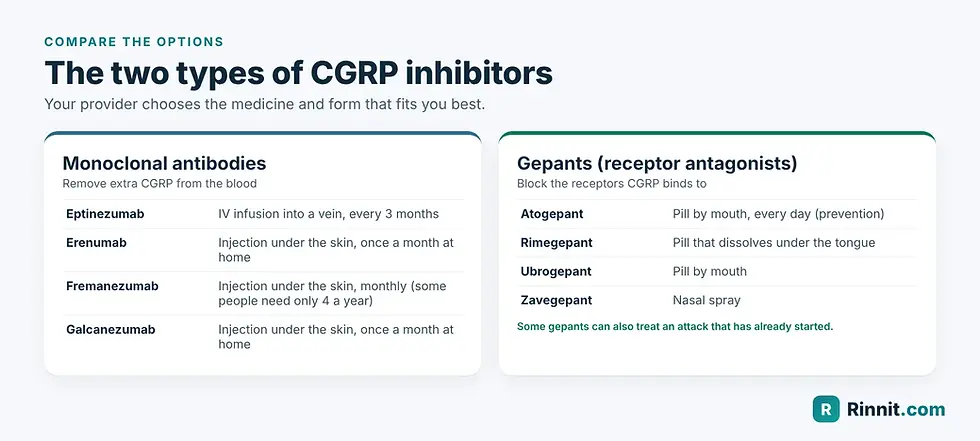
The two types of CGRP inhibitors are CGRP monoclonal antibodies and CGRP receptor antagonists, also called gepants.
CGRP monoclonal antibodies
Monoclonal antibodies are proteins made in a lab. They act like the antibodies your immune system uses to fight germs.
Instead of fighting germs, these antibodies target extra CGRP in your blood. Think of them as security robots that find and remove it.
Medication | How you take it | How often |
Eptinezumab | IV infusion into a vein, given by your provider | Every three months |
Erenumab | Injection under the skin, at home | Once a month |
Fremanezumab | Injection under the skin, at home | Once a month (some people need only four injections a year) |
Galcanezumab | Injection under the skin, at home | Once a month |
Your provider will teach you how to give yourself the injections at home.
CGRP receptor antagonists (gepants)
Gepants block the receptors in your brain that CGRP attaches to.
Picture a game of musical chairs. The medicine takes the seats CGRP would normally fill, which are the receptors on your nerves. With no free seat, CGRP cannot attach and trigger pain signals.
Medication | Form |
Atogepant | Pill you take by mouth every day |
Rimegepant | Pill that dissolves under your tongue |
Ubrogepant | Pill you take by mouth |
Zavegepant | Nasal spray |
Do CGRP inhibitors prevent migraines or treat an attack?
CGRP inhibitors can do both, depending on the medicine.
Gepants may also manage migraine symptoms after an attack has started. Your healthcare provider will tell you if it is safe to take one for that purpose.
Atogepant is a daily pill for preventing migraines. Rimegepant treats attacks and, taken every other day, is also approved to prevent episodic migraine.
CGRP inhibitors at a glance
Monoclonal antibodies | Gepants | |
How they work | Attach to CGRP, or (erenumab) block its receptor | Block the receptors CGRP binds to |
Forms | Injection under the skin or IV infusion | Pills, dissolving tablet, nasal spray |
Schedule | Monthly or every three months | Varies; atogepant is taken daily |
Can treat an attack in progress? | — | Some can, if your provider says it is safe |
What are the benefits of CGRP inhibitors?
CGRP inhibitors are the first medications designed to directly treat and prevent migraine.
Taking a CGRP inhibitor can:
Reduce how often you get migraines
Make the migraines you do get shorter and milder
Prevent some migraines completely
You may still have some migraines. But the ones you get should be milder and interrupt your day less. If your attacks start with visual warning signs, see our guide to migraine with aura.
What are the side effects of CGRP inhibitors?
The side effects of CGRP inhibitors are usually mild and manageable, but rare serious problems can happen.
Common side effects | Rare but serious complications |
Back pain | High liver enzymes (transaminitis) |
Constipation or diarrhea | Liver damage |
Dry mouth | Vision problems |
Tingling, numbness or "pins and needles" (paresthesia) | |
Joint pain | |
Nausea and vomiting | |
Non-migraine headaches | |
Pain or a reaction where the injection or infusion was given |
Call your healthcare provider if you have any side effects. Get emergency help for signs of a serious allergic reaction, such as swelling of the face, lips or throat, or trouble breathing. Erenumab can also raise blood pressure and cause severe constipation, so report these.

How long do CGRP inhibitors take to work?
CGRP inhibitors can take a month or two before you start feeling better.
How soon you notice a change depends on:
Which CGRP inhibitor you take
How often you get migraines
How severe your migraine symptoms are
Your overall health
Your healthcare provider will explain which medicine they think is right for you and when to expect changes.
When should you see your healthcare provider while taking a CGRP inhibitor?
You should see your healthcare provider for regular checkups after you start a CGRP inhibitor, so they can confirm the medicine is helping.
At each visit, tell your provider:
Whether you are having fewer migraines or milder symptoms
Any side effects you have noticed
Any questions about giving yourself injections at home
If you take eptinezumab, you will also visit your provider for your infusions.
Not every headache is a migraine. If your head pain feels different, read about tension headaches and cluster headaches.
Conclusion
Migraine can bring your whole day to a stop, and chronic migraine makes that even harder. CGRP inhibitors target the protein behind much of that pain. They come in several forms, from monthly injections to daily pills and a nasal spray.
Most people can expect fewer, shorter and milder attacks, with improvement starting in one to two months. Side effects are usually mild, though liver and vision problems are rare possibilities worth discussing.
Next step: Save or print this guide and bring it to your next appointment. Ask your provider which CGRP inhibitor fits your migraine pattern, how you would take it, and what side effects to watch for. To understand the full picture, read our guide to the four phases of a migraine and how to recover from a migraine hangover.
FAQ
What does CGRP stand for?
CGRP stands for calcitonin gene-related peptide. It is a protein that normally helps control blood pressure by widening blood vessels. In migraine, the body makes extra CGRP, which strengthens pain signals.
Are CGRP inhibitors only for chronic migraine?
No. Healthcare providers may suggest them for chronic migraine, but they can also treat occasional (episodic) migraines.
Are CGRP inhibitors injections or pills?
Both. Monoclonal antibodies are given as injections under the skin or as an IV infusion. Gepants come as pills, a tablet that dissolves under the tongue, or a nasal spray.
How often do you take a CGRP inhibitor injection?
Erenumab, fremanezumab and galcanezumab are usually injected at home once a month; some people on fremanezumab need only four injections a year. Eptinezumab is an IV infusion given every three months.
Can a CGRP inhibitor stop a migraine that has already started?
Some gepants may manage migraine symptoms after an attack begins. Your healthcare provider will tell you whether it is safe for you to use one this way.
Will I still get migraines on a CGRP inhibitor?
You might. The goal is fewer migraines, and the ones you do get should be shorter, milder and less disruptive.
What are the side effects of CGRP inhibitors?
Most side effects are mild, such as soreness where the shot is given, constipation or nausea. Rare but serious problems include liver and vision problems, and you should get emergency help for signs of a severe allergic reaction.
How long do CGRP inhibitors take to work?
It can take one to two months before you notice fewer or milder migraines. Keep track of your headaches so you and your provider can see if the medicine is helping.
What are gepants?
Gepants are CGRP inhibitors that come as pills, dissolving tablets or a nasal spray. Some treat a migraine attack, and some are used to prevent migraines.
Can I take a CGRP inhibitor with my other migraine medicines?
Many people use a CGRP inhibitor alongside other migraine treatments. Ask your provider which medicines are safe to combine for you.
Related Reading
Botox for Migraines: How It Works, Injection Sites and Results explains how Botox helps prevent chronic migraine.
References
Cleveland Clinic. CGRP Inhibitors. Cleveland Clinic Health Library. Last updated January 27, 2025. https://my.clevelandclinic.org/health/treatments/cgrp-inhibitors
Lampl C, MaassenVanDenBrink A, Deligianni CI, et al. The comparative effectiveness of migraine preventive drugs: a systematic review and network meta-analysis. J Headache Pain. 2023;24(1):56. PMID 37208596. https://doi.org/10.1186/s10194-023-01594-1
Lipton RB, Croop R, Stock EG, et al. Rimegepant, an Oral Calcitonin Gene-Related Peptide Receptor Antagonist, for Migraine. N Engl J Med. 2019;381(2):142-149. PMID 31291516. https://doi.org/10.1056/NEJMoa1811090
Messina R, Huessler EM, Puledda F, et al. Safety and tolerability of monoclonal antibodies targeting the CGRP pathway and gepants in migraine prevention: A systematic review and network meta-analysis. Cephalalgia. 2023;43(3):3331024231152169. PMID 36786548. https://doi.org/10.1177/03331024231152169
Rashid A, Patel P, Manghi A. Calcitonin Gene-Related Peptide Receptor. StatPearls (NCBI Bookshelf). Last updated September 14, 2026. https://www.ncbi.nlm.nih.gov/books/NBK560648/
Medical disclaimer
This article is for general education and does not replace advice from your healthcare provider. Do not start, stop or change any medication without talking to your provider.



Comments