Botox for Migraines: How It Works, Injection Sites and Results

Updated: 2 days ago
Written and medically reviewed by Dr. Baraa Alnahhal, MD · Last reviewed: November 2026 · How we review
Quick Answer
Botox for migraines uses onabotulinumtoxinA, a botulinum toxin that's FDA-approved to prevent chronic migraines. It may be recommended if you have 15 or more headache days a month. A provider gives 31 small injections in the head, neck and shoulders every 12 weeks. Effects begin in one to two weeks and last 10 to 12 weeks.
What the research says
Botox reduced headache days in chronic migraine: in pooled PREEMPT trials of 1,384 adults with chronic migraine, headache days fell by 8.4 per month with Botox versus 6.6 with placebo at 24 weeks, and only 3.8% stopped because of side effects (Dodick DW et al., Headache, 2010) [2]
It helps chronic, not episodic, migraine: a meta-analysis found botulinum toxin A cut about 2.3 headaches per month versus placebo in 1,508 people with chronic migraine, but did not help episodic migraine in 1,838 people (Jackson JL et al., JAMA, 2012) [3]
Key takeaways
Botox is FDA-approved to prevent chronic migraines.
Treatment is 31 injections into seven head, neck and shoulder areas.
Injections are repeated every 12 weeks.
Effects start in one to two weeks.
Providers usually reassess after three rounds.
What is Botox for migraines?
Botox is best known as a cosmetic treatment, but it's also used to prevent chronic migraine. It may lower how often migraines happen, how severe they are and how long they last. It can be combined with other migraine medicines. Sources: [1]
How it works

Botox prevents migraines rather than treating one in progress.
Botox travels along nerves toward your brainstem and blocks the release of chemicals that trigger pain. This stops pain signals before they reach your brain. Sources: [1]
Injection sites
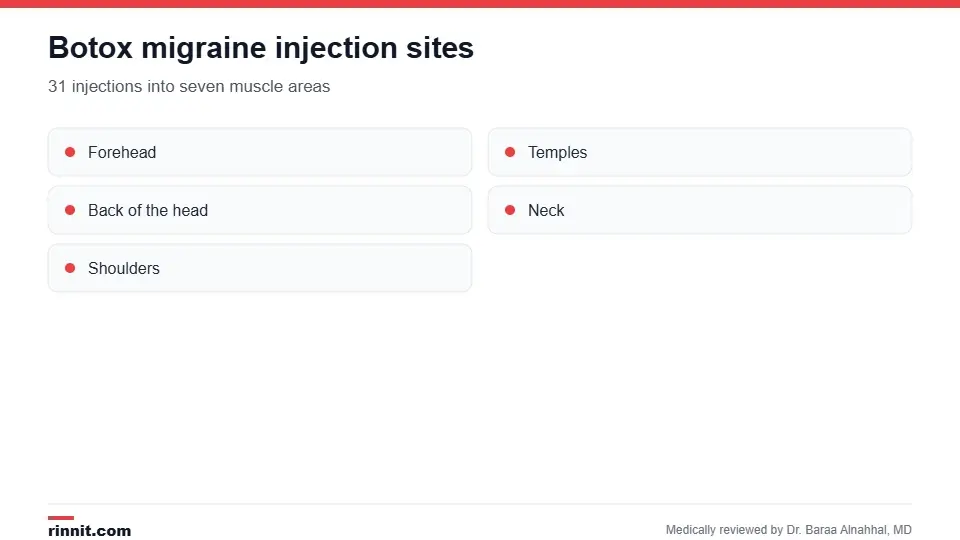
Most people feel only a quick pinch or sting.
Forehead.
Temples.
Back of the head.
Neck.
Shoulders. Sources: [1]
How to prepare
Review the risks and benefits with your provider and sign a consent form.
Tell your provider about all medicines and supplements, such as muscle relaxants.
Wear comfortable clothing that lets your provider reach your neck and shoulders.
Skip makeup.
Have your migraine pain medicine ready and plan a few hours of quiet time afterward. Sources: [1]
What happens during treatment
Your provider cleans your skin with alcohol.
You get 31 injections with a very small needle.
No anesthesia is needed; most people feel a quick pinch or sting.
The visit takes about 15 to 20 minutes, and you can drive yourself home. Sources: [1]
Aftercare
Don't lie down for four hours after treatment.
Avoid hair dye or chemical treatments for 24 hours before and after.
For 24 hours, avoid exercise, sweating and rubbing or massaging your head, neck or face.
Keep taking your regular migraine medicine unless told otherwise. Sources: [1]
Side effects
Side effect | Notes |
Flu-like symptoms | Muscle aches, fever, tiredness |
Headache | Usually short-lived |
Injection site pain or bruising | Mild |
Neck pain and stiffness | Usually resolves quickly |
Appearance changes | Smoother wrinkles or a raised eyebrow arch, temporary |
Botox isn't approved during pregnancy or breastfeeding. Get cosmetic Botox only with your provider's approval. Sources: [1, 2]
Results
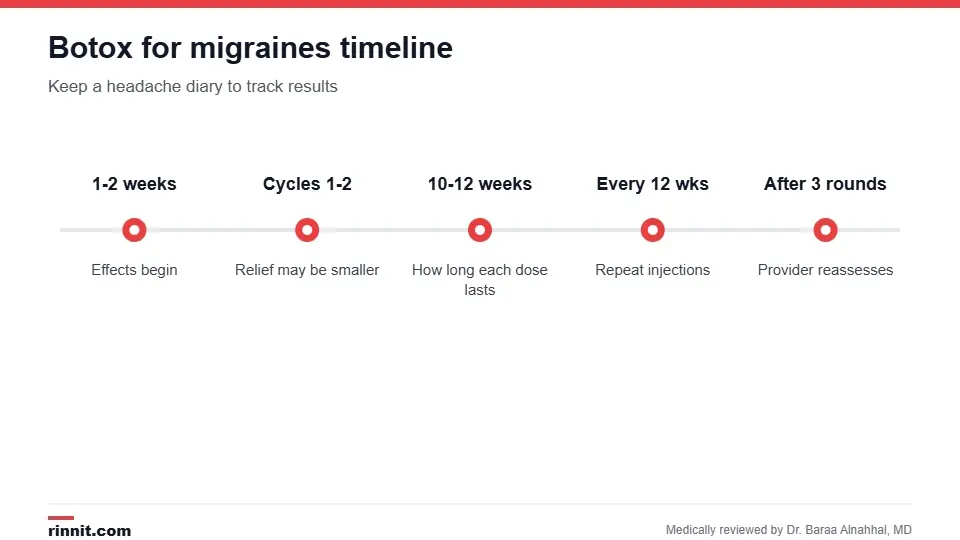
A headache diary helps track your progress.
Keep a headache diary to track changes. Treatment may continue for a few years and may be spaced out or stopped if your symptoms improve. Other preventive options include CGRP inhibitors. Sources: [1, 3]
When to call your provider
A bad headache or symptoms that don't improve.
Droopy eyelids or muscle weakness.
Severe pain at the injection site.
Signs of an allergic reaction, such as rash or itching.
Trouble breathing or swallowing.
Double or blurred vision. Sources: [1]
Conclusion
Botox is a proven option for preventing chronic migraine when you have frequent headache days. Giving it a few rounds and tracking your headaches helps you and your provider see how well it works.
Keep learning: read about chronic migraine and migraine treatment.
Frequently asked questions
Is Botox FDA-approved for migraines?
Yes, for preventing chronic migraines.
Who can get Botox for migraines?
People with 15 or more headache days a month may be candidates.
How many injections are given?
31 injections into seven muscle areas.
How often do I need Botox for migraines?
Every 12 weeks.
How long does a session take?
About 15 to 20 minutes.
Does it hurt?
Most people feel a quick pinch or sting.
How soon does Botox work for migraines?
Effects begin in one to two weeks.
How long does it last?
About 10 to 12 weeks.
Does Botox help episodic migraine?
Studies show it helps chronic migraine, not episodic migraine.
Can I drive after treatment?
Yes.
Related Reading
What Is Chronic Migraine? Symptoms, Causes, Triggers, and Treatment the condition Botox treats.
Migraine Headaches: What Causes Them and How to Treat Them an overview of migraine care.
Botox Injections: Uses, Results, Side Effects and Aftercare all the uses of Botox.
CGRP Inhibitors: How These Migraine Medicines Work, the Types, and What to Expect another migraine preventive.
Medication-Overuse Headache: When Your Headache Medicine Becomes the Problem, and How to Break the Cycle headaches from overusing pain medicine.
References
Cleveland Clinic. Botox for Migraines: How It Works, Side Effects & Injection Sites. Cleveland Clinic. Last updated October 29, 2025. https://my.clevelandclinic.org/health/treatments/botox-for-migraines
Dodick DW, Turkel CC, DeGryse RE, et al. OnabotulinumtoxinA for treatment of chronic migraine: pooled results from the double-blind, randomized, placebo-controlled phases of the PREEMPT clinical program. Headache. 2010;50(6):921-936. PMID 20487038. https://doi.org/10.1111/j.1526-4610.2010.01678.x
Jackson JL, Kuriyama A, Hayashino Y. Botulinum toxin A for prophylactic treatment of migraine and tension headaches in adults: a meta-analysis. JAMA. 2012;307(16):1736-1745. PMID 22535858. https://doi.org/10.1001/jama.2012.505
Medical disclaimer
This article is for general education only and does not replace advice from a qualified healthcare professional. Talk to your doctor about your own diagnosis and treatment, and seek emergency care right away for severe or sudden symptoms.



Comments