Cervical Check: What Dilation, Effacement, and Station Mean in Labor

Updated: 3 days ago
Medically reviewed by Dr. Baraa Alnahhal, MD · Last reviewed: October 2026
Quick Answer
A cervical check is a manual exam in which a provider inserts gloved fingers into the vagina to assess the cervix's dilation, effacement and the baby's station. Some providers offer checks from around 38 weeks of pregnancy, while others wait until labor. They help monitor progress but do not predict labor length, and you can decline them.
What the research says
More vaginal examinations in labor were linked to more fever and infection. In a retrospective cohort of 22,183 women who delivered vaginally at term, having 5 or more examinations was independently associated with intrapartum febrile morbidity (intrapartum fever and chorioamnionitis). Compared with up to 4 examinations, the adjusted odds ratio was 1.83 (95% CI 1.29 to 2.61) for 5 to 6 examinations and 3.47 (95% CI 2.44 to 4.92) for 9 or more. This is an observational study, so it shows association rather than proof of cause (PubMed: Gluck et al., BMC Pregnancy Childbirth, 2020) [2].
Glove type may matter less than expected. A randomized trial of 163 women compared sterile with clean (non-sterile) gloves for cervical checks in labor and found no significant difference in chorioamnionitis (5.4% vs 4.4%; P = 1.0). The trial stopped early because infection rates were lower than expected, and the authors suggested that labor duration may be more closely associated with infection than the number of examinations (PubMed: Morshedi et al., Am J Obstet Gynecol MFM, 2023) [3].
The Bishop score is useful but imperfect. A meta-analysis of 10 observational studies (1,612 patients) compared transvaginal ultrasound with the Bishop score for predicting successful labor induction. Ultrasound had 2.17 times higher odds of predicting success (95% CI 0.95 to 4.97), which was not statistically significant, and heterogeneity was high (PubMed: Namutosi et al., J Matern Fetal Neonatal Med, 2026) [4].
What is a cervical check during labor?
A cervical check, clinically referred to as a digital vaginal exam, is a standard physical assessment used to monitor the changes a cervix undergoes in preparation for childbirth. During this exam, a healthcare provider evaluates several key physical markers that indicate how labor is advancing. This information helps the medical team determine if labor is progressing normally or if specific interventions, such as labor induction, are warranted.
The examination focuses on five primary measurements that describe the state of the cervix and the baby's location. Dilation measures how much the cervix has opened, with a target of 10 centimeters for vaginal delivery. Effacement refers to the thinning and shortening of the cervix, expressed as a percentage. Additionally, providers assess the cervix's consistency (softness), its position (forward or backward), and the fetal station, which identifies the location of the baby's head relative to the mother's pelvis.
Assessment Marker | Description | Clinical Goal for Delivery |
Dilation | The opening of the cervix measured in centimeters. | 10 centimeters |
Effacement | The thinning and shortening of the cervix. | 100% effaced |
Consistency | The firmness or flexibility of the cervical tissue. | Soft and flexible |
Position | The orientation of the cervix in the birth canal. | Anterior (forward-facing) |
Fetal Station | The position of the baby's head in the pelvis. | Progression through birth canal |
When and how often are cervical checks done in labor?
The timing for the first cervical check varies depending on the provider and the specific circumstances of the pregnancy. Some providers may offer a check during prenatal visits starting around the 38th week, while others wait until the patient is officially in labor. Specific situations, such as a history of rapid deliveries or the need for a labor induction, may prompt earlier or more frequent examinations to calculate a Bishop score, which helps determine the best method for starting labor.
Once admitted to a hospital for labor, protocols often involve a check upon admission and subsequent checks about every four hours during active labor, although each hospital sets its own rules. These intervals may change if labor appears to be stalling or if there are concerns regarding the health of the mother or the baby. Providers aim to balance the need for information with the goal of minimizing medical interventions and potential complications.
What is a cervical check like, and is consent needed?
Undergoing a cervical check is a personal experience, and healthcare providers must obtain informed consent before proceeding. Patients have the right to understand why a check is recommended, how the information will influence their care, and the potential consequences of declining the exam. Many individuals choose to limit these checks due to discomfort, privacy concerns, or a history of trauma.
The procedure itself typically involves the patient lying on a bed with their knees apart. The provider, wearing sterile gloves and using a lubricating gel, inserts one or two fingers to reach the cervix. While the process only takes a few minutes, it can be uncomfortable or even painful for some, especially if the cervix is still high or if the patient is feeling anxious. Deep breathing and relaxation techniques are often recommended to help manage these sensations.

What are the risks of a cervical check during labor?
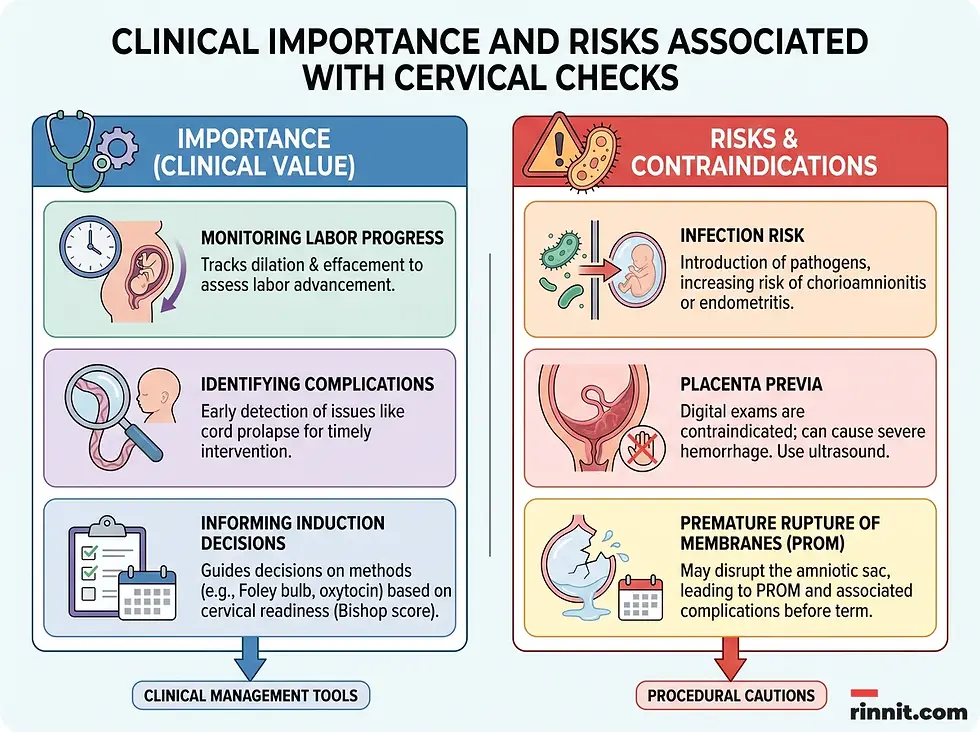
Cervical checks are generally considered safe, but their main risk is infection, which rises with the number of digital exams performed. The primary concern is the increased risk of infection, such as chorioamnionitis (infection of the amniotic fluid) or endometritis (infection of the uterine lining). The risk of introducing bacteria into the vagina and cervix increases with the frequency of digital exams. Consequently, providers use sterile techniques and limit the number of checks performed.
There are also specific medical conditions where digital vaginal exams may be skipped or performed with extreme caution. For instance, if a patient has placenta previa (where the placenta covers the cervix) or premature rupture of membranes (PROM), a cervical check could lead to serious complications. In these cases, providers may rely on other methods of assessment to ensure the safety of both the mother and the baby.

Why is a cervical check important in labor management?
Despite the preference for sparse use, cervical checks remain an important tool in modern obstetrics. They are particularly useful for identifying rare but life-threatening complications, such as umbilical cord prolapse, where the cord precedes the baby through the cervix. A check can also help a provider recommend the most appropriate interventions to keep labor moving, such as the use of a Foley bulb or oxytocin infusion.
For many patients, the information gathered from a cervical check can be encouraging, providing a tangible sense of progress during a challenging process. It can also assist in making decisions regarding pain management, such as the timing for an epidural. Ultimately, the use of cervical checks is a collaborative decision between the patient and their healthcare team, aimed at ensuring a safe and positive birth experience.
Conclusion
Cervical checks are a fundamental part of monitoring labor, providing essential data on dilation, effacement, and fetal station. While they offer valuable insights into the progress of childbirth, their use should be balanced against the potential for infection and the patient's personal comfort. By maintaining open communication with their healthcare providers, patients can ensure that these exams are used appropriately and with their full consent.
Consult your provider: If you have questions about the frequency or necessity of cervical checks in your birth plan, consult your obstetrician or midwife. They can provide guidance based on your specific medical history and labor progress.
Frequently Asked Questions
1. What is the difference between dilation and effacement?
Dilation refers to how much the cervix has opened, measured in centimeters from 0 to 10. Effacement describes how much the cervix has thinned and shortened, measured as a percentage from 0% to 100%.
2. Are cervical checks mandatory during labor?
No, cervical checks are not mandatory. You have the right to consent to or decline any medical procedure, including vaginal exams. Discuss your preferences with your provider as part of your birth plan.
3. Why does my provider limit the number of cervical checks?
Providers limit these exams primarily to reduce the risk of infection. Each check can potentially introduce bacteria into the birth canal, which can lead to complications for both the mother and the baby.
4. Can a cervical check predict when I will give birth?
No, a cervical check only provides information about your status at that specific moment. It cannot accurately predict how long labor will last or exactly when delivery will occur.
5. What if I experience spotting after an exam?
Light spotting is a common and typically normal occurrence after a cervical check due to the sensitivity of the cervix during pregnancy. However, you should report any significant bleeding to your provider immediately.
6. How can I make a cervical check more comfortable?
Trying to relax your pelvic muscles, practicing deep breathing, and using distractions can help. If you have an epidural, you likely won't feel much discomfort during the exam.
7. What is a fetal station?
Fetal station is a measurement of how far the baby's head has descended into the pelvis. It is given as a number indicating the head's position relative to specific landmarks in the mother's pelvis.
8. When is a cervical check avoided?
Providers may skip a cervical check if you have placenta previa or if your water has broken prematurely (PROM) without labor starting, because the risk of complications or infection is higher.
9. Can I ask for a chaperone during the exam?
Yes, you can ask for a chaperone, such as another healthcare provider, to be in the room. You may also have a loved one present for support during the procedure.
10. What is a Bishop score?
A Bishop score is a calculation based on the findings of a cervical check (dilation, effacement, station, consistency, and position) that helps providers determine how likely a labor induction is to be successful.
11. How do I prepare for a cervical check?
The main preparation for a cervical check is deciding whether you want one and talking with your healthcare provider ahead of time about your wishes. [1] Your provider should explain why they recommend the check and what declining could mean, and they must get your consent before doing it. [1] You can ask that only female providers perform the exam and have a loved one in the room with you. [1] You can also tell your provider to stop the check at any point. [1]
12. Does a cervical check hurt, and what anesthesia is used?
A cervical check may be uncomfortable or even painful, partly because your cervix is more sensitive during pregnancy from extra pressure and blood flow to the area. [1] How much you feel varies from person to person, and a cervix that sits high can be harder to reach and more uncomfortable. [1] If you already have an epidural, you likely won't feel much during the check. [1] Tell your provider if the check hurts, and you can ask them to stop at any time. [1]
Related Reading
Understanding the Three Stages of Labor walks through each stage of labor from early contractions to delivery.
Bishop Score: How It's Calculated and What It Means for Labor Induction explains how cervical findings are scored to predict labor readiness.
Cervical Ripening: Preparing for a Safe Labor and Delivery describes methods used to soften and open the cervix before labor.
Understanding Labor Induction: A Comprehensive Patient Guide covers why labor is started early and what the process involves.
References
Cleveland Clinic. Cervical Check: Is It Necessary? Exam, Procedure & Timing. Cleveland Clinic. June 4, 2026. https://my.clevelandclinic.org/health/procedures/cervical-check
Gluck O, Mizrachi Y, Ganer Herman H, Bar J, Kovo M, Weiner E. The correlation between the number of vaginal examinations during active labor and febrile morbidity, a retrospective cohort study. BMC Pregnancy Childbirth. 2020;20(1):246. PMID 32334543. https://doi.org/10.1186/s12884-020-02925-9
Morshedi B, Strohm S, James H, et al. Effect of sterile vs clean gloves for cervical checks in labor on maternal infection at term: a randomized trial. Am J Obstet Gynecol MFM. 2023;5(6):100931. PMID 36965695. https://doi.org/10.1016/j.ajogmf.2023.100931
Namutosi E, Akankwasa P, Suleiman IA, et al. Accuracy of preinduction transvaginal sonography (TVS) and Bishop scores in predicting successful labor induction: a global systematic review and meta-analysis. J Matern Fetal Neonatal Med. 2026;39(1):2607251. PMID 41485908. https://doi.org/10.1080/14767058.2025.2607251
Medical Disclaimer
This article is for informational purposes only and does not constitute medical advice. Always seek the advice of your physician or other qualified health provider with any questions you may have regarding a medical condition. Never disregard professional medical advice or delay in seeking it because of something you have read here.


Comments