Casts for Broken Bones: Types, Care and Removal

Updated: 2 days ago
Written and medically reviewed by Dr. Baraa Alnahhal, MD · Last reviewed: November 2026 · How we review
Quick Answer
A cast is a hard shell that holds an injured body part still while a broken bone heals. Unlike a splint, you can't remove or adjust it yourself. Most people wear a cast for six to eight weeks. Keep it dry, and call your provider right away if it hurts more, smells bad, cracks or feels loose.
What the research says
Some kids' wrist fractures heal fine without a cast: in 87 children aged 6 to 15 with wrist buckle fractures, a removable splint gave better daily function and easier bathing than a 3-week cast, with the same pain and no repeat fractures (Plint AC et al., Pediatrics, 2006) [2]
A soft bandage can be enough for buckle fractures: in 965 children with a buckle fracture of the wrist, a soft bandage gave the same pain and function over 6 weeks as rigid immobilization (Perry DC et al., Lancet, 2022) [3]
Key takeaways
A cast holds a broken bone still while it heals.
Fiberglass casts are lighter and stronger; plaster casts are easier to mold.
Most people wear a cast for six to eight weeks.
Keep your cast dry and never put objects inside it.
Call your provider for worsening pain, color changes, a bad smell or cracks.
What is a cast?
A cast keeps a broken bone in place so it can heal in the right position. Providers call this immobilization. Unlike a splint, which can be taken off and adjusted, a cast stays on until your provider removes it. Sources: [1]
Why casts are used

A cast keeps the bone in the right position while it heals.
Bone fractures, the most common reason.
Some other injuries.
After some orthopedic surgeries. Sources: [1]
Casts can go on the arm or elbow, wrist and hand, leg or knee, ankle or foot. A common example is a Colles fracture of the wrist. Sources: [1]
Types of casts
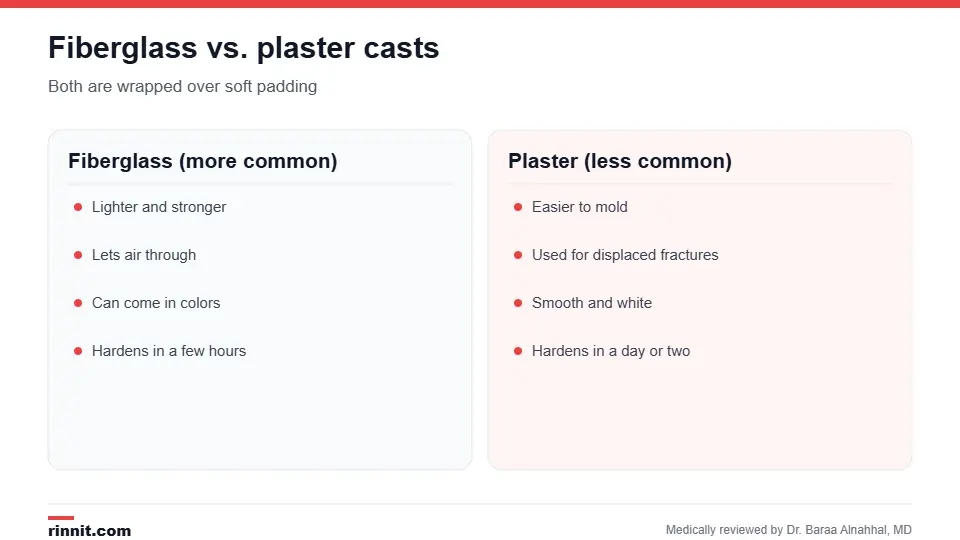
Both are wrapped over soft padding.
Type | Features | Drying time |
Fiberglass (more common) | Lighter and stronger; lets air through, so it's more comfortable; may come in colors; feels rough | Hardens within a few hours |
Plaster (less common) | Easier to mold; used mainly for displaced fractures; smooth and white | A day or two |
Sources: [1]
Before the cast goes on
Your provider examines the injury and may order an X-ray. The bone may need to be set (reduced). In a closed reduction, the provider moves the bone back into place from the outside, with anesthesia to prevent pain. Severe fractures may need surgery, such as internal fixation with metal pieces, usually under general anesthesia. Sources: [1]
How a cast is put on
A soft, stretchy tube called a stockinette goes over the area.
Cotton padding is rolled over it to protect your skin and limit swelling.
Wet strips of fiberglass or plaster are wrapped in layers.
The cast hardens as it dries. Handle it gently until it's fully hard. Sources: [1]
This takes about 15 minutes to an hour; a wrist cast is faster than a leg cast. Sources: [1]
Caring for your cast

Most people wear a cast for six to eight weeks.
Raise the injured limb on pillows as often as you can for the first few days.
Ice it in a sealed bag wrapped in a towel, keeping the cast dry.
Wiggle your fingers or toes as directed.
Keep the cast dry; cover it with plastic or a cast guard to shower and never put it under water.
Don't put weight on it until your provider says so; you may need crutches.
Never stick anything inside to scratch, and keep lotions, powders, sand and dirt away.
Don't remove or trim the cast yourself. Sources: [1]
Risks
Problem | Signs |
Pressure sores or skin problems | Pain, burning or a bad smell under the cast |
Compartment syndrome | Severe, worsening pain, numbness or tingling |
Blood clot (deep vein thrombosis) | Swelling, warmth or pain in the leg |
Infection | Bad smell, drainage or fever |
Serious complications are rare. Casts can also be itchy and inconvenient. Sources: [1]
How a cast is removed
After six to eight weeks, depending on the break and how fast you heal, your provider removes the cast with a special saw. The blade vibrates and cuts the hard cast but isn't sharp enough to cut your skin. Scissors cut through the padding. Never try to remove a cast at home. Sources: [1]
When to call your provider
The cast hurts, especially if pain gets worse.
Skin above or below the cast changes color.
Itching is severe.
There's a bad smell.
The cast cracks, breaks, feels soft, peels or gets loose. Sources: [1]
Conclusion
A cast is one of the safest and most effective ways to protect a healing bone. Taking good care of it and watching for warning signs helps your bone heal well.
Keep learning: read about splints and buckle fractures in children.
Frequently asked questions
What is a cast?
A hard shell that holds a broken bone still while it heals.
What's the difference between a cast and a splint?
You can't remove or adjust a cast; a splint can be taken off.
Which is better, fiberglass or plaster?
Fiberglass is lighter and stronger; plaster is easier to mold.
How long will I wear a cast?
Usually six to eight weeks.
How long does a cast take to dry?
Fiberglass hardens within a few hours; plaster takes a day or two.
Can I get my cast wet?
No. Cover it to shower and never put it under water.
What can I do about itching?
Never put objects inside the cast; call your provider if itching is severe.
Does cast removal hurt?
No. The saw vibrates and can't cut your skin.
What are the risks of a cast?
Pressure sores, compartment syndrome, blood clots and infection.
When should I call my provider?
For worsening pain, color changes, a bad smell or a cracked or loose cast.
Related Reading
Splints: Types, Uses, and How Long You Need to Wear One a removable alternative to a cast.
Bone Fractures: What Happens When a Bone Breaks, and How It Heals the main reason people need a cast.
What Is a Colles Fracture? Symptoms, Causes, Diagnosis and Treatment a common wrist fracture treated with a cast.
Buckle Fracture (Torus Fracture): What It Is, How It Heals, and Why Surgery Is Almost Never Needed a minor wrist fracture in children.
Greenstick Fractures: What They Are, Why They Happen, and How They Heal a common childhood fracture.
References
Cleveland Clinic. Casts: Types & Care. Cleveland Clinic. Last updated August 11, 2023. https://my.clevelandclinic.org/health/treatments/25191-casts
Plint AC, Perry JJ, Correll R, et al. A randomized, controlled trial of removable splinting versus casting for wrist buckle fractures in children. Pediatrics. 2006;117(3):691-697. PMID 16510648. https://doi.org/10.1542/peds.2005-0801
Perry DC, Achten J, Knight R, et al. Immobilisation of torus fractures of the wrist in children (FORCE): a randomised controlled equivalence trial in the UK. Lancet. 2022;400(10345):39-47. PMID 35780790. https://doi.org/10.1016/S0140-6736(22)01015-7
Medical disclaimer
This article is for general education only and does not replace advice from a qualified healthcare professional. Talk to your doctor about your own diagnosis and treatment, and seek emergency care right away for severe or sudden symptoms.



Comments