Greenstick Fractures: What They Are, Why They Happen, and How They Heal

Updated: 3 days ago
Medically reviewed by Dr. Baraa Alnahhal, MD · Last reviewed: October 2026
Quick Answer
A greenstick fracture is a partial fracture in which one side of a bone cracks while the other side bends [1] [2]. It mainly affects children under 10 because their bones are pliable [1]. Symptoms include pain, swelling, bruising and a visibly bent limb [1]. Treatment is a cast for about six weeks, and most children recover fully with no long-term issues [1].
What the research says
A lighter wrap may work for undisplaced fractures. In a randomized trial of 79 children with undisplaced greenstick and torus fractures of the wrist end of the radius, an elastic tubular bandage (Tubigrip) was better than a plaster cast for interference with daily activities, stiffness, and grip strength, with no difference in pain, pain-medicine needs, or deformity. Ultrasound was also more sensitive than X-ray for detecting these fractures (Pountos et al., J Child Orthop, 2010) [4]. Your child's doctor decides which support is right for a given fracture.
The link between vitamin D and children's fractures is unclear. A pooled analysis of 13 studies (3,943 participants aged 18 or younger) found no significant relationship between vitamin D level and fracture risk in children and adolescents (Zheng et al., J Bone Miner Metab, 2021) [5].
What Is a Greenstick Fracture?
A greenstick fracture is a specific pattern of bone injury where the bone cracks along one side without breaking into multiple pieces [1]. This type of fracture gets its name from a simple analogy: imagine trying to snap a young, living “green” twig. Instead of snapping cleanly in half like a dry, brittle branch, the green twig bends and splinters only on the side facing the pressure [1].
Because children's bones are still developing, they are softer and more flexible than adult bones [1]. This pliability allows the bone to bend significantly under force. When the force exceeds what the bone can handle, it cracks on one side—the “greenstick” effect—rather than shattering. This is one of the most common injuries in pediatrics, with millions of cases reported in the United States every year [1].
Feature | Details |
Primary Age Group | Children under 10 years old |
Bone Type Affected | Long bones (arms, legs, fingers, toes) |
Fracture Pattern | One-sided crack with bending |
Typical Healing Time | 6 weeks |
Common Treatment | Immobilization with a cast |

Why Do Greenstick Fractures Happen?
Anything that applies significant force to a child's long bone can cause a greenstick fracture [1]. Children are particularly susceptible not only because of their bone structure but also because of their high activity levels and tendency to fall [1].
Common Causes
Falls: The most frequent cause, especially when a child instinctively reaches out their hands to break a fall [1] [2].
Sports Injuries: Contact sports or high-impact activities like gymnastics or skateboarding.
Accidents: Car accidents or other sudden trauma can provide enough force to bend the bone [1] [2].
Risk Factors
The primary risk factor is age. As children grow, their bones become more mineralized and brittle. By the time a person reaches adulthood, their bones are much more likely to snap completely rather than bend [1]. Additionally, nutritional deficiencies, such as a lack of Vitamin D or general malnutrition, can weaken a child's bones, although a 2021 review found no clear link between vitamin D levels and fracture risk in children [1] [2] [5].
What are the symptoms of a greenstick fracture?
A greenstick fracture can be mistaken for a severe sprain, but signs such as intense pain, swelling, bruising and visible deformity point to a damaged bone [1]. If your child experiences a fall or injury, look for the following:
Intense Pain: Persistent pain that does not subside shortly after the injury.
Swelling and Tenderness: The area around the bone becomes puffy and painful to the touch [1].
Bruising: Discoloration or bruising that appears quickly after the trauma.
Visible Deformity: A limb that looks slightly bent, twisted, or “off” compared to the other side [1].
In rare cases, the bone may be visible through the skin, or the child may be completely unable to move the affected body part [1]. These are signs of a medical emergency.

When to Seek Emergency Care
Go to the emergency room immediately if your child has intense pain, cannot move a limb, has a noticeably out-of-place body part, or if the bone is visible through the skin [1]. Prompt treatment is essential to prevent permanent damage or poor bone alignment.
How are greenstick fractures diagnosed and treated?
Healthcare providers diagnose greenstick fractures through a physical examination and imaging [1]. X-rays are the standard tool used to confirm the “bend and crack” pattern of a greenstick fracture [1] [2]. In more complex cases, such as when surgery is being considered, a doctor might request an MRI or CT scan to get a three-dimensional view of the bone and surrounding tissue [1].
Standard Treatment: The Cast
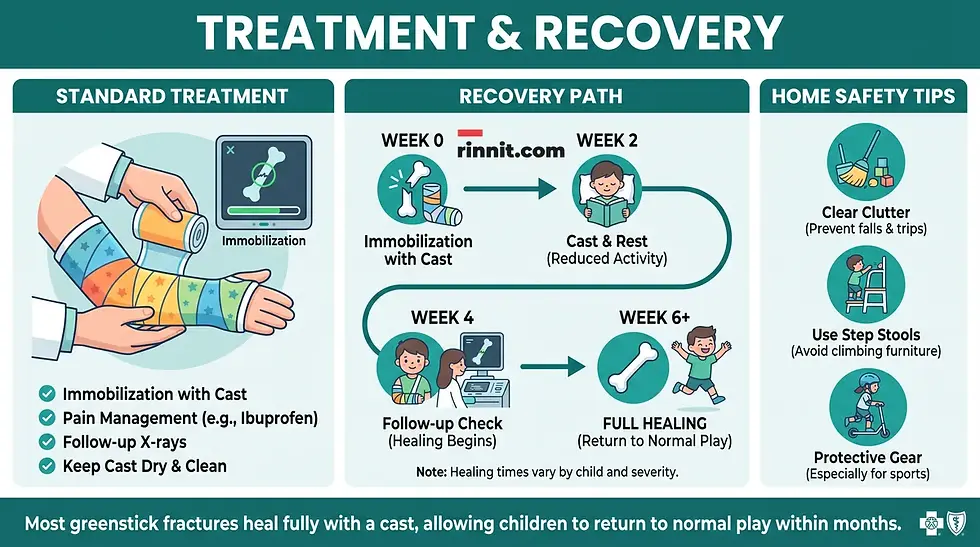
Most greenstick fractures are treated by keeping the bone perfectly still so it can grow back together. A cast is applied for approximately six weeks [1]. During this time, follow-up X-rays are usually scheduled to ensure the bone is healing straight [1] [2].
When Surgery Is Needed
If the bone is bent at a severe angle, a doctor may need to manually realign it [2] [3]. This is sometimes done under sedation [2]. In the most severe cases, a surgeon may perform “internal fixation,” which involves placing small metal pins into the bone to hold it in the correct position while it heals [1].
Treatment Method | When It's Used |
Cast / Splint | Standard for most simple greenstick fractures. |
Manual Realignment | Used when the bone is bent but doesn't require hardware. |
Surgery (Pins) | Reserved for severe angles or multiple injuries. |
What is recovery and the long-term outlook for greenstick fractures?
The good news for parents is that the long-term prognosis for a greenstick fracture is excellent [2]. Because children's bones are actively growing, they have a remarkable ability to heal and remodel themselves [2]. Most children return to their normal activities [1] [2], including sports, within a few months.
It is important to note that fractures in the forearm (the radius and ulna) have a slightly higher risk of re-breaking if they aren't treated promptly [1] or if the child returns to high-impact activities too soon. Always follow your healthcare provider's guidance on when it is safe to resume sports.
Frequently Asked Questions
Q: Why is it called a “greenstick” fracture?
A: It is named after the way a young, living (green) branch bends and splinters on one side instead of snapping cleanly like a dry stick.
Q: Can adults get greenstick fractures?
A: It is extremely rare. Adult bones are more brittle and mineralized, so they typically snap completely or shatter under force.
Q: How long does the pain last?
A: The most intense pain usually subsides within a few days of being placed in a cast, though the area will remain tender for several weeks.
Q: Will my child need physical therapy?
A: Most children do not need formal physical therapy for a simple greenstick fracture, as they naturally regain strength through normal play once the cast is removed.
Q: Can a greenstick fracture heal on its own without a cast?
A: While the bone will eventually grow back together, a cast is necessary to ensure it heals straight and to prevent the injury from becoming a complete break.
Q: Is a greenstick fracture worse than a regular break?
A: Actually, it is often considered “better” because the bone remains partially intact, which can make the healing process more stable.
Q: What is the most common bone to have a greenstick fracture?
A: The long bones of the forearm (the radius and ulna) are the most common sites for this injury.
Q: How can I tell the difference between a sprain and a greenstick fracture?
A: It can be difficult without an X-ray. However, visible bending of the limb or extreme tenderness directly over the bone usually points to a fracture.
Q: Does my child need extra calcium while healing?
A: A balanced diet is important, but you should consult your doctor before starting any supplements like calcium or Vitamin D.
Q: Can my child go swimming with a cast?
A: Unless you have a special waterproof cast, you must keep the cast completely dry. Moisture trapped inside a standard cast can cause skin infections.
Q: What are the pins used for in surgery?
A: The metal pins hold the bone in the correct alignment. They are often removed in a simple follow-up procedure once the bone is strong enough.
Q: Will the bone be weaker after it heals?
A: No. Once fully healed, the bone is typically just as strong as it was before the injury.
Q: What is “malunion”?
A: Malunion is a complication where the bone heals in a crooked or incorrect position. This is why follow-up X-rays are so important.
Q: How do I keep my child safe at home?
A: Clear away clutter that could cause trips, use proper step stools, and ensure they wear helmets and pads during outdoor play.
Q: When can my child go back to gym class?
A: Most doctors recommend waiting until the cast is removed and a final X-ray confirms the bone is fully stable, usually around 6 to 8 weeks.
Sources
Cleveland Clinic. Greenstick Fractures. Cleveland Clinic. Last updated September 18, 2023. https://my.clevelandclinic.org/health/diseases/17812-greenstick-fractures
Collins AC, Krishnaprasadh D. Greenstick Fracture. StatPearls [Internet]. Treasure Island (FL): StatPearls Publishing. Last updated July 6, 2026. https://www.ncbi.nlm.nih.gov/books/NBK513279/
American Academy of Orthopaedic Surgeons. Forearm Fractures in Children. OrthoInfo. Accessed October 15, 2026. https://www.orthoinfo.org/diseases--conditions/forearm-fractures-in-children/
Pountos I, et al. Diagnosis and treatment of greenstick and torus fractures of the distal radius in children: a prospective randomised single blind study. J Child Orthop. 2010;4(4):321-6. PMID 21804894. https://doi.org/10.1007/s11832-010-0269-3
Zheng C, et al. Vitamin D level and fractures in children and adolescents: a systematic review and meta-analysis. J Bone Miner Metab. 2021;39(5):851-857. PMID 34115219. https://doi.org/10.1007/s00774-021-01238-x
Related Reading
Casts for Broken Bones: Types, Care and Removal explains how casts protect healing bones and how to care for one.
Medical disclaimer
This article is for general educational purposes only and is not a substitute for professional medical advice, diagnosis, or treatment. Always seek the advice of your physician or other qualified healthcare provider with any questions you may have about a medical condition. Never disregard professional medical advice or delay seeking care because of something you have read here. If you think you may have a medical emergency, call your doctor or emergency services immediately.



Comments