Buckle Fracture (Torus Fracture): What It Is, How It Heals, and Why Surgery Is Almost Never Needed

Updated: 2 days ago
Medically reviewed by Dr. Baraa Alnahhal, MD · Last reviewed: October 17, 2026
Quick answer
A buckle fracture (torus fracture) is an incomplete fracture in which sudden pressure buckles the bone without snapping it through [1]. It mostly affects children under 12, whose bones are softer and more flexible [1]. It is almost always treated with a splint worn for 2–3 weeks, with no surgery needed [1] [6], and most children heal fully within about a month [1] [7].
What the research says
According to PubMed:
A soft bandage or removable splint works well as first-line treatment. A meta-analysis of 7 randomized trials (1,550 patients) found that splints caused slightly more pain than casts early on (mean difference of 1.00 at 3 days and 1.46 at 1 week on pain scales), but children returned to activities sooner (relative risk 1.77 at 3 weeks and 1.44 at 4 weeks). All torus fractures healed clinically within 3–4 weeks (low-certainty evidence), and the authors concluded that a soft bandage or removable wrist splint seems to be the best first-line choice. (Pakarinen et al., Sci Rep, 2024 [7]).
Many children can go home with a brace and clear instructions. In a multicenter study of 274 children with isolated greenstick or torus wrist fractures, discharge straight from the emergency department with a brace and information, summarized in a smartphone app and a helpline was as satisfying as the traditional approach of a soft cast plus outpatient follow-up (no significant difference for torus fractures, p = 0.93). No complications were seen, function scores were similar, and children needed about one fewer follow-up appointment on average. (Spierings et al., Eur J Trauma Emerg Surg, 2024 [8]).
Study details are from PubMed abstracts.
What is a buckle fracture?
A buckle fracture is a type of broken bone that almost always affects kids. It is an incomplete fracture, which means the break doesn't go all the way through the bone [1] [5]. You may also see it called an impacted fracture or a torus fracture.
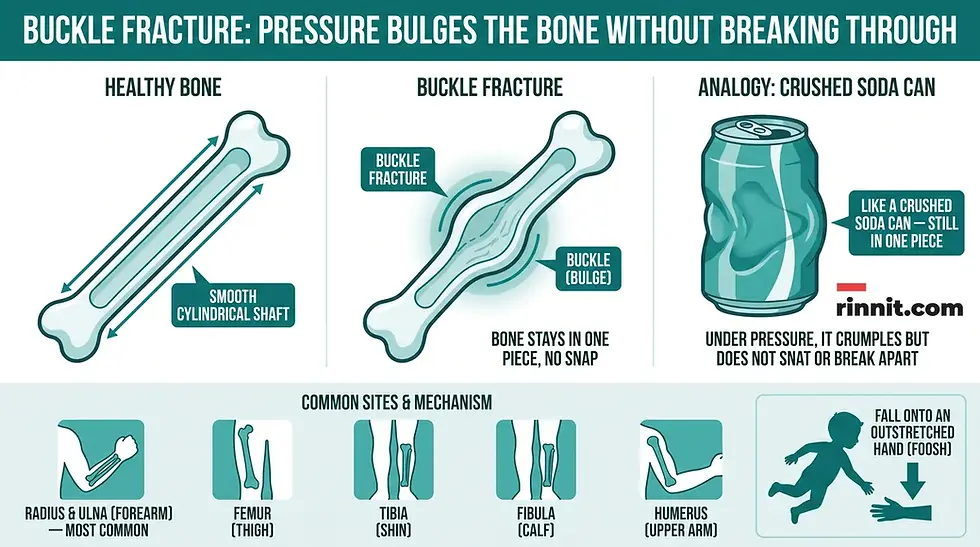
The name comes from how it happens. A buckle fracture is a compression fracture, meaning the break is caused by sudden pressure on a bone [1]. That pressure — usually from a fall — pushes on the child's bone hard enough to bulge it out of place. The force “buckles” the bone without snapping it [1].
Picture crushing an aluminum soda can. Pressure forces the can to bulge and collapse in on itself, but it is still in one piece. That is exactly what happens to the bone in a buckle fracture.
Buckle fractures most commonly affect the radius and ulna — the two bones that connect the forearm to the wrist [1]. But they can happen to any long bone, including the femur (thigh), tibia (shin), fibula (calf), and humerus (upper arm) [1].
Nearly every buckle fracture can be treated with a splint or a cast [1]. Your child will not need surgery, but they will need some form of protection while the bone heals.
How common are buckle fractures?
Buckle fractures are remarkably common, especially in the wrists of children who fall onto an outstretched hand. One in four children who break a bone has a buckle fracture [1], and half of all pediatric broken wrists are buckle fractures [1] [6]. Because the mechanism is a fall onto an outstretched hand, wrists are simply the most likely place for this pressure to land.
Who gets buckle fractures?
Buckle fractures almost always affect kids under 12 [1]. Children have softer, more flexible bones than adults [1] because their skeletons are still growing and changing. As you get older, your bones naturally lose some of that flexibility. That softness is precisely why kids' bones tend to bend and buckle rather than break the way adult bones do — kids' bones behave more like plastic, while adult bones behave more like glass or ceramic.
That said, a buckle fracture is still possible in adults — it is just very rare. When adults do get one, it typically happens in flat bones like the ribs [1]. People with osteoporosis (a condition that weakens and thins bones) also have an increased risk for all types of broken bones, including buckle fractures [1].
It is worth noting what buckle fractures do not usually affect: they almost always involve the longer bones of the body and don't usually strike the small bones of the hands, fingers, or thumbs [1]. If your child has hand or finger pain, the injury is more likely a sprained or broken finger — talk to a healthcare provider about any new symptoms.
Buckle fracture vs. greenstick fracture: what's the difference?
Buckle (impacted) and greenstick fractures are both incomplete fractures that mostly affect children. They are different names that tell your healthcare provider specific details about how your child's bone is broken, where it broke, and what it looks like inside the body right now.
Feature | Buckle (impacted/torus) fracture | Greenstick fracture |
What happens | The bone is pressed to the point of bulging out of place | |
What it looks like | A bump on the bone | A crack along one side of the bone |
Everyday analogy | A crushed aluminum soda can that bulges but stays in one piece | A green or young stick that cracks when bent but doesn't snap cleanly like a dry twig |
Common cause | Compression from a fall onto an outstretched arm | Bending force on a soft, growing bone |
Both types are much more common in children for the same reason: kids' bones are softer and more flexible than adult bones, so they tend to bend and buckle rather than break. No matter which name applies to your child's fracture, the most important first step is getting the injury examined by a healthcare provider as soon as possible.
What are the symptoms of a buckle fracture?
The symptoms cluster around the injured bone, and in very young children they can show up as behavior changes rather than complaints.
Symptom | What to watch for |
Pain | Around the injured bone, worse with movement |
Swelling | The area around the break puffs up |
Tenderness | The spot hurts when touched |
Bruising or discoloration | Skin over the bone changes color |
Deformity or bump | A bump that isn't usually on your child's body |
Avoiding use (young children) | Playing with toys with only one hand, or not wanting to move a leg or walk [1] |
What causes buckle fractures?
Buckle fractures are most commonly caused by kids catching themselves with outstretched arms after falling [1] [5] [6]. The force of the fall compresses the bone and produces the fracture. This is why most buckle fractures affect kids' forearm bones — the radius and ulna take the full impact of a hand-first fall.
How are buckle fractures diagnosed?
Your healthcare provider diagnoses a buckle fracture with a physical exam and imaging tests. After the exam, your child will likely need an X-ray to confirm the buckle fracture (or another type of break) and to show how damaged the bones are [1] [6].
How are buckle fractures treated?
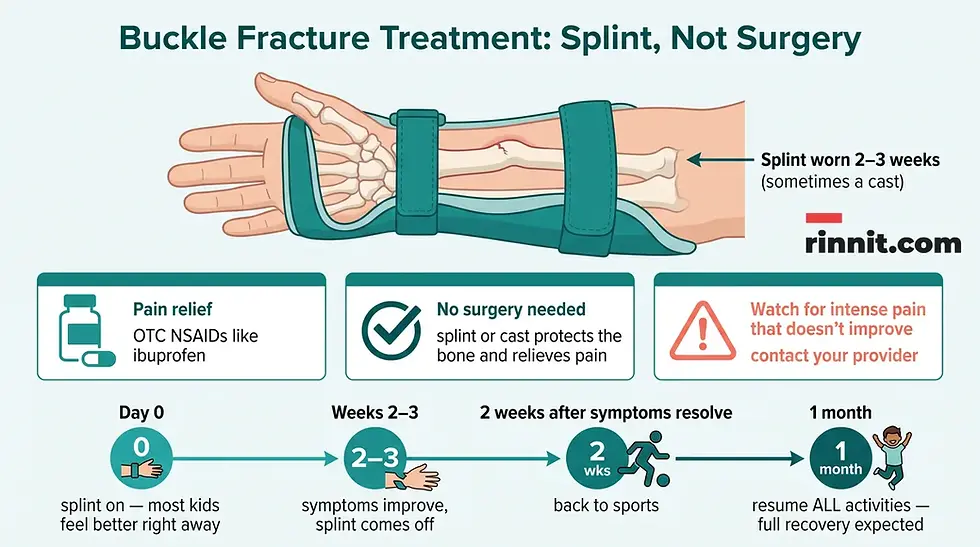
Buckle fractures are usually treated with a splint — a process sometimes called immobilization. In some cases, kids may need to wear a cast instead. Talk to your healthcare provider about which option is best for your child. The splint or cast does three jobs at once: it protects your child from reinjury, makes them more comfortable, and relieves their pain [1].
Treatment component | Details |
Splint (or cast) | |
Pain relief | Over-the-counter NSAIDs like ibuprofen are typically all that's needed; your provider will advise which medications are safe for your child, and aspirin is generally not given to children |
Surgery |
Can a buckle fracture heal on its own?
Even though buckle fractures are less severe than other types of fractures, never ignore symptoms like pain, swelling, or tenderness. If a buckle fracture goes untreated, your child might face more serious complications later.
What are the complications of buckle fracture treatment?
Complications are uncommon but worth knowing about.
Complication | What happens |
Reinjury | Resuming activities like sports too soon can reinjure the bone or cause a more serious injury or fracture [1] |
Other internal damage | Fractures can damage the area around the injury, including muscles, nerves, blood vessels, tendons, and ligaments |
NSAID side effects | Bleeding, ulcers, stomach pain, and bowel complications from pain medication [1] |
How soon after treatment will my child feel better?
Most kids feel better right away after they start using their splint, but it usually takes a few weeks for symptoms to improve completely [1]. Immobilization holds the bone in place and reduces the pain. If your child is in intense pain that doesn't get better, contact your healthcare provider right away.
How long does it take a buckle fracture to heal?
Buckle fractures heal very quickly, especially compared to other types of broken bones. Most children only need to wear a splint for 2 to 3 weeks [1] [6]. If their symptoms — like pain and tenderness — go away, there's usually no additional treatment or follow-up needed. Most kids can resume all their sports and activities in a month [1].
Will my child need to miss school?
Your child shouldn't need to miss any school while healing from a buckle fracture [1]. They should avoid intense physical activities, like sports, for two weeks after their symptoms have completely gone away [1]. Your healthcare provider will tell you how long your child should avoid certain activities.
What is the outlook for a buckle fracture?
The outlook is very positive. You should expect your child to make a full recovery — buckle fractures are a temporary issue, and your child shouldn't have any long-term consequences, long-lasting pain, or other symptoms afterward [1].
How can I reduce my child's risk?
Because buckle fractures are usually caused by falls or other accidents, there isn't much you can do to prevent them outright. You can, however, lower the general risk of injury.
Safety step | How it helps |
Always wear seatbelts | Reduces injury risk in the car |
Wear the right protective equipment | For all activities and sports |
Keep spaces free of clutter | Prevents trips at home and at work |
Use proper tools to reach things | Never stand on chairs, tables, or countertops |
Support bone health | A diet and exercise plan that maintains good bones [1] |
Adults should talk to their provider about a bone density test if they're older than 50 or have a family history of osteoporosis [1].
When should I go to the emergency room?
If you think your child has a buckle fracture — or any other broken bone — see a healthcare provider as soon as possible. Go to the emergency room if your child experiences any of the following.
Emergency: Go to the ER right away if your child has intense pain, an inability to move a body part they usually can, a body part that looks noticeably different or out of its usual place, or visible bone through the skin [1]. Swelling and new bruising that appear alongside any of these symptoms are also emergency signs. Go right away after any significant trauma [1].

What questions should I ask my doctor?
Bringing questions to your visit makes recovery smoother. Consider asking: Which bones are fractured? Does my child have a buckle fracture or another type of break? How long will my child need to wear a splint? How long will recovery take? When can they resume physical activities?
What should parents know about a child's buckle fracture?
Learning your child has a buckle fracture is scary, but parents can help by explaining the injury and why the splint must be worn. Buckle fractures are very treatable and one of the most common pediatric injuries — which means your healthcare provider will recognize and treat it right away. Help your child understand their injury, and make sure they know why they have to wear a splint and for how long. Make sure they know their injury is only temporary and that they will be able to resume all the sports and activities they love as soon as their body heals.
Conclusion
A buckle fracture is the most reassuring kind of broken bone a child can have. The bone compresses and bulges — like a crushed soda can — but never breaks through, and almost every case is handled with a simple splint for two to three weeks. Surgery is not needed, school is not missed, and a full recovery with no lasting effects is the expected outcome. The key steps are simple: have the injury examined promptly, keep the splint on as directed, and give the bone a month to fully heal before returning to full-contact sports.
For clear, trustworthy guidance on fractures, bone health, and your child's well-being, visit Rinnit.com.
Frequently asked questions
What is a buckle fracture?
A buckle fracture is an incomplete broken bone where sudden pressure “buckles” the bone out of place without snapping it through. It looks like a bump on the bone and is also called a torus or impacted fracture.
Why is it called a buckle fracture?
The name comes from the mechanism: it is a compression fracture, and the sudden pressure “buckles” the bone — like an aluminum soda can that bulges and collapses inward but stays in one piece.
Who gets buckle fractures?
Mostly children under 12, because growing bones are softer and more flexible and bend or buckle rather than break. Very rarely, adults can get them in flat bones like the ribs.
How common are buckle fractures?
Very common — 1 in 4 kids who break a bone has a buckle fracture, and half of all pediatric broken wrists are buckle fractures.
Where do buckle fractures happen?
Most often in the radius and ulna of the forearm, but they can occur in any long bone, including the femur, tibia, fibula, and humerus.
What causes a buckle fracture?
Usually a fall where a child catches themselves with an outstretched arm; the compressive force of the fall buckles the forearm bone.
What are the symptoms?
Pain, swelling, tenderness, bruising or discoloration, and a deformity or bump that isn't usually there. Young children may also avoid using the injured limb.
Is a buckle fracture the same as a greenstick fracture?
No. A buckle fracture bulges the bone out of place, while a greenstick fracture bends the bone until it cracks without breaking all the way through. Both are incomplete fractures common in children.
How is it diagnosed?
With a physical exam and an X-ray, which confirms the fracture and shows how damaged the bones are.
Does my child need surgery?
No. Buckle fractures can almost always be treated with a splint or cast; surgery is not needed.
How long does my child wear a splint?
Most children wear a splint for 2 to 3 weeks, depending on how long symptoms take to improve.
How long until my child feels better?
Most kids feel better right away once the splint is on, though complete symptom improvement takes a few weeks.
Can a buckle fracture heal on its own?
Untreated buckle fractures risk malunion (misaligned healing), nonunion (incomplete healing), and worsening, longer-lasting symptoms — so it should always be treated, even though the injury itself is mild.
Will my child miss school?
No. Children typically don't need to miss school, though they should avoid intense activities like sports for two weeks after symptoms fully resolve — most resume everything within a month.
What is the long-term outlook?
Very positive. Children are expected to make a full recovery with no long-term pain, complications, or consequences.
Related reading
Casts for Broken Bones: Types, Care and Removal explains how casts protect healing bones and how to care for one.
This article is for general informational purposes only and is not a substitute for professional medical advice, diagnosis, or treatment. Always seek the advice of your physician or qualified health provider with any questions you may have regarding a medical condition. Never disregard professional medical advice or delay in seeking it because of something you have read here. If you think you may have a medical emergency, call your doctor or 911 immediately.
References
Cleveland Clinic. Buckle Fracture (Impacted Fracture). Cleveland Clinic. Last updated December 27, 2021. https://my.clevelandclinic.org/health/diseases/22235-buckle-fracture
Ben-Yakov M, Boutis K. Buckle fractures of the distal radius in children. CMAJ. 2016;188(7):527. PMID 26976961. https://doi.org/10.1503/cmaj.151239
Campagne D. Overview of Fractures. Merck Manual Professional Version. Last updated May 2025. https://www.merckmanuals.com/professional/injuries-poisoning/fractures/overview-of-fractures
Radiopaedia. Greenstick fracture. Radiopaedia.org. Last revised May 9, 2024. https://radiopaedia.org/articles/greenstick-fracture?lang=us
Radiopaedia. Torus fracture. Radiopaedia.org. Accessed October 14, 2026. https://radiopaedia.org/articles/torus-fracture-1?lang=us
Asokan A, Kheir N. Pediatric Torus Buckle Fracture. Updated July 31, 2023. In: StatPearls [Internet]. Treasure Island (FL): StatPearls Publishing; 2023 Jan-. PMID 32809469. https://www.ncbi.nlm.nih.gov/books/NBK560634/
Pakarinen O, Saarinen AJ, Ponkilainen VT, et al. Soft bandage, splint or cast as the treatment of distal forearm torus fracture in children: a systematic review and meta-analysis. Sci Rep. 2024;14(1):21052. PMID 39251716. https://doi.org/10.1038/s41598-024-71970-7
Spierings JF, Willinge GJA, Schuijt HJ, et al. Direct discharge for children with a greenstick or torus fracture of the wrist is a non-inferior satisfactory solution to traditional treatment. Eur J Trauma Emerg Surg. 2024;50(6):2663-2671. PMID 38217672. https://doi.org/10.1007/s00068-023-02391-w



Comments