Brown Fat: Understanding Its Role in Thermogenesis and Metabolism

Updated: 3 days ago
Medically reviewed by Dr. Baraa Alnahhal, MD · Last reviewed: October 2026
Quick Answer: What is brown fat?
Brown fat is a type of adipose tissue that regulates body temperature by burning calories to produce heat, a process called thermogenesis. [1] It activates in cold conditions and is rich in iron-rich mitochondria, also helping regulate glucose and fat metabolism. [1] Newborns have significant amounts, while adults retain smaller deposits around the neck, heart and kidneys. [1]
What the research says
In healthy adults, cold exposure raised free fatty acids but did not change fasting glucose, insulin, or triglycerides. A systematic review and meta-analysis of 7 studies (85 participants) compared cold exposure with thermoneutral conditions. Free fatty acid levels rose significantly with cold exposure (P = 0.002; n = 38), while fasting glucose, insulin, and triglyceride concentrations showed no significant change. The authors suggested circulating free fatty acids, the main fuel for thermogenesis, may signal brown fat activation, and that understanding its wider metabolic effects needs more than fasting measurements (PubMed: Tabei et al., Biomedicines, 2024) [2].
Adults living in the Arctic show signs of high brown fat activity. A systematic review of 8 studies in Arctic adults with habitual cold exposure reported high brown fat activity, supported by higher skin temperatures over the collarbone region after cold exposure, thyroid hormone changes, and genetic markers linked to brown fat. A meta-analysis was not possible because the studies differed too much, and the authors noted methodological limitations (PubMed: Motzfeldt Jensen et al., Int J Circumpolar Health, 2025) [3].
Deliberate cold-water exposure may stimulate brown fat and energy expenditure, but strong trial evidence is still missing. A review of interventional and observational studies concluded that evidence, mostly from small interventional studies, suggests cold water therapy may stimulate brown fat, increase energy expenditure, and improve cardiometabolic risk factors. The optimal duration and temperature are uncertain, and the authors called for definitive interventional evidence (PubMed: Kunutsor et al., GeroScience, 2025) [4].
What does brown fat do in the body?
Brown fat plays a critical role in the body's ability to maintain a stable internal temperature, especially when exposed to cold environments. Its primary responsibility is thermogenesis, the production of heat to warm the blood. This activation typically occurs just before the body begins to shiver, providing a more efficient way to generate warmth. [1] By breaking down molecules of fat and blood sugar (glucose), brown fat releases energy as heat rather than storing it. [1]
Beyond temperature regulation, brown fat contributes significantly to metabolic health. It helps control insulin levels and blood sugar, making it an essential component of the body's energy management system. [1] Research indicates that individuals with higher levels of active brown fat, such as lean individuals and athletes, may experience better metabolic outcomes compared to those with lower levels.
Function Category | Description of Brown Fat's Role |
Thermogenesis | Produces heat by burning calories in response to cold. |
Energy Management | Stores and produces energy through the breakdown of fat and sugar. |
Metabolic Control | Assists in regulating blood sugar and insulin levels. |
Temperature Regulation | Maintains core body temperature right before shivering starts. |
What is the structure of brown fat and where is it found?
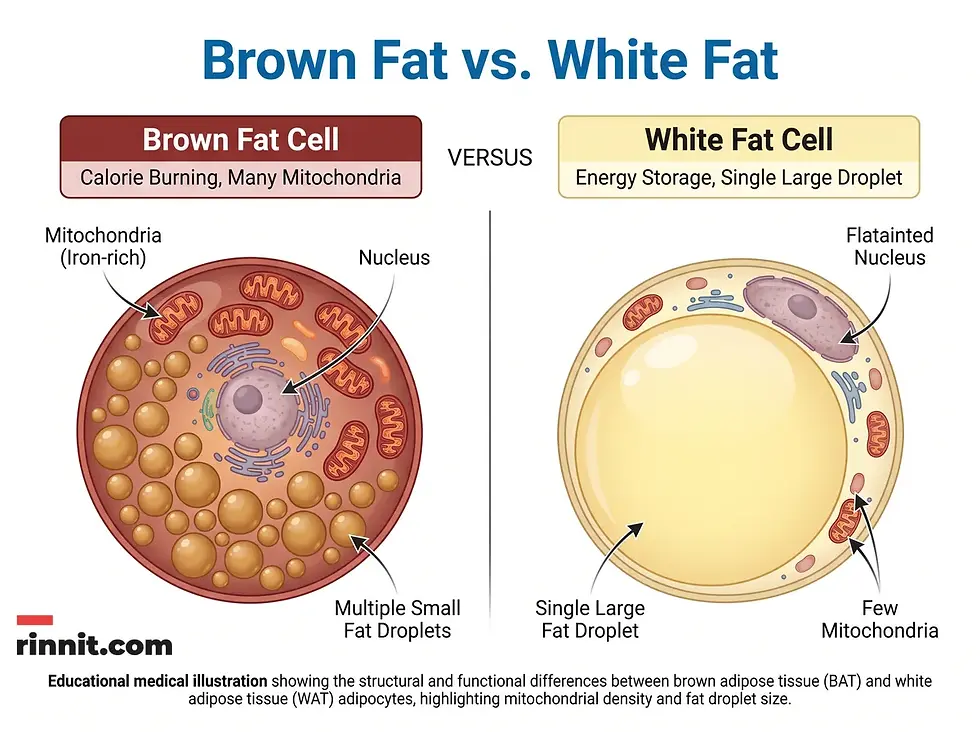
The anatomy of brown fat is unique, resembling muscle tissue more closely than typical white fat due to the smaller size of its storage cells, known as adipocytes. [1] Its characteristic brown color is derived from a high concentration of mitochondria, which are rich in iron. [1] These mitochondria act as the “power plants” of the cell, driving the calorie-burning process that generates heat.
The distribution of brown fat changes significantly throughout a person's life. In newborns, it is a vital survival mechanism, making up 2% to 5% of their total body weight and concentrated in the back, neck, and shoulders. [1] As individuals age, these deposits scatter and reduce in size. In adults, brown fat is primarily located in specific regions, including the neck, chest (mediastinum), and around major organs like the heart, kidneys, and adrenal glands. [1]

Which conditions affect brown fat and other adipose tissue?
Medical conditions can affect the health and distribution of brown fat, and some can severely impair the body's ability to regulate its temperature. Anorexia nervosa, for instance, leads to a significant loss of both white and brown fat, which can severely impair the body's ability to regulate its temperature. [1] Other conditions, such as lipodystrophy, affect how the body stores and uses energy from food, leading to an abnormal distribution of adipose tissue. [1]
Healthcare providers use various diagnostic tools to evaluate the health of fat cells and their distribution. Common tests include imaging studies like PET, CT scans, and MRIs, which can identify active areas of brown fat. Additionally, blood tests such as a complete blood count (CBC) may be used to assess overall metabolic health and the presence of any underlying conditions affecting fat metabolism.
Condition | Impact on Adipose Tissue |
Anorexia Nervosa | Causes loss of both white and brown fat, affecting temperature regulation. |
Lipodystrophy | Disrupts the normal storage and distribution of fat tissue. |
Leptin Deficiency | Impairs the hormone that controls body weight, increasing obesity risk. |
Lipoma | Results in non-painful lumps of fatty tissue underneath the skin. |
How can you activate brown fat?
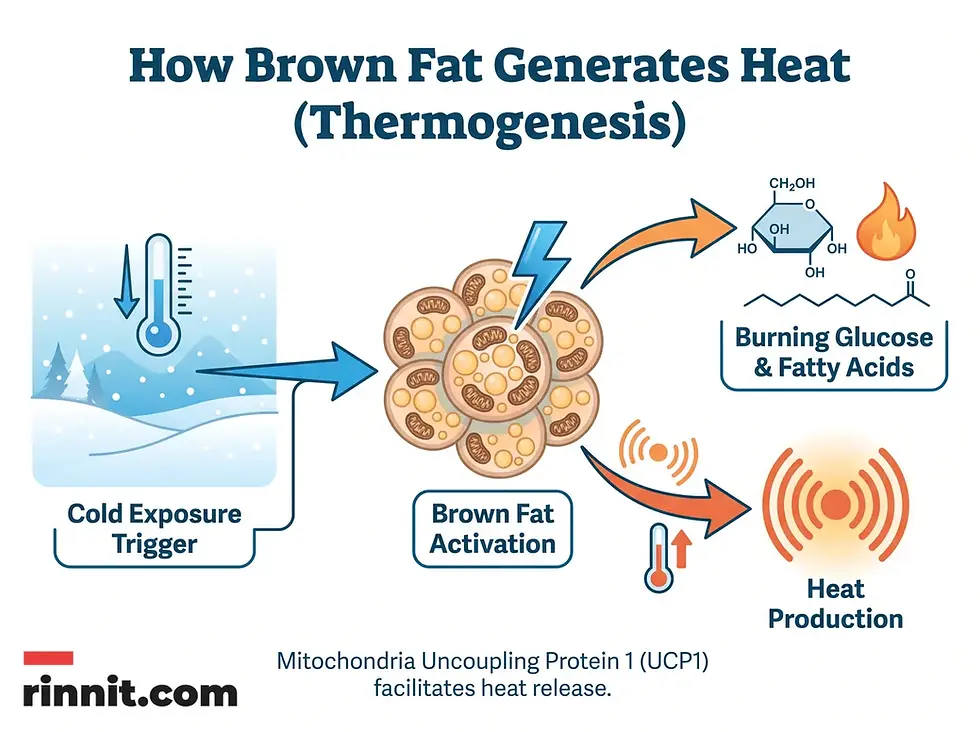
Increasing the activity and amount of brown fat in the body is a goal for many looking to improve their metabolism and manage weight. One of the most effective methods is controlled cold exposure, such as taking cold showers, ice baths, or simply lowering the thermostat. These activities trigger the activation of brown fat cells, encouraging the body to burn more calories to maintain warmth. [1] [4]
Diet and exercise also play pivotal roles in brown fat health. Consuming iron-rich foods like leafy vegetables, beans, and lean meats supports the mitochondria that give brown fat its function. [1] Exercise has been shown to activate the hormone irisin, which can signal white fat to behave more like brown fat, creating “beige fat.” [1] A well-balanced diet that includes healthy fats from avocados, nuts, and fish further supports overall metabolic function. [1]
Conclusion
Brown fat is a remarkable component of the human body, acting as a natural furnace that burns calories to keep us warm and metabolically healthy. While its presence diminishes with age, its impact on blood sugar regulation and energy management remains significant. By adopting lifestyle habits that support brown fat activation—such as cold exposure, regular exercise, and a nutrient-dense diet—we can leverage this specialized tissue to enhance our overall well-being.
If you are considering significant changes to your diet or cold exposure routine, consult with a healthcare professional to ensure these strategies are safe and appropriate for your individual health needs.
Frequently Asked Questions
1. What is the main difference between white fat and brown fat?
White fat stores energy and insulates organs, while brown fat burns calories to produce heat.
2. Why is brown fat the color brown?
Brown fat contains a high concentration of mitochondria, which are rich in iron, giving the tissue its brown appearance.
3. Where is brown fat located in adults?
In adults, it is typically found around the neck, kidneys, adrenal glands, heart, and chest.
4. How does cold exposure affect brown fat?
Cold temperatures activate brown fat, causing it to burn calories to generate heat and maintain body temperature.
5. Can exercise help increase brown fat activity?
Yes, exercise triggers the release of the hormone irisin, which can convert white fat into calorie-burning beige fat.
6. What foods are good for supporting healthy fat?
Avocados, nuts, seeds, fish like salmon, and yogurt are excellent sources of healthy fats.
7. What is thermogenesis?
Thermogenesis is the process by which the body produces heat, often through the activation of brown fat.
8. Do newborns have more brown fat than adults?
Yes, brown fat makes up 2% to 5% of a newborn's body weight, whereas adults have much smaller amounts.
9. What is beige fat?
Beige fat is a combination of white and brown fat cells that burn calories by converting white fat to brown-like tissue.
10. What medical tests check the health of brown fat?
PET, CT scans, and MRIs are commonly used to identify and assess active brown fat in the body.
Related Reading
Adipose Tissue: Understanding the Vital Role of Body Fat explains the different kinds of body fat and what they do.
Basal Metabolic Rate (BMR) Explained: How Your Body Uses Energy at Rest describes how many calories the body burns at rest.
Understanding Metabolism: The Science of Cellular Energy explains how cells turn food into usable energy.
Understanding the Hypothalamus: The Brain's Homeostasis Center covers the brain area that controls body temperature.
References
Cleveland Clinic. Brown Fat, Brown Adipose Tissue: What It Is & What It Means. Cleveland Clinic. Aug. 7, 2022. https://my.clevelandclinic.org/health/body/24015-brown-fat
Tabei S, Chamorro R, Meyhöfer SM, Wilms B. Metabolic effects of brown adipose tissue activity due to cold exposure in humans: A systematic review and meta-analysis of RCTs and non-RCTs. Biomedicines. 2024;12(3):537. PMID 38540150. https://doi.org/10.3390/biomedicines12030537
Motzfeldt Jensen M, Jørgensen MG, Elberling Almasi C, Andersen S. Effect of habitual cold exposure on brown adipose tissue activity in Arctic adults: a systematic review. Int J Circumpolar Health. 2025;84(1):2545059. PMID 40804739. https://doi.org/10.1080/22423982.2025.2545059
Kunutsor SK, Lehoczki A, Laukkanen JA. The untapped potential of cold water therapy as part of a lifestyle intervention for promoting healthy aging. GeroScience. 2025;47(1):387-407. PMID 39078461. https://doi.org/10.1007/s11357-024-01295-w
Medical Disclaimer
This article is for informational purposes only and does not constitute medical advice. Always seek the advice of your physician or other qualified health provider with any questions you may have regarding a medical condition. Never disregard professional medical advice or delay in seeking it because of something you have read here.



Comments