Basal Metabolic Rate (BMR) Explained: How Your Body Uses Energy at Rest

Updated: 2 days ago
Medically reviewed by Dr. Baraa Alnahhal, MD · Last reviewed: September 2026

TL;DR
Basal Metabolic Rate (BMR) is the minimum number of calories your body needs to maintain essential life functions like breathing and circulation while at rest. It accounts for 60% to 70% of your total daily energy expenditure and is influenced by factors such as muscle mass, age, and genetics. While largely determined by biology, building lean muscle mass is the primary healthy way to increase your BMR.
Quick Answer
Basal Metabolic Rate (BMR) represents the minimum number of calories your body requires to perform basic life-sustaining functions, such as breathing, blood circulation, and cell maintenance, while in a state of complete rest. It serves as the body’s primary energy consumer, accounting for the majority of total daily calorie usage. Factors like age, sex, and body composition determine an individual's unique BMR, providing a baseline for weight management and health planning.
The Core Function of Basal Metabolic Rate
Basal metabolic rate serves as the body's major source of energy expenditure, fulfilling approximately 60% to 70% of the total energy the body uses daily. While physical movement and the processing of food (thermogenesis) account for the remaining energy needs, BMR provides the baseline energy required to keep the body alive and functioning at a cellular level. This includes maintaining body temperature and supporting the continuous work of vital organs.
Factors That Determine Your BMR
Several biological and environmental factors influence how many calories a body burns at rest. Body size and composition are among the most significant drivers; individuals with more body tissue or higher lean muscle mass generally require more energy to maintain those cells. Because muscle tissue is more metabolically active than adipose (fat) tissue, increasing muscle mass through resistance training is a primary method for raising one's baseline metabolism.
Muscle Mass (increases BMR): Muscle tissue requires significant energy to maintain itself.
Body Size (increases BMR): More cells and tissue require more energy for maintenance.
Sex (males typically higher): Higher testosterone levels often lead to greater muscle mass.
Age (decreases BMR): Metabolism slows due to muscle loss and hormonal changes.
Temperature (increases BMR): The body works harder to maintain temperature in extreme heat or cold.
BMR vs. RMR: Understanding the Difference
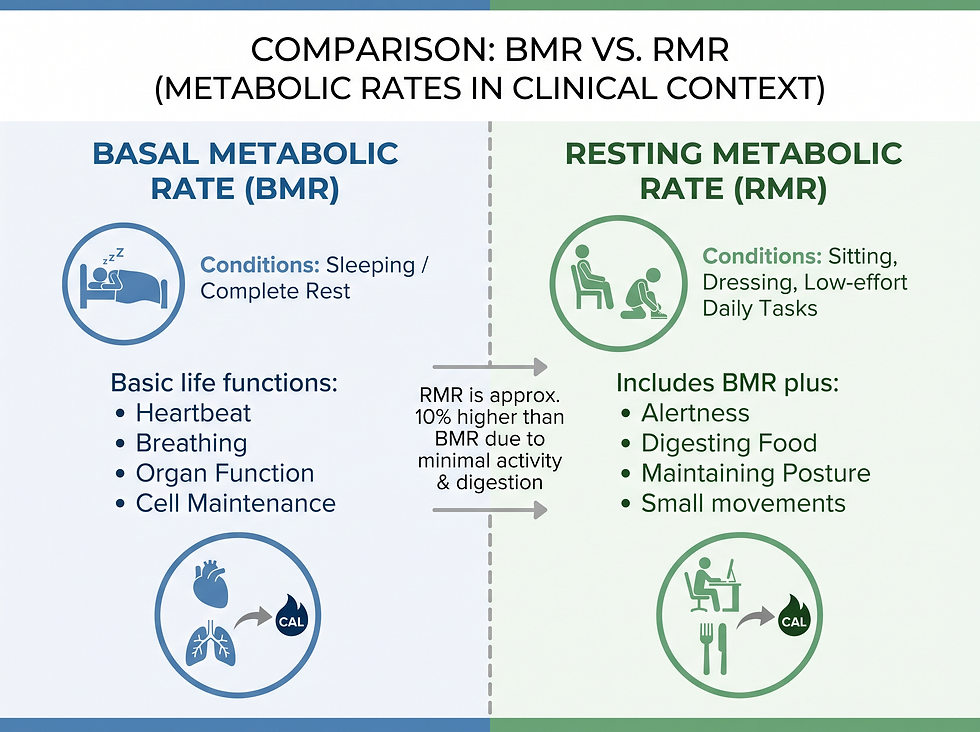
While the terms are often used interchangeably, Basal Metabolic Rate (BMR) and Resting Metabolic Rate (RMR) have distinct definitions. BMR is measured under strict laboratory conditions after a period of fasting and rest. In contrast, RMR represents the energy needed for basic functions plus low-effort daily activities like dressing or moving around the house. Consequently, RMR is typically about 10% higher than BMR.
BMR: Measured at strict rest, after a 12-14 hour fast, at a neutral temperature. It covers basic life-sustaining functions only.
RMR: Measured at general rest with no strict fasting required. It covers basic functions plus low-effort daily tasks.
Estimating Energy Needs: The Harris-Benedict Equation
Because laboratory testing is inaccessible for most people, mathematical equations are used to estimate BMR. The Harris-Benedict equation is a widely accepted standard that uses sex, weight, height, and age to provide a baseline estimate. These calculations help individuals understand their energy requirements, though they remain estimates that may vary based on race, ethnicity, and genetic predispositions.

Managing and Improving Metabolism
While genetics and age cannot be altered, building lean muscle mass remains the most effective healthy way to influence BMR. Resistance training, such as weightlifting or Pilates, helps develop muscle tissue that requires more energy to maintain than fat. However, it is important to note that a very fast metabolism is not always beneficial; certain medical conditions like hyperthyroidism or hypermetabolism during illness can cause unhealthy increases in energy expenditure.
Conclusion
Understanding your basal metabolic rate is an essential step in managing weight and overall health. By recognizing the factors that influence energy usage and focusing on healthy habits like muscle development, individuals can better support their body's unique metabolic needs. Consulting with a healthcare provider or registered dietitian can provide a more personalized assessment and a realistic plan for health management.
Take the Next Step
If you are looking to better understand your metabolism or manage your weight, consider speaking with a healthcare professional or a registered dietitian to develop a personalized energy and nutrition plan tailored to your body's unique requirements.
Frequently Asked Questions (FAQ)
1. What exactly is BMR? It is the minimum number of calories your body needs to maintain basic functions like breathing and circulation while at rest.
2. How much of my daily energy does BMR use? BMR typically accounts for 60% to 70% of your total daily energy expenditure.
3. What is the difference between BMR and RMR? BMR measures energy for basic life functions under strict conditions, while RMR includes calories for low-effort daily activities and is about 10% higher.
4. Can I change my BMR? While many factors are fixed, you can increase your BMR by building lean muscle mass through resistance training.
5. Does muscle burn more calories than fat? Yes, muscle tissue is more metabolically active and requires more energy to maintain than fat tissue.
6. Why does BMR decrease with age? The decrease is primarily due to a loss of muscle mass and changes in hormonal and neurological function.
7. Do men have higher BMRs than women? Generally, yes, because men typically have more muscle mass and larger body sizes.
8. How does illness affect BMR? Illness or injury typically increases BMR as the body uses more energy to fight infection and repair tissues.
9. Does temperature affect metabolism? Yes, extreme heat or cold increases BMR as the body works harder to maintain a stable internal temperature.
10. What is the Harris-Benedict equation? It is a formula used to estimate BMR based on an individual's sex, weight, height, and age.
11. Can stimulants increase BMR? Substances like caffeine, nicotine, and amphetamines can temporarily increase metabolic rate.
12. Does fasting speed up metabolism? No, prolonged fasting or starvation actually causes the body to slow down its BMR to conserve energy.
13. Is a very fast BMR always healthy? Not necessarily; conditions like hyperthyroidism or hypermetabolism during serious illness can cause an unhealthily high BMR.
14. How does pregnancy affect BMR? BMR increases during pregnancy due to increased body mass and the energy required for fetal growth.
15. Who should I talk to about my BMR? A healthcare provider or a registered dietitian is the best resource for calculating and understanding your specific metabolic needs.
Medical Disclaimer: This content is for informational purposes only and does not constitute medical advice. Always seek the advice of a qualified healthcare provider with any questions regarding a medical condition.
Comments