Back Muscles: Anatomy, Function, and Common Injuries

Updated: 3 days ago
Medically reviewed by Dr. Baraa Alnahhal, MD · Last reviewed: October 2026
Quick Answer: What are back muscles?
Back muscles are organized into three layers, superficial, intermediate and intrinsic, running from just under the skull down the spine to just above the hips. They provide the main structural support for the trunk, let you bend, twist and move your head, arms and legs, keep you upright and help you breathe. [1] Knowing the layers helps explain back pain.
What the research says
In people with low back pain, the multifidus is the back muscle that changes most. A meta-analysis of 17 imaging studies found a smaller functional cross-sectional area of the multifidus (SMD −0.369, 95% CI −0.581 to −0.156) and more fat infiltration in both the multifidus (SMD 0.583) and the erector spinae (SMD 0.235) than in people without back pain. No significant differences were found for the psoas major or quadratus lumborum, and these are associations rather than proof of cause (PubMed: Li et al., Acad Radiol, 2025 [2]).
The changes are most consistent at the mid-to-lower lumbar levels. A systematic review of 21 studies (10 in the meta-analysis) found lower multifidus cross-sectional area and higher fat infiltration in chronic low back pain, particularly from L3/L4 to L5, while erector spinae and psoas differences were less consistent (PubMed: Kalli et al., Eur Spine J, 2026 [3]).
Training the trunk muscles may reduce pain, but the evidence is limited. A meta-analysis of 8 randomized trials compared isokinetic trunk training (134 people) with conventional exercise (133 people) in non-specific low back pain. Pain scores were lower by 1.50 points immediately after training and by 2.48 points at six months, though the certainty of evidence was very low to low (PubMed: Reyes-Ferrada et al., J Back Musculoskelet Rehabil, 2023 [4]).
What do the back muscles do?
Back muscles are the main structural support for the trunk. They keep you stable and maintain your posture whether you are moving or sitting still, constantly holding you in place without your having to think about it. Beyond support, they work together to let you bend over, twist, turn your head and extend your back, and they help move your head, neck, shoulders, arms and legs. [1]
Back muscles also contribute to breathing. They help expand and contract the chest when you breathe in and out, an involuntary action your body performs automatically. [1]
What are the three layers of back muscles?
Back muscles attach to the vertebrae, ribs and shoulder blades. [1] Healthcare providers divide them into three groups, or layers, based on their depth and main role.
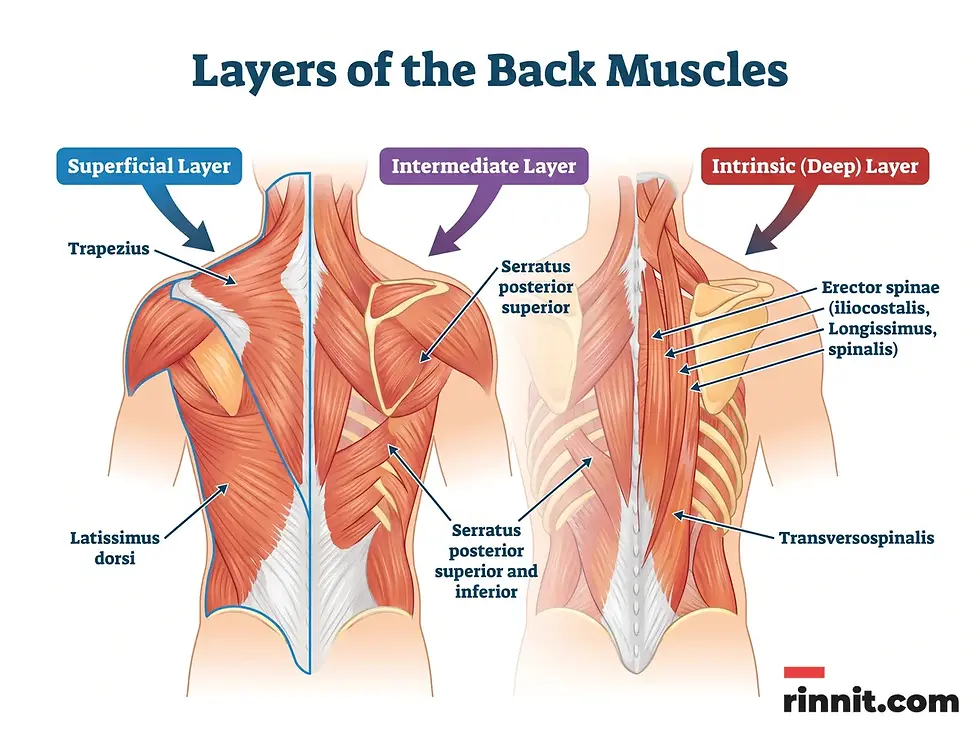
Muscle Group | Depth and Primary Role | Key Muscles Included |
Superficial (Extrinsic) | Closest to the skin; mainly responsible for shoulder and arm movement. | Trapezius, latissimus dorsi, rhomboids, levator scapulae and serratus anterior. |
Intermediate | Located just above and below the ribcage; helps move the ribs, including during breathing. | Serratus posterior superior and serratus posterior inferior. |
Intrinsic (Deep) | Closest to the spine; provides structural support and controls posture. | Divided into superficial, intermediate and deep intrinsic subgroups, such as the erector spinae and transversospinalis. |
Superficial Back Muscles

These muscles sit just beneath the skin and move the shoulders and upper limbs. They are usually the muscles people picture when they think of the back.
Latissimus dorsi (lats): The largest muscles in the upper half of the body, running from below the shoulder blades to the spine in the lower back.
Trapezius (traps): Muscles that start at the neck, cross the shoulders and extend down to the lower back in a V shape. [1]
Rhomboids: Muscles that connect the shoulder blades to the spine.
Levator scapulae: Smaller muscles that run from the side of the neck to the shoulder blades.
Serratus anterior: Muscles that cover the top of the ribcage, just below the armpits.
Intermediate and Intrinsic Muscles
The intermediate layer sits just above and below the ribcage and helps move the ribs during breathing. The intrinsic, or deep, muscles are the deepest layer, lying closest to the spinal column. [1] They are essential for maintaining an upright posture and give the whole torso its stability. Providers divide the intrinsic muscles into their own superficial, intermediate and deep subgroups, which describe where they sit relative to one another.
What are common back muscle injuries and their symptoms?
Because they support so much weight and perform so many movements, back muscles are some of the most commonly injured muscles in the body, and back muscle problems are one of the most common causes of low back pain. [1] Back strains, or pulled muscles, are the most common injury. They happen when you overuse a muscle or lift something incorrectly, and the muscle fibers are stretched beyond their limit and tear. [1]
Common symptoms of a back muscle injury include:
Muscle pain.
Muscle tightness or weakness.
Stiffness.
Back spasms.
Swelling.
Bruising or skin discoloration. [1]
How are back muscle injuries treated?

A healthcare provider will suggest treatment depending on the type and severity of the injury. Most back muscle injuries are managed with a combination of the following:
Rest and activity modification: Avoid the activity that caused the injury and intense physical activity while the muscle heals. Your provider can tell you how long to pause exercise or physical work.
Heat and/or ice: Apply a warm compress or ice pack for about 15 minutes at a time, a few times a day. Wrap heating pads and ice packs in a towel or thin cloth so they do not touch your skin directly. [1]
Medication: Over-the-counter NSAIDs (such as ibuprofen) or acetaminophen can relieve pain and reduce swelling. Do not take pain relievers for more than 10 days in a row without talking to your provider. [1]
Physical therapy: A physical therapist can teach exercises that strengthen the muscles, improve flexibility and posture, relieve pain and help prevent future injuries. [1]
Prevention
Stretching and warming up before exercise or physical activity are among the best ways to prevent muscle injuries, and greater flexibility gives muscle fibers more room to stretch before they tear. Increase your activity level gradually rather than suddenly ramping up the intensity or frequency of your training. [1]
When to Seek Medical Care
See a healthcare provider if back pain does not get better within a week of rest and home treatment. [1] Go to the emergency room if you have:
Fever.
Numbness, tingling or weakness in your legs.
Severe pain, muscle spasms or muscle weakness.
Sudden, unexplained weight loss.
Problems controlling your bladder or bowels. [1]
Conclusion
Understanding the anatomy and function of your back muscles is the first step toward a healthy, pain-free back. By supporting the spine and powering nearly every movement of the trunk, these muscles are vital to your overall physical well-being. Warming up, building flexibility and using proper lifting techniques can significantly reduce the risk of injury and protect your spine over the long term.
Experiencing persistent back pain? If your symptoms last more than a week or come with fever or numbness, consult a healthcare provider.
Frequently Asked Questions
1. What are the three layers of back muscles?
The back muscles are divided into three layers: superficial (extrinsic), intermediate and intrinsic (deep).
2. What is the most common back muscle injury?
Back strains, also called pulled muscles, are the most common back muscle injury. They are usually caused by overuse or lifting something incorrectly.
3. Which muscle is the largest in the upper body?
The latissimus dorsi, commonly called the “lats,” is the largest muscle in the upper half of the body.
4. How do back muscles help with breathing?
Back muscles help expand and contract the chest when you breathe in and out. This happens automatically, without you controlling it.
5. Where do the back muscles attach?
The back muscles attach to bones across the body, including the vertebrae of the spine, the ribs and the shoulder blades (scapulae).
6. What are the symptoms of a pulled back muscle?
Symptoms include muscle pain, tightness, weakness, stiffness, spasms, swelling, and sometimes bruising or skin discoloration.
7. How can I prevent back muscle injuries?
Stretching and warming up before exercise, building flexibility, and increasing your activity level gradually can help prevent muscle injuries.
8. What treatments are recommended for back muscle injuries?
Common treatments include rest from the activity that caused the injury, heat or ice, over-the-counter pain relievers and physical therapy.
9. When should I see a doctor for back pain?
See a healthcare provider if your back pain has not improved after a week of rest and home care. Go to the emergency room for fever, numbness, tingling or weakness in the legs, severe pain, sudden weight loss, or bladder or bowel control problems.
10. What are the “traps” in the back?
The trapezius muscles, or “traps,” start at the neck, cross the shoulders and extend down to the lower back in a V shape.
Related Reading
What Are Back Strains and Sprains? Symptoms, Causes, and the Two-Phase Recovery explains common back muscle and ligament injuries and recovery.
Back Pain: Symptoms, Causes, and Proven Relief Strategies covers the many causes of back pain and what helps.
Understanding Your Spine: The Foundation of Movement and Support describes the spine that the back muscles support and move.
Herniated Disk: Symptoms, Causes & What Actually Helps explains slipped disks and when back pain needs a doctor.
References
Cleveland Clinic. Back Muscles. Cleveland Clinic. Jul. 7, 2024. https://my.clevelandclinic.org/health/body/21632-back-muscles
Li Y, Zhang X, Xu X, et al. The morphology and composition of paravertebral muscles evaluated by MRI technology are used to predict low back pain: a systematic review and meta-analysis. Acad Radiol. 2025;32(8):4750-4766. PMID 40348711. https://doi.org/10.1016/j.acra.2025.04.026
Kalli I, Niglas M, Naeini MK, et al. Paraspinal muscle quality in chronic low back pain: a systematic review and meta-analysis of muscle atrophy and fat infiltration. Eur Spine J. 2026;35(5):2693-2711. PMID 41148279. https://doi.org/10.1007/s00586-025-09454-z
Reyes-Ferrada W, Chirosa-Rios L, Martinez-Garcia D, et al. Isokinetic trunk training on pain, disability, and strength in non-specific low back pain patients: a systematic review and meta-analysis. J Back Musculoskelet Rehabil. 2023;36(6):1237-1250. PMID 37458013. https://doi.org/10.3233/BMR-220301
Medical Disclaimer
This article is for informational purposes only and does not constitute medical advice. Always seek the advice of your physician or other qualified health provider with any questions you may have regarding a medical condition. Never disregard professional medical advice or delay in seeking it because of something you have read here.



Comments