Baby Helmet for Flat Head: How Helmet Therapy Works, Best Age to Start, and What to Expect

Updated: 6 days ago
Written and medically reviewed by Dr. Baraa Alnahhal, MD · Last reviewed: October 2026 · How we review
Quick Answer: What is a baby helmet for flat head?
A baby helmet, or helmet therapy, is a custom-fitted brace that gently guides a growing infant's skull into a rounder shape when it is flat or uneven from positioning. It works best when started around 4 to 6 months, is worn about 23 hours a day, and only changes head shape during the first year. [1]
What the research says
Helmets correct asymmetry more than repositioning alone. A 2025 meta-analysis of 13 studies with 1,189 infants found a larger short-term reduction in skull asymmetry with helmet therapy than with no helmet (standardized mean difference −1.16), including when compared with repositioning only. The authors note high variation between studies and call for more randomized trials. (de Sousa et al., J Clin Neurosci, 2025) [3]
Most babies with moderate to severe flattening improve. In 90 infants (average age 5.6 months) treated for about 6.4 months, 84.4% reached normal or mild shape. Starting before 9 months and wearing the helmet more than 15 hours a day gave better results. (Kim et al., Clin Exp Pediatr, 2024) [4]
Every month of delay matters. In more than 140,000 helmeted infants, each extra month of age at the start raised the odds of leftover asymmetry by about 1.7 times; later starts, more severe flattening and poor wear were all linked to worse results. (Hauc et al., J Craniofac Surg, 2023) [5]
Key takeaways
A baby helmet improves head shape and appearance; it does not affect your baby's development. [1]
It treats positional flat head (plagiocephaly, brachycephaly, dolichocephaly) and is sometimes used after surgery for craniosynostosis. [1]
The best window is early infancy, around 4 to 6 months; after the first year, a helmet no longer changes head shape. [1]
Babies build up to about 23 hours a day of wear over the first week. [1]
Treatment usually lasts several months; earlier starts tend to be shorter. [1][6]
What is helmet therapy for babies?
Helmet therapy is a treatment that uses a custom-fitted brace to mold a baby's skull into a more typical shape while the head is growing quickly. [1]
You may also hear it called helmeting or a cranial orthosis. The helmet does not squeeze the head. Instead, it acts as a guide: it rests on the rounded parts of the skull and leaves open space over the flat areas, so new growth fills in where it is needed. [1]
Two points matter most for parents:
Why do babies need to wear a helmet?
Babies need a helmet for one of two reasons: a positional skull deformity or craniosynostosis. [1]
Positional skull deformity
A positional skull deformity is a flat or uneven head caused by outside pressure on the soft, growing skull. It can start from the baby's position in the uterus, difficulties during labor and delivery, or spending a lot of time lying in one position. [1]

Head shape | What it looks like | Common name |
Plagiocephaly | Flatter on one side of the back of the head | "Flat head syndrome" |
Brachycephaly | Wider head, flat across the whole back | — |
Dolichocephaly | Longer, narrower head | — |
Table: Positional head shapes that helmet therapy can treat. [1]
Craniosynostosis
Craniosynostosis is a condition in which a baby's skull bones fuse too early, so the head grows into an abnormal shape as the brain grows. In some cases it can affect brain growth. It needs surgery to correct, and a helmet may be used after the operation. [1]
Positional flat head | Craniosynostosis | |
Cause | Outside pressure on a soft skull | Skull bones fuse too early |
Effect on the brain | None — appearance only | May affect brain growth in some cases |
Main treatment | Repositioning, physical therapy, helmet if needed | Surgery |
Role of the helmet | Main treatment for moderate to severe cases | May be used after surgery |
Table: How the two reasons for a baby helmet differ. [1]
How do I know if my baby needs a helmet?
Your baby likely needs a helmet only if the flattening is moderate to severe, does not improve with simpler measures, or is found after about 8 months of age. [1]
Here is how the decision usually unfolds, step by step:
Your pediatrician examines the head. They check your baby's head shape and growth at routine visits. [1]
Mild flattening → position changes. If it is mild, the first step is changing your baby's position more often. [1]
Tight neck muscles → physical therapy. If your baby has torticollis (tight neck muscles that keep the head turned one way), physical therapy is recommended, sometimes throughout the first year, so the tightness does not affect growth and development. [1]
Referral to an orthotics specialist. Your pediatrician refers you to discuss a helmet if any of the following applies: [1]
Referral reason | Why it matters |
Flattening is moderate to severe | Simple repositioning is less likely to be enough |
No improvement with position changes or physical therapy | The skull needs extra guidance while it is still growing |
Your baby is older than 8 months | Less growth time is left, so waiting costs results |
Table: When a pediatrician refers a baby for a helmet evaluation. [1]
How does a baby helmet reshape the skull?
A baby helmet reshapes the skull by holding the rounded areas snugly and leaving space over the flat areas, so the head's natural growth fills in the flat spot. [1]
A baby's skull is made of flexible bone plates joined by seams called sutures, which leave room for the brain's fast growth. As your baby gets older, these plates fuse and harden, which is why the helmet only works in the first year. [1]

How is a baby helmet made and fitted?
A baby helmet is made and fitted by an orthotist, a healthcare provider specially trained to measure and fit helmets. [1]
Measurement. The orthotist measures your baby's head; a computer scan may be used to capture its exact shape. [1]
Custom design. The helmet is built with a hard outer shell and a foam lining. [1]
First fitting. The fit is checked at the first appointment. Never try to fit the helmet at home. [1]
Adjustments. As the head grows, the orthotist adjusts the helmet at follow-up visits. [1]
What is the best age to start helmet therapy?
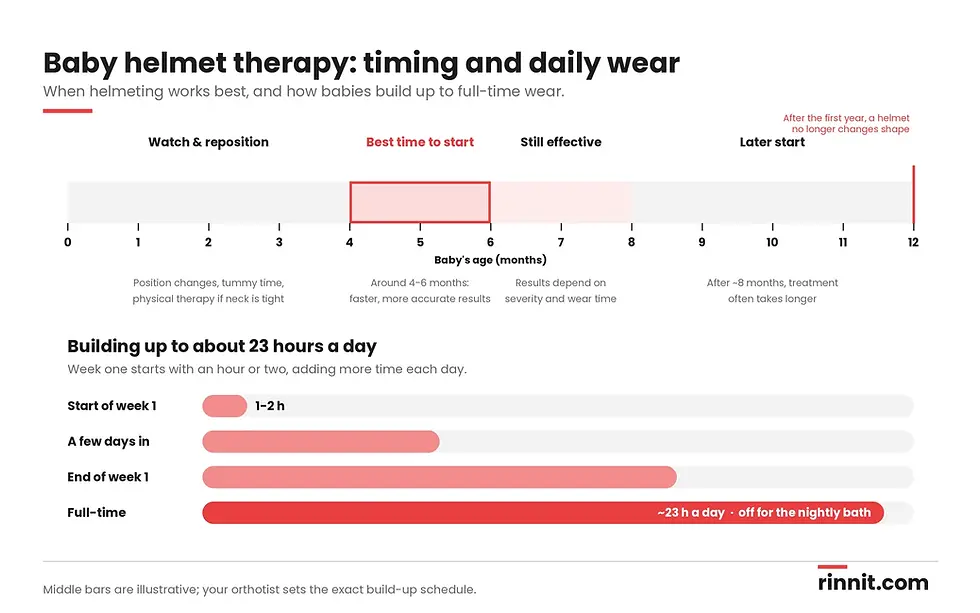
The best age to start helmet therapy is early infancy, after about 4 months and ideally around 4 to 6 months, when head growth is fastest. [1]
Starting in this window generally gives faster, more accurate results. After about 8 months, treatment often takes longer and may not work as well, and after the first year a helmet will no longer change head shape. [1]
The research points the same way. In one large study, each extra month of age at the start was linked to higher odds of leftover flattening. [5] In another, babies who started before 24 weeks (about 5.5 months), or who had milder flattening, improved quickly and reached a near-plateau by about 12 weeks of treatment, while later or more severe cases kept improving more slowly. [6]
How many hours a day does a baby wear a helmet?
A baby wears the helmet for about 23 hours a day once fully adjusted, taking it off mainly for the nightly bath. [1]
You do not start at full time. During the first week, your baby wears it for an hour or two and adds more time each day. Most babies get used to it very quickly. [1]
Stage | Daily wear | What to do |
Start of week 1 | 1–2 hours | Watch the skin after each session |
Rest of week 1 | A little more each day | Follow your orthotist's schedule |
Full time | About 23 hours | Remove for the nightly bath and cleaning |
Table: Building up to full-time helmet wear. [1]
How long does helmet therapy take?
Helmet therapy usually takes several months, depending on your baby's age at the start, growth rate and how severe the flattening is. [1]
Babies who start younger often need the helmet for a shorter time, while those who start after about 8 months often need longer. [1] In published studies, average treatment lasted about 5 months (21.2 weeks) in one group of 159 infants [6] and about 6.4 months in a group with moderate to severe flattening. [4]
Factor | Shorter treatment | Longer treatment |
Age at start | Younger (around 4–6 months) | Older (after ~8 months) |
Severity | Milder flattening | More severe flattening |
Growth rate | Fast head growth | Slower head growth |
What are the benefits and downsides of a baby helmet?
The main benefit of a baby helmet is a more even head shape, while the main downside is the daily time and effort it takes. Helmets may also not fully correct very severe flattening. [1]
Benefits | Downsides |
Redirects growth into flat areas and improves head shape | Must be worn up to 23 hours a day, every day |
Faster, more accurate results when started around 4–6 months | Older babies often need longer treatment, with less success |
Helps when repositioning or physical therapy is not enough | Frequent follow-up visits and helmet care take time and energy |
Can make standard eyeglasses or a bike helmet easier to wear later | May not fully correct severe deformities |
Table: Pros and cons of helmet therapy. [1]
How do I care for my baby's helmet and skin?
You care for your baby's helmet by checking the scalp every day, cleaning the helmet during the nightly bath, and keeping all fitting appointments. [1]
Clean it daily. Wipe the helmet with an alcohol wipe or gentle detergent while it is off for bath time. [1]
Check the skin daily. Look for discoloration or sores on the scalp. [1]
Stay consistent. The helmet works best when worn the full 23 hours. [1]
Leave fitting to the professionals. Have adjustments made at follow-up visits, not at home. [1]
Make it theirs. Stickers or decals are a simple way to personalize the helmet. [1]
The helmet should not be uncomfortable. Mild indentations or skin changes that fade within a few minutes of removing it are normal. [1]
When should I call the orthotist or doctor?
You should call your baby's orthotist right away if the helmet causes skin problems, signs of infection, a poor fit, or distress you cannot soothe. [1]
Warning sign | Examples |
Skin irritation | Redness or discoloration that does not fade, sores, swelling |
Possible infection | Fever, warmth or tenderness under the helmet, pus, foul odor |
Poor fit | Feels too tight or loose, shifts or slides often, leaves pressure marks |
Distress | Excessive fussiness or crying in the helmet, refusing to eat, not sleeping |
Pain | Signs of pain or discomfort usual soothing does not relieve |
Table: Signs that need a call to your baby's orthotist. [1]
How much does a baby helmet cost?
The cost of a baby helmet varies with the price of the helmet itself and the number of follow-up visits for adjustments. [1]
Insurance coverage also varies. Before starting, check which orthotic companies are in your plan's network and ask the orthotics company about any out-of-pocket costs. Some plans help cover the cost; others do not. [1]
Conclusion
A baby helmet is a temporary way to guide a flat or uneven head into a rounder shape, and it works best when started early in infancy and worn consistently. It treats appearance, not development, and it only has a window in the first year of life. If you notice a flat spot, raise it at your baby's next checkup so repositioning, physical therapy or a helmet referral can start while growth is on your side. The months of cleaning, checks and appointments are demanding, but they are temporary, and research shows that consistent wear leads to better results.
Next step: Bring up your baby's head shape at the next pediatric visit, and keep reading our parent guides, including safe sleep and SIDS prevention and craniosynostosis, on Rinnit.com.
FAQ
Why do babies wear helmets?
Babies wear helmets to correct a flat or uneven head shape while the skull is still growing quickly. The most common reasons are positional flat head (plagiocephaly or brachycephaly) and, after surgery, craniosynostosis. [1]
Does a baby helmet affect brain development?
No. A baby helmet improves the appearance of the head shape and does not affect your baby's development. [1]
What age is too late for a baby helmet?
After the first year of life, a helmet will no longer change head shape. Starting after about 8 months still works but often takes longer and may be less successful. [1]
Do babies sleep in their helmets?
Yes. Babies wear the helmet about 23 hours a day, including during sleep, and take it off mainly for the nightly bath. [1]
Is wearing a baby helmet painful?
No. A well-fitted helmet should not be uncomfortable, and most babies get used to it quickly. Call the orthotist if you see sores, lasting redness, or your baby seems to be in pain. [1]
Can a flat head fix itself without a helmet?
Mild flattening is usually first managed with more frequent position changes, and with physical therapy if the neck is tight. A helmet is considered when flattening is moderate to severe or does not improve. [1]
How long does a baby wear a helmet?
Most babies wear a helmet for several months. Treatment tends to be shorter when started younger and longer when started after about 8 months. [1]
How do you clean a baby helmet?
Clean the helmet daily during your baby's nightly bath, using an alcohol wipe or a gentle detergent as your orthotist instructs. [1]
How many hours a day does a baby wear a helmet?
Once fully adjusted, a baby wears the helmet about 23 hours a day. Most babies build up to this over the first week and take it off mainly for bath time.
Does insurance cover a baby helmet?
Coverage varies by plan. Before starting, check which orthotic companies are in your network and ask about any out-of-pocket costs.
Related Reading
Craniosynostosis: Symptoms, Causes, Diagnosis, and Treatment Explained explains early skull bone fusion and how it is treated.
Understanding Metopic Craniosynostosis and Trigonocephaly covers a type of craniosynostosis that causes a triangle-shaped forehead.
Skull Sutures: Anatomy, Function, and Growth explains how a baby's skull bones and seams grow.
Sudden Infant Death Syndrome (SIDS): Causes, Risk Factors, and Prevention explains SIDS and why safe back-sleeping matters.
References
Cleveland Clinic. Why Do Babies Wear Helmets? (Helmet Therapy & Your Baby). Cleveland Clinic. Last updated January 12, 2026. https://my.clevelandclinic.org/health/treatments/baby-helmet-for-flat-head
American Academy of Pediatrics. Baby Helmet Therapy: Parent FAQs. HealthyChildren.org. Last updated August 31, 2020. https://www.healthychildren.org/English/health-issues/conditions/Cleft-Craniofacial/Pages/Baby-Helmet-Therapy-Parent-FAQs.aspx
de Sousa YG, Marques Lopes TL, Soares ÁM, et al. Helmet versus non-helmet treatment in infants with positional cranial deformation: A systematic review and meta-analysis. J Clin Neurosci. 2025;139:111431. PMID 40578012. https://doi.org/10.1016/j.jocn.2025.111431
Kim J, Kim J, Chae KY. Effectiveness of Helmet therapy for infants with moderate to severe positional plagiocephaly. Clin Exp Pediatr. 2024;67(1):46-53. PMID 38062714. https://doi.org/10.3345/cep.2023.00626
Hauc SC, Long AS, Rivera JC, et al. Predictive Factors of Outcomes in Helmet Therapy for Deformational Plagiocephaly and Brachycephaly. J Craniofac Surg. 2023;34(1):231-234. PMID 36210494. https://doi.org/10.1097/SCS.0000000000009048
Tsugu W, Hikosaka M, Takamatsu A, et al. Serial Changes in Cranial Asymmetry During Helmet Therapy for Deformational Plagiocephaly. J Craniofac Surg. 2025;36(2):531-535. PMID 39785842. https://doi.org/10.1097/SCS.0000000000011042
Medical disclaimer
This article is for general educational purposes only and is not a substitute for professional medical advice, diagnosis or treatment. Always talk with your baby's pediatrician or a qualified healthcare provider about your child's head shape and any treatment decisions.



Comments