Aphasia: Signs, Causes, Diagnosis & Treatment — Complete Guide

Updated: 1 day ago
Medically reviewed by Dr. Baraa Alnahhal, MD · Last reviewed: October 2026
Quick Answer: What Is Aphasia?
Aphasia is a disorder that affects how you communicate, impairing speech, writing and the ability to understand spoken and written language. It usually happens suddenly after a stroke or head injury, and its severity depends on the cause and extent of brain damage [1]. Treatment addresses the underlying condition plus speech and language therapy to relearn skills and communicate differently [1] [2].
What the research says
Depression is common in people with post-stroke aphasia. A systematic review and meta-analysis of 16 studies found a pooled depression prevalence of 31.7% (95% CI 23.5–40.4%) among people with post-stroke aphasia. (Vogel-Eyny et al., BMC Neurol, 2025) [3]
Therapy that uses language for real communication helped in one trial. In a crossover randomized trial of 18 people with chronic non-fluent aphasia, Intensive Language-Action Therapy (speech practiced in social, communicative situations) significantly improved language test performance whenever it was given, while naming therapy tended to help only when given first; both were delivered at the same intensity of 3.5 hours per session over six consecutive working days. (Stahl et al., Cortex, 2016) [4]
Brain stimulation has not yet shown lasting benefit. A network meta-analysis of 7 randomized trials (249 patients) found no clear evidence that tDCS added to speech-language therapy improved naming of nouns or communication at follow-up compared with sham stimulation, and the authors called for longer-term trials. (You et al., NeuroRehabilitation, 2023) [5]
Speech and language therapy improves everyday communication after stroke. A Cochrane review of 57 randomized trials with 3,002 participants found that therapy improved functional communication, reading, writing, and expressive language compared with no therapy, and higher-intensity, higher-dose, or longer therapy gave better functional communication, although more people dropped out of the most intensive programs. (Brady et al., Cochrane Database Syst Rev, 2016) [6]
Intensive therapy helps even years after a stroke. In a randomized trial of 158 people aged 70 or younger who had aphasia for 6 months or more, 3 weeks of intensive therapy (at least 10 hours a week) significantly improved everyday verbal communication, while scores did not change in the group that waited. (Breitenstein et al., Lancet, 2017) [7]
The total amount of therapy matters. An analysis of individual data from 959 people in 25 randomized trials found that the greatest overall language gains were linked to a total of 20 to 50 hours of speech and language therapy, with the best schedule varying by age, severity, and time since stroke. (RELEASE Collaborators, Int J Stroke, 2022) [8]
Aphasia at a Glance
Feature | Summary |
Definition | A disorder affecting speech, writing, and understanding of spoken and written language [1] |
Most common cause | Stroke — brain damage from a blocked or ruptured blood vessel [1] |
Other causes | Severe head injury, tumor, infection, degenerative disease; primary progressive aphasia (gradual); temporary episodes from migraines, seizures, or TIA [1] |
Key signs | Short/incomplete sentences, nonsensical speech, word substitutions, word-finding trouble, poor comprehension of speech and writing [1] |
Emergency signal | Sudden speech or understanding trouble — may mean stroke; call emergency services [1] |
Complications | Job, relationships, and daily function; embarrassment, frustration, isolation, depression [1] |
Diagnosis | Physical/neurological exams, MRI or CT scan, speech-language pathologist assessment [2] |
Main treatment | |
Under study | Medications (memantine, donepezil, galantamine, piracetam) and brain stimulation (TMS, tDCS) — not yet recommended [2] |
What Is Aphasia?
Aphasia is a disorder that affects how you communicate. It can impact your speech, as well as the way you write and understand both spoken and written language [1].
An important framing up front: aphasia is a symptom of some other condition — such as a stroke or a brain tumor [1]. It is not a disease in itself.
Two things determine how much aphasia affects someone: the cause and the extent of the brain damage [1]. Severity varies widely — some people have subtle word-finding trouble, while others can barely communicate at all.
How it begins also varies:

What are the eight signs of aphasia?
Aphasia signs include short or nonsensical sentences, swapped words or sounds, unrecognizable words, trouble finding words, and difficulty understanding conversation, reading or writing.
Speak in short or incomplete sentences [1]
Speak in sentences that don't make sense [1]
Substitute one word for another or one sound for another [1]
Speak unrecognizable words [1]
Have difficulty finding words [1]
Not understand other people's conversation [1]
Not understand what they read [1]
Write sentences that don't make sense [1]
Patterns of Aphasia: Types and Their Limits
People with aphasia may have different strengths and weaknesses in their speech patterns. Sometimes these patterns are labeled as different types, including:
These labels describe how well the person can understand what others say, how easy it is for them to speak, and how easily they can correctly repeat what someone else says.
One caveat matters: many people with aphasia have patterns of speech difficulty that don't match these types [1]. It may help to consider that each person with aphasia has unique symptoms, strengths and weaknesses rather than trying to label a particular type.
When to See a Doctor — This Is Often an Emergency
Because aphasia is often a sign of a serious problem such as a stroke, seek emergency medical care if you or a loved one suddenly develops [1]:
Difficulty speaking
Trouble understanding speech
Difficulty with word recall
Problems with reading or writing
What causes aphasia by damaging the brain's language centers?
The most common cause of aphasia is brain damage resulting from a stroke — the blockage or rupture of a blood vessel in the brain [1]. Loss of blood to the brain leads to brain cell death or damage in areas that control language [1].
About one third of people who have a stroke develop aphasia [6].
Other causes include:
Cause | Notes |
Severe head injury | Usually occurs with other cognitive problems, such as memory problems or confusion [1] |
Brain tumor | Slow-growing tumors cause gradual-onset aphasia [1] |
Infection | Usually with memory problems or confusion |
Degenerative process | Gradual, progressive damage; may affect memory and thinking too |
Primary progressive aphasia | Language difficulty that develops gradually from gradual degeneration of brain cells located in the language networks; sometimes progresses to a more generalized dementia [1] |
Migraines, seizures, or TIA | Can cause temporary episodes of aphasia. A transient ischemic attack (TIA) occurs when blood flow is temporarily blocked to an area of the brain — and people who have had a TIA are at an increased risk of having a stroke in the near future [1] |
What are the complications of aphasia?
Aphasia can create numerous quality-of-life problems because communication is so much a part of your life. Communication difficulty may affect your:
Job
Relationships
Day-to-day function
Difficulty expressing wants and needs can result in embarrassment, frustration, isolation and depression [1]. Other problems may occur together, such as more difficulty moving around and problems with memory and thinking [1].
How is aphasia diagnosed?
Your health care provider will likely begin with physical and neurological exams — testing your strength, feeling and reflexes, and listening to your heart and the vessels in your neck [2].
An imaging test, usually an MRI or CT scan, can be used to quickly identify what's causing the aphasia [2].
The Language Assessment
A speech-language pathologist can complete a comprehensive language assessment to confirm the presence of aphasia and determine the appropriate course of language treatment [2]. The assessment helps find out whether the person can:
Name common objects
Engage in a conversation
Understand and use words correctly
Answer questions about something read or heard
Repeat words and sentences
Follow instructions
Answer yes-no questions and respond to open-ended questions about common subjects
Read and write
What are the treatment options for aphasia?
If the brain damage is mild, it's possible to recover language skills without treatment [2]. However, most people undergo speech and language therapy to rehabilitate their language skills and supplement their communication experiences [2].
A realistic expectation: recovery of language skills is usually a slow process. Although most people make significant progress, few people regain full pre-injury communication levels [2].
Speech and language therapy aims to improve the ability to communicate by doing three things: restoring as much language as possible, teaching how to make up for lost language skills, and finding other methods of communicating [2].
Three Features of Effective Therapy
Feature | Why It Helps |
Therapy starts early | Some studies have found therapy is most effective when it begins soon after the brain injury [2] |
Often works in groups | A safe environment to practice starting conversations, speaking in turn, clearing up confusion, and fixing conversations that have broken down [2] |
May include computers | Computer-assisted therapy is especially helpful for relearning verbs and word sounds (phonemes) [2] |
Medications (Still Under Study)
Certain drugs are being studied for the treatment of aphasia — drugs that may improve blood flow to the brain, enhance the brain's recovery ability, or help replace depleted chemicals in the brain (neurotransmitters) [2].
Several medications — memantine (Namenda), donepezil (Aricept, Adlarity), galantamine (Razadyne ER) and piracetam — have shown promise in small studies. But more research is needed before these treatments can be recommended [2].
Brain Stimulation (Still Under Study)
Brain stimulation is being studied for aphasia treatment and may help improve the ability to name things, but no long-term research has been done yet [2]. Two noninvasive approaches — transcranial magnetic stimulation (magnetic fields) and transcranial direct current stimulation (low current through electrodes placed on the head) — aim to stimulate damaged brain cells.
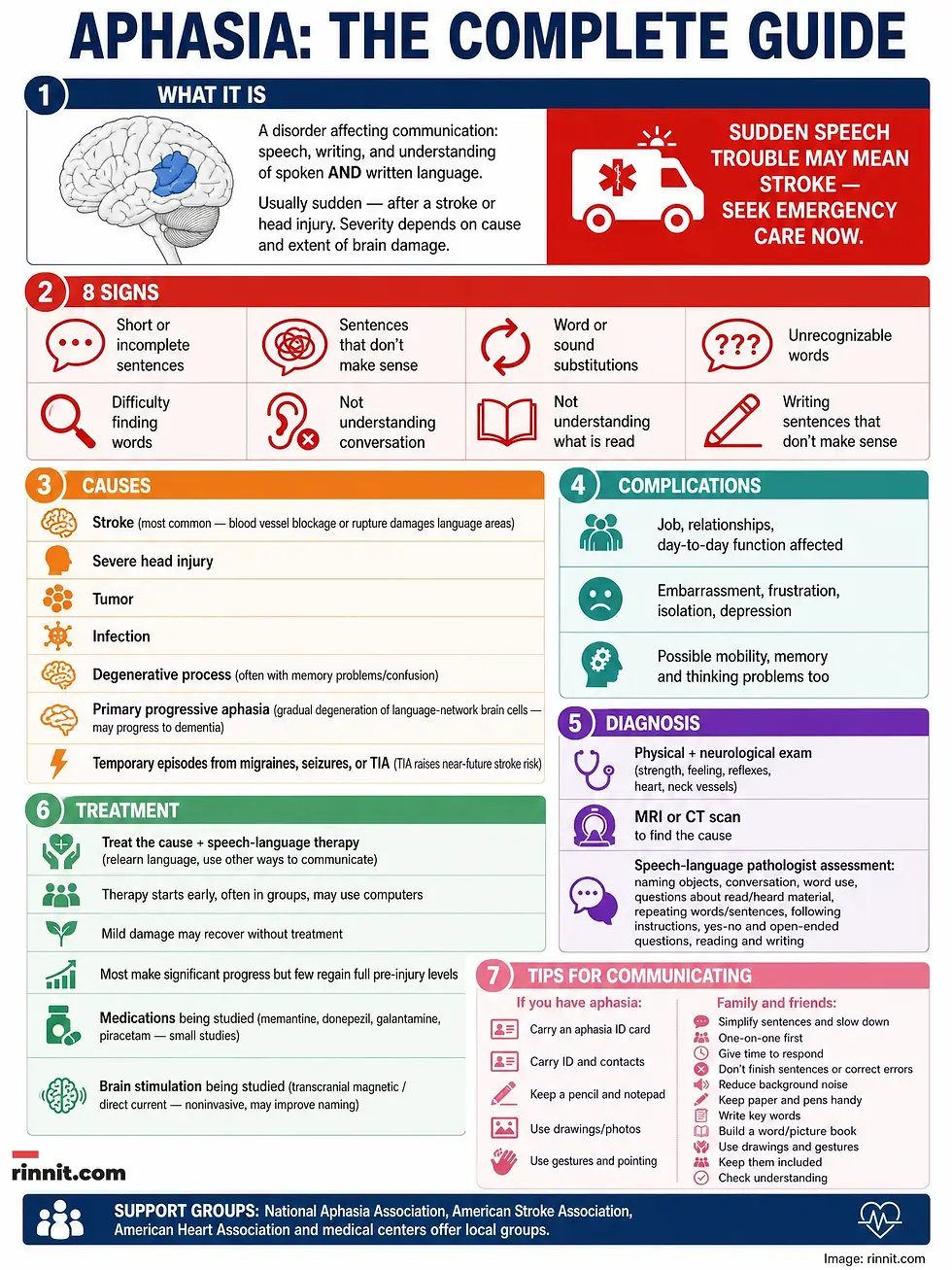
What coping and support tips help people with aphasia?
People with aphasia can communicate more easily by carrying an aphasia card, paper and a pencil, while family and friends help by simplifying sentences and allowing time to respond.
If You Have Aphasia
The following tips may help you communicate with others:
Carry a card explaining that you have aphasia and what aphasia is.
Carry identification and information on how to contact significant others.
Carry a pencil and a small pad of paper with you at all times.
Use drawings, diagrams or photos as shortcuts.
Use gestures or point to objects.
How Family and Friends Can Help
Family members and friends play an enormous role in daily communication. The following tips can make every conversation easier:
Simplify your sentences and slow your pace.
Keep conversations one-on-one initially.
Allow the person time to respond.
Don't finish sentences or correct errors — though it's OK to ask confirming questions, such as, "Are you saying you want juice?"
Reduce distracting noise in the environment.
Keep paper and pencils or pens available.
Write a key word or a short sentence to help explain something.
Help the person create a book of words, pictures and photos to assist with conversations.
Use drawings or gestures when you aren't understood.
Involve the person with aphasia in conversations as much as possible.
Check for comprehension or summarize what you've discussed.
Support Groups
Local chapters of organizations such as the National Aphasia Association, the American Stroke Association, the American Heart Association, and some medical centers may offer support groups for people with aphasia and others affected by the disorder [2]. These groups provide a sense of community and a place to air frustrations and learn coping strategies. Ask your health care provider or speech-language pathologist about local support groups.
How should you prepare for an aphasia appointment?
If your aphasia is due to a stroke or head injury, you'll probably first be seen in an emergency room, then see a doctor who specializes in disorders of the nervous system (neurologist), and may eventually be referred to a speech-language pathologist for rehabilitation [2].
Because this condition generally arises as an emergency, you won't have time to prepare. If possible, bring the medications or supplements you take with you to the hospital so the health care team is aware of them.
For follow-up appointments, you'll likely need someone to take you — and that person can help you communicate with your health care provider.
Six Questions a Loved One May Ask
What's the most likely cause of these speech difficulties?
Are tests needed?
Is aphasia temporary or long lasting?
What treatments are available for aphasia, and which do you recommend?
Are there services available, such as speech-language therapy or home health assistance?
Are there ways to help my loved one understand others or communicate more effectively?
Six Questions Your Doctor Will Ask
When did the symptoms start?
Do you understand what others are saying?
Do others understand what you're saying?
Has the aphasia been continuous, or does it come and go?
Have you noticed changes in your speech — such as the way you move your jaw, tongue and lips to make speech sounds — or the sound of your voice?
Have you noticed changes in your ability to understand what you read or your ability to spell and write sentences?
Frequently Asked Questions (FAQ)
What is aphasia?
Aphasia is a disorder that affects how you communicate — it can impact speech, writing, and understanding of both spoken and written language. It is a symptom of some other condition, such as a stroke or brain tumor, and usually happens suddenly after brain injury.
What causes aphasia?
The most common cause is brain damage from a stroke — the blockage or rupture of a blood vessel damages the brain areas that control language. Severe head injury, tumors, infections, and degenerative diseases can also cause it. Temporary episodes can come from migraines, seizures, or a TIA [1].
Is sudden trouble speaking a medical emergency?
Yes. Because aphasia is often a sign of a serious problem such as a stroke, seek emergency medical care immediately if you or a loved one suddenly develops difficulty speaking, trouble understanding speech, difficulty with word recall, or problems with reading or writing.
What are the different types of aphasia?
Patterns include Broca's, Wernicke, transcortical, conduction, mixed, and global aphasia (sudden onset), and logopenic, semantic, and agrammatism (slow-developing). But many people's symptoms don't match these labels — each person has unique strengths and weaknesses, so treatment is individualized.
Can aphasia be cured?
There is no quick cure, but recovery is possible. If brain damage is mild, language skills may return without treatment. Most people undergo speech and language therapy and make significant progress — though few regain full pre-injury communication levels [2].
What does speech and language therapy for aphasia involve?
Therapy aims to restore as much language as possible, teach ways to compensate for lost skills, and find other methods of communicating. It works best when it starts early after the injury, often happens in groups for safe practice, and may include computers for relearning verbs and word sounds.
Can family members really help with aphasia?
Absolutely. The most effective daily strategies: simplify sentences and slow down, keep conversations one-on-one at first, allow time to respond, avoid finishing sentences or correcting errors, reduce background noise, use drawings and gestures, keep paper and pens handy, and help build a word-and-picture book. Involving the person in conversations — and checking comprehension — keeps them connected.
Does aphasia affect intelligence?
No. Aphasia affects language, such as speaking, understanding, reading and writing, but not intelligence. People with aphasia usually still know what they want to say.
How long does it take to recover from aphasia?
Recovery time varies by cause and how much of the brain is affected. Many people improve most in the first months after a stroke, and progress can continue for years with speech and language therapy.
What is primary progressive aphasia?
Primary progressive aphasia is a rare form caused by a disease that slowly damages the brain's language areas. Unlike aphasia after a stroke, it starts gradually and worsens over time.
Conclusion: Recovery Is a Team Effort
The main lessons from this guide are:
Aphasia is a communication disorder with a physical cause — damage to the brain's language areas, most often from stroke. Sudden speech or understanding trouble is a warning sign that demands emergency care, not a wait-and-see moment.
Severity and path are individual: the cause and extent of damage set the stage, and while named "types" exist, each person's symptoms, strengths, and weaknesses are unique.
Progress is real, if gradual: most people make significant gains with early speech and language therapy — and family communication strategies, support groups, and practical workarounds (ID cards, notepads, drawings, gestures) are powerful tools that cost nothing.
We hope this complete guide has helped you understand what aphasia is, why speed matters, and how therapy and family teamwork rebuild communication.
Disclaimer: This article is for informational purposes only and is not a substitute for professional medical advice, diagnosis, or treatment. Always seek the advice of your physician or other qualified health provider with any questions you may have regarding a medical condition.
Related Reading
Stroke: Symptoms, Causes, Diagnosis, and Treatment — A Complete Guide explains stroke warning signs, the most common cause of aphasia.
Primary Progressive Aphasia: Symptoms, 3 Variants, Causes & Treatment explains the gradually worsening form of aphasia and its three variants.
Broca's Aphasia: What It Is, Why It Happens, and How Speech Therapy Helps explains the type of aphasia that makes speaking slow and effortful.
Wernicke's Aphasia (Receptive Aphasia): Symptoms, Causes, and Recovery explains the type of aphasia that makes understanding language hard.
References
Mayo Clinic. Aphasia — Symptoms & causes. Accessed October 12, 2026. https://www.mayoclinic.org/diseases-conditions/aphasia/symptoms-causes/syc-20369518
Mayo Clinic. Aphasia — Diagnosis & treatment. Accessed October 12, 2026. https://www.mayoclinic.org/diseases-conditions/aphasia/diagnosis-treatment/drc-20369523
Vogel-Eyny A, Jung YJ, Hyun J, et al. Prevalence of depression in post-stroke aphasia: systematic review and meta-analysis. BMC Neurol. 2025;26(1):43. PMID 41388458. https://doi.org/10.1186/s12883-025-04570-1
Stahl B, Mohr B, Dreyer FR, et al. Using language for social interaction: communication mechanisms promote recovery from chronic non-fluent aphasia. Cortex. 2016;85:90-99. PMID 27842269. https://doi.org/10.1016/j.cortex.2016.09.021
You Y, Li Y, Zhang Y, et al. Long-term effects of transcranial direct current stimulation (tDCS) combined with speech language therapy (SLT) on post-stroke aphasia patients: a systematic review and network meta-analysis of randomized controlled trials. NeuroRehabilitation. 2023;53(3):285-296. PMID 37781820. https://doi.org/10.3233/NRE-230099
Brady MC, Kelly H, Godwin J, Enderby P, Campbell P. Speech and language therapy for aphasia following stroke. Cochrane Database Syst Rev. 2016;2016(6):CD000425. PMID 27245310. https://doi.org/10.1002/14651858.CD000425.pub4
Breitenstein C, Grewe T, Flöel A, et al. Intensive speech and language therapy in patients with chronic aphasia after stroke: a randomised, open-label, blinded-endpoint, controlled trial in a health-care setting. Lancet. 2017;389(10078):1528-1538. PMID 28256356. https://doi.org/10.1016/S0140-6736(17)30067-3
RELEASE Collaborators; Brady MC, Ali M, et al. Precision rehabilitation for aphasia by patient age, sex, aphasia severity, and time since stroke? A prespecified, systematic review-based, individual participant data, network, subgroup meta-analysis. Int J Stroke. 2022;17(10):1067-1077. PMID 35422175. https://doi.org/10.1177/17474930221097477



Comments