Primary Progressive Aphasia: Symptoms, 3 Variants, Causes & Treatment

Updated: 2 days ago
Medically reviewed by Dr. Baraa Alnahhal, MD · Last reviewed: October 2026
Quick Answer: What Is Primary Progressive Aphasia?
Primary progressive aphasia (PPA) is a rare nervous system condition that gradually impairs a person's ability to communicate, including expressing thoughts, understanding and finding words. Symptoms often begin before age 65 and worsen over time. It is usually grouped with frontotemporal dementia. There is no cure or medication, but speech and language therapy can help people manage for years.
What the research says
Three variants are defined by speech and language features. An international consensus group developed criteria for the three PPA variants — nonfluent/agrammatic, semantic and logopenic — in which patients are first diagnosed with PPA and then classified by their characteristic speech and language features, with the classification further specified as "imaging-supported" when the expected pattern of atrophy is found. (Gorno-Tempini et al., Neurology, 2011) [3]
The variant helps predict what is happening in the brain. In a meta-analysis of 1,251 patients from 36 centers, amyloid-β positivity was found in 86% of those with the logopenic variant versus 20% with the nonfluent and 16% with the semantic variant (P<0.001); at autopsy, Alzheimer disease pathology was the most common diagnosis in the logopenic variant (76%) and frontotemporal lobar degeneration with TDP-43 in the semantic variant (80%). (Bergeron et al., Ann Neurol, 2018) [4]
There is still no proven drug or device treatment. A meta-analysis of randomized controlled trials found no significant overall difference between noninvasive brain stimulation and sham on naming and fluency tasks in PPA, whether given alone or alongside speech and language therapy; the authors caution that the number of studies was low and the samples small. (Lomi et al., Neuropsychol Rev, 2025) [5]
At a Glance
Feature | Summary |
Definition | A rare nervous system condition causing gradual, worsening loss of the ability to communicate |
Typical onset | Gradual, often before age 65 |
Classification | A type of frontotemporal dementia |
The 3 variants | Semantic, logopenic, nonfluent-agrammatic |
Cause | Brain lobe atrophy (frontal, temporal, or parietal — mainly left side), linked to certain brain proteins |
Risk factors | Childhood learning disability (e.g., dyslexia); rare gene changes |
Complications | Loss of speech/writing in 3–15 years, memory/planning problems, movement/balance/swallowing issues, depression, blunted emotions, poor judgment |
Diagnosis | Neurological/speech-language/neuropsychological exams; blood tests and lumbar puncture; genetic tests; MRI; FDG PET and other PET scans |
Treatment | No cure, no medicines; speech and language therapy (may slow some symptoms); physical and occupational therapy |
Prevention | None known — brain health habits (GROWTH) may help general brain health |
What Is Primary Progressive Aphasia?
Primary progressive aphasia is a rare nervous system condition that affects a person's ability to communicate. People who have it can have trouble expressing their thoughts and understanding or finding words.
What sets it apart from other forms of aphasia is the timeline:
Symptoms develop gradually, often before age 65.
They get worse over time.
People with PPA can lose the ability to speak and write — and eventually not be able to understand written or spoken language.
The pace offers some reassurance: this condition progresses slowly. People who have it may continue caring for themselves and participating in daily activities for several years.
How PPA Relates to Frontotemporal Dementia
PPA is a type of frontotemporal dementia (although the logopenic form is most often caused by Alzheimer's disease) — a cluster of conditions that result from the degeneration of the frontal or temporal lobes of the brain. These areas include brain tissue involved in speech and language.
Two clarifications help here:
Not all people with PPA have dementia, but most develop it.
The term "dementia" is typically not used until a person can't do things alone due to changes in their thinking and understanding.
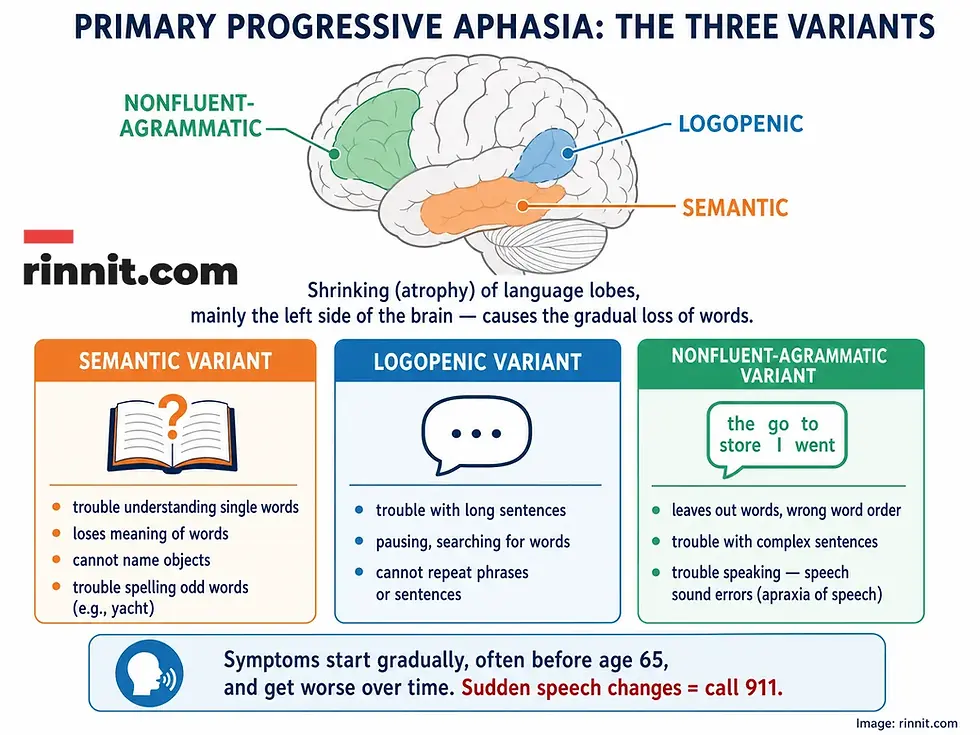
What are the symptoms of the three variants of primary progressive aphasia?
Primary progressive aphasia symptoms vary based on which part of the brain's language areas are involved. The condition has three types, and each causes different symptoms. Symptoms develop over time and gradually get worse.
Variant | What Happens |
Semantic variant PPA | Trouble understanding spoken or written language — particularly single words; trouble understanding the meaning of words; not being able to name objects; trouble spelling words, especially those not spelled the way they sound (such as the word "yacht") |
Logopenic variant PPA | Trouble understanding spoken language — particularly long sentences; pausing and hesitating to search for words while speaking; not being able to repeat phrases or sentences |
Nonfluent-agrammatic variant PPA | Leaving out words or putting words in the wrong order in written and spoken language; trouble understanding complex sentences; trouble speaking — including making errors in speech sounds, known as apraxia of speech |
A Related Condition Worth Knowing
Primary progressive apraxia of speech is related to primary progressive aphasia. However, people with this condition don't have trouble with language — they have problems speaking, including making errors in speech sounds or having trouble saying words quickly.
When to See a Doctor
See your healthcare professional if you have concerns about your ability to communicate. If a family member or friend shows symptoms, talk to the person about your concerns and offer to go with them to see a healthcare professional.
One critical rule: if changes in speech or communication come on suddenly, call 911 or your local emergency number. Sudden changes point to other causes — such as stroke — that need immediate care.
How does brain shrinkage in language areas cause primary progressive aphasia?
Primary progressive aphasia is caused by a shrinking of certain areas of the brain, known as lobes. In PPA, the frontal, temporal or parietal lobes are affected. When areas of the brain shrink, it's called atrophy.
Three details define the damage:
The atrophy caused by PPA mainly happens on the left side of the brain — the side where the affected areas are responsible for speech and language.
Atrophy is linked to the presence of certain proteins in the brain.
These proteins may reduce brain activity or function.
Risk Factors
Two factors are known to raise the risk of developing PPA:
Learning disabilities. People who had a childhood learning disability such as dyslexia may have a higher risk of developing primary progressive aphasia.
Certain gene changes. Although PPA most often happens randomly, rare gene changes have been linked to the condition. If other members of your family have had PPA, consider genetic testing to see if you are more likely to develop it.
What complications of primary progressive aphasia can be expected over time?
People with primary progressive aphasia eventually lose the ability to speak and write — this may take anywhere from 3 to 15 years. They also have trouble understanding written and spoken language.
As the disease progresses, the reach widens:
Other mental skills such as memory, planning and organizing can be affected.
Some people develop problems with movement, balance and swallowing — and with these complications, people eventually need help with day-to-day care.
People can develop depression as the disease progresses.
Other complications might include blunted emotions (such as not showing concern), poor judgment, or social behavior that's not appropriate.
How is primary progressive aphasia (PPA) diagnosed?
A neurologist or speech-language pathologist will likely review your symptoms and order tests. One finding is especially telling: communication troubles that get worse without significant changes in thinking and behavior for 2 to 3 years are a hallmark of primary progressive aphasia.
Test | What It Does |
Neurological exam | May include a speech-language evaluation and a neuropsychological evaluation; tests measure speech, language comprehension and skills, plus recognition and naming of objects, recall, and other factors |
Blood and body fluid tests | Blood tests or a lumbar puncture (spinal tap) check for infections or other medical conditions; genetic tests can determine whether gene changes linked to PPA or other neurological conditions are present |
Brain MRI | Helps diagnose PPA by detecting shrinking of specific areas of the brain; also detects strokes, tumors, and other conditions that affect brain function |
FDG PET scan | A fluorodeoxyglucose positron emission tomography scan shows brain function — changes in how the brain uses glucose in language-related areas |
Other PET scans | May look for the presence of certain proteins linked to Alzheimer's disease |
What are the treatment options for primary progressive aphasia?
An honest starting point: primary progressive aphasia can't be cured, and there are no medicines to treat it. However, some therapies might help improve or maintain your ability to communicate and manage your condition.
Speech and Language Therapy
Working with a speech-language pathologist, focusing primarily on ways to make up for lost language skills, can be helpful.
Three realities are worth knowing:
Therapy can't stop the progression of the condition, but it can help you manage your condition.
The therapy may slow the progression of some symptoms.
Your therapist may recommend that your caregivers also attend the appointments — communication is a two-person skill.
Physical and Occupational Therapy
If symptoms affect movement and balance, working with a physical therapist and an occupational therapist can help manage the symptoms.

How can caregivers cope with primary progressive aphasia and find support?
Losing the ability to communicate can be stressful and frustrating — for both the person with PPA and for friends and family. If you're a caregiver, these steps can help everyone cope:
Learn all you can about the condition.
Have the person carry an identification card and other materials that can help explain the condition to others.
Give the person time to talk.
Speak slowly in simple, adult sentences and listen carefully.
Talk with the person about how you can help.
Take care of your personal needs — get enough rest and make time for social activities.
Planning Ahead — Early
Family members eventually may need to make long-term care choices, plan the person's finances, and help make legal decisions to prepare for more-serious stages of the condition. Start this process early so the person with PPA can be involved in their own decisions.
Support Groups
Support groups may be offered for caregivers and people with PPA or related conditions. Ask your social worker or other members of your healthcare team about community resources. Other sources of information include the National Aphasia Association and the Association for Frontotemporal Degeneration.
Can PPA Be Prevented?
There is no known way to prevent primary progressive aphasia. However, you can keep your brain healthy by using the GROWTH approach:
Letter | Brain-Health Habit |
G | Get quality sleep |
R | Reduce stress |
O | Open connections |
W | Work out |
T | Try new things |
H | Healthy eating |
How should you prepare for a primary progressive aphasia appointment?
If you're experiencing symptoms, you might start by seeing your primary healthcare professional, who may refer you to a doctor trained in brain and nervous system conditions (neurologist) and possibly a speech-language pathologist.
What You Can Do
Be aware of anything you need to do ahead of time — ask if there's anything to do in advance, such as restricting your diet.
Write down symptoms you have, including any that may not seem related.
Write down important personal information, including major stresses or recent life changes.
Make a list of all medicines, vitamins and supplements you're taking and the doses.
Take a family member or friend along — it can be very hard to remember all the information provided during an appointment.
Write down questions to ask your healthcare team.
Eleven Questions to Ask
What's likely causing my symptoms?
What tests do I need?
Is my condition likely temporary or ongoing?
Should I see a specialist?
Should I consider genetic testing?
Are there brochures or other printed material I can have? What websites do you recommend?
What's the best course of action?
Are there other choices to the primary approach you're suggesting?
I have other health conditions. How can I best manage them together?
Are there restrictions I need to follow?
What is going to happen to me over time?
Don't hesitate to ask other questions.
Nine Questions Your Doctor Will Ask
When did your symptoms begin?
What symptoms came first?
Have you had any new symptoms?
Have your symptoms come and gone or stayed steady?
How bad are your symptoms?
Have your symptoms gotten worse?
What, if anything, seems to make your symptoms better?
What, if anything, seems to make your symptoms worse?
Have other family members had similar conditions?
Frequently Asked Questions (FAQ)
What is primary progressive aphasia?
Primary progressive aphasia (PPA) is a rare nervous system condition that gradually affects a person's ability to communicate — expressing thoughts, understanding, and finding words. It is usually grouped with frontotemporal dementia (the logopenic form is most often due to Alzheimer's disease), and while most people with PPA eventually develop dementia, the term dementia is used only when a person can no longer do things alone.
How is PPA different from aphasia after a stroke?
Stroke-related aphasia usually happens suddenly after brain injury. PPA develops gradually — symptoms worsen slowly over years, often beginning before age 65. Sudden speech or communication changes are never PPA — call 911, because they may signal a stroke.
What are the three variants of PPA?
The semantic variant involves losing word meanings and object names; the logopenic variant involves pausing to search for words and inability to repeat phrases; the nonfluent-agrammatic variant involves leaving out words, wrong word order, and speech-sound errors (apraxia of speech).
What causes primary progressive aphasia?
PPA is caused by atrophy (shrinking) of the frontal, temporal, or parietal lobes — mainly the left side of the brain, where speech and language areas live. The atrophy is linked to certain brain proteins that may reduce brain activity or function.
Are there risk factors for PPA?
Two known risk factors: a childhood learning disability such as dyslexia, and rare gene changes. Because PPA most often happens randomly, genetic testing is mainly worth considering if the condition has occurred in your family.
Can PPA be treated or cured?
There is no cure and no medicines for PPA. Speech and language therapy helps people make up for lost language skills and may slow some symptoms; a speech-language pathologist may recommend caregivers attend sessions too. Physical and occupational therapy can help if movement or balance problems develop.
How should families plan for the future?
Start early: make long-term care choices, financial plans, and legal decisions while the person can still be involved. Give the person time to talk, speak slowly in simple sentences, help them carry an ID card explaining the condition, and care for your own well-being. Support groups through the National Aphasia Association and the Association for Frontotemporal Degeneration can help.
How is primary progressive aphasia diagnosed?
Diagnosis uses neurological, speech-language, and thinking tests, along with brain imaging such as MRI or PET scans. Blood tests, a spinal tap, or genetic tests are sometimes added.
Is primary progressive aphasia a type of dementia?
Yes. PPA is usually grouped with frontotemporal dementia, although the logopenic form is most often caused by Alzheimer's disease.
How fast does primary progressive aphasia get worse?
PPA usually gets worse slowly over several years, and the pace varies from person to person. A care team can help plan for changes as they happen.
Conclusion: Slowing the Loss, Preserving the Connection
The main lessons from this guide are:
PPA is a gradual thief of language — it creeps in, often before age 65, variant by variant: losing word meanings, searching for words, or dropping words in the wrong order. The slow pace means years of daily-life participation, but preparation matters.
Diagnosis relies on a clear pattern: communication troubles worsening for 2–3 years without major thinking or behavior changes, confirmed by exams, scans (MRI, PET), and fluid and genetic tests.
Help is real, even without a cure: speech and language therapy focused on compensation, caregiver involvement, early planning, and support communities together preserve communication and dignity for as long as possible.
We hope this complete guide has helped you understand what primary progressive aphasia is, how it differs from sudden aphasia, and what families can do.
Medical disclaimer: This article is for general educational and informational purposes only and does not constitute medical advice. Please consult a qualified healthcare professional for diagnosis and treatment of any health condition.
Related Reading
Aphasia Explained: Causes, Types, Symptoms, and How Speech Therapy Helps You Find Your Words Again explains the different types of aphasia and how therapy helps.
Speech Therapy: What It Is, Who Needs It, and How It Works describes how speech-language therapy supports communication skills.
Alzheimer's Disease: Symptoms, Causes, Treatment & Complete Guide explains Alzheimer's disease, which causes most logopenic PPA.
Early-Onset Alzheimer's Disease (EOAD): Symptoms, Causes, Genetics, Diagnosis, Treatment and When to See Your Provider — What You Need to Know covers Alzheimer's disease that begins before age 65.
References
Mayo Clinic Staff. Primary progressive aphasia - Symptoms and causes. Mayo Clinic. February 7, 2025. https://www.mayoclinic.org/diseases-conditions/primary-progressive-aphasia/symptoms-causes/syc-20350499
Mayo Clinic Staff. Primary progressive aphasia - Diagnosis and treatment. Mayo Clinic. February 7, 2025. https://www.mayoclinic.org/diseases-conditions/primary-progressive-aphasia/diagnosis-treatment/drc-20350504
Gorno-Tempini ML, et al. Classification of primary progressive aphasia and its variants. Neurology. 2011;76(11):1006-1014. PMID 21325651. https://doi.org/10.1212/WNL.0b013e31821103e6
Bergeron D, et al. Prevalence of amyloid-β pathology in distinct variants of primary progressive aphasia. Ann Neurol. 2018;84(5):729-740. PMID 30255971. https://doi.org/10.1002/ana.25333
Lomi F, et al. Noninvasive Brain Stimulation in Primary Progressive Aphasia with and Without Concomitant Speech and Language Therapy: Systematic Review and Meta-analysis. Neuropsychol Rev. 2025;35(4):617-643. PMID 39893271. https://doi.org/10.1007/s11065-025-09659-5



Comments