Broca's Aphasia: What It Is, Why It Happens, and How Speech Therapy Helps

Updated: 3 days ago
Medically reviewed by Dr. Baraa Alnahhal, MD. Last reviewed October 17, 2026. This content is for educational purposes and is not medical advice.

Quick Answer
Broca's aphasia is an expressive language disorder in which you know what to say but have trouble speaking, while understanding is largely preserved [1] [2]. It is caused by damage to Broca's area, most commonly from an ischemic stroke [1]. There is no cure, but with speech therapy language skills often improve within two to six months after a stroke.
What the research says
Speech and language therapy helps people with aphasia after a stroke. In a Cochrane review of 57 randomized trials with 3,002 participants, therapy beat no therapy for functional communication (standardized mean difference 0.28, 95% CI 0.06 to 0.49; 27 comparisons, 1,620 participants). People who received therapy at a higher intensity, dose, or over a longer period did better, although more of them dropped out (Brady et al., Cochrane Database Syst Rev, 2016) [6].
Melodic intonation therapy showed promise for non-fluent aphasia, but the evidence is small. In a meta-analysis of 4 randomized trials with 94 patients, it improved functional communication (standardized mean difference 1.47, 95% CI 0.39 to 2.56) and repetition (0.45, 95% CI 0.01 to 0.90), with no significant effect on comprehension. The authors called for larger trials (Haro-Martínez et al., Front Neurol, 2021) [7].
Depression is common in post-stroke aphasia. Pooling 16 studies, researchers estimated that 31.7% (95% CI 23.5% to 40.4%) of people with post-stroke aphasia had depression, which is why mood screening and support matter (Vogel-Eyny et al., BMC Neurol, 2026) [8].
What Is Broca's Aphasia?
Broca's aphasia is an expressive language disorder that affects how you speak (your fluency) but not your understanding of words (your comprehension). You might have trouble forming sentences longer than four words [1], finding the right words for a sentence, or making the correct sounds to say each word. It may be easier for you to read than write [1].
The following are examples of Broca's aphasia speech:
"Want water now" instead of "I want a glass of water."
"Me go store buy milk" instead of "I'm going to the store to buy milk."
"Dog dog park" instead of "There are two dogs at the park."
Broca's aphasia, sometimes called expressive aphasia, is the most common form of non-fluent aphasia [1]. It usually happens after brain damage from a stroke or traumatic brain injury [1].
What Are the Symptoms of Broca's Aphasia?
Broca's aphasia means you know what you want to say but cannot say it, causing trouble forming sentences, using only a few words and leaving out linking words.
What does Broca's aphasia look and sound like?
The symptoms of Broca's aphasia affect your communication skills. You know what to say but can't say it. You may have trouble forming sentences, only use a few words instead of saying a full sentence, rely on nouns and/or leave out linking words (conjunctions like "and," "or," and "but"), and have trouble repeating phrases and sentences [1].
Symptom | What it looks like |
Trouble forming sentences | Speech is limited to a few words instead of a full sentence |
Leaves out linking words | Relies on nouns; drops conjunctions like "and," "or," and "but" |
Short sentences | Difficulty forming sentences longer than about four words |
Trouble repeating | Difficulty repeating phrases and sentences |
Reading vs. writing | Reading may be easier than writing |

Does Broca's aphasia affect intelligence?
No. Broca's aphasia doesn't affect your intelligence [1]. You might have trouble understanding long, complex sentences at times, but not always.
How does Broca's aphasia affect mental health?
You may notice it takes a lot of effort to formulate words and sentences. As a result, this can significantly impact your mental health and your willingness to connect with others. It's common to experience frustration, isolation, and depression [1] with Broca's aphasia.
Can Broca's aphasia come with other symptoms?
Yes. Depending on what caused the aphasia symptoms and the area of your brain where damage occurred, you may have additional symptoms beyond your speech. For example, after a stroke, you're more likely to have trouble moving or paralysis on one side of your body [1]. Stroke damage can also affect the muscles that control your arms and legs, and you may have residual weakness.
What Causes Broca's Aphasia?
Damage to the Broca's area of your brain causes this type of aphasia. The Broca's area is in your frontal lobe, on the left side of your head, near your temple. This part of your brain controls your speech and articulation [1].
What is the most common cause?
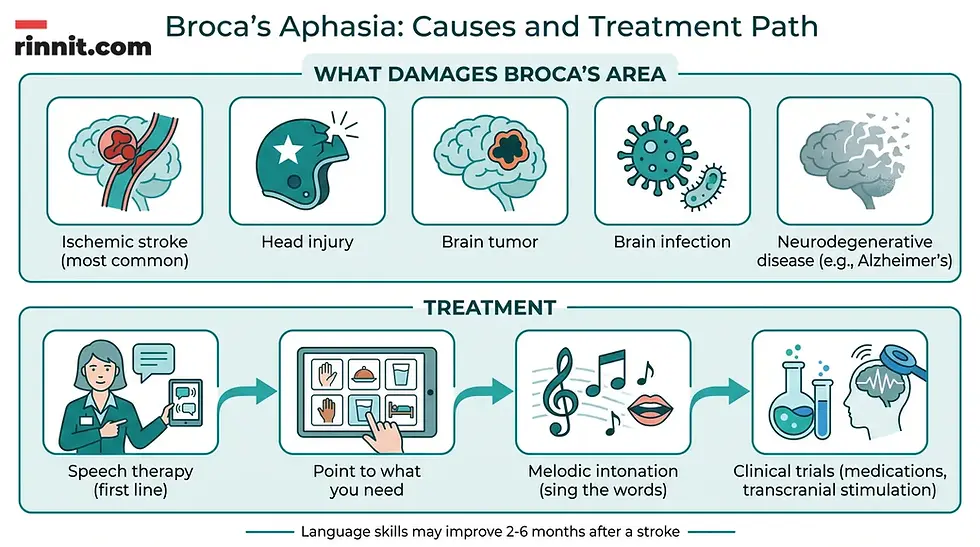
The most common reason for damage to this part of your brain is an ischemic stroke — a stroke caused by a blood clot that cuts off blood flow to the brain [1].
What are the other causes?
Other possible causes include traumatic brain injuries, brain tumors, brain infections [1] [5], and neurodegenerative conditions like Alzheimer's disease.
Cause | How it damages Broca's area |
Ischemic stroke (most common) | A clot cuts off blood flow, damaging brain tissue |
Traumatic brain injury | Impact to the head injures the left frontal lobe |
Brain tumors | A growth presses on or damages speech-control tissue |
Brain infections | Infection damages the language-processing area |
Neurodegenerative conditions | Conditions like Alzheimer's disease gradually affect brain function |
How Is Broca's Aphasia Diagnosed?
A healthcare provider will diagnose this condition after a physical exam, neurological exam, language evaluation, and testing. Your provider will review your health history during the exam. They may refer you to a speech-language pathologist (SLP) for a language evaluation. A speech-language pathologist will assess your ability to name objects, repeat phrases, follow commands, read, and write [1].
What tests confirm the diagnosis?
Imaging tests can detect brain damage, which confirms a diagnosis. Your provider may order one of the following tests:
Test | What it does |
MRI (magnetic resonance imaging) | Uses magnets and radio waves to create detailed brain images |
CT scan (computed tomography) | Uses X-rays to produce cross-sectional brain images |
PET scan | Shows how brain tissue is functioning and where damage occurred |
Is depression screening part of the evaluation?
Yes. Since depression is common with aphasia, you may receive a referral to visit a mental health professional [1].
How Is Broca's Aphasia Treated?
Broca's aphasia is treated first with speech therapy, where a speech-language pathologist helps you find effective ways to communicate, sometimes along with melodic intonation therapy.
What is the first-line treatment?
Treatment for Broca's aphasia varies based on what symptoms you experience. Your healthcare provider will first recommend speech therapy. A speech-language pathologist will help you find effective ways to communicate. You may use a board with images on it and point to what you want or need [1].
What is melodic intonation therapy?
Your provider may teach you melodic intonation. This is where you learn to use musical tones (like singing) to express words or phrases more fluently than speaking [1] [2].
Are there newer treatments being studied?
Healthcare providers are studying new medications and treatment options for aphasia in clinical trials. These are tests on humans. Examples of available trials include transcranial stimulation and different types of medications [1].
What if I feel depressed?
If you experience mental health challenges with aphasia, your healthcare provider will recommend treatment options for depression, as well.
How do caregivers fit into treatment?
During treatment, your care team will work closely with your caregivers and loved ones so everyone can effectively communicate with each other [1]. This can improve your outcome and quality of life.
Treatment approach | How it helps |
Speech therapy (first line) | An SLP helps you find effective ways to communicate |
Image board | You point to pictures of what you want or need |
Melodic intonation | Musical tones (like singing) help express words and phrases more fluently |
Clinical trials | New medications and transcranial stimulation are being studied |
Depression treatment | Mental health support for frustration, isolation, and depression |
Caregiver involvement | Loved ones learn to communicate effectively with you |
What is the long-term outlook for Broca's aphasia?
Broca's aphasia has no cure, but recovery varies with the severity of brain damage, and language skills may improve within two to six months after a stroke [1].
Can Broca's aphasia be cured?
There isn't a cure for Broca's aphasia. Researchers are doing clinical trials to find new treatment options [1].
Can you recover from Broca's aphasia?
Your ability to recover varies based on the severity of damage to the language processing area of your brain. Some cases may be temporary and you'll make a full recovery, while others require lifelong management to help you communicate. You may notice language skill improvement within two to six months after a stroke [1]. Speech therapy can help you maintain or increase these improvements over time.
Can Broca's Aphasia Be Prevented?
You can't prevent all cases of this condition. You can, however, reduce your risk of conditions that cause aphasia like a stroke or traumatic brain injury by managing any underlying health conditions, following an eating and physical activity plan that's healthy for you, and protecting yourself from injury (like wearing a helmet during contact sports [1]). Your provider may make additional recommendations specific to your needs.
How can people live well with Broca's aphasia?
Living with Broca's aphasia means seeing a healthcare provider if symptoms appear or worsen and asking about speech therapy, clinical trials and mental health support.
When should I see a healthcare provider?
Talk to a healthcare provider if you or a loved one have symptoms of aphasia, especially after a stroke or accident where you had head trauma. If speech problems start suddenly, call 911, because sudden trouble speaking can be a sign of a stroke. If you have an aphasia or neurodegenerative condition diagnosis and your symptoms get worse, let your provider know.
What questions should I ask my healthcare provider?
What caused my symptoms?
How often should I participate in speech therapy?
Do I qualify for clinical trials?
Should I talk to a mental health professional?
Conclusion
Broca's aphasia is an expressive language disorder where you know what you want to say but the words won't come out easily — while your intelligence and most of your understanding remain intact. It most often follows damage to Broca's area in the left frontal lobe, usually from an ischemic stroke [1]. Speech becomes short and effortful, linking words disappear, and reading is often easier than writing. There's no cure, but there's real hope: speech therapy, image boards, and melodic intonation open up new ways to communicate, clinical trials are testing new medications and transcranial stimulation, and language skills can improve within two to six months after a stroke [1]. Because frustration, isolation, and depression are common, mental health support and caregiver involvement are key parts of treatment. If you or someone else suddenly has trouble speaking, call 911 right away, because it can be a sign of a stroke.
Want more plain-language answers about brain health and communication? Visit Rinnit.com for clear, trustworthy guides to understanding your health.
Frequently Asked Questions
What is Broca's aphasia?
Broca's aphasia is an expressive language disorder that affects how you speak (your fluency) but not your understanding of words (your comprehension). You know what to say but have trouble speaking, and it may be easier to read than write.
Does Broca's aphasia affect intelligence?
No. Broca's aphasia doesn't affect your intelligence. You might have trouble understanding long, complex sentences at times, but not always.
Why is it called expressive aphasia?
Because it mainly affects your ability to express yourself through speech. The understanding of words is largely preserved. It is the most common form of non-fluent aphasia.
What does Broca's aphasia speech sound like?
Speech is effortful and shortened, with linking words left out. Examples include "Want water now" instead of "I want a glass of water," "Me go store buy milk" instead of "I'm going to the store to buy milk," and "Dog dog park" instead of "There are two dogs at the park."
What causes Broca's aphasia?
Damage to the Broca's area of the brain, which sits in the frontal lobe on the left side of the head near the temple and controls speech and articulation. The most common cause is an ischemic stroke.
Can a head injury cause Broca's aphasia?
Yes. Traumatic brain injuries are one possible cause, along with brain tumors, brain infections, and neurodegenerative conditions like Alzheimer's disease.
How is Broca's aphasia diagnosed?
Through a physical exam, neurological exam, language evaluation, and testing. Your provider reviews your health history and may refer you to a speech-language pathologist (SLP), who assesses your ability to name objects, repeat phrases, follow commands, read, and write. Imaging tests (MRI, CT scan, or PET scan) detect brain damage to confirm the diagnosis.
What does a speech-language pathologist (SLP) do?
An SLP conducts the language evaluation and provides speech therapy, helping you find effective ways to communicate — such as using an image board or learning melodic intonation.
Is there a cure for Broca's aphasia?
There isn't a cure. However, researchers are running clinical trials on new medications and treatment options, including transcranial stimulation.
Can people recover from Broca's aphasia?
Recovery varies based on the severity of damage to the language processing area of the brain. Some cases are temporary and people make a full recovery, while others require lifelong management. You may notice language skill improvement within two to six months after a stroke.
What is melodic intonation?
A technique where you learn to use musical tones (like singing) to express words or phrases more fluently than speaking.
Why is depression common with Broca's aphasia?
It takes a lot of effort to formulate words and sentences, which can significantly impact your mental health and your willingness to connect with others. Frustration, isolation, and depression are common — and depression treatment is part of care.
Does stroke cause other symptoms besides aphasia?
It can. After a stroke, you're more likely to have trouble moving or paralysis on one side of your body, and stroke damage can affect the muscles controlling your arms and legs, leaving residual weakness.
Can Broca's aphasia be prevented?
You can't prevent all cases, but you can lower your risk of conditions that cause it (like stroke or traumatic brain injury) by managing underlying health conditions, following a healthy eating and physical activity plan, and protecting yourself from injury, such as wearing a helmet during contact sports.
When should I see a healthcare provider?
If you or a loved one have symptoms of aphasia, especially after a stroke or accident with head trauma. If speech problems start suddenly, call 911, because this can be a sign of a stroke. Also contact your provider if an existing aphasia or neurodegenerative condition diagnosis worsens.
Related Reading
Aphasia Explained: Causes, Types, Symptoms, and How Speech Therapy Helps You Find Your Words Again explains all aphasia types and how speech therapy aids recovery.
Wernicke's Aphasia (Receptive Aphasia): Symptoms, Causes, and Recovery compares receptive aphasia, where understanding language is the main problem.
Stroke: Symptoms, Causes, Diagnosis, and Treatment — A Complete Guide covers the most common cause of Broca's aphasia and its warning signs.
Speech Therapy: What It Is, Who Needs It, and How It Works describes how speech therapy works and what sessions involve.
References
Cleveland Clinic. Broca’s Aphasia. Cleveland Clinic. Updated November 19, 2024. https://my.clevelandclinic.org/health/diseases/brocas-aphasia
Le H, et al. Aphasia. StatPearls. Updated October 29, 2024. https://www.ncbi.nlm.nih.gov/books/NBK559315/
American Heart Association. Types of Aphasia. American Stroke Association. Reviewed April 14, 2024. https://www.stroke.org/en/about-stroke/effects-of-stroke/cognitive-and-communication-effects-of-stroke/types-of-aphasia
National Aphasia Association. Understanding Aphasia: Glossary of Key Terms. National Aphasia Association. Accessed October 14, 2026. https://aphasia.org/glossary-of-terms/
National Institute on Deafness and Other Communication Disorders. Aphasia. NIDCD. Updated April 16, 2025. https://www.nidcd.nih.gov/health/aphasia
Brady MC, et al. Speech and language therapy for aphasia following stroke. Cochrane Database Syst Rev. 2016;2016(6):CD000425. PMID 27245310. https://doi.org/10.1002/14651858.CD000425.pub4
Haro-Martínez A, et al. Melodic Intonation Therapy for Post-stroke Non-fluent Aphasia: Systematic Review and Meta-Analysis. Front Neurol. 2021;12:700115. PMID 34421802. https://doi.org/10.3389/fneur.2021.700115
Vogel-Eyny A, et al. Prevalence of depression in post-stroke aphasia: systematic review and meta-analysis. BMC Neurol. 2026;26(1):43. PMID 41388458. https://doi.org/10.1186/s12883-025-04570-1
Medical disclaimer
This article is for general informational purposes only and is not a substitute for professional medical advice, diagnosis, or treatment. Always consult a healthcare provider for symptoms of aphasia, especially after a stroke or head injury, and seek urgent care for sudden signs of stroke.



Comments