Wernicke's Aphasia (Receptive Aphasia): Symptoms, Causes, and Recovery

Updated: 3 days ago
Medically reviewed by Dr. Baraa Alnahhal, MD · Last reviewed: October 2026
Quick Answer
Wernicke's aphasia, also known as receptive or fluent aphasia, is a neurological condition in which the brain struggles to understand language. People speak fluently but use random or made-up words, making speech hard to follow, and often are unaware of the problem. [1] [4] It is usually caused by stroke or brain injury, and speech-language therapy is the main treatment. [1]
What the research says
Speech and language therapy improves communication after stroke. A Cochrane review of 57 randomized trials (3,002 participants) found that, across 27 comparisons (1,620 participants), therapy improved functional communication compared with no therapy (standardized mean difference 0.28, 95% CI 0.06 to 0.49), along with reading, writing, and expressive language. Higher-intensity or longer therapy may help more, but those programs also had higher dropout, and benefits were not clearly evident at follow-up in the smaller group of trials that measured it (Brady et al., Cochrane Database Syst Rev, 2016) [2].
How severe the aphasia is at the start strongly predicts how much improvement follows. In 21 stroke patients assessed on the Western Aphasia Battery at admission and again at 90 days, the starting score explained most of the change (R² = 0.81), and patients recovered about 73% of their maximal potential recovery. Most improvement from post-stroke aphasia occurs within the first 3 months. This was a small study, so individual recovery can differ (Lazar et al., Stroke, 2010) [3].
Emergency alert: If symptoms of aphasia, such as sudden confusion, difficulty speaking, or inability to understand others, appear abruptly, it may be a sign of a stroke. [1] Call 911 or your local emergency services immediately.
What Is Wernicke's Aphasia?
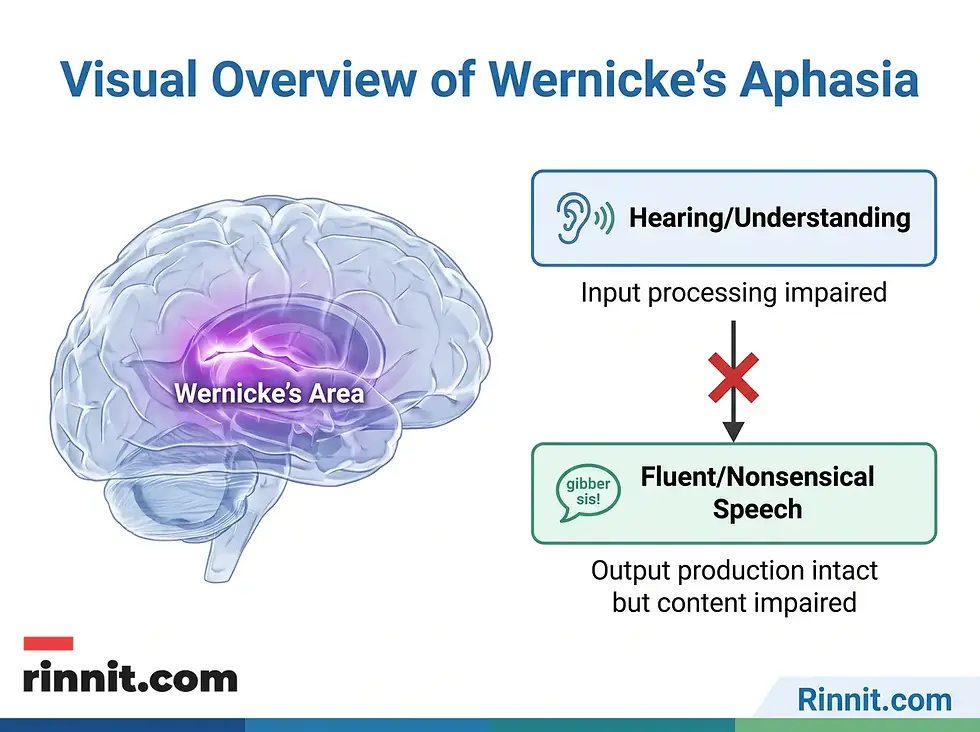
Wernicke's aphasia is a type of fluent aphasia that affects the brain's language processing center. Unlike Broca's aphasia, where speech is labored and slow, people with Wernicke's aphasia speak at a normal pace and with natural-sounding inflection. [1] However, the content of their speech is often nonsensical.
This condition is frequently described as "word salad," because the sentences produced may sound like a random jumble of dictionary terms. For example, a person might say, "The green dog jump helicopter cheese on the yesterday smoodle." [1] Importantly, this disorder affects language processing, not intelligence. [1]
Symptoms and Characteristics
The primary hallmark of Wernicke's aphasia is the disconnect between the physical act of speaking and the meaning of the words.
Common Speech Errors
Others may find it difficult to understand a person with Wernicke's aphasia because of paraphasic errors:
Semantic paraphasia: substituting one word for a related one (for example, saying "table" when meaning "chair"). [1]
Phonemic paraphasia: substituting a sound or syllable (for example, saying "hat" when meaning "cat"). [1]
Neologisms: creating entirely new, made-up words that have no meaning to others. [1]
Other Symptoms
Difficulty understanding: struggling to grasp what others are saying, often feeling like everyone is speaking a foreign language. [1]
Anosognosia: a lack of awareness of the condition. The brain may not recognize that there is a communication problem. [1]
Reading and writing challenges: difficulty processing written words or numbers [1], even if the physical act of writing remains fluent.
Vision changes: because the Wernicke's area is near visual processing centers, some patients experience vision loss. [1]
Causes of Receptive Aphasia
Damage to the Wernicke's area, located in the temporal lobe (usually on the left side of the brain, above the ear), is the direct cause of this condition. [1] [4]
Cause | Description |
Ischemic stroke | The most common cause, where blood flow to the brain is blocked. [1] |
Traumatic brain injury (TBI) | Physical trauma to the head that damages brain tissue. [1] |
Brain tumors | Abnormal growths that press on or damage the Wernicke's area. [1] |
Infections | Central nervous system infections that affect brain function. [1] |
Degenerative diseases | Conditions like Alzheimer's disease or Lewy body dementia. [1] |
Diagnosis and Language Evaluation
Diagnosis involves a comprehensive physical exam and a detailed language evaluation, often performed by a speech-language pathologist (SLP). [1]
Evaluation Tasks
Healthcare providers will ask the patient to perform specific tasks to assess brain function:
Commands: following simple and complex instructions (for example, "Touch your left ear with your right hand"). [1]
Naming: identifying common objects or listing animals. [1]
Repetition: repeating specific phrases or sentences. [1]
Fluency: describing a simple topic, such as the weather. [1]
Reading and writing: assessing the ability to read aloud and write dictated sentences. [1]
Imaging tests such as MRI, CT, or PET scans are used to confirm the location and extent of brain damage. [1]
Management and Recovery
While there is no "cure" that instantly restores language, the brain has a remarkable ability to adapt through a process called neuroplasticity.
Speech-Language Therapy
The primary treatment is speech therapy, which focuses on:
Supporting a Loved One
Caregivers play a vital role in the recovery process. Effective communication strategies include:

Outlook and Prognosis
The speed and extent of recovery depend on the severity of the brain damage. [1] Most significant improvement typically occurs in the first few months after a stroke (often within the first three to six months), though recovery can continue at a slower pace for years. [1] [3] [4] Proactive management of underlying health conditions, such as high blood pressure, can help prevent future incidents.
Frequently Asked Questions
1. What is the main difference between Wernicke's and Broca's aphasia?
Wernicke's aphasia is "fluent" (speech is fast but nonsensical), while Broca's aphasia is "non-fluent" (speech is slow and labored but meaningful).
2. Can Wernicke's aphasia be cured?
There is no instant cure, but speech therapy can significantly improve communication skills and language understanding over time.
3. Does aphasia affect intelligence?
No. Wernicke's aphasia affects language processing and communication, not a person's underlying intelligence or thinking ability.
4. What is "word salad"?
"Word salad" is a term for speech that follows normal grammatical patterns but consists of random or nonsensical words.
5. Why doesn't the person know they are making mistakes?
Being unaware of mistakes is due to anosognosia, a condition where the brain's monitoring system is damaged, preventing the person from recognizing their own errors.
6. Is Wernicke's aphasia permanent?
Some degree of impairment may be permanent, but many people see significant improvement with consistent therapy and support.
7. How common is it after a stroke?
Wernicke's aphasia is one of the most common types of aphasia resulting from an ischemic stroke.
8. Can children get Wernicke's aphasia?
While rare, it can occur in children following a traumatic brain injury or infection, though it is much more common in adults.
9. Does it affect the ability to use numbers?
Yes. Many people with receptive aphasia struggle with mathematics and using numbers correctly.
10. Can vision be affected?
Yes. Because the Wernicke's area is near visual centers, partial or full vision loss can occur alongside language problems.
11. Is group therapy better than individual therapy?
Both are helpful. Group therapy is particularly good for practicing social communication and reducing feelings of isolation.
12. What are neologisms?
Neologisms are entirely new, made-up words that the person uses as if they were real words.
13. Can sign language help?
Yes. Alternative communication methods, including sign language and assistive technology, are often taught in speech therapy.
14. Should I correct a loved one's speech errors?
Generally, no. Constant correction can be frustrating. It is better to focus on the intent of the communication and use simple questions.
15. How long does speech therapy last?
The duration varies, but it often continues for months or even years, depending on the person's progress and goals.
Trusted External Resources
Related Reading
Broca's Aphasia: What It Is, Why It Happens, and How Speech Therapy Helps explains the expressive aphasia that makes speaking slow and effortful.
Global Aphasia: What It Is, Why It Happens, and How It's Treated covers the most severe aphasia, affecting both speaking and understanding.
Aphasia Explained: Causes, Types, Symptoms, and How Speech Therapy Helps You Find Your Words Again explains the main aphasia types and how speech therapy helps.
Stroke: Symptoms, Causes, Diagnosis, and Treatment — A Complete Guide explains stroke warning signs, the most common cause of aphasia.
References
Cleveland Clinic. Wernicke's aphasia (receptive aphasia). Cleveland Clinic. Reviewed July 3, 2024. https://my.clevelandclinic.org/health/diseases/wernickes-aphasia-receptive-aphasia
Brady MC, Kelly H, Godwin J, Enderby P, Campbell P. Speech and language therapy for aphasia following stroke. Cochrane Database Syst Rev. 2016;2016(6):CD000425. PMID 27245310. https://doi.org/10.1002/14651858.CD000425.pub4
Lazar RM, Minzer B, Antoniello D, Festa JR, Krakauer JW, Marshall RS. Improvement in aphasia scores after stroke is well predicted by initial severity. Stroke. 2010;41(7):1485-1488. PMID 20538700. https://doi.org/10.1161/STROKEAHA.109.577338
National Institute on Deafness and Other Communication Disorders. Aphasia. NIDCD, National Institutes of Health. NIH Pub. No. 97-4257. Last updated April 16, 2025. https://www.nidcd.nih.gov/health/aphasia
Medical Disclaimer
This article is for informational purposes only and does not constitute medical advice. Always seek the advice of your physician or other qualified health provider with any questions you may have regarding a medical condition. Never disregard professional medical advice or delay in seeking it because of something you have read here.



Comments