ADHD Screening: How ADHD Is Diagnosed in Children and Adults

Updated: 2 days ago
Written and medically reviewed by Dr. Baraa Alnahhal, MD · Last reviewed: November 2026 · How we review
Quick Answer
ADHD screening (an ADHD assessment) is an evaluation, not a single test, used to diagnose attention-deficit/hyperactivity disorder in children and adults. A provider gathers information through a health exam, rating scales and an interview. Symptoms are compared with the DSM-5-TR criteria, including lasting at least six months and starting before age 12.
What the research says
Rating scales are helpful but not enough alone: a meta-analysis of studies of common parent and teacher rating scales for ADHD found pooled sensitivities of 72–83% and specificities of 73–84%, with the brief Conners Abbreviated Symptom Questionnaire performing as well as longer scales (Chang LY et al., Pediatrics, 2016) [2]
Self-report screeners produce many false positives: a systematic review of self-report ADHD measures found they were very good at ruling out ADHD (negative predictive values above 96%), but positive predictive values were mostly below 20% and at best 61% in clinical samples, so a positive screen needs a full evaluation (Harrison AG et al., Journal of Attention Disorders, 2023) [3]
Key takeaways
ADHD is diagnosed through an evaluation by a trained provider, not by a single test or an online quiz.
DSM-5-TR requires 6 or more symptoms in children (5 or more from age 17) in at least one category, lasting 6 months or longer.
Symptoms must start before age 12, appear in 2 or more settings and interfere with daily functioning.
Other conditions, such as anxiety, depression, sleep problems and learning disabilities, must be ruled out.
The core assessment takes 1–3 hours; ruling out other conditions can take longer.
What is an ADHD screening?
ADHD is a common neurodevelopmental condition that affects attention, activity level and impulse control. There's no blood test or brain scan for it. Instead, providers use a structured evaluation with three goals: identify symptoms that impair daily life, rule out other causes, and look for conditions that often occur alongside ADHD. Sources: [1]
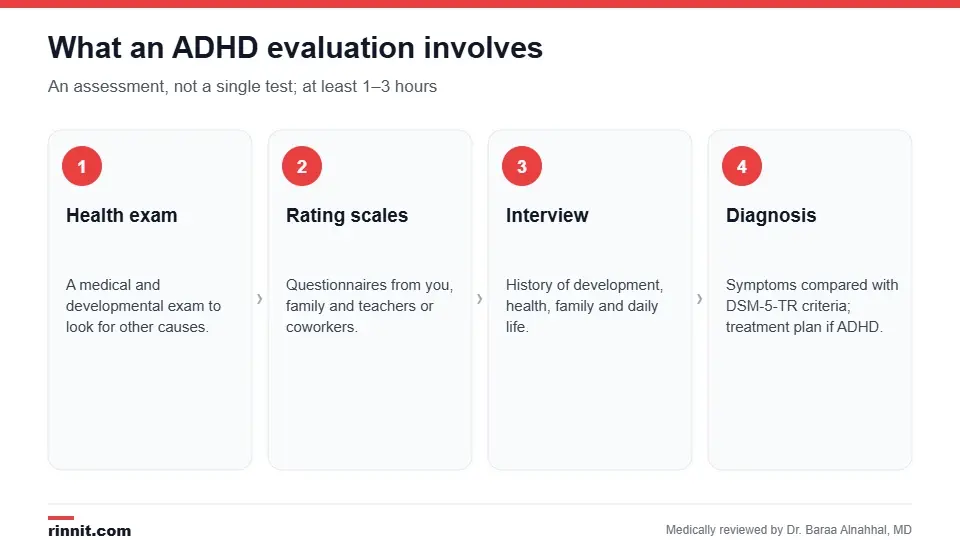
An ADHD evaluation gathers information from several sources.
Who performs it?
Usually a pediatrician or primary care provider, or a specialist such as a psychiatrist, psychologist or developmental-behavioral pediatrician. Schools can screen children aged 3 to 21 for learning problems, but they can't diagnose ADHD. Adults can be evaluated at any age; about 4% of US adults show ongoing ADHD behaviors, often undiagnosed since childhood (see adult ADHD). Sources: [1]
DSM-5-TR criteria
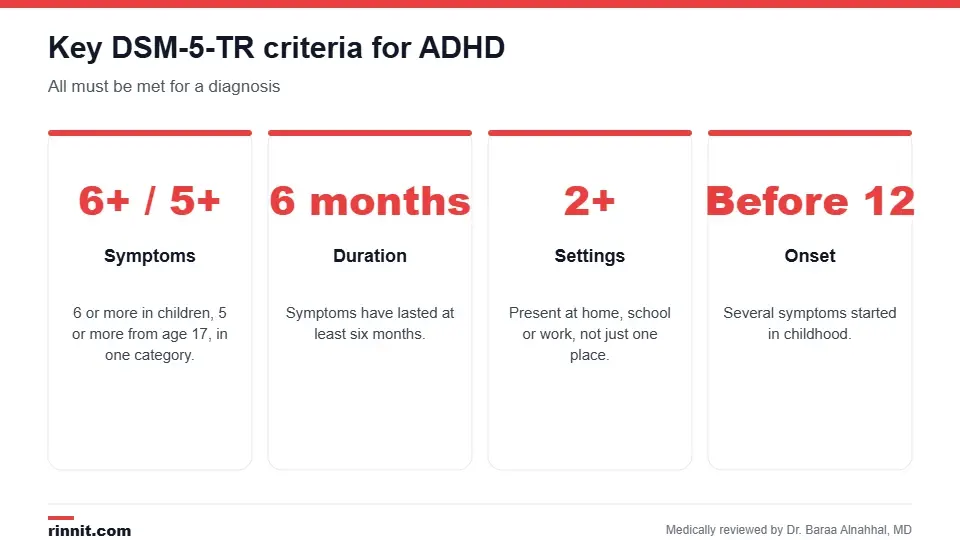
All criteria must be met for an ADHD diagnosis.
Criterion | Requirement |
Number of symptoms | 6 or more in children; 5 or more from age 17, in inattention, hyperactivity-impulsivity or both |
Duration | At least 6 months |
Settings | Two or more, such as home, school or work, usually reported by two or more observers |
Onset | Several symptoms before age 12 |
Impact | Symptoms clearly interfere with daily functioning |
Other causes | Not better explained by another condition, such as anxiety or depression |
Sources: [1]
What happens during the evaluation?
Health exam: a medical, physical or neurodevelopmental exam to look for other causes.
Rating scales and questionnaires: completed by you and others, such as parents, teachers, coaches, partners or coworkers.
Interview: questions about development, health, family history and behavior at home, school or work.
Observation: for children, the provider may watch the child directly. Sources: [1]
The core assessment takes at least one to three hours. If other conditions need to be ruled out, testing can take days or weeks, sometimes including neuropsychological testing. Sources: [1]
Conditions that can look like ADHD

These conditions are ruled out during the evaluation.
Anxiety and depression.
Autism (see autism assessment).
Sleep problems.
Thyroid disorders and other medical conditions affecting the brain.
Undetected seizures.
Lead toxicity. Sources: [1]
ADHD also often occurs with learning disabilities, anxiety, mood disorders or intellectual disability, so the evaluation looks for these too. Sources: [1]
Understanding the results
ADHD diagnosed: the type is described as predominantly inattentive (formerly called ADD; see inattentive ADHD), predominantly hyperactive-impulsive, combined, or other specified/unspecified.
Another condition found: such as anxiety or depression, which is then treated.
More testing needed: when the picture isn't clear. Sources: [1]
If ADHD is confirmed, treatment may include behavioral strategies, school or workplace support and ADHD medication, with a follow-up visit a few weeks later. Sources: [1]
What about online ADHD tests?
Online questionnaires can prompt you to seek help, but only a trained provider can diagnose ADHD. Research shows screening questionnaires flag many people who don't have ADHD, so a positive result always needs a full evaluation. Sources: [1, 3]
Conclusion
An ADHD screening is a careful, multi-step evaluation rather than a quick test. Bring school reports, past evaluations and input from people who know you well, and expect your provider to check for other conditions before making a diagnosis. The evaluation itself carries no risks.
Keep learning: read about ADHD and adult ADHD.
Frequently asked questions
Is there a test for ADHD?
Not a single test. ADHD is diagnosed through an evaluation using interviews, rating scales and an exam.
Who can diagnose ADHD?
A pediatrician, primary care provider, psychiatrist, psychologist or other trained specialist.
How long does an ADHD evaluation take?
The core assessment takes at least one to three hours; more testing can take longer.
How many symptoms are needed for ADHD?
Six or more in children, or five or more from age 17, in at least one symptom category.
Can adults be screened for ADHD?
Yes, at any age.
Can a school diagnose ADHD?
No. Schools can screen for learning problems but can't diagnose ADHD.
Are online ADHD tests accurate?
They can't diagnose ADHD and often flag people who don't have it.
What conditions can look like ADHD?
Anxiety, depression, learning disabilities, autism, sleep problems, thyroid disorders, seizures and lead toxicity.
What are the types of ADHD?
Predominantly inattentive, predominantly hyperactive-impulsive, combined, and other specified or unspecified.
Are there risks to an ADHD evaluation?
No.
Related Reading
ADHD: Complete Guide to Symptoms, Causes, Diagnosis & Treatment the condition this evaluation diagnoses.
Adult ADHD: Complete Guide to Symptoms, Causes, Diagnosis & Treatment how ADHD shows up in adults.
Inattentive ADHD the type of ADHD once called ADD.
ADHD Medication: Types, Benefits, and Management treatment options after diagnosis.
Learning Disabilities: Identifying Signs, Types, and Support Strategies a condition that can mimic or accompany ADHD.
References
Cleveland Clinic. ADHD Screening: What To Expect. Cleveland Clinic. Last updated February 23, 2023. https://my.clevelandclinic.org/health/diagnostics/24758-adhd-screening
Chang LY, Wang MY, Tsai PS. Diagnostic accuracy of rating scales for attention-deficit/hyperactivity disorder: a meta-analysis. Pediatrics. 2016;137(3):e20152749. PMID 26928969. https://doi.org/10.1542/peds.2015-2749
Harrison AG, Edwards MJ. The ability of self-report methods to accurately diagnose attention deficit hyperactivity disorder: a systematic review. J Atten Disord. 2023;27(12):1343-1359. PMID 37366274. https://doi.org/10.1177/10870547231177470
Medical disclaimer
This article is for general education only and does not replace advice from a qualified healthcare professional. Talk to your doctor about your own diagnosis and treatment, and seek emergency care right away for severe or sudden symptoms.



Comments