YAG Laser Capsulotomy (Posterior Capsulotomy)

Updated: 3 days ago
Medically reviewed by Dr. Baraa Alnahhal, MD · Last reviewed: October 2026
Quick Answer
YAG laser capsulotomy is a fast outpatient procedure that treats posterior capsule opacification, often called a secondary cataract, in which tissue holding the artificial lens clouds after cataract surgery [1]. In under ten minutes, a laser opens the clouded tissue so light passes clearly again [1]. No incision is needed, most people resume activities the next day, and complications are uncommon.
What the research says
Vision improves in nearly everyone who is treated. In a study of YAG capsulotomies done at six clinics, average Snellen visual acuity improved from 20/40 to 20/23 (P < .001), and 77 of 78 patients who answered a follow-up survey (99%) reported better vision. No patient had raised eye pressure, inflammation, macular edema, or retinal detachment (PubMed: Lighthizer et al., Optom Vis Sci, 2023) [2].
Raised eye pressure and macular swelling are the most common problems, and retinal detachment is rare. A French nationwide claims study of 6,210 patients (7,958 procedures) found that 8.6% had at least one of three problems (high eye pressure, macular edema, or retinal detachment) within 3 months and 13.3% within 12 months. Rates of high eye pressure and macular edema were about 5% each at 3 months, while retinal detachment stayed at or below 0.5%. Diabetes and having the procedure within a year of cataract surgery raised the risk (PubMed: Dot et al., Ophthalmology, 2023) [3].
What Is YAG Laser Capsulotomy?
YAG laser capsulotomy, also called posterior capsulotomy, is a follow-up treatment for people whose vision becomes cloudy again after successful cataract surgery [1]. This condition is called posterior capsule opacification (PCO). It involves thickening and clouding of the membrane that holds the artificial lens in place. It is often called a "secondary cataract," but it is not a new cataract. It is a natural reaction of the eye's tissue to the earlier surgery.
The procedure uses a YAG (yttrium aluminum garnet) laser [1], which produces very precise pulses of energy. These pulses cut through the clouded posterior capsule without disturbing the delicate tissues at the front or back of the eye. By making a small opening in the center of the capsule, the laser clears the path so light can travel through the eye without being blocked [1].

What Happens During the Procedure?
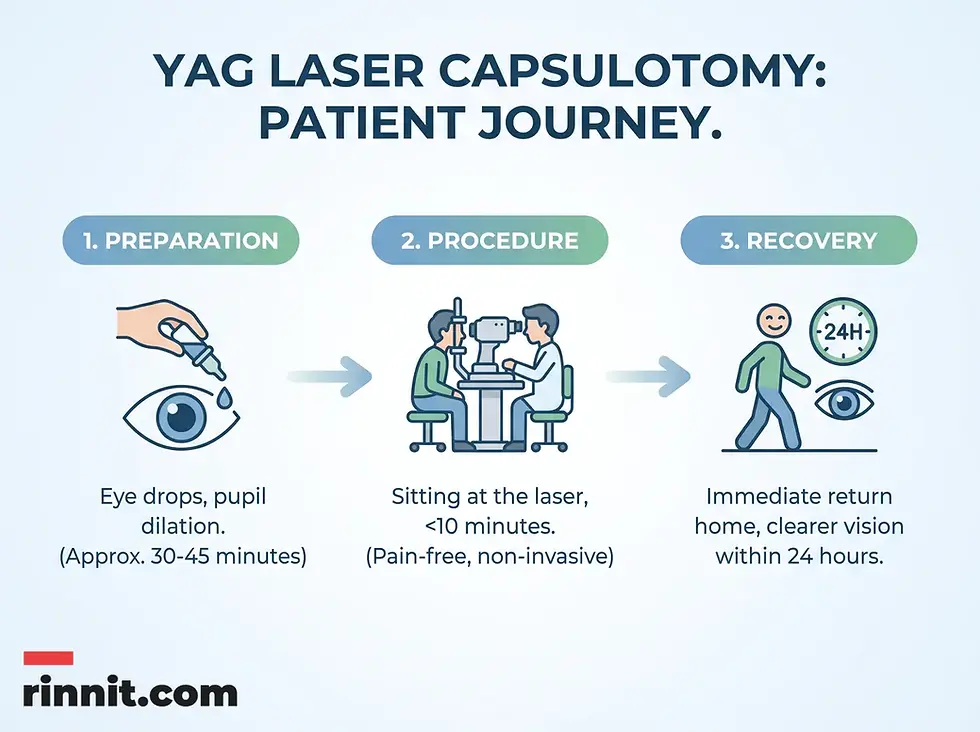
Preparation is minimal. YAG laser capsulotomy is an outpatient procedure usually done in a clinic [1]. When you arrive, an eye specialist gives you numbing drops so you feel no pain, followed by dilating drops to widen your pupil [1]. This gives the specialist a clear view of the posterior capsule.
During the procedure, you sit in a chair with your head positioned in front of the laser. The specialist may use a special lens with lubricating gel to hold the eye steady and focus the laser beam. The laser gives off invisible, high-frequency pulses of energy. You may hear a clicking sound or notice unusual color changes during the process. The procedure is painless and usually takes less than ten minutes [1].
What Are the Benefits and Success Rates?
The main advantages of YAG laser capsulotomy are its high success rate and good safety record. It is a non-invasive alternative to traditional surgery, which would require an incision into the eyeball.
Benefit | Description |
Effectiveness | Between 83% and 96% of patients report significant vision improvement [1]. |
Safety | Complications are uncommon and are usually minor when they do occur. |
Convenience | Done as an outpatient procedure with no hospital stay [1]. |
Comfort | Little to no pain during the procedure because of numbing drops [1]. |
What Are the Risks and Complications?
YAG laser capsulotomy is considered very safe, but you should know about the possible side effects. The most common is a temporary increase in eye floaters [1], which usually goes away within a few days as the eye adjusts.
Complication | Frequency and management |
Eye floaters | Very common; usually temporary and last only a few days [1]. |
Increased eye pressure | Can occur, mostly within the first 3 months [3]; checked at follow-up visits. |
Uveitis | Rare; inflammation inside the eye. |
Retinal issues | Very rare; includes retinal tear or detachment. |
Macular edema | Uncommon; swelling of the central part of the retina. |

What Is Recovery Like?
Recovery is usually quick. Most people go home right after the procedure and return to normal activities the next day. You may feel some minor soreness or discomfort [1] once the numbing drops wear off. Significant pain is unusual and should be reported to an eye care provider right away [1].
Follow-up care usually involves a standard eye exam to make sure the eye is healing well and your vision has settled. Watch your vision for any sudden changes. The long-term results of the procedure are generally permanent.
Conclusion
YAG laser capsulotomy is the standard treatment for cloudy vision after cataract surgery. It restores clarity quickly, safely, and without invasive surgery, which makes it an essential tool in modern eye care. By clearing the path for light to enter the eye, it lets you enjoy the full benefit of your original cataract surgery again.
What are the next steps for YAG laser capsulotomy?
If your vision becomes cloudy or blurred months or years after cataract surgery, see your eye care specialist to find out whether you have posterior capsule opacification. Ask about the benefits and risks of YAG laser capsulotomy to see whether it is right for you, and keep up with routine eye exams to monitor your long-term eye health.
Frequently Asked Questions
1. What is YAG laser capsulotomy?
YAG laser capsulotomy is a quick laser procedure used to treat cloudiness that can develop after cataract surgery.
2. Is the procedure painful?
No. Numbing drops are used so that the eye is comfortable during the treatment.
3. How long does the procedure take?
The laser part of the procedure usually takes less than ten minutes.
4. What are "secondary cataracts"?
The term "secondary cataracts" is a common name for posterior capsule opacification, which the YAG laser treats.
5. Can I drive home after the procedure?
Because your eyes will be dilated, it is recommended that someone else drives you home.
6. How soon will my vision improve?
Many people notice better vision within 24 hours.
7. Are the results permanent?
Yes. The opening made in the capsule does not close or grow back.
8. What are eye floaters?
Eye floaters are small spots or lines in your vision that may temporarily increase after the procedure.
9. Is YAG laser capsulotomy safe?
Yes, it is generally very safe. Complications such as raised eye pressure or macular swelling can occasionally occur, and retinal detachment is rare.
10. What does YAG stand for?
YAG stands for yttrium aluminum garnet, the type of crystal used to generate the laser.
11. Do I need to stay in the hospital?
No. It is an outpatient procedure done in a doctor's office or clinic.
12. Are there any restrictions after the procedure?
Most people can return to normal activities almost right away.
13. What are the signs of a complication?
Sudden vision loss, flashes of light, or a large number of new floaters. Contact an eye care provider right away if you notice any of these.
14. Is it more invasive than cataract surgery?
No. It is much less invasive because it does not require any surgical incision.
15. Who performs this procedure?
An ophthalmologist or another trained eye care provider performs the treatment.
16. How do I prepare for YAG laser capsulotomy?
Usually no preparation is needed on your part, because this is an outpatient procedure done in your eye specialist's office [1]. Right before the laser, the specialist gives you eye drops to numb the eye and dilate the pupil, and some place a contact lens with lubricating gel on the numbed eye, so you may feel only slight pressure [1]. The laser steps take under 10 minutes, and you can go home once the laser part is finished [1].
Related Reading
Trusted External Resources
References
Cleveland Clinic. YAG Laser Capsulotomy (Posterior Capsulotomy): Procedure. Cleveland Clinic. Aug. 28, 2024. https://my.clevelandclinic.org/health/procedures/yag-laser-capsulotomy-posterior-capsulotomy
Lighthizer N, Johnson S, Holthaus J, et al. Nd:YAG laser capsulotomy: efficacy and outcomes performed by optometrists. Optom Vis Sci. 2023;100(10):665-669. PMID 37594749. https://doi.org/10.1097/OPX.0000000000002057
Dot C, Schweitzer C, Labbé A, et al. Incidence of retinal detachment, macular edema, and ocular hypertension after neodymium:yttrium-aluminum-garnet capsulotomy: a population-based nationwide study, the French YAG 2 study. Ophthalmology. 2023;130(5):478-487. PMID 36581227. https://doi.org/10.1016/j.ophtha.2022.12.022
Medical Disclaimer
This article is for informational purposes only and does not constitute medical advice. Always seek the advice of your physician or other qualified health provider with any questions you may have regarding a medical condition. Never disregard professional medical advice or delay in seeking it because of something you have read here.



Comments