Wrist X-Ray: Why It's Done, What It Shows and What to Expect

Updated: 2 days ago
Written and medically reviewed by Dr. Baraa Alnahhal, MD · Last reviewed: November 2026 · How we review
Quick Answer
A wrist X-ray is a painless imaging test that shows the bones of the wrist. It's the first test for wrist pain, swelling or a fall, and it finds fractures, dislocations, arthritis and infection. It takes under 15 minutes. Some injuries, such as ligament tears and hairline scaphoid fractures, may not show, so CT or MRI is sometimes needed.
What the research says
Some fractures hide on plain X-rays: a meta-analysis of 5 studies and 439 patients with suspected occult wrist fractures found cone-beam CT was 87.7% sensitive and 99.2% specific for scaphoid fractures and 90.6% sensitive and 100% specific for other carpal fractures, suggesting it could supplement or replace repeat X-rays (Fitzpatrick E et al., Skeletal Radiology, 2022) [2]
AI is learning to read wrist X-rays: a systematic review of 14 studies found deep-learning models detecting scaphoid fractures on X-rays reached accuracies of 81–96% and areas under the curve up to 0.97, with multi-view models performing best (Jha G et al., Cureus, 2025) [3]
Key takeaways
Shows the radius, ulna and 8 carpal bones; bone appears white, soft tissue gray, air black.
Used for fractures, dislocations, arthritis, carpal tunnel causes, cysts, infection, tumors, fracture healing and bone age in children.
Remove rings, bracelets and watches; tell the technologist if you might be pregnant.
At least two views (palm-down and side), sometimes an oblique view; under 15 minutes.
Ligaments don't show clearly; a normal X-ray doesn't always rule out a scaphoid fracture.
What is a wrist X-ray?
X-rays pass through the body and are absorbed differently by different tissues. Dense bone absorbs the most and appears white; soft tissues appear in shades of gray; air appears black. A radiologic technologist takes the images, and a radiologist, a doctor specialized in imaging, interprets them. Sources: [1]

A wrist X-ray takes less than 15 minutes.
Why is it done?
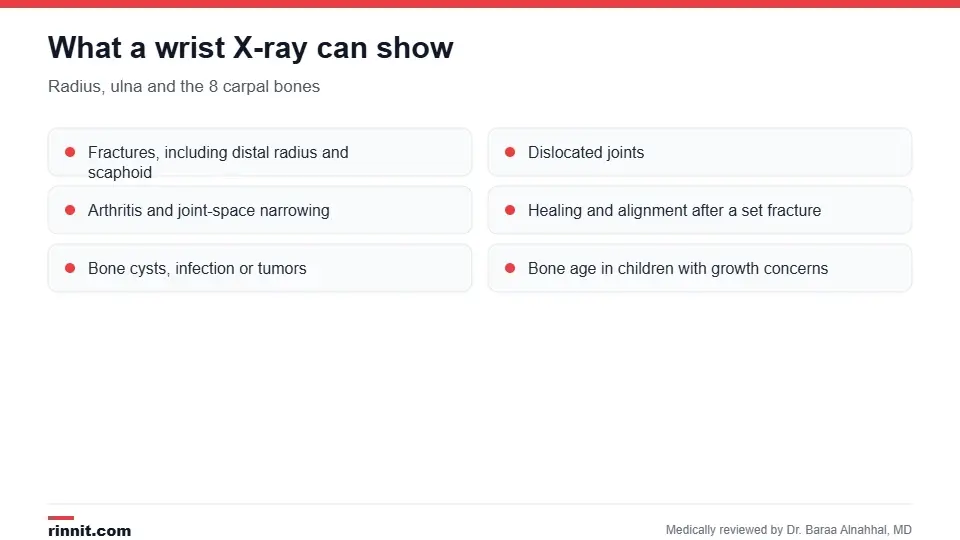
A wrist X-ray shows the radius, ulna and 8 carpal bones.
Pain, swelling or tenderness after a fall or injury, including a broken wrist or Colles fracture.
Dislocated wrist joints.
Bone changes linked to carpal tunnel syndrome.
Bone cysts, bone infection (osteomyelitis) or bone tumors.
Checking that a fracture is aligned and healing after it has been set.
Estimating "bone age" in children when growth is a concern. Sources: [1]
How do I prepare?
Remove all jewelry from your hand and wrist, since metal can hide parts of the image. No other preparation is usually needed. Tell the technologist if you are or might be pregnant. Sources: [1]
What happens during the X-ray?
You sit beside the X-ray table in the radiology department; the room is kept cool for the equipment.
Your arm rests on the table, sometimes with foam pads to hold it in position.
The technologist takes at least two views: posteroanterior (palm down, from above) and lateral (from the side), and sometimes an oblique view.
You hold still and may be asked to hold your breath briefly for each image.
Tell the technologist if positioning is painful; the X-ray itself causes no sensation. Sources: [1]
The test takes no more than 15 minutes. Sources: [1]
Understanding your results
In an emergency, results are available immediately. Otherwise, the radiologist usually sends a report to your provider within 1–2 days. The report describes any fracture (location, displacement, whether it enters the joint), joint alignment, signs of arthritis and any bone lesions. Sources: [1]
Finding | What it may mean |
Break in the bone outline | Fracture; displacement guides casting vs surgery |
Gap or overlap between carpal bones | Possible ligament injury; CT or MRI may confirm |
Narrowed joint space, bone spurs | Arthritis |
Lucent (dark) area in bone | Cyst, infection or tumor needing further tests |
Normal X-ray with snuffbox tenderness | Possible hidden scaphoid fracture; often splinted and re-imaged |
When an X-ray isn't enough

Ligaments and some hairline fractures don't show on plain X-rays.
X-rays don't clearly show ligaments, and small scaphoid fractures can be invisible on the first images. If symptoms strongly suggest a fracture, your provider may splint the wrist and repeat the X-ray, or order CT or MRI. Studies show cone-beam CT detects about 88% of hidden scaphoid fractures with very high specificity, and AI tools are being developed to help readers spot subtle breaks. Sources: [1, 2, 3]
Radiation and safety
The radiation dose is small and side effects are rare; very high cumulative exposure carries a small cancer risk.
Wrist X-rays are considered safe in pregnancy; precautions reduce exposure to the fetus if the test is urgent.
Children are slightly more sensitive, and technologists may use lower settings. Sources: [1]
Conclusion
A wrist X-ray is the fast first step after a wrist injury or ongoing pain. It reliably shows most fractures and arthritis, but if your wrist still hurts after a normal X-ray, especially at the base of the thumb, follow up, because scaphoid fractures and ligament injuries can hide.
Keep learning: read about wrist pain and the related hand X-ray.
Frequently asked questions
How long does a wrist X-ray take?
No more than 15 minutes, including positioning.
Does a wrist X-ray hurt?
No. Only positioning an injured wrist may be uncomfortable; tell the technologist if it hurts.
How many views are taken?
At least two: palm-down (PA) and from the side (lateral). An oblique view is often added.
Can a wrist X-ray miss a fracture?
Yes, especially small scaphoid fractures. A repeat X-ray, CT or MRI may be needed if pain persists.
Does an X-ray show ligament damage?
Not directly. Gaps or overlap between carpal bones can suggest it, but MRI or CT confirms.
Is the radiation dose safe?
Yes. The dose from a wrist X-ray is small, and side effects are rare.
Can I have a wrist X-ray while pregnant?
It is considered safe, with precautions to reduce exposure, but tell the technologist first.
When will I get my results?
Immediately in an emergency; otherwise usually within 1–2 days.
Why do children sometimes get a wrist X-ray for growth?
The wrist's growth plates and bones show "bone age," which helps assess growth problems.
What happens if a fracture is found?
Treatment depends on the type and displacement, from a splint or cast to surgery, with follow-up X-rays to check healing.
Related Reading
Broken Wrist: Symptoms, Causes, and Treatment the injury a wrist X-ray most often confirms.
What Is a Colles Fracture? Symptoms, Causes, Diagnosis and Treatment the common distal radius fracture seen on wrist X-rays.
What Is Arthritis in the Wrist? Symptoms, Causes, and Treatment joint changes a wrist X-ray can show.
Carpal Tunnel Syndrome: Symptoms, Causes, Diagnosis and Treatment when X-rays help find a bony cause of nerve compression.
Wrist Pain: Symptoms, Causes, and Proven Relief Strategies the broader work-up of a painful wrist.
References
Cleveland Clinic. Wrist X-Ray: Anatomy, Procedure & What to Expect. Cleveland Clinic. Last updated January 31, 2022. https://my.clevelandclinic.org/health/diagnostics/22328-wrist-x-ray
Fitzpatrick E, Sharma V, Rojoa D, et al. The use of cone-beam computed tomography (CBCT) in radiocarpal fractures: a diagnostic test accuracy meta-analysis. Skeletal Radiology. 2022;51(5):923-934. PMID 34542681. https://doi.org/10.1007/s00256-021-03883-9
Jha G, Dhanjal R, Malasani S, et al. Deep learning in scaphoid fracture detection and healing prediction: a systematic review of artificial intelligence applications in hand surgery. Cureus. 2025;17(11):e97900. PMID 41323004. https://doi.org/10.7759/cureus.97900
Medical disclaimer
This article is for general education only and does not replace advice from a qualified healthcare professional. Talk to your doctor about your own diagnosis and treatment, and seek emergency care right away for severe or sudden symptoms.



Comments