Widowmaker Heart Attack: Understanding the LAD Blockage

Updated: 2 days ago
Medically reviewed by Dr. Baraa Alnahhal, MD · Last reviewed: October 2026
A widowmaker heart attack is a life-threatening medical emergency caused by a total blockage in the heart's largest artery, the left anterior descending (LAD) artery [1]. Because the LAD supplies approximately 50% of the heart muscle's blood, a blockage can cause rapid tissue death. Despite the name, this condition affects both men and women [1]. Immediate emergency intervention—such as angioplasty, stenting, or bypass surgery—is critical for survival. Recovery typically involves a combination of medication, cardiac rehabilitation, and long-term lifestyle changes to prevent recurrence.
Quick Answer
A widowmaker heart attack is a heart attack in which the left anterior descending (LAD) artery is 100% blocked, cutting off blood to half of the heart muscle [1]. Symptoms include severe chest pain, shortness of breath and upper body pain [1]. It is a critical emergency requiring an immediate call to 911; treatment reopens the artery with stenting or bypass.
What the research says
Cardiac rehab after stenting or bypass lowered the chance of another heart attack. A meta-analysis of 25 randomized trials (4,106 participants) found that exercise-based cardiac rehabilitation after bypass surgery or PCI reduced new myocardial infarction (RR 0.50, 95% CI 0.28-0.90) and all-cause hospital admissions (RR 0.74, 95% CI 0.62-0.88), improved quality of life, and did not increase mortality (Shi et al., Int J Surg, 2025) [2].
LAD disease is common among people having a STEMI with multivessel disease. In the COMPLETE trial of 4,041 patients, 1,666 (41.2%) had a non-culprit lesion in the proximal or mid LAD; their rate of cardiovascular death or new heart attack (8.5%) was similar to patients without one (9.9%), and complete revascularization helped both groups to a similar degree (McGrath et al., JACC Cardiovasc Interv, 2025) [3].
What is the anatomy behind a widowmaker heart attack?
A widowmaker heart attack is clinically defined as a myocardial infarction involving a complete blockage of the left anterior descending (LAD) artery. This vessel is the heart's most significant artery because it supplies oxygenated blood to the left ventricle, which is the lower chamber responsible for pumping blood to the aorta and the rest of the body. When the LAD is obstructed, approximately 50% of the heart muscle is deprived of oxygen, leading to rapid tissue death if blood flow is not restored immediately. While the term "widowmaker" suggests it primarily affects men, women can have this type of heart attack too [1].
The underlying cause of these blockages is typically atherosclerosis, a process where cholesterol and other deposits build up along the arterial walls, eventually narrowing the passage [1]. A blood clot can also block the LAD [1]. Because the LAD feeds such a large portion of the heart, the stakes are significantly higher than in heart attacks involving smaller vessels. Survival depends heavily on how quickly blood flow is restored, which clinicians often track as "door-to-balloon" time: the interval between the patient's arrival at the hospital and the restoration of blood flow.
Heart Structure | Role in Blood Supply | Relevance to a Widowmaker Attack |
Left Anterior Descending (LAD) Artery | Supplies about 50% of the heart muscle's blood | A total blockage causes a widowmaker heart attack; high risk of death |
Left Ventricle (Lower Chamber) | Pumps blood to the aorta and the entire body | Depends on the blood supplied by the LAD |
Aorta | Main artery leaving the heart | Carries the blood pumped by the left ventricle to the body |
What are the emergency symptoms of a widowmaker heart attack?
The symptoms of a widowmaker heart attack are often intense and require immediate action. Chest pain is the most common indicator, but it is frequently accompanied by shortness of breath, dizziness, and lightheadedness. Many patients also report pain radiating to other parts of the upper body, including the arms, shoulders, neck, jaw, or back [1]. Less specific symptoms such as tiredness and an upset stomach can also occur [1], which sometimes leads to dangerous delays in seeking care.
Call 911 or your local emergency number if you have these symptoms. Paramedics can start treating you on the way to the hospital, so do not drive yourself or ask a friend or relative to drive you [1]. The faster you get help, the more heart muscle a provider may be able to save.

How is a widowmaker heart attack diagnosed and treated?
Upon arrival at a medical facility, providers use a suite of diagnostic tools to confirm an LAD blockage. An electrocardiogram (EKG) and blood tests are typically among the first steps. Imaging and other tests such as an echocardiogram, chest X-ray, coronary angiogram, cardiac CT, heart MRI, nuclear heart scan, or an exercise stress test may also be used [1].
Treatment focuses on restoring blood flow as quickly as possible. If a heart attack leads to cardiac arrest, CPR and a shock from a defibrillator may be needed [1]. After emergency care, providers use a mix of oxygen therapy, medicines to treat pain, blood clots, and abnormal heart rhythms, angioplasty to open the artery, a stent to hold it open, and, in more complex cases, coronary artery bypass surgery (CABG) to create a new path for blood flow around the blockage [1]. Hospitalization typically lasts between two to four days, though complications can extend this period [1].
Damage to the heart from a heart attack can lead to complications such as heart failure, abnormal heart rhythms that can cause cardiac arrest, a second heart attack, stroke, or kidney problems [1], which is why treatment is needed as soon as possible.

What are recovery and long-term prevention like after a widowmaker heart attack?
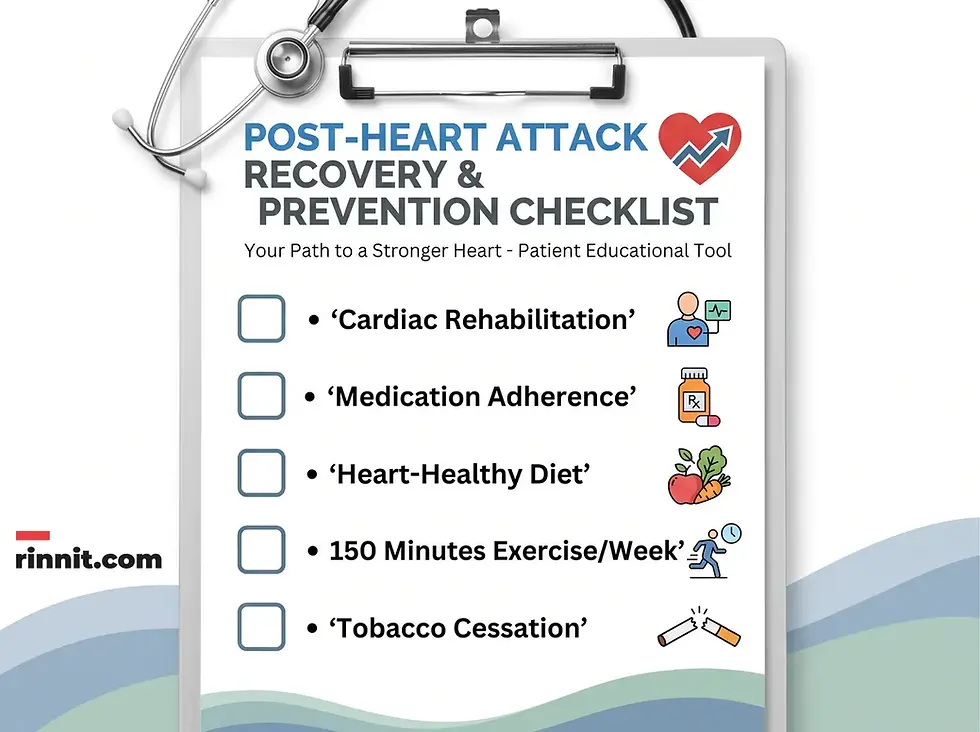
Recovery from a treated widowmaker heart attack may take weeks to months [1]. A critical component of long-term survival is participation in cardiac rehabilitation, which provides supervised exercise that starts slowly and progresses over a number of weeks, along with education on heart-healthy eating and stress management [1]. If your job is physically demanding, talk to your healthcare provider about what level of physical activity is safe [1].
Many people leave the hospital with medicines such as antiplatelet agents to help prevent future heart attacks, beta-blockers to lessen the heart's workload, ACE inhibitors or ARBs to lower blood pressure, statins to lower cholesterol, and SGLT2 inhibitors to manage blood sugar [1]. Attend all follow-up appointments so your provider can check your progress and adjust medicine doses.
Prevention strategies focus on managing systemic health and lifestyle choices. A heart-healthy diet that limits saturated fats and sugars, combined with at least 150 minutes of weekly exercise, can significantly reduce the risk of atherosclerosis. Weight control and avoiding tobacco products are also vital. For those with existing conditions like diabetes, high blood pressure, or high cholesterol, consistent management is the most effective way to prevent the arterial buildup that leads to a widowmaker event.
Frequently Asked Questions
Why is it called a "widowmaker" heart attack?
The name stems from the high mortality rate associated with a total blockage of the LAD artery, which supplies half the heart's blood. However, it affects both men and women.
Can you survive a widowmaker heart attack?
Yes. Survival is possible with immediate emergency treatment. The sooner you get treatment, the more likely it is that you will survive, and prompt treatment limits damage to the heart muscle.
What is the LAD artery?
The left anterior descending (LAD) artery is the heart's largest coronary artery, providing about half of the blood supply to the heart muscle.
What are the main risk factors?
Key risks include being older than 45 (men) or 50 (women), family history of heart disease, tobacco use, high blood pressure, high cholesterol, obesity, diabetes, and not getting enough physical activity.
How long does recovery take?
Recovery from a treated widowmaker heart attack may take weeks to months. Many people stay in the hospital for two to four days, and attending follow-up appointments and cardiac rehab is extremely important. If your job is physically demanding, ask your healthcare provider what level of activity is safe.
Is a widowmaker different from a regular heart attack?
A widowmaker is a type of heart attack, but it is considered more dangerous because the blocked artery is the heart's largest and supplies a large amount of blood to the heart muscle.
What is the "door-to-balloon" time?
The door-to-balloon time is the time from arrival at the hospital to restoring blood flow with angioplasty. It is a standard way to measure how quickly blood flow is restored, because faster treatment means more heart muscle can be saved.
Should I take an aspirin if I suspect a heart attack?
Call 911 or your local emergency number first and follow the dispatcher's instructions about whether to take any medicine. Do not delay calling, and do not drive yourself to the hospital.
What is cardiac rehab?
A supervised program that includes exercise, education on heart-healthy eating, and stress management to help patients recover and prevent another heart attack.
Can a widowmaker be prevented?
You can lower your risk by managing high blood pressure, cholesterol and diabetes, avoiding tobacco, eating foods low in saturated fat, limiting sugar, staying physically active, and keeping a healthy weight.
Related Reading
Understanding STEMI: The Severe Heart Attack explains the full-blockage heart attack type and its emergency treatment.
Coronary Artery Disease: Symptoms, Causes, Diagnosis, Treatment and Prevention — What You Need to Know explains how plaque narrows the heart arteries over time.
Angioplasty: Procedure, Types, Risks and Recovery explains how a balloon and stent reopen a blocked artery.
Cardiac Rehab: Phases, Exercises, Benefits and What to Expect describes the supervised program that helps recovery after a heart attack.
References
Cleveland Clinic. Widowmaker Heart Attack. Cleveland Clinic. Last updated September 28, 2026. https://my.clevelandclinic.org/health/diseases/24507-widowmaker-heart-attack
Shi Y, Xu H, Dong J. Exercise-based cardiac rehabilitation for patients undergoing coronary artery operation: a systematic review and meta-analysis based on current randomized controlled trials. Int J Surg. 2025;111(3):2708-2721. PMID 39903572. https://doi.org/10.1097/JS9.0000000000002268
McGrath BP, Pinilla-Echeverri N, Wood DA, et al. Left Anterior Descending Nonculprit Lesions and Clinical Outcomes in Patients With ST-Segment Elevation Myocardial Infarction. JACC Cardiovasc Interv. 2025;18(3):297-307. PMID 39641724. https://doi.org/10.1016/j.jcin.2024.09.004
Medical disclaimer
The information provided in this article is for educational purposes only and should not be used as a substitute for professional medical advice, diagnosis, or treatment. Always seek the advice of your physician or other qualified health provider with any questions you may have regarding a medical condition.



Comments