Whipple Procedure (Pancreaticoduodenectomy): What to Expect Before, During, and After Surgery

Updated: 3 days ago
Medically reviewed by Dr. Baraa Alnahhal, MD · Last reviewed: October 2026
Quick Answer
The Whipple procedure, also called pancreaticoduodenectomy, is a major abdominal operation that removes tumors from the head of the pancreas, along with the duodenum, gallbladder and part of the bile duct, then reconnects the digestive tract. [1] Recovery usually includes a one-to-two-week hospital stay and several months before full activity. It is the main surgery for localized pancreatic adenocarcinoma.
What the research says
Minimally invasive Whipple surgery looks safe in randomized trials, with less blood loss and a shorter stay. A meta-analysis of eight randomized trials (laparoscopic and robotic) found that minimally invasive surgery took about 50 minutes longer (95% CI 27.53 to 72.27) but reduced blood loss by about 97 mL and hospital stay by about 1 day. There were no significant differences in 90-day mortality (RR 1.13), overall complications (RR 0.99), or pancreatic fistula (RR 0.98) (Zhang et al., Surg Endosc, 2025) [2].
Long-term cancer outcomes with the minimally invasive approach are still being studied. An individual patient data meta-analysis of 16 studies (1,949 patients) with non-pancreatic periampullary cancers found similar short-term complications and mortality with minimally invasive and open surgery. However, disease-free survival was lower with the minimally invasive approach for ampullary cancer (HR 2.27) and distal bile duct cancer (HR 1.84), and overall survival was lower for distal bile duct (HR 1.71) and duodenal cancer (HR 4.59). The authors called for more prospective data (Uijterwijk et al., Langenbecks Arch Surg, 2023) [3].
What is the Whipple procedure (pancreaticoduodenectomy)?
The Whipple procedure, clinically known as a pancreaticoduodenectomy, is one of the most sophisticated operations in modern abdominal surgery. It is designed to address tumors and other conditions affecting the "head" of the pancreas, the wide part of the organ where the common bile duct and the small intestine meet. Because this area is a critical junction for digestive fluids and nutrients, surgery here requires precise removal and complex reconstruction of several vital structures.
In a standard Whipple procedure, the surgeon removes the head of the pancreas, the duodenum (the first section of the small intestine), the gallbladder, and a portion of the common bile duct. [1] In some cases, the bottom part of the stomach, including the pylorus, is also removed. However, many surgeons now perform a modified version called a "pylorus-sparing Whipple," which leaves the stomach intact to better preserve digestive function after the operation.

When is the Whipple procedure needed?
The Whipple procedure is most often used for pancreatic cancer but also treats other tumors and chronic conditions in the periampullary region. The primary goal is to remove all cancerous tissue before it can spread to distant organs. To understand the disease behind the operation, see our guide to pancreatic cancer.
Condition | Description |
Pancreatic adenocarcinoma | The most common form of pancreatic cancer, typically located in the head of the pancreas. |
Neuroendocrine tumors | Slower-growing tumors that arise from the hormone-producing cells of the pancreas. |
Duodenal cancer | Malignant growths in the first part of the small intestine. |
Bile duct cancer | Cancer that begins in the tubes that carry bile from the liver to the small intestine. |
Chronic pancreatitis | Severe inflammation of the pancreas that can cause damage to surrounding organs. |
How is the Whipple procedure performed?
Preparation for a Whipple procedure involves extensive testing to ensure the patient is a suitable candidate and that the cancer has not spread beyond the surgical site. This often includes advanced imaging such as CT scans or MRIs, and sometimes a minor exploratory procedure called a staging laparoscopy.
The surgery itself is performed under general anesthesia and usually takes about 4 to 12 hours. Depending on the patient's health and the surgeon's expertise, the procedure may be performed through a traditional "open" incision or using minimally invasive laparoscopic or robotic techniques. [1] Robotic surgery uses smaller incisions and specialized instruments, which can lead to a faster initial recovery for eligible patients. To learn more about these techniques, see our guide to minimally invasive surgery.
Key Surgical Steps
The procedure is divided into two main phases: removal and reconstruction. First, the surgeon carefully detaches and removes the gallbladder, the pancreatic head, the duodenum, and the necessary portions of the bile duct and lymph nodes. Once the affected tissues are removed, the reconstruction phase begins. The surgeon creates three new connections (anastomoses) to restore the digestive path:
Connecting the remaining pancreas to the small intestine.
Connecting the bile duct to the small intestine.
Connecting the stomach (or pylorus) to the small intestine.

What are recovery and long-term outlook like after the Whipple procedure?
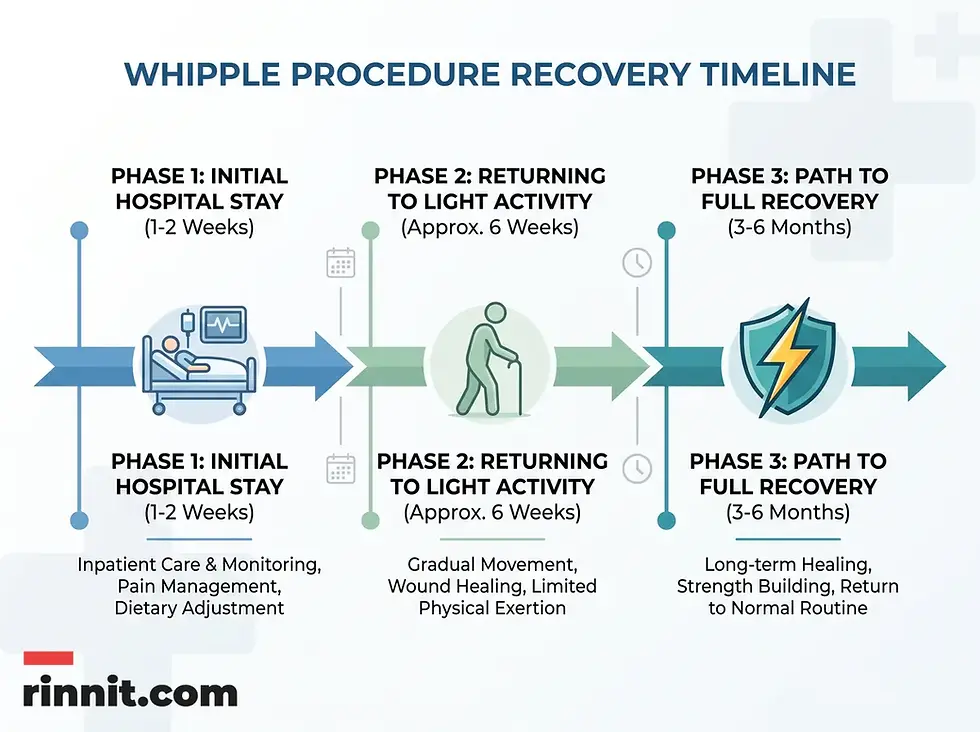
Recovery from a Whipple procedure is a gradual journey that begins with a one-to-two-week stay in the hospital. During the first few days, patients may receive nutrition through an IV or a feeding tube while the new internal connections begin to heal. Pain management and monitoring for potential complications, such as leaks at the surgical sites, are top priorities during this time.
Most patients can return to light, regular activities within six weeks [1], but a full recovery often takes several months. It is common to experience significant fatigue and changes in appetite during this period. Over time, the digestive system adjusts to its new configuration, though some patients may require long-term dietary modifications or pancreatic enzyme supplements to aid digestion.
Recovery milestone | Expected timeline |
Hospital stay | 1 to 2 weeks for monitoring and initial healing. |
Light activity | About 6 weeks for a return to non-strenuous daily tasks. |
Full recovery | 3 to 6 months for energy levels and digestion to stabilize. |
What are the potential risks and complications of the Whipple procedure?
As with any major operation, the Whipple procedure carries risks. Most complications are treatable if caught early, which is why close follow-up care is essential. One of the most common concerns is an "anastomotic leak," where digestive fluids escape from one of the new connections. [1] Other risks include infection, bleeding, delayed gastric emptying (where the stomach takes longer than usual to move food into the intestine), and diabetes if the remaining pancreas cannot produce enough insulin. [1]
Conclusion
The Whipple procedure offers the best chance for a cure in patients with localized pancreatic and periampullary cancers. While the road to recovery is long and requires patience, the ability to remove life-threatening tumors while preserving digestive function makes it a cornerstone of pancreatic cancer treatment.
What are the next steps for the Whipple procedure?
If you or a loved one has been diagnosed with a tumor in the head of the pancreas, consult with a surgical oncologist who specializes in the Whipple procedure. Discuss the potential benefits of minimally invasive options and ask about the necessary steps to optimize your health before surgery. A comprehensive care plan, including nutritional support and physical preparation, can significantly improve your surgical outcome.
Frequently Asked Questions
1. What is the Whipple procedure?
The Whipple procedure is a major surgery to remove tumors from the head of the pancreas, the duodenum, the gallbladder, and part of the bile duct.
2. What does "pancreaticoduodenectomy" mean?
Pancreaticoduodenectomy is the clinical name for the Whipple procedure, referring to the removal of part of the pancreas and the duodenum.
3. Is the Whipple procedure only for cancer?
While it is primarily used for cancer, it can also treat severe chronic pancreatitis or benign tumors.
4. How long does the surgery take?
The operation usually takes about 4 to 12 hours, depending on the case.
5. What is a pylorus-sparing Whipple?
A pylorus-sparing Whipple is a modified version of the surgery that leaves the entire stomach intact, including the pylorus.
6. How long is the hospital stay?
Most patients stay in the hospital for one to two weeks after surgery.
7. Can I live without a duodenum?
Yes. The surgeon reconnects the stomach directly to the next part of the small intestine (the jejunum).
8. What are the most common risks?
Risks include infections, bleeding, and leaks at the new surgical connections.
9. Will I need chemotherapy after surgery?
Many patients receive "adjuvant" chemotherapy or radiation after recovery to help ensure all cancer cells are gone.
10. Can the Whipple procedure cause diabetes?
Yes. Diabetes is a possible risk of the Whipple procedure, and it can be short-lived or lifelong [1]. Some people need to take pancreatic enzymes and insulin after surgery [4].
11. How long is the full recovery?
While light activity resumes at about six weeks, full recovery often takes several months.
12. Will my diet change after surgery?
Some patients need to eat smaller, more frequent meals or take pancreatic enzyme supplements.
13. What is the success rate?
For localized tumors that are fully removed, it offers the best long-term survival outlook for pancreatic cancer.
14. Can the surgery be done robotically?
Yes. Minimally invasive robotic and laparoscopic options are available for eligible candidates.
15. Why is it called the "Whipple" procedure?
The Whipple procedure is named after Dr. Allen Whipple, the surgeon who refined the technique in the 1930s.
16. How do I prepare for the Whipple procedure?
You meet with your surgeon and care team to discuss what to expect, the risks and how the surgery will affect your life, and you may need more medical tests to confirm you are healthy enough for this difficult operation [1]. Some people need chemotherapy or radiation first, so ask whether your treatment comes before or after surgery [1]. Ask how many Whipple and other pancreatic procedures the surgeon and hospital have done, since outcomes are better at high-volume centers, and consider a second opinion [1]. Tell family or friends what help you will need, because most people need support for the first couple of weeks at home [1].
17. Does the Whipple procedure hurt, and what anesthesia is used?
The operation is done under general anesthesia, so you are in a sleep-like state for the whole surgery, which takes about 4 to 12 hours [1]. An IV in your arm delivers fluids and medicines, and pain control may include a thin tube placed near the spine (an epidural) or spinal or abdominal injections, which lowers the need for strong pain medicines afterward [1]. Expect at least a week in the hospital, sometimes with a few days in intensive care, and the urinary catheter is usually removed one or two days after surgery [1].
18. When should I call my doctor after the Whipple procedure?
Contact your surgeon if you have a fever of 101°F (38.3°C) or higher, a wound that bleeds, looks red, feels warm or has thick, discolored or milky drainage, or problems with your drain [4]. Also call for pain your medicines don't help, trouble breathing, a cough that won't go away, being unable to eat or drink, nausea, diarrhea or constipation that isn't controlled, yellowing of your skin or eyes, or gray stools [4].
Related Reading
Trusted External Resources
References
Mayo Clinic. Whipple procedure. Mayo Clinic. Accessed October 8, 2026. https://www.mayoclinic.org/tests-procedures/whipple-procedure/about/pac-20385054
Zhang J, Chen F, Tang G, Chen R, Zhou R. Minimally invasive versus open pancreaticoduodenectomy for periampullary tumors: a systematic review and meta-analysis of randomized controlled trials. Surg Endosc. 2025;39(11):7666-7679. PMID 40931101. https://doi.org/10.1007/s00464-025-12163-9
Uijterwijk BA, Kasai M, Lemmers DHL, et al. The clinical implication of minimally invasive versus open pancreatoduodenectomy for non-pancreatic periampullary cancer: a systematic review and individual patient data meta-analysis. Langenbecks Arch Surg. 2023;408(1):311. PMID 37581763. https://doi.org/10.1007/s00423-023-03047-4
MedlinePlus. Surgery for pancreatic cancer - discharge. MedlinePlus. Last updated July 9, 2025. https://medlineplus.gov/ency/patientinstructions/000820.htm
Medical Disclaimer
This article is for informational purposes only and does not constitute medical advice. Always seek the advice of your physician or other qualified health provider with any questions you may have regarding a medical condition. Never disregard professional medical advice or delay in seeking it because of something you have read here.



Comments