What Is Undifferentiated Pleomorphic Sarcoma? A Plain-Language Guide to a Rare Cancer

Updated: 3 days ago
Medically reviewed by Dr. Baraa Alnahhal, MD · Last reviewed: October 2026
Quick Answer
Undifferentiated pleomorphic sarcoma is a rare cancer of the soft tissues that most often forms in a leg or arm. [1] It usually appears as a growing lump, often painless at first. [1] [3] Its exact cause is unknown, and it mostly affects people aged 50 to 70. [1] Treatment is surgery, often combined with radiation and medicines, ideally by an experienced expert team. [2]
What the research says
Complete surgery and radiation were linked to better outcomes. In a retrospective review of 534 people who had surgery for primary UPS (median age 60, median tumor size 8.5 cm), median overall survival was 109 months and median recurrence-free survival was 49 months. Tumors larger than 5 cm and positive resection margins were associated with worse survival, while complete (R0) resection and radiation treatment were independent predictors of better overall and recurrence-free survival. (Makris et al., J Surg Oncol, 2024) [4]
UPS is rare, and exact numbers are hard to pin down. Using U.S. cancer registry data, researchers estimated UPS incidence at between 0.06 and 0.67 per 100,000 persons in 2016 to 2020, depending on how UPS was defined, and incidence decreased under every definition between 2000 and 2020 as classification methods evolved. (Ma et al., Sarcoma, 2024) [5]
What exactly is undifferentiated pleomorphic sarcoma?
Undifferentiated pleomorphic sarcoma is a rare type of cancer. [1] It starts mostly in the body's soft tissues — the tissues that connect, support, and surround other body structures. Soft tissues include muscle, fat, blood vessels, nerves, tendons, and the linings of the joints. [1] Rarely, UPS can start in bone; UPS of bone is considered a bone sarcoma and is treated differently from soft tissue UPS. [1]
This cancer typically forms in a leg or an arm. [1] Less often, it can happen in the area behind the organs in the belly. [1] That area is called the retroperitoneum (reh-troe-PER-ih-toe-NEE-um).
The name sounds complicated, but it simply describes how the cancer cells look under a microscope. Undifferentiated means the cells do not look like the healthy cells around them. [1] Pleomorphic (plee-o-MOR-fik) means the cells grow in many shapes and sizes. [1]
Treatment depends on where the cancer is located and whether it has spread. It often involves surgery, radiation therapy, and medicines. [1]
Where does it form in the body?

Soft tissue cancers can technically appear anywhere in the body. But the overwhelming majority form in the limbs, where muscle, fat, and tendons make up large volumes of soft tissue. The retroperitoneum — the space behind the stomach and other abdominal organs — is the second most common site.
What are the symptoms?
Symptoms depend on where the cancer is located. The most common warning signs are listed below.
Because the lump is often painless, it is easy to overlook. That is why any unexplained lump deserves attention.
When should you see a doctor?
Make an appointment with a healthcare professional if you have ongoing symptoms that worry you [1] — especially a lump that is growing, no matter whether it hurts.
Most lumps turn out to be harmless. But only a doctor can tell the difference through an exam and testing.
What causes undifferentiated pleomorphic sarcoma?
The exact cause is not known. [1] What doctors do know is how this cancer — like all cancers — gets started.
Cancer happens when cells develop changes in their DNA. A cell's DNA holds the instructions that tell the cell what to do. In healthy cells, the DNA tells the cells to grow and multiply at a set rate, and to die at a set time. [1]
In cancer cells, the DNA changes give different instructions. The changes tell the cancer cells to grow and multiply quickly. Cancer cells can keep living when healthy cells would die. This causes too many cells. [1]
The cancer cells might form a mass called a tumor. The tumor can grow to invade and destroy healthy body tissue. In time, cancer cells can break away and spread to other parts of the body. When cancer spreads, it is called metastatic cancer. [1] UPS that has spread most often spreads to the lungs. [1] [3]
Why do the cells look so unusual?
The visual distinctiveness of this cancer is worth a moment of explanation, because the diagnosis hinges on it.
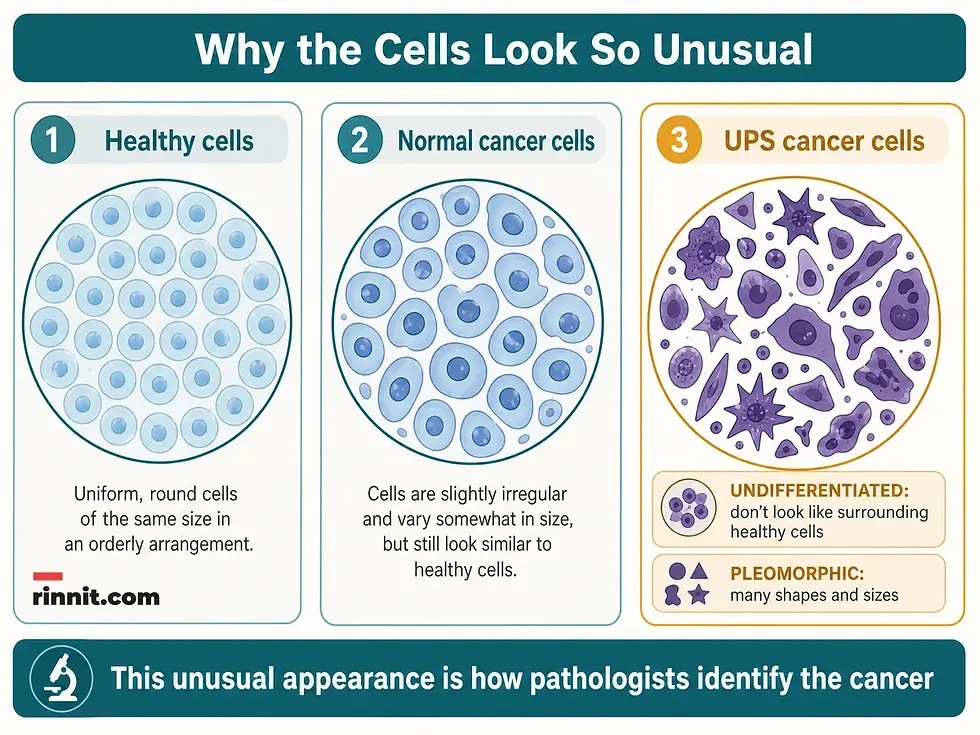
In most cancers, pathologists can trace the cells back to a clear tissue of origin — the cells still look like muscle, fat, or nerve cells gone wrong. In undifferentiated pleomorphic sarcoma, the cells have changed so much that their original tissue type can no longer be identified. [3] They simply look abnormal, and they vary wildly in shape and size. That distinctive appearance is the whole reason the cancer carries its long, technical name.
What are the risk factors?
Two factors may raise the risk of undifferentiated pleomorphic sarcoma.
Two important reassurances come with this list. First, most people who develop undifferentiated pleomorphic sarcoma have no known risk factors. [1] Second, many people who have risk factors never develop this cancer. [1]
How is undifferentiated pleomorphic sarcoma diagnosed?
Diagnosis usually starts with a review of symptoms and a physical exam. Imaging tests and a biopsy are also used to confirm the diagnosis. [2]
During the physical exam, a healthcare professional asks when symptoms started and whether they have changed over time. [2] This helps the team decide what tests are needed.
Imaging tests make pictures of the body. They give the healthcare team information about the size and location of the cancer and about nearby tissues. Options include X-rays, CT scans, MRI scans, and positron emission tomography (PET) scans. [2] Some tests, such as X-rays, are better for seeing bones, while others, such as MRIs, are better for seeing soft tissues. [2]
A biopsy is a procedure to remove a sample of tissue for testing in a lab. The sample may be collected using a needle, or sometimes surgery is needed to remove a tissue sample if a biopsy is hard to do because of the location. [2] In the lab, doctors trained in analyzing body tissues — called pathologists — examine the types of cells. Because UPS is rare, pathologists who specialize in sarcoma can help confirm the diagnosis. [2]

How is undifferentiated pleomorphic sarcoma treated?
Treatment for UPS that has not spread typically involves surgery to remove the cancer. Radiation therapy is often used along with surgery. Other treatments may include medicines — chemotherapy, targeted therapy, and immunotherapy. [2] Treatment choices are based on the size and location of the cancer. [2]
Because undifferentiated pleomorphic sarcoma is rare and often requires complex care, this type of cancer is best handled by a team of experts with a lot of experience treating it. [2]
Surgery
The goal of surgery is to remove the sarcoma completely when possible. An area of healthy tissue around it is also removed to make sure all cancer cells are taken out. [2]
When the cancer affects an arm or a leg, surgery is done in a way that saves the limb whenever possible. Although it is not common, sometimes the arm or leg may need to be removed. That procedure is called amputation. [2]
Radiation therapy
Radiation therapy treats cancer with powerful energy beams. The energy beams can come from X-rays, protons, or other sources. [2]
Radiation therapy might be done before surgery to help control the tumor. Or it can be done after surgery to kill cancer cells that might be left behind. [2] The goal of radiation before or after surgery is to lower the risk of the cancer coming back.
Chemotherapy
Chemotherapy treats cancer with strong medicines. It may be used for some people with UPS, including when the cancer has spread or come back. [2]
Sometimes chemotherapy is used before surgery to shrink the cancer so it is easier to remove. Or it may be used after surgery to lower the risk that the sarcoma will come back. The benefit of chemotherapy for UPS that has not spread isn't clear. [2]
Targeted therapy
Targeted therapy uses medicines to attack specific chemicals in the cancer cells. By blocking these chemicals, targeted treatments can cause cancer cells to die.
Some targeted therapies only work in people whose cancer cells have certain genetic changes. Because of that, the cancer cells may be tested in a lab first to see whether targeted therapy might help.
Immunotherapy
Immunotherapy is a treatment with medicine that helps the body's immune system kill cancer cells. The immune system fights off diseases by attacking germs and other cells that should not be in the body. Cancer cells survive by hiding from the immune system. Immunotherapy helps the immune cells find and kill the cancer cells. It is being studied in both early-stage and advanced UPS. [2]
Palliative care
Palliative care focuses on relieving symptoms and improving quality of life at any stage of cancer. Surgery, radiation therapy, or medicines may be used to relieve symptoms even when eliminating the cancer isn't possible, and palliative care can be provided alongside treatments meant to control the cancer. [2]

What is the outlook?
The outlook for someone with UPS depends on many things and is different from person to person. It depends on the features of the cancer, how well treatment works, whether the cancer has spread to organs or bones, and a person's overall health. [2] In general, survival rates for sarcoma are better when the cancer has not spread, and UPS may be cured if it has not spread and surgery can remove the entire tumor. [2] Your care team knows the details of your cancer and can give you a personalized outlook.
Are clinical trials an option?
Clinical trials are research studies that test new treatments, interventions, and tests as a way to prevent, detect, treat, or manage a condition. For a rare cancer like undifferentiated pleomorphic sarcoma, trials can open access to therapies that are not yet widely available. A healthcare team can explain whether a trial is a reasonable option for a particular situation.
Do alternative treatments help?
No alternative treatments have been found helpful in treating undifferentiated pleomorphic sarcoma. [2]
That said, complementary approaches might help ease some symptoms or side effects of cancer treatment. Examples include acupuncture, exercise, and massage. Mindfulness-based activities such as yoga, relaxation, and music therapy may also be useful. [2] If you are interested in trying complementary treatments, talk with a healthcare professional first.
How can you cope with the diagnosis?
With time, most people find what helps them cope with the worries and feelings that come with a cancer diagnosis. Until then, three practical strategies help.
Learn enough about the diagnosis to make decisions about care. Talk with the healthcare team about the cancer, the test results, and the treatment choices. The more you learn, the more confident you can become about decisions.
Find a good listener. Sharing hopes and fears helps. That person could be a friend or family member. A counselor, medical social worker, or clergy member can also offer helpful guidance and care.
Connect with others. People who have had sarcoma can offer unique support and insight because they understand the experience. A healthcare team can suggest support groups, or the American Cancer Society can help connect patients with others facing the same diagnosis.
How should you prepare for a doctor's appointment?
If a healthcare professional suspects undifferentiated pleomorphic sarcoma, you will likely be referred to an oncologist (on-KOL-uh-jist) — a doctor who treats cancer. [2]
A lot of information comes up at that appointment, so it helps to be prepared. When making the appointment, ask whether anything is needed beforehand, such as fasting for a period of time. [2]
Before the visit, prepare a list of your symptoms, your key personal information, such as medical and surgical history and family medical history, and all medicines, vitamins, and supplements you take, including the doses. Also write down the questions you want to ask. Bring a family member or friend along, if possible, to help remember the information you are given.
Some useful questions to ask the healthcare professional include: What tests do I need? What are my treatment options and the potential side effects of each? How can my other health conditions be managed alongside treatment? Are there brochures or other printed materials I can take with me, and what websites do you recommend?
Expect the doctor to ask several questions as well: When did your symptoms start? Are they always present, or do they come and go? How severe are they? What makes them better or worse? [2]
What is the bottom line on undifferentiated pleomorphic sarcoma?
Undifferentiated pleomorphic sarcoma is a rare cancer, but the core facts are straightforward: it usually begins in the soft tissues of an arm or a leg, it often shows up as a growing, painless lump, and it is most common in adults between 50 and 70. The name is intimidating, but it only describes what the cells look like under a microscope — not how the disease behaves.
The single most important step is paying attention to your body. Any growing lump, any ongoing pain or pressure, deserves a doctor's visit. Diagnosis takes a physical exam, imaging tests, and a biopsy, and treatment usually combines surgery with radiation therapy and medicines. Because this cancer is rare, an experienced, expert care team makes a real difference.
Take the Next Step
If you have a growing lump or ongoing pain or pressure, contact a healthcare provider for an evaluation. For more plain-language guides to rare cancers and other health topics, explore the related articles on Rinnit.com.
Frequently Asked Questions
Is undifferentiated pleomorphic sarcoma contagious?
No. It cannot spread from person to person. It develops when a person's own cells develop DNA changes that make them grow out of control.
Is undifferentiated pleomorphic sarcoma the same as other sarcomas?
No. Sarcomas are a group of cancers, and undifferentiated pleomorphic sarcoma is one specific type. It gets its name from the unusual, varied appearance of its cells under a microscope, which do not resemble the surrounding healthy tissue.
Does a painless lump mean cancer?
Not usually — most lumps are harmless. But a painless lump that keeps growing is a common way this cancer first appears, which is why any new or growing lump should be checked by a healthcare professional rather than ignored.
Can undifferentiated pleomorphic sarcoma be prevented?
There is no known way to prevent it. Most people who develop it have no identifiable risk factors, and the exact cause is unknown. The best protection is prompt evaluation of any new or growing lump.
Why does the doctor test the cancer cells before choosing treatment?
Some targeted therapies only work when the cancer cells carry certain genetic changes. Testing the cells in a lab first tells the team whether a targeted medicine is likely to help, so treatment can be matched to the individual cancer.
Will I lose my arm or leg?
In most cases, no. When the cancer affects an arm or a leg, surgeons use limb-sparing surgery whenever possible. Amputation is sometimes necessary, but it is not common.
Related Reading
References
Mayo Clinic Staff. Undifferentiated pleomorphic sarcoma (UPS): Symptoms and causes. Mayo Clinic. Last updated September 5, 2026. Accessed October 14, 2026. https://www.mayoclinic.org/diseases-conditions/undifferentiated-pleomorphic-sarcoma/symptoms-causes/syc-20389554
Mayo Clinic Staff. Undifferentiated pleomorphic sarcoma (UPS): Diagnosis and treatment. Mayo Clinic. Last updated September 5, 2026. Accessed October 14, 2026. https://www.mayoclinic.org/diseases-conditions/undifferentiated-pleomorphic-sarcoma/diagnosis-treatment/drc-20389565
Menon G, Solis-Ledesma G. Undifferentiated pleomorphic sarcoma. In: StatPearls [Internet]. Treasure Island (FL): StatPearls Publishing; 2025 Jan-. Updated June 23, 2025. PMID 34033374. https://www.ncbi.nlm.nih.gov/books/NBK570612/
Makris EA, Tran TB, Delitto DJ, et al. Natural history of undifferentiated pleomorphic sarcoma: experience from the US Sarcoma Collaborative. J Surg Oncol. 2024;129(7):1354-1363. PMID: 38562002. https://doi.org/10.1002/jso.27620
Ma J, Groisberg R, Shao C, et al. Incidence of undifferentiated pleomorphic sarcoma (UPS) in the United States. Sarcoma. 2024;2024:6735002. PMID: 39502684. https://doi.org/10.1155/2024/6735002
Disclaimer: This guide is for general information only and is not a substitute for professional medical advice, diagnosis, or treatment. Always seek the advice of a physician or other qualified health provider with any questions about a medical condition. Never disregard professional medical advice or delay seeking it because of something you have read here.



Comments