What Is Iritis? The Eye Inflammation That Can Show Up Suddenly — and Why It Needs Prompt Care

Updated: 2 days ago
Medically reviewed by Dr. Baraa Alnahhal, MD · Last reviewed: October 2026
Quick Answer: Key Facts About Iritis
Iritis is inflammation of the iris, the colored part of the eye, and nearby tissues, and is the most common form of uveitis. It causes eye pain, redness, watery discharge and light sensitivity. Often no cause is found. Steroid eyedrops are the main treatment, and because untreated iritis can lead to cataracts, glaucoma and vision loss, early treatment matters. [1] [2]
What the research says
Steroid eyedrops are the standard treatment, and newer formulations hold up in trials. In a phase III randomized trial of 110 people with mild to moderate endogenous anterior uveitis, difluprednate 0.05% four times a day was noninferior to prednisolone acetate 1% eight times a day for reducing inflammation (change in anterior chamber cell grade -2.2 vs -2.0). By day 21, inflammatory cells had cleared completely in 73.9% of the difluprednate group and 63.8% of the prednisolone group, and eye pressure rose slightly more at day 3 with difluprednate (2.5 vs 0.1 mm Hg). (Sheppard et al., Invest Ophthalmol Vis Sci, 2014) [4]
Smoking is linked to a higher risk of uveitis. A systematic review and meta-analysis of seven studies (1,557 people with uveitis and 4,293 controls) found that smokers had about twice the odds of uveitis (pooled odds ratio 1.97, 95% CI 1.71-2.27), and former smokers also had higher odds (OR 1.23). The included studies were observational, so the finding shows an association. (Kuč et al., Ocul Immunol Inflamm, 2025) [5]
A gene-linked form of anterior uveitis is strongly tied to joint disease. A meta-analysis of 22 studies of acute anterior uveitis found that HLA-B27-positive cases were strongly associated with ankylosing spondylitis (relative risk 6.80) and with other systemic disease (relative risk 9.9). (D'Ambrosio et al., Semin Ophthalmol, 2016) [6]
Iritis (i-RYE-tis) is inflammation of the iris, the colored part of the eye, and the nearby tissues. It is the most common type of a broader condition called uveitis (u-vee-I-tis), which is inflammation of the layer of tissue beneath the white of the eye. [1]
Symptoms often come on suddenly and get worse quickly. The condition can affect one eye or both, and it can affect people of all ages, including children. Early diagnosis and treatment are important because untreated iritis can lead to vision loss. [1]
Iritis is also sometimes called anterior uveitis, which means inflammation of the front part of the eye. Uveitis can cause vision loss if it is not treated, which is why prompt care matters. [3]
What does the iris look like, and where does the inflammation happen?
The iris sits inside a layer of tissue called the uvea, located beneath the white of the eye (the sclera). The uvea has three parts. The iris is the colored part you can see. The ciliary body is the structure that secretes the transparent liquid inside the front of the eye. The choroid is a layer of blood vessels between the sclera and the retina. [1]
In iritis, the inflammation is mostly in the iris and the front part of the ciliary body. Because these structures sit at the front of the eye, iritis often causes visible redness and sensitivity to light. [1]
Inflammation itself is the immune system's normal reaction to disease or injury. It increases blood flow, releases proteins that defend cells and delivers disease-fighting cells to the area. Short-term inflammation helps the body heal, but long-term inflammation from untreated disease or injury can damage tissue. Inflammation can also happen when the immune system attacks healthy tissue, which is called an autoimmune disease. All of these processes can drive inflammation inside the eye. [1]

What are the symptoms of iritis?
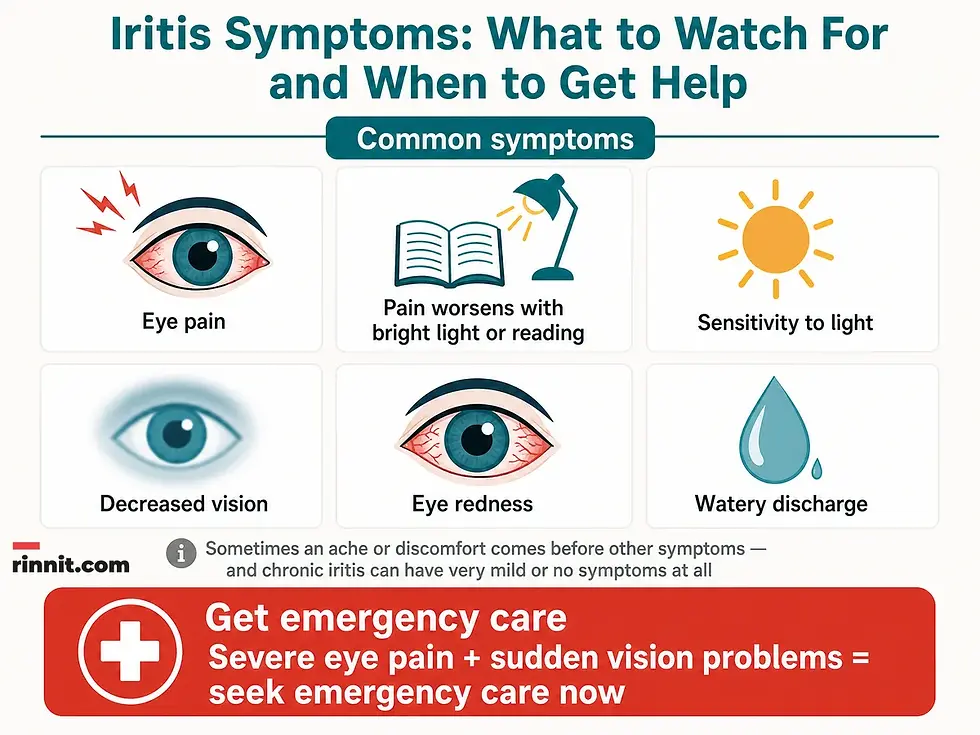
Symptoms of iritis usually appear suddenly. The most common ones include eye pain, pain that worsens with bright light or reading, sensitivity to light, decreased vision, eye redness and watery discharge. Some people feel an achiness or general discomfort in the affected eye before the other symptoms show up. [1]
Some people have very mild symptoms or no symptoms at all. This happens most often when the condition develops gradually over a long period. That slower, quieter form is called chronic iritis. [1]
Symptom | What it looks or feels like |
Eye pain | Achiness or sharp pain in one eye, sometimes preceded by general discomfort |
Light-related pain | Pain that worsens with bright light or while reading |
Light sensitivity | Bright light feels uncomfortable or painful to the affected eye |
Decreased vision | Vision in the affected eye becomes blurry or dimmer |
Eye redness | The white of the eye takes on a red, irritated appearance |
Watery discharge | Watery fluid leaking from the affected eye |
Symptoms can appear in one eye or both eyes. If the symptoms are very mild, the condition is more likely to be the chronic, slow-developing type. [1]
When should you see a doctor?
Contact your healthcare team if you think you have symptoms of iritis. You may be referred to an eye specialist called an ophthalmologist, a doctor who specializes in diseases of the eye. If you have severe eye pain and sudden vision problems, get emergency care right away. [1]
Prompt care matters because early treatment helps prevent vision loss. Left untreated, iritis can lead to four kinds of complications. Cataracts (clouding of the eye's lens) can result from iritis itself or from corticosteroid treatment for inflammation. Glaucoma (damage to the optic nerve) can also result from the disease or its treatment. The inflamed iris can stick to the cornea (the clear outer covering of the eye) or to the capsule holding the lens, leaving the pupil irregular and unable to adjust to light. And calcium can be deposited on the cornea in a condition called band keratopathy, which clouds corneal tissue and can decrease vision. [1]
What causes iritis?
In many cases, no cause can be found. When a cause does exist, it typically falls into one of three groups: injury, infection or an immune system condition. [1]
Injury to the eye from trauma or from eye surgery can trigger inflammation. Infections most often linked to iritis include herpes, chicken pox and shingles, syphilis and Lyme disease. A bacterial infection after eye surgery can also cause inflammation. [1]
Autoimmune diseases are another important group. Juvenile rheumatoid arthritis is an autoimmune disease and the most common cause of iritis in children. Some autoimmune diseases linked to a particular gene, including ankylosing spondylitis and reactive arthritis (both diseases of the bones and joints), can cause iritis. Sarcoidosis, an autoimmune disease that causes inflammation throughout the body, can affect the eyes as well. [1]
Cause | Details |
No cause found | In many cases, the cause of the inflammation cannot be identified |
Eye injury | Trauma or surgery to the eye can trigger inflammation |
Herpes infections | A common infectious cause of iritis |
Chicken pox and shingles | Viral infections that can inflame the iris |
Syphilis | A bacterial infection linked to iritis |
Lyme disease | A tick-borne infection that can cause eye inflammation |
Post-surgical infection | Bacterial infection after eye surgery |
Juvenile rheumatoid arthritis | The most common cause of iritis in children |
Ankylosing spondylitis, reactive arthritis | Gene-linked autoimmune diseases of the bones and joints |
Sarcoidosis | An autoimmune disease causing body-wide inflammation, including in the eyes |
What increases the risk?
Having an infection or autoimmune disease linked to iritis does not guarantee that inflammation will develop, but it raises the chance. Smoking is another important factor: it may increase the risk of iritis and the risk of more severe disease. [1]
How is iritis diagnosed?
A doctor who specializes in eye care, an ophthalmologist, will usually do a complete eye exam and take a thorough health history. The exam typically has three core parts. A vision test (also called a visual acuity test) uses eye charts to measure how well you can read a series of letters, one eye at a time. A microscopic exam uses a specialized microscope called a slit lamp, which combines bright light and magnification to see precise details of the eye's structures; you may get eye drops to enlarge your pupils. An intraocular pressure test measures the pressure inside your eye. [2]
Your eye doctor may order other tests to rule out other types of uveitis or other eye conditions. These can include color photography of the inside of the eye, optical coherence tomography (OCT) imaging that maps the retina and choroid to reveal inflammation in those layers, and fluorescein angiography or indocyanine green angiography, tests in which a dye is delivered through an intravenous (IV) tube in your arm, travels to the blood vessels in your eyes and allows detailed photographs of inflamed vessels. In some cases the doctor may analyze fluid taken from the eye. [2]
Because iritis can have an underlying cause, your doctor may also order tests to find it. These can include blood tests to look for possible infections, genetic tests to look for links to possible autoimmune diseases, and X-rays to look for signs of diseases that may cause iritis. [2]
Test | What it does |
Vision test | Uses eye charts to measure how well each eye can read letters |
Slit lamp exam | A bright-light microscope exam, often with pupil-dilating drops, to see structures and changes inside the eye |
Intraocular pressure test | Measures the pressure inside the eye |
Color photography | Photographs the inside of the eye |
OCT imaging | Maps the retina and choroid to reveal inflammation in those layers |
Angiography (fluorescein or indocyanine green) | An IV dye highlights inflamed blood vessels in the eye for detailed photos |
Eye fluid analysis | Examines fluid from the eye |
Blood tests | Look for possible infections |
Genetic tests | Look for links to possible autoimmune diseases |
X-rays | Look for signs of diseases that may cause iritis |
How is iritis treated?
The treatment goals for iritis are to reduce inflammation, lessen symptoms and prevent vision loss or other complications. Most often, treatment involves two kinds of eyedrops. Steroid eyedrops (corticosteroid medicines given as eyedrops) are the primary treatment for reducing inflammation and lessening symptoms. Dilating eyedrops temporarily make the pupils larger, which can lessen pain and also prevent the pupil from sticking to the cornea or the lens capsule. [2]
If symptoms do not clear up or if they worsen, the eye doctor may prescribe corticosteroid pills or other anti-inflammatory medicine. The doctor may also prescribe other medicines or refer you to other specialists to treat any underlying disease. Follow-up care and monitoring are usually part of the plan. [2]

How can you prepare for an eye appointment?
If your symptoms make you seek care, you will likely start with your primary healthcare team and may be referred to an ophthalmologist. Preparing ahead makes the visit more useful. Make a list of your symptoms, including any that seem unrelated to your eyes. List all medicines, vitamins and supplements you take, along with the doses and the reason for each. Gather key personal information, including any recent trauma or injury and your family medical history, especially whether any family member has an autoimmune disease. And write down the questions you want to ask. [2]
If possible, take a family member or friend to the appointment to help you remember the information you are given. Having your pupils dilated for the eye exam also affects your vision for a time afterward, so it can help to have someone drive you home. [2]
Useful questions to ask your eye doctor include what is likely causing your symptoms, what tests will be ordered, and what you should do if symptoms do not go away or seem to worsen. You can also ask how to manage other health conditions alongside the iritis, whether follow-up exams are needed and when, and whether the doctor has printed materials or recommended websites. [2]
Your eye doctor will likely ask you questions too. Expect questions about whether symptoms are in one or both eyes, when they began, how you would rate the pain on a scale of 1 to 10, whether your vision has changed, whether you are sensitive to light, and whether bright light or reading worsens the pain. The doctor may also ask whether you have joint pain or other arthritis symptoms, sores in your mouth or on your genitals, whether you are taking medicine for an infection, and whether you have had iritis or other eye conditions before. [2]
Conclusion and next steps
Iritis is the most common form of uveitis, and the message is simple: sudden eye pain, redness and light sensitivity deserve a prompt eye exam. The condition can strike anyone at any age, and in many cases no cause is ever found. What makes iritis dangerous is delay, because untreated inflammation can lead to cataracts, glaucoma and lasting changes to the pupil and cornea. [1]
If you have noticed new eye pain, redness or sensitivity to light, especially pain that worsens with bright light or reading, the most important next step is to contact your healthcare team. Severe eye pain with sudden vision changes is an emergency. [1]
Talk with an eye specialist. If you notice sudden eye pain, redness, light sensitivity or any drop in vision, contact your healthcare team for a prompt exam. Mention any recent eye injury, infections, joint pain or family history of autoimmune disease, since these clues help your eye doctor find the cause. For more plain-language guides on eye health, visit Rinnit.com.
Frequently Asked Questions
What is iritis?
Iritis is inflammation of the iris, the colored part of the eye, and nearby tissues. It is the most common type of uveitis, a broader term for inflammation of the uvea, the tissue layer beneath the white of the eye. Symptoms often appear suddenly and include eye pain, redness and light sensitivity.
What does iritis feel like?
Iritis typically causes eye pain, redness, watery discharge, decreased vision and sensitivity to light. The pain often worsens with bright light or reading. Some people feel a general achiness in the affected eye before other symptoms appear, and some people, especially with chronic iritis, have very mild symptoms or none at all.
What causes iritis?
In many cases no cause is found. Known causes include eye injury from trauma or surgery; infections such as herpes, chicken pox and shingles, syphilis and Lyme disease; and autoimmune conditions such as juvenile rheumatoid arthritis (the most common cause in children), ankylosing spondylitis, reactive arthritis and sarcoidosis.
Is iritis dangerous?
Iritis itself is usually treatable, but it can be dangerous if it is left untreated. Without treatment it can lead to cataracts, glaucoma, an irregular pupil that no longer adjusts to light, and calcium deposits on the cornea, all of which can reduce vision.
How is iritis treated?
The primary treatment is steroid eyedrops, which reduce inflammation and symptoms, along with dilating eyedrops that ease pain and keep the pupil from sticking to the cornea or lens capsule. If symptoms persist, doctors may prescribe steroid pills or other anti-inflammatory medicines and treat any underlying disease.
Can iritis come back?
Yes. Uveitis can come back, and follow-up care and monitoring are usually part of the treatment plan. Tell your eye doctor promptly if symptoms return.
Is iritis the same as pink eye?
No. Pink eye usually feels gritty or itchy, while iritis tends to cause aching eye pain, strong light sensitivity and blurred vision. Because the treatments are very different, a painful red eye needs an eye exam.
How is iritis diagnosed?
An eye doctor does a full eye exam, including a vision test, a slit lamp exam with a bright microscope and an eye pressure check. Blood tests or X-rays may be added to look for an underlying cause.
Is iritis contagious?
Iritis itself does not spread from person to person. Some infections that can trigger it, such as herpes or syphilis, can be passed on, but the eye inflammation is not.
How long does iritis last?
With prompt treatment, a sudden flare often improves within a few weeks. The slow, chronic form can last for months, so keep all follow-up visits and get emergency care for severe pain with sudden vision loss.
Related Reading
Uveitis: Symptoms, Causes, and Treatment — What Eye Inflammation Means for Your Vision explains the wider group of eye inflammation conditions that includes iritis.
Ankylosing Spondylitis: Symptoms, Causes, Treatment & Complete Guide covers a spine condition often linked with iritis.
Slit Lamp Exam: What It Checks, How It's Done and What to Expect describes the microscope eye exam used to diagnose iritis.
Glaucoma: The Silent Threat to Vision, and How Early Treatment Can Protect Your Sight explains a possible complication of iritis that damages the optic nerve.
References
Mayo Clinic Staff. Iritis: Symptoms & causes. Mayo Clinic. Updated July 14, 2026. https://www.mayoclinic.org/diseases-conditions/iritis/symptoms-causes/syc-20354961
Mayo Clinic Staff. Iritis: Diagnosis & treatment. Mayo Clinic. Updated July 14, 2026. https://www.mayoclinic.org/diseases-conditions/iritis/diagnosis-treatment/drc-20354966
National Eye Institute. Uveitis. National Eye Institute. Last updated December 4, 2024. https://www.nei.nih.gov/eye-health-information/eye-conditions-and-diseases/uveitis
Sheppard JD, Toyos MM, Kempen JH, et al. Difluprednate 0.05% versus prednisolone acetate 1% for endogenous anterior uveitis: a phase III, multicenter, randomized study. Invest Ophthalmol Vis Sci. 2014;55(5):2993-3002. PMID 24677110. https://doi.org/10.1167/iovs.13-12660
Kuč S, Drent M, Erckens R, et al. Smoking and risk of uveitis: a systematic review and meta-analysis. Ocul Immunol Inflamm. 2025;34(1):48-55. PMID 41133437. https://doi.org/10.1080/09273948.2025.2574484
D'Ambrosio EM, La Cava M, Tortorella P, et al. Clinical features and complications of the HLA-B27-associated acute anterior uveitis: a metanalysis. Semin Ophthalmol. 2016;32(6):689-701. PMID 27404944. https://doi.org/10.3109/08820538.2016.1170158
Medical disclaimer
This article is for general educational purposes only and is not a substitute for professional medical advice. Always seek the advice of your physician or other qualified health provider with any questions about an eye condition or treatment plan.



Comments