What Is Guttate Psoriasis? Symptoms, Triggers, and Treatment

Updated: 3 days ago
Medically reviewed by Dr. Baraa Alnahhal, MD · Last reviewed: October 2026
Quick Answer
Guttate psoriasis is a type of psoriasis that causes small, round or teardrop-shaped pink or red patches, usually 2 to 10 millimeters wide [1]. It usually follows an infection such as strep throat and is most common in people under 30 [1]. It isn't contagious [1]. Most people recover completely, but about one-third develop chronic plaque psoriasis [1].
Key takeaways
Main symptom: Small, teardrop-shaped red or pink patches, usually 2 to 10 millimeters wide, that can itch [1].
Main trigger: Bacterial infections, especially strep throat caused by Group A Streptococcus [1].
Who gets it: Children, teenagers, and young adults, especially those under 30 [1].
Duration: It usually goes away on its own after a few weeks, though it can come back [1].
Chronic risk: About one-third of cases become chronic plaque psoriasis [1].
Treatments: Topical corticosteroids and other creams for mild cases; phototherapy, immunosuppressants, or biologics for severe cases [1].
What the research says
Light therapy has the strongest evidence, and antibiotics may not clear the rash. A systematic review of 75 studies, only 5 of them randomized trials, found that phototherapy had the most robust evidence, with narrowband UVB the most effective. Topical corticosteroids and calcipotriol creams had the most evidence among topical treatments, while evidence on antibiotics suggested only a minimal link between clearing the infection and the skin lesions going into remission. The authors note the evidence is limited and at high risk of bias (Zhou et al., J Cutan Med Surg, 2024) [2].
Many cases clear in a few months, but a large share persist. A review of childhood guttate psoriasis reports that it affects 0.5% to 2% of children, may remit within 3 to 4 months without scarring, and in 40% to 50% of cases may persist and progress to chronic plaque psoriasis. Topical corticosteroids are first-line for mild cases, and ultraviolet phototherapy is first-line for moderate-to-severe cases (Leung et al., Drugs Context, 2023) [3].
Treatment trials are scarce. A Cochrane review of interventions for guttate psoriasis found only one eligible trial, in 21 hospitalized patients, and concluded there was no firm evidence on which to base treatment. It was published in 2000, and newer reviews like those above have since gathered more data (Chalmers et al., Cochrane Database Syst Rev, 2000) [4].
What is guttate psoriasis?
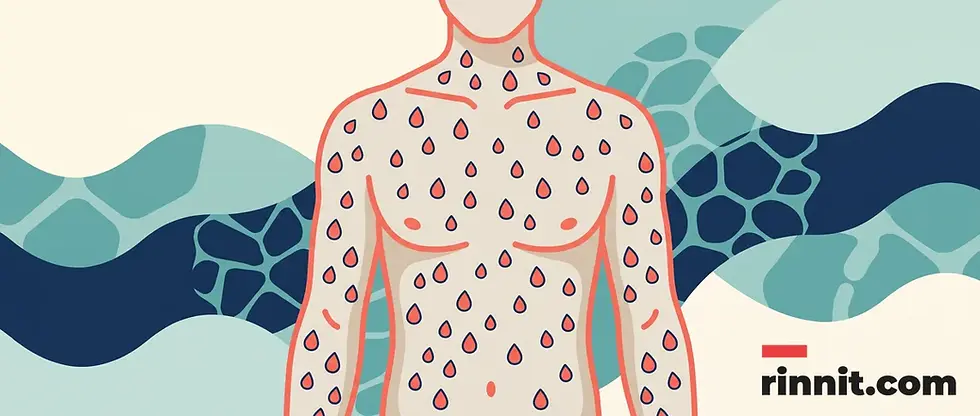
Guttate psoriasis is a skin disease that often appears without warning [1]. Like other forms of psoriasis, it is an inflammatory disease, which means the immune system overreacts for reasons that aren't fully understood and causes the skin symptoms [1]. It is related to chronic psoriasis, but the two are not the same condition [1].
Guttate psoriasis is not contagious. It is strongly connected to bacterial infections that are contagious, such as strep throat, but the skin patches themselves can't be passed to other people [1].
What triggers guttate psoriasis, and who is at risk?
Guttate psoriasis is usually triggered by Group A strep infections, and genetics, immune problems, skin injuries, certain medications and stress can raise the risk or cause flare-ups [1].
1. Bacterial infections
Guttate psoriasis is usually connected to infections caused by Group A Streptococcus, which commonly causes strep throat and related illnesses [1]. It tends to appear without warning after a bacterial infection [1].
2. Genetics and immune factors
Psoriasis is strongly connected to at least two genes and may be linked to others [1]. Having family members, especially parents, with chronic psoriasis makes a person more likely to develop it [1]. People with HIV, autoimmune disorders such as rheumatoid arthritis, or immune systems suppressed by chemotherapy also have a higher risk of guttate psoriasis [1].
3. Triggers for flare-ups
People who have had guttate psoriasis can have follow-up attacks [1]. These are commonly connected to:
Bacterial or viral infections, especially respiratory infections such as strep throat [1].
Burns and sunburns [1].
Cuts, scrapes, and other skin injuries [1].
Insect bites and stings [1].
Certain medications, especially lithium and medicines that treat malaria and certain heart problems [1].
Drinking too much alcohol [1].
Stress [1].

What are the symptoms of guttate psoriasis?
Guttate psoriasis causes small, round or teardrop-shaped pink or red spots, usually on the torso, legs and arms, that may be scaly and itchy [1].
Teardrop-shaped patches: Round or teardrop-shaped pink or red spots, usually between 2 and 10 millimeters wide [1]. Each patch is usually distinct, with healthy skin around it [1].
Scales: Dry skin may peel or flake off the patches [1].
Location: Most often on the torso, legs, and arms, but they can appear on other parts of the body too [1].
Itching: The patches are usually irritated and itchy [1].
How is guttate psoriasis different from plaque psoriasis?
Guttate psoriasis mostly affects younger people, follows a bacterial infection and causes small spots that last weeks, while plaque psoriasis forms large, often lifelong plaques at any age [1].
Age: Guttate psoriasis mostly affects children, teenagers, and young adults, especially those under 30. Plaque psoriasis can appear at any age, usually with peaks between 20 and 30 and between 50 and 60 [1].
Trigger: Guttate psoriasis is typically triggered by a bacterial infection such as strep throat [1]. Triggers for plaque psoriasis vary widely from person to person [1].
Appearance: Guttate patches are small and distinct. Plaque psoriasis forms large, often scaly red patches that join into plaques [1].
Common locations: Guttate patches appear mostly on the torso, arms, and legs. Plaques are most common on the elbows, knees, scalp, and lower back [1].
Duration: Guttate psoriasis usually lasts a few weeks. Chronic plaque psoriasis is lifelong, although treatment can reduce symptoms and flare-ups [1].
How is guttate psoriasis diagnosed?
Guttate psoriasis can usually be diagnosed by a healthcare provider through an examination of the skin [1]. To confirm the diagnosis or find the trigger, they may also order:
Throat swab culture: Looks for bacteria such as group A streptococcus [1]. People with guttate psoriasis commonly test positive [1].
Blood tests (titers): Look for immune system markers that show a current or recent bacterial infection [1].
Skin biopsy: A small sample of skin can be tested to confirm the diagnosis [1].
How is guttate psoriasis treated and managed?
Treatment depends on how severe the case is.
Milder cases
Severe or persistent cases
Phototherapy: Ultraviolet (UV) light, on its own or combined with a medicine taken by mouth or applied to the skin [1]. Laser therapy may be used if guttate psoriasis becomes chronic plaque psoriasis [1].
Immunosuppressant medicines: Medicines that reduce the body's immune response [1].
Biologic medicines: Medicines that block specific parts of the immune system [1].
What about antibiotics?
Because strep throat is the most common trigger, a provider may test for strep and treat an active infection if one is found. Research suggests, though, that clearing the infection doesn't reliably clear the skin rash [2], so antibiotics are best seen as supportive care alongside skin treatment [2].
Don't try to treat a scaly rash yourself with over-the-counter products unless your healthcare provider says it's OK [1].

What is the outlook for guttate psoriasis, and how do people live with it?
Most cases of guttate psoriasis, especially in children, go away on their own [1]. Some people have recurring episodes, which can also clear without becoming chronic [1]. In about one-third of cases, guttate psoriasis turns into chronic plaque psoriasis, a separate, lifelong condition [1]. Guttate psoriasis doesn't cause joint pain, but chronic plaque psoriasis can lead to psoriatic arthritis [1]. There's no way to predict who will develop guttate psoriasis, so it can't be prevented [1]. Guttate psoriasis isn't dangerous [1].
Conclusion
Guttate psoriasis can be startling because it starts so suddenly, but for many people it is a temporary problem. By talking to a provider early, avoiding known triggers, and following a treatment plan, most people can clear their skin and keep the risk of flare-ups low.
For more visual health guides and educational resources, explore Rinnit's infographic templates.
Frequently Asked Questions
What is guttate psoriasis?
A skin condition that often appears suddenly as small, teardrop-shaped, red or pink scaly patches.
What does “guttate” mean?
It comes from the Latin word for “drop,” as in a teardrop.
Is guttate psoriasis contagious?
No. The skin patches can't be spread to other people.
What is the main trigger?
Group A Streptococcus infections, such as strep throat, are the most common trigger.
Who gets it most often?
Children, teenagers, and young adults, especially those under 30.
How long does it last?
It usually goes away on its own after a few weeks, although some reviews describe it clearing within 3 to 4 months. It can recur.
Can it go away on its own?
Yes. Most cases, especially in children, clear without treatment.
What is the difference between guttate and plaque psoriasis?
Guttate psoriasis causes small, separate patches, while plaque psoriasis forms larger scaly patches that join into plaques.
Can guttate psoriasis become chronic?
Yes. About one-third of cases become chronic plaque psoriasis.
Does it itch?
Yes. The patches are usually irritated and itchy.
Where does it appear?
Most often on the torso, arms, and legs.
Can it appear on other parts of the body?
Yes. The patches can develop on other parts of the body too.
How is it diagnosed?
A provider usually diagnoses it by examining the skin, and may order a throat swab, blood tests, or a skin biopsy.
Is a skin biopsy necessary?
Not always. It may be used to confirm the diagnosis.
What are titers?
Blood tests that look for immune markers showing a current or recent bacterial infection.
Can stress trigger a flare-up?
Yes. Stress is a known trigger of follow-up attacks.
Can sunburn trigger it?
Yes. Burns and sunburns can bring on attacks, as can cuts, scrapes, and other skin injuries.
Are there genetic factors?
Yes. Psoriasis is strongly connected to genes, and having family members with psoriasis makes it more likely.
Which medications can trigger it?
Lithium and medicines that treat malaria and certain heart problems are linked to attacks.
Can alcohol affect it?
Yes. Drinking too much alcohol is a known trigger for recurring episodes.
What is the first-line treatment?
For mild cases, creams that contain corticosteroids are usually recommended.
What is coal tar?
An ingredient in some creams and lotions used to treat psoriasis.
Does vitamin D help?
Medicines containing vitamin D applied to the skin are used to treat guttate psoriasis.
What is phototherapy?
Treatment that uses ultraviolet (UV) light, alone or with a medicine, to treat the skin.
Are biologics used for guttate psoriasis?
They may be used in severe cases. Biologics block specific parts of the immune system.
Do antibiotics help?
They treat an active strep infection, but research suggests clearing the infection doesn't reliably clear the skin lesions.
Can I use dandruff shampoo?
Yes, over-the-counter or prescription-strength dandruff shampoo can be used if the scalp is affected.
Is it related to HIV?
People with HIV have a higher risk of developing guttate psoriasis.
What is the Koebner phenomenon?
New psoriasis patches forming at the site of a skin injury.
Does it affect the joints?
Guttate psoriasis doesn't cause joint pain. Psoriatic arthritis is a separate condition that can occur if it becomes chronic plaque psoriasis.
Is it an autoimmune disease?
It is an inflammatory disease in which the immune system overreacts.
Can children get guttate psoriasis?
Yes. Most cases are seen in children, though young adults can develop it too.
Does it leave scars?
Guttate psoriasis typically clears without scarring.
Does sun exposure help?
Sunburns can trigger attacks. Ask your provider about supervised light therapy rather than sunbathing.
Is it the same as eczema?
No. They are different conditions, so a proper diagnosis from a provider matters.
How common is it?
It accounts for about 2% of all psoriasis cases.
Can I prevent it?
There's no way to know who will develop it, so there's no way to prevent it.
What if my strep test is negative?
A negative test doesn't completely rule out a recent infection. Blood tests (titers) can look for signs of one.
Is it lifelong?
Usually not. For most people it goes away, but for about one-third it becomes chronic plaque psoriasis.
Can I use over-the-counter creams?
Don't treat it yourself with over-the-counter products unless your provider says it's OK.
Should I see a dermatologist?
Contact your healthcare provider for any scaly rash, and ask about seeing a dermatologist.
Can it cause a fever?
The skin patches don't, but a triggering infection such as strep might.
Is it related to rheumatoid arthritis?
Both involve the immune system, and people with autoimmune disorders such as rheumatoid arthritis have a higher risk of guttate psoriasis.
Can I use a tanning bed?
Medical phototherapy is supervised by a provider. Ask your provider before using any light treatment.
What is the long-term outlook?
Most people do well. Guttate psoriasis isn't dangerous, and those who develop chronic psoriasis can reduce symptoms with treatment.
When should I contact a healthcare provider?
For any scaly rash, especially in a child, before treating it yourself.
What are the most common triggers for repeat attacks?
Infections, sunburns, skin injuries, insect bites, certain medicines, too much alcohol, and stress.
Can it come back?
Yes. Some people have recurring episodes, which may also go away without becoming chronic.
Is it dangerous?
No. Guttate psoriasis isn't dangerous, but it should be checked by a provider.
Related Reading
Helpful Resources
References
Cleveland Clinic. Guttate Psoriasis. Cleveland Clinic. Medically reviewed; last updated April 25, 2022. https://my.clevelandclinic.org/health/diseases/22812-guttate-psoriasis
Zhou T, Koussiouris J, Kim L, et al. Management of guttate psoriasis: a systematic review. J Cutan Med Surg. 2024;28(6):577-584. PMID: 39080843. https://doi.org/10.1177/12034754241266187
Leung AKC, Barankin B, Lam JM, et al. Childhood guttate psoriasis: an updated review. Drugs Context. 2023;12:2023-8-2. PMID: 37908643. https://doi.org/10.7573/dic.2023-8-2
Chalmers RJ, O'Sullivan T, Owen CM, et al. Interventions for guttate psoriasis. Cochrane Database Syst Rev. 2000;(2):CD001213. PMID: 10796758. https://doi.org/10.1002/14651858.CD001213
Medical disclaimer
This article is for informational purposes only and is not a substitute for professional medical advice, diagnosis, or treatment. Always seek the advice of a qualified healthcare provider with any questions about a medical condition or before making decisions about treatment. Never disregard professional medical advice or delay seeking it because of something you have read here.



Comments