What Is Bedwetting (Nocturnal Enuresis)? Symptoms, Causes, and Treatment

Updated: 2 days ago
Medically reviewed by Dr. Baraa Alnahhal, MD · Last reviewed: October 2026
Quick Answer: What is bedwetting and is it treatable?
Bedwetting, or nocturnal enuresis, is the involuntary release of urine during sleep, most often caused by still-developing bladder control, genetics, low nighttime vasopressin or a small bladder capacity. It is treatable with measures such as limiting evening fluids, bedtime bathroom routines, enuresis alarms, bladder training and medications. Most children outgrow it. [1]
Key takeaways
Bedwetting (nocturnal enuresis) is the involuntary release of urine during sleep, and it affects children, teenagers, and adults. [1]
About 1 in 10 U.S. children have it; it is most common before age 6, and most children outgrow it between ages 4 and 6. [1]
It is never caused by laziness or poor toilet training, and it can run in families. [1]
Concerning bedwetting means wetting at least twice per week for at least three months after age 7, or accidents that return after six or more dry months. [1]
Behavioral changes, alarms, medications, and (rarely) surgery can all help; treatment depends on the cause.
Emotional support matters: shame and embarrassment are common but treatable, and positive reinforcement helps.
What the research says
Nocturnal enuresis affects roughly 1 in 14 children and adolescents worldwide, and some factors raise the odds. A meta-analysis of 128 studies (445,242 people in 39 countries) found a pooled prevalence of 7.2% (95% CI 6.2% to 8.1%). Family history (adjusted OR 1.49), urinary tract infection (adjusted OR 3.89), and male sex (adjusted OR 1.63) were significantly associated with nocturnal enuresis, while being the first-born child was associated with lower odds (adjusted OR 0.5). (Adisu et al., Child Adolesc Psychiatry Ment Health, 2025) [2]
Enuresis alarms work better than no treatment, with fewer side effects than desmopressin. A Cochrane review of 74 trials (5,983 children) found low-quality evidence that more children achieve a complete response (14 consecutive dry nights) with alarms than with no treatment (RR 7.23; 95% CI 1.40 to 37.33). Compared with desmopressin, alarms probably slightly increase the number of children who remain dry after treatment (RR 1.30; 95% CI 0.92 to 1.84) and probably cause fewer adverse events (RR 0.38; 95% CI 0.20 to 0.71). (Caldwell et al., Cochrane Database Syst Rev, 2020) [3]
Children with enuresis tend to sleep differently. A systematic review of nine observational studies (1,685 participants, 581 with nocturnal enuresis) found that sleep questionnaires showed more sleep problems in children with enuresis than in controls, especially parasomnias, breathing disorders, and daytime sleepiness. The authors note the studies used different assessment tools and that more research is needed. (Fernandes et al., Pediatr Nephrol, 2023) [4]
What Is Bedwetting (Nocturnal Enuresis)?

Bedwetting, or nocturnal enuresis, is the accidental or involuntary release of urine while sleeping. It is common among children, even after they have completed toilet training. Most children gradually stop wetting the bed on their own as they grow older, usually between ages 4 and 6. [1]
A healthcare provider begins to consider bedwetting a concern if a child is over age 7 and accidents happen at least twice per week for at least three months in a row, or if a child over age 12 continues to wet the bed two or more times a week for at least three months. Although bedwetting is not a serious condition, it can cause real stress for a child and the whole family. Children may feel ashamed or embarrassed, hide wet clothes, or avoid sleepovers. [1]
Importantly, bedwetting is never the result of poor toilet training or laziness. Many different factors lead to nocturnal enuresis in both children and adults, and the condition is treatable. [1]
What are the two types of bedwetting?
There are two main types of nocturnal enuresis, distinguished by whether the person ever had a long stretch of dry nights. [1]
Type | Definition | Typical meaning |
Primary nocturnal enuresis | The person has never remained dry throughout the night for six months in a row or longer [1] | Usually reflects a developmental or physical factor such as bladder control, genetics, or hormone levels |
Secondary nocturnal enuresis | The person wets the bed again after going six months or more without bedwetting [1] | Usually points to a medical or psychological condition that needs evaluation |
How Common Is Bedwetting?
Bedwetting affects people of all ages, from children to adults. It is most common before age 6 because children are still learning to control their bladder. It also occurs more often in boys. [1] [5]
You may be more at risk of nocturnal enuresis if you carry severe emotional trauma or stress, or if a parent or sibling also had or has bedwetting, since the condition can be genetic and run in families. Adults with nocturnal enuresis usually have an underlying medical or psychological condition behind it. [1]
How Does Bedwetting Affect Mental Health?
It is normal for both children and adults to feel embarrassed about bedwetting, and some people find it difficult to even raise the topic with a healthcare provider because they fear shame. Those feelings are valid, but bedwetting is common, and the negative stigma around it, not the condition itself, usually drives the distress. [1]
In older children, teenagers, and adults, bedwetting is usually involuntary or a sign that the body is not working the way it is expected to. A healthcare provider can help navigate those changes and support a path to waking up dry. [1]
What Are the Symptoms of Bedwetting?
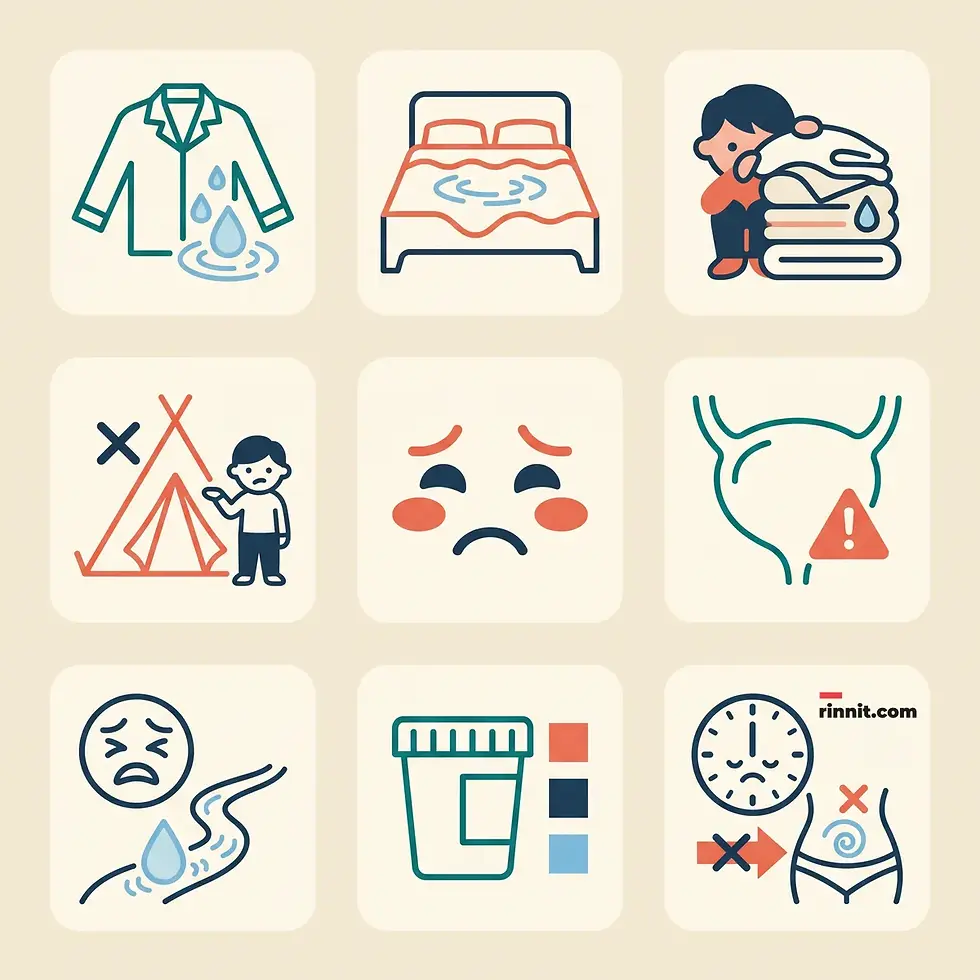
Waking up with wet pajamas or wet sheets is the main physical symptom of bedwetting. By definition, you will not know an accident happened until it is too late. [1]
Beyond the physical symptom, bedwetting can take a serious emotional toll. Common emotional effects include feeling embarrassed or ashamed, hiding wet clothes or sheets from others, and avoiding nighttime social activities such as sleepovers. These distressing symptoms typically go away once the bedwetting resolves, but they can weigh heavily on a person while they are happening. [1]
Symptom or sign | What it looks like |
Wet pajamas or sheets | Waking to find urine has been released during sleep [1] |
Embarrassment or shame | Feeling ashamed about accidents, especially away from home |
Hiding wet items | Concealing wet clothes or bedding from family members |
Avoiding sleepovers | Skipping nighttime social activities out of fear of an accident |
When Is Bedwetting a Sign of an Underlying Condition?
Bedwetting can signal an underlying medical problem if it happens in a toilet-trained person who has frequent episodes after being completely dry for at least six months. [1] Several daytime signs point toward a medical cause.
Warning sign | What it suggests |
Changes to how often or how much you pee during the day | The urinary system may not be working normally |
Pain while peeing | A possible infection or irritation |
A small stream of pee | A possible blockage or narrowing |
Color changes to urine | A possible infection or other urinary change |
Changes in mood | An emotional or psychological contributor |
Lack of daytime bowel movements | Constipation may be pressing on bladder nerves |
What Causes Bedwetting in Children?
The most common cause of childhood bedwetting is simply a lack of bladder control. Children usually learn bladder control between ages 2 and 4, but wetting the bed between ages 4 and 6 remains common as each child adapts at their own pace. The majority of children gain bladder control by age 7. After age 7 and through the teenage years, accidents can still happen. [1]
In some cases, frequent or recurring childhood bedwetting points to an underlying medical condition. [1]
Possible underlying condition | How it connects to bedwetting |
Urinary tract infection (UTI) | Irritation and urgency can trigger nighttime accidents |
Constipation | Pressure on the bladder interferes with normal function |
Spina bifida or nerve problems | Nerve pathways controlling the bladder may not develop fully |
Diabetes | Increased urine production and other urinary changes |
Urinary tract blockage or narrow urethra | Bladder cannot empty completely |
Obstructive sleep apnea | Breathing disruption interferes with nighttime signals |
ADHD | Attention and sleep-pattern differences play a role |
What Causes Bedwetting in Adults?
Adult bedwetting usually traces back to a physical or psychological factor. [1] There are seven recognized causes.
Cause | How it leads to bedwetting |
Genetics | |
Constipation | A full rectum presses on bladder nerves, reduces bladder capacity, and can prevent full emptying |
Hormones | Low vasopressin, the hormone that reabsorbs water into the bloodstream at night, increases nighttime urine volume [1] |
Small functional bladder capacity | The bladder is normal-sized but feels full too early, causing frequent daytime urination and nighttime accidents [1] |
Failure to awaken at night | Underlying conditions can interrupt the full-bladder signals meant to wake you up [1] |
Psychological or emotional problems | Stress from moving, a new school, the death of a loved one, or trauma; often improves over time and with professional support |
Medical conditions | Sickle cell disease, neurological changes, and kidney or bladder abnormalities; recurrence after six or more dry months suggests a medical cause [1] |
How Is Bedwetting Diagnosed?
A healthcare provider diagnoses nocturnal enuresis through a physical exam and a complete medical history. To determine whether an underlying medical condition is responsible, the provider may order a urine test, a blood test, or an imaging test. If emotional or psychological factors appear to be the cause, the provider may recommend speaking with a mental health professional. [1]
Bedwetting vs. Daytime Wetting
Nighttime bedwetting is very normal and common, and it is a good idea to mention it to a provider. Daytime wetting (enuresis), however, is not typically normal. A child may wet themselves during the day simply because they are too busy playing and do not want to stop for the bathroom, but because daytime wetting is less common, it should always be evaluated by a healthcare provider. [1]
How Is Bedwetting Treated?
Treatment for nocturnal enuresis varies based on the cause. [1] Options range from simple bedtime habits to medications and, rarely, surgery for adults.

Treatment option | What it involves |
Behavioral changes | Fluid limits before bed, pre-sleep bathroom visits, alarms, and bladder training [1] |
Treating underlying conditions | Addressing infections, constipation, sleep apnea, or other causes stops or reduces bedwetting [1] |
Medications | Drugs that reduce nighttime urine production or calm an overactive bladder [1] |
Mental health support | Therapy or counseling for stress, trauma, or emotional challenges [1] |
Surgery (adults only) | Bladder, bowel, and pelvic floor (sacral) nerve stimulation, or removal of muscle around the bladder to improve contractions, considered only after all other noninvasive treatments fail [1] |
Behavioral changes
Behavioral techniques change the nighttime routine without medication. Limiting fluids before bedtime means no drinks at least two hours before bed while keeping fluids plentiful during the day. This does not always prevent bedwetting but can reduce the nighttime urine volume. Going to the bathroom before bed means emptying the bladder before sleep, even without the urge, by sitting on the toilet for a few minutes. [1]
An enuresis alarm is a device that sounds a loud noise or vibrates when it detects wetness, awakening the sleeper to finish urinating in the bathroom. Over time, the person learns to wake when the bladder feels full and may eventually sleep through the night. This technique can take several months to succeed. Bladder therapy gradually increases functional bladder capacity by lengthening the time between daytime bathroom visits, training the bladder to hold more urine. [1]
What medications are used for bedwetting?
Medications may be used alone or alongside behavioral techniques. [1]
Medication | How it works | Key details |
Desmopressin | Effective in about half of cases; works best in older children with normal bladder capacity; can lower sodium, so limit fluids after dinner [1] | |
Oxybutynin or tolterodine | Reduces bladder contractions to treat an overactive bladder [1] | Can combine with desmopressin or an alarm; suited for children who wet more than once per night and also wet during the day [1] |
Imipramine | Increases brain signals to body parts like the bladder [1] | Prevents bedwetting in an estimated 40% of cases; provider reviews drug interactions and side effects [1] |
Solifenacin | Anticholinergic medication controlling nerve impulses against an overactive bladder | Fewer side effects than traditional anticholinergic medications [1] |
Trospium chloride | Blocks muscle cell receptors on the bladder wall to help the bladder relax [1] | Prevents bladder over-activity [1] |
What Is the Outlook?
Bedwetting does not typically last forever. Children usually grow out of the condition as they learn bladder control. If an underlying condition caused the bedwetting, treating that condition will stop or reduce the accidents. Managing nocturnal enuresis can take time, but it is a treatable condition. [1]
Because bedwetting is stressful for the person experiencing it as well as for parents and caregivers, some people find comfort in speaking with a mental health professional. The healthcare team is there to provide support throughout the process. [1]
How Can Bedwetting Be Prevented?
You cannot prevent all cases of bedwetting, since so much of it is developmental or genetic. But several habits reduce the risk. [1]
Prevention habit | How it helps |
Avoid lots of fluids two hours before bedtime | Less urine is produced overnight [1] |
Avoid caffeinated beverages in the evening | Caffeine increases urine production |
Go to the bathroom before bed | Empties the bladder before sleep [1] |
Wear absorbent pants at night | Reduces the impact of accidents |
Keep the bathroom easily accessible | Makes nighttime trips simpler |
Use positive reinforcement | Affirmations and praise for dry mornings build confidence |
Avoid shaming or teasing | Protects emotional well-being during treatment |
When Should You See a Healthcare Provider?
Visit a healthcare provider if you have questions about how often bedwetting occurs, if bedwetting happens alongside daytime wetting, if sudden accidents begin after months without any, or if accidents happen after age 12. [1]
Good questions to ask a provider include what caused the nocturnal enuresis, which behavioral changes will help prevent accidents, whether prescribed medications carry side effects, and how to help a child feel better about embarrassment. [1]
Conclusion
Bedwetting is one of the most common and most misunderstood childhood conditions, yet it touches teenagers and adults too. It is never a sign of laziness or bad parenting, and it is almost always temporary. Understanding the type, primary or secondary, and watching for warning signs like pain, urine changes, or accidents after a long dry stretch helps families know when to ask for help. With the right combination of behavioral changes, alarms, medications, and emotional support, most people can expect to wake up dry.
Explore Rinnit's infographic templates to turn health explanations like this one into clear, shareable patient education visuals for your practice, school, or caregiving community.
Frequently Asked Questions
What is bedwetting, exactly?
Bedwetting, or nocturnal enuresis, is the accidental or involuntary release of urine while sleeping. It is common in children even after toilet training and can also affect teenagers and adults. [1]
What is the difference between primary and secondary enuresis?
Primary nocturnal enuresis means a person has never stayed dry through the night for six months in a row. Secondary nocturnal enuresis means bedwetting returns after at least six months of dry nights, and it usually signals a medical or psychological condition. [1]
At what age should bedwetting become a concern?
Providers generally consider bedwetting a concern if a child is over age 7 and wets the bed at least twice per week for at least three months in a row, or if accidents persist beyond age 12. [1]
How common is bedwetting?
About 1 in 10 U.S. children experience it. Roughly 30% of children age 7 and under wet the bed, compared with about 5% of 10-year-olds, 1% to 2% of 15-year-olds, and 2% to 3% of adults. [1]
Is bedwetting caused by laziness or poor toilet training?
No. Bedwetting is never the result of laziness or poor toilet training. It stems from developing bladder control, genetics, hormone levels, bladder capacity, stress, or underlying medical conditions. [1]
Does bedwetting run in families?
Yes. Bedwetting can be genetic and often runs in families when a parent or sibling also had or has the condition. Boys are also affected more often than girls. [1] [5]
Why do some people wet the bed at night?
At night, a full bladder normally sends signals that wake a person up. [1] Bedwetting happens when those signals are interrupted, when the bladder holds more urine than it comfortably can, when the hormone vasopressin is low, or when stress or a medical condition disrupts normal function.
What medical conditions can cause bedwetting?
In children, possible causes include urinary tract infections, constipation, spina bifida or nerve problems, diabetes, a urinary tract blockage or narrow urethra, obstructive sleep apnea, and ADHD. In adults, sickle cell disease, neurological changes, and kidney or bladder abnormalities are possibilities. [1]
Is an enuresis alarm effective?
An enuresis alarm detects wetness and wakes the sleeper so they can finish urinating in the bathroom. Over time, the person learns to wake to the sensation of a full bladder, though the technique can take several months to succeed. [1]
What medications treat bedwetting?
Options include desmopressin (effective in about half of cases), oxybutynin or tolterodine (for an overactive bladder), imipramine (effective in about 40% of cases), solifenacin, and trospium chloride. A provider will match the medication to the cause and review side effects. [1]
How long does bedwetting last?
Most children outgrow bedwetting as they develop bladder control, usually between ages 4 and 6. If an underlying condition caused it, treating that condition stops or reduces the accidents. Bedwetting is treatable, though it may take time. [1]
Can adults need surgery for bedwetting?
In rare cases, yes. Adults who have tried all other noninvasive treatments without success may be candidates for surgery, which can stimulate the bladder, bowels, and pelvic floor (sacral nerve) or remove muscle around the bladder to improve bladder contractions. [1]
When should I worry about daytime wetting?
Daytime wetting (enuresis) is not typically normal and should always be evaluated, even though some children wet themselves simply because they are too busy playing to stop for the bathroom. [1]
How can I support a child who is embarrassed about bedwetting?
Use positive reinforcement and affirmations when the child wakes up dry, keep accidents matter-of-fact, avoid shaming or teasing, and reassure them that bedwetting is common, involuntary, and treatable.
Related Reading
Urinary Tract Infection (UTI): Symptoms, Causes, Treatment, and Prevention
Constipation: Symptoms, Causes, Diagnosis and Treatment — What You Need to Know
Obstructive Sleep Apnea in Children Comprehensive Guide: Symptoms, Treatment, and Long-Term Health
American Academy of Child & Adolescent Psychiatry: Bedwetting
NIDDK: Treatment of Bladder Control Problems & Bedwetting in Children
References
Cleveland Clinic. Bedwetting (Nocturnal Enuresis). Cleveland Clinic Health Library. Last updated January 20, 2023. Accessed October 15, 2026. https://my.clevelandclinic.org/health/diseases/15075-bedwetting
Adisu MA, Habtie TE, Munie MA, et al. Global prevalence of nocturnal enuresis and associated factors among children and adolescents: a systematic review and meta-analysis. Child Adolesc Psychiatry Ment Health. 2025;19(1):23. PMID: 40114238. https://doi.org/10.1186/s13034-025-00880-x
Caldwell PH, Codarini M, Stewart F, et al. Alarm interventions for nocturnal enuresis in children. Cochrane Database Syst Rev. 2020;5(5):CD002911. PMID: 32364251. https://doi.org/10.1002/14651858.CD002911.pub3
Fernandes AER, Roveda JRC, Fernandes CR, et al. Relationship between nocturnal enuresis and sleep in children and adolescents. Pediatr Nephrol. 2023;38(5):1427-1438. PMID: 36427087. https://doi.org/10.1007/s00467-022-05818-5
Kiddoo DA. Nocturnal enuresis. CMAJ. 2012;184(8):908-911. PMID: 22529169. https://doi.org/10.1503/cmaj.111652
American Academy of Child & Adolescent Psychiatry. Bedwetting. Facts for Families No. 18. AACAP. Updated October 2023. Accessed October 15, 2026. https://www.aacap.org/AACAP/Families_and_Youth/Facts_for_Families/FFF-Guide/Bedwetting-018.aspx
National Association for Continence. Adult Bedwetting (Sleep Enuresis). NAFC. Accessed October 15, 2026. https://nafc.org/adult-bedwetting/
National Institute of Diabetes and Digestive and Kidney Diseases. Treatment of Bladder Control Problems & Bedwetting in Children. NIDDK Health Information. Last reviewed September 2017. Accessed October 15, 2026. https://www.niddk.nih.gov/health-information/urologic-diseases/bladder-control-problems-bedwetting-children/treatment
Medical disclaimer
The information provided in this article is for educational purposes only and is not intended as medical advice. Always seek the advice of your physician or other qualified health provider with any questions you may have regarding a medical condition. Daytime wetting, accidents that return after months of dry nights, pain when urinating, or changes in urine color should be evaluated by a healthcare provider.



Comments