What Is Auditory Neuropathy? Symptoms, Causes, and Treatment

Updated: 2 days ago
Medically reviewed by Dr. Baraa Alnahhal, MD · Last reviewed: October 2026
Quick Answer
Auditory neuropathy is a hearing disorder in which sound reaches the inner ear but the signal to the brain breaks down, so a child may hear sounds without understanding speech. [1] [2] It affects about 5 to 10 out of 100 children with hearing loss. [1] It is treated with hearing devices such as hearing aids or cochlear implants plus speech therapy. [1]
Key Takeaways
A child with auditory neuropathy can often hear sounds but struggles to understand speech — the hallmark sign of the condition. [1] [2]
About 5 to 10 out of 100 children with hearing loss have this condition, and severity exists on a spectrum from normal hearing to deafness. [1]
Warning signs appear by age: no startle in newborns, no response to voices at 6 months, and no babbling at 12 months. [1]
The diagnostic signature is normal cochlea function (OAE) combined with an abnormal auditory nerve response (ABR). [1] [2]
Most children are helped by hearing devices and speech therapy, and early intervention protects speech and learning milestones. [1]
What the research says
Auditory neuropathy is a significant cause of childhood hearing loss, and genes are a major driver. A 2025 review reports that it represents about 10% of cases of permanent hearing loss in children, with mutations in the OTOF gene a major cause. (Yang et al., Am J Transl Res, 2025) [6]
Genetic testing finds an answer in many people. A systematic review of 29 studies covering 441 children and adults with auditory neuropathy found 136 pathogenic or likely pathogenic variants across 21 genes. A genetic diagnosis was confirmed in 195 of 362 people tested (diagnostic yield 54%, or 31% after adjusting for study bias), and the authors support considering genetic testing early in the diagnostic pathway. (Yong et al., J Clin Med, 2026) [7]
Cochlear implants help children with auditory neuropathy about as much as children with other types of sensorineural hearing loss. A meta-analysis of 14 studies (722 children: 212 with ANSD and 520 with sensorineural hearing loss) found comparable auditory performance scores (mean difference −0.52, 95% CI −1.34 to 0.29) and comparable speech intelligibility scores (mean difference −0.26, 95% CI −0.65 to 0.13). (Tawakkul et al., Audiol Neurootol, 2025) [8]

What is auditory neuropathy?
Auditory neuropathy is a hearing condition that makes it difficult to understand speech clearly. In this condition, the ear may be able to hear the volume of sound, but there is a problem when the inner ear tries to send sound signals to the brain through the auditory nerve. [2]
It is also called auditory neuropathy spectrum disorder (ANSD) because the severity exists on a spectrum. Some children have normal hearing, while others have profound hearing loss (deafness). [1] What is common to all cases is that speech is challenging to understand. [1]
According to research, about 5 to 10 out of 100 children with hearing loss have this condition. [1]
Why is it called a "spectrum" disorder?
The word "spectrum" matters because no two children experience auditory neuropathy the same way. Hearing ability can range from fully normal to profoundly impaired, and speech understanding can vary from day to day in the same child. [1] This variability is exactly why a careful, multi-test diagnosis is essential — a single hearing screening often cannot capture what is going on.
Regardless of where a child falls on the spectrum, the shared experience is the same: sounds arrive, but speech does not come through clearly.
What are the symptoms of auditory neuropathy?
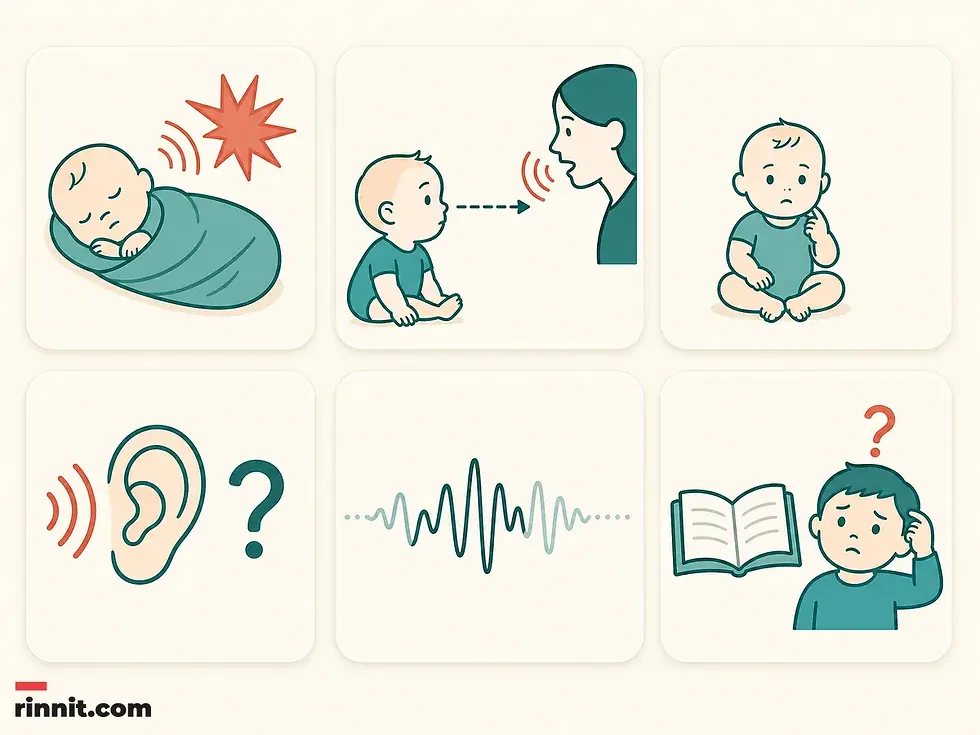
Children with auditory neuropathy have trouble with speech perception — understanding what words mean, not just hearing that sounds exist. Hearing loss shows up differently depending on age:
Age | Warning sign |
Newborn | Not being startled by loud noises |
6 months | Not responding to a parent or caregiver's voice |
12 months | Not babbling, cooing, or trying to make basic words like "mama" or "dada" |
Beyond these developmental milestones, a child may experience their surroundings differently from other children. They may hear sounds but not know what the sounds are or where they are coming from. Their hearing ability may fade in and out or change from day to day. [1]
Symptom | What it looks like |
Unclear speech perception | Hears others but cannot understand what they are saying |
Disoriented hearing | Hears sounds but cannot identify them or locate where they come from |
Fluctuating hearing | Hearing ability fades in and out or changes by the day |
Limited speech | Unable to speak or has limited speaking ability |
Learning difficulty | Trouble learning, often tied to missed speech input |
Hearing loss can keep a child from engaging in the world around them the way they otherwise would. It can lead to isolation and get in the way of how they grow and develop. [1] This is why it is important to let a pediatrician know as soon as possible if there is any concern.
What causes auditory neuropathy?
Auditory neuropathy happens when sound signals do not travel normally from the cochlea — the hearing organ in the inner ear — to the brain. [1] [2]
Here is how normal hearing works. Sound waves from the environment travel through the outer and middle ear until they reach the cochlea. Sensory hair cells inside the cochlea turn the sound waves into electrical signals. Those signals travel along the auditory nerve to the hearing part of the brain. [1]
With auditory neuropathy, there is a communication breakdown somewhere along the end part of the hearing pathway. [1] The cochlea may do its job, but the signal never reaches the brain intact.
What are the known risk factors?
There are many potential causes and risk factors, and in some children more than one applies:
Risk factor | Description |
Faulty OTOF gene | The gene that codes for a protein helping the cochlea work |
Inherited neurological conditions | Such as Charcot-Marie-Tooth disease and Friedreich's ataxia |
Inner-ear-damaging medicines | Medications that cause damage to the inner ear |
Infections | Including measles, mumps, and cytomegalovirus |
Newborn conditions | Premature birth, low birth weight, low oxygen, and neonatal jaundice — many of these involve a stay in the neonatal intensive care unit (NICU) |
Head injuries | Trauma affecting the hearing pathway |
How is auditory neuropathy diagnosed?
Healthcare providers may find an issue during a newborn hearing screening that leads to a diagnosis. But often, children are diagnosed several months later, when parents start to notice issues — because the standard newborn screening process can miss some cases of auditory neuropathy. [1]
A child may need to see an otolaryngologist (ENT) or an audiologist for a full diagnosis. Three core hearing tests form the diagnostic signature:
Test | What it checks | Typical result in ANSD |
Otoacoustic emissions (OAE) | How the cochlea receives sound waves | Normal |
Auditory brain stem response (ABR) | How the auditory nerve and hearing brain respond to sound | Abnormal |
Middle ear muscle reflex testing (MEMR) | How the middle ear muscle reflex responds to loud noise | Absent or requiring extreme loudness |
The combination of a normal OAE and an abnormal ABR is the classic fingerprint of auditory neuropathy: the inner ear works, but the nerve pathway does not. [2]
What other tests might be needed?
Because auditory neuropathy can be connected to other conditions, a child will likely need additional tests to find possible causes or diagnose related issues:
Test | Purpose |
Neurological test | Shows whether auditory neuropathy is part of a larger neurological condition |
Vision tests | Hearing and vision problems are sometimes related |
MRI | Imaging that can show structural issues or nerve problems causing symptoms |
Genetic testing | Tests for genes linked to the condition |
How is auditory neuropathy treated?
Hearing assistive devices and speech therapy help most children and their families learn to manage the condition. [1] Treatment is individualized based on the child's symptoms:
Treatment | How it works |
FM systems | A speaker wears a microphone that connects wirelessly to a hearing device the child wears; helps the child make out speech in noisy environments, especially at school |
Hearing aids | Boost the volume when a child has difficulty hearing; some children benefit from using hearing aids together with FM systems |
Cochlear implant | Helps many children with sensorineural hearing loss (affecting the inner ear and/or auditory nerve) hear better; studies show this applies to ANSD too |
Speech therapy | Lip-reading and sign language help the child understand others and communicate with confidence; a speech-language pathologist teaches these and other communication strategies |

Does auditory neuropathy ever go away?
The outlook can be challenging to predict, which is why individualized follow-up matters. In some cases, auditory neuropathy goes away on its own, and some children begin speaking and interacting like typical children within a year or two. [1] [2]
Cochlear implants help many children with auditory neuropathy hear and understand others better — though they do not work in all cases of ANSD. [1] [5] This is why a healthcare provider will develop a treatment plan for the child that is based on their specific symptoms.
When should I see my healthcare provider?
See your child's pediatrician right away if you suspect your child is having hearing issues. The sooner you contact a provider, the sooner your child can receive the care they need. Early interventions often prevent children from missing out on key developmental milestones related to hearing loss. [1]
Children cannot always tell us about the challenges they are facing, even when we wish they could. That is why it is important not to ignore the feeling that something might not be quite right. Hearing loss can interfere with a child's development and limit how they interact with their surroundings — but treatments are available, and hearing specialists can help.
Conclusion
Auditory neuropathy is a deceptively subtle condition: a child may pass a basic hearing screening yet still struggle to understand a single spoken word. [1] The good news is that the condition is identifiable through the right combination of hearing tests, and it is treatable through hearing devices and speech therapy. [1]
If you notice that a newborn is not startled by loud sounds, a 6-month-old does not respond to your voice, or a 12-month-old is not babbling, contact a pediatrician without delay. [1] Early intervention often prevents children from missing key speech and learning milestones. [1]
Want to turn complex health topics like this one into clear, shareable visuals? Rinnit's infographic templates make it easy to present medical knowledge in a way families can actually understand.
Frequently Asked Questions
What is auditory neuropathy?
Auditory neuropathy is a hearing condition in which the ear can hear the volume of sound, but the signal from the inner ear to the brain breaks down, making speech difficult to understand. [1] [2] It is also called auditory neuropathy spectrum disorder (ANSD). [1]
Can a child with auditory neuropathy hear at all?
Yes. Many children with ANSD hear sounds — they simply cannot identify what the sounds are, where they are coming from, or what words are being said. [1] Hearing ability may also fade in and out or change by the day. [1]
How common is auditory neuropathy?
About 5 to 10 out of 100 children with hearing loss have this condition. [1]
What are the earliest warning signs?
In newborns, no startle response to loud noises; at 6 months, no response to a parent's or caregiver's voice; at 12 months, no babbling, cooing, or attempts at basic words like "mama" or "dada." [1]
Can the newborn hearing screening miss auditory neuropathy?
Yes. The standard newborn hearing screening can miss some cases, which is why many children are diagnosed several months later when parents notice missed speech milestones. [1]
What does a "normal OAE and abnormal ABR" result mean?
Otoacoustic emissions (OAE) testing checks the cochlea, and auditory brain stem response (ABR) testing checks the auditory nerve and brain. In ANSD, the cochlea typically works normally while the nerve response is abnormal — the classic diagnostic signature of the condition. [1] [2]
What causes auditory neuropathy?
Causes and risk factors include a faulty OTOF gene, inherited neurological conditions (such as Charcot-Marie-Tooth disease and Friedreich's ataxia), inner-ear-damaging medicines, infections (measles, mumps, cytomegalovirus), newborn conditions (premature birth, low birth weight, low oxygen, neonatal jaundice), and head injuries. [1]
Is auditory neuropathy the same as deafness?
No. ANSD exists on a spectrum — some children have normal hearing, while others have profound hearing loss. [1] The defining feature is difficulty understanding speech, not the absence of hearing. [2]
Does a cochlear implant always work for ANSD?
Cochlear implants help many children with ANSD hear and understand others better, but they do not work in all cases. [1] Treatment is tailored to each child's symptoms.
Can auditory neuropathy go away on its own?
In some cases, yes. [1] [2] Some children begin speaking and interacting typically within a year or two. [1]
How is it treated?
Most children are helped by a combination of hearing assistive devices — FM systems, hearing aids, and cochlear implants — and speech therapy covering strategies like lip-reading and sign language. [1]
Does a child with ANSD need other medical tests?
Often, yes. Neurological tests, vision tests, MRI, and genetic testing may be used to look for underlying causes or related conditions. [1]
Related Reading
References
Cleveland Clinic. Auditory neuropathy. Cleveland Clinic. Last updated June 3, 2026. https://my.clevelandclinic.org/health/diseases/auditory-neuropathy
National Institute on Deafness and Other Communication Disorders. Auditory neuropathy. NIDCD. Last updated January 26, 2018. https://www.nidcd.nih.gov/health/auditory-neuropathy
Cleveland Clinic. Charcot-Marie-Tooth disease (CMT). Cleveland Clinic. Last updated December 11, 2025. https://my.clevelandclinic.org/health/diseases/6009-charcot-marie-tooth-disease-cmt
Cleveland Clinic. Friedreich's ataxia (FA). Cleveland Clinic. Last updated June 2, 2025. https://my.clevelandclinic.org/health/diseases/23084-friedreichs-ataxia-fa
Bernardes M, Costa C, Ramos H, et al. Cochlear implantation in children with auditory neuropathy: meta-analysis. Audiol Neurootol. 2024;29(3):167-180. PMID 38016438. https://doi.org/10.1159/000533298
Yang JH, Zhang DM, Wang K. Pathogenesis and research progress of OTOF gene related auditory neuropathy: a retrospective review. Am J Transl Res. 2025;17(3):1643-1650. PMID 40226018. https://doi.org/10.62347/JDLC8070
Yong N, Cao M, Anderson E, et al. The genetic causes of auditory neuropathy: a systematic review. J Clin Med. 2026;15(11):4260. PMID 42279121. https://doi.org/10.3390/jcm15114260
Tawakkul Q, Alsanosi S, Alahmadi A, et al. Comparative outcomes of cochlear implantation in children with auditory neuropathy spectrum disorder and sensorineural hearing loss: a systematic review and meta-analysis. Audiol Neurootol. 2025;30(6):545-555. PMID 40623386. https://doi.org/10.1159/000546962
Medical disclaimer
This article is for general educational purposes only and does not replace professional medical advice, diagnosis, or treatment. Always consult a qualified healthcare provider with questions about your child's health.



Comments