What Is an MRSA Infection? A Plain-Language Guide to This Tough Staph Germ

Updated: 3 days ago
Medically reviewed by Dr. Baraa Alnahhal, MD · Last reviewed: October 2026
Quick Answer: Key Facts About MRSA
MRSA is a staph infection caused by bacteria that resist many antibiotics used for ordinary staph infections. It often appears as swollen, painful red bumps that become deep boils. Healthcare strains are linked to surgery and hospital stays, while community strains spread by skin contact. Treatment uses certain antibiotics, draining infected tissue and sometimes removing infected devices. [1] [2]
Feature | Details |
What it is | A staph infection caused by bacteria that resist many of the antibiotics used to treat ordinary staph infections. |
What it looks like | Swollen, painful red bumps that look like pimples or spider bites, often turning into deep, painful boils (abscesses); the skin may be warm and leak thick fluid. |
How you get it | Healthcare strains are linked to surgery, medical tubing, and hospital stays; community strains spread mainly through skin-to-skin contact. |
How it's diagnosed | By finding the bacteria in samples of pus, tissue, or body fluids; imaging tests check for internal infections. |
How it's treated | Certain antibiotics (on the skin, by mouth, or by IV), draining or removing infected tissue, and sometimes removing infected medical devices. |
What the research says
Antibiotics add benefit after a skin abscess is drained. In a randomized trial at five U.S. emergency departments (about 45% of participants had MRSA-positive wound cultures), clinical cure after drainage was 80.5% with trimethoprim-sulfamethoxazole vs 73.6% with placebo. In the per-protocol analysis, new skin infections at other sites were less common with the antibiotic (3.1% vs 10.3%). (Talan et al., N Engl J Med, 2016) [6]
Decolonization in intensive care reduced infections. In a trial of 74 ICUs in 43 hospitals (74,256 patients), universal decolonization lowered MRSA clinical isolates (hazard ratio 0.63) more than screening and isolation alone (0.92), and cut bloodstream infections from any pathogen (hazard ratio 0.56). (Huang et al., N Engl J Med, 2013) [7]
MRSA is mostly a healthcare-linked problem, and older adults are hit hardest. CDC surveillance covering July 2004 to December 2005 found 8,987 invasive MRSA cases; 58.4% were community-onset healthcare-associated infections and 13.7% were community-associated. Incidence was highest in people 65 and older (127.7 per 100,000, vs 31.8 per 100,000 overall). (Klevens et al., JAMA, 2007) [8]
What is an MRSA infection?
MRSA infection is caused by a type of staph bacteria that is resistant to many of the antibiotics used to treat ordinary staph infections. The full name is methicillin-resistant Staphylococcus aureus, but most people just call it MRSA (say it "MER-suh"). [1]
Where MRSA strikes matters a lot. Infections that happen in a healthcare setting are often linked to surgery or the use of artificial joints or tubing, and they can be life-threatening. Infections that happen in the wider community usually spread through skin-to-skin contact, often start as a painful skin boil, and can most often be treated with antibiotics. [1]
What are the symptoms of an MRSA infection?
MRSA skin infections usually begin with swollen, painful bumps that look like pimples or spider bites. These early signs come from staph bacteria, including MRSA. The red bumps can turn into deep, painful boils, also called abscesses. [1]
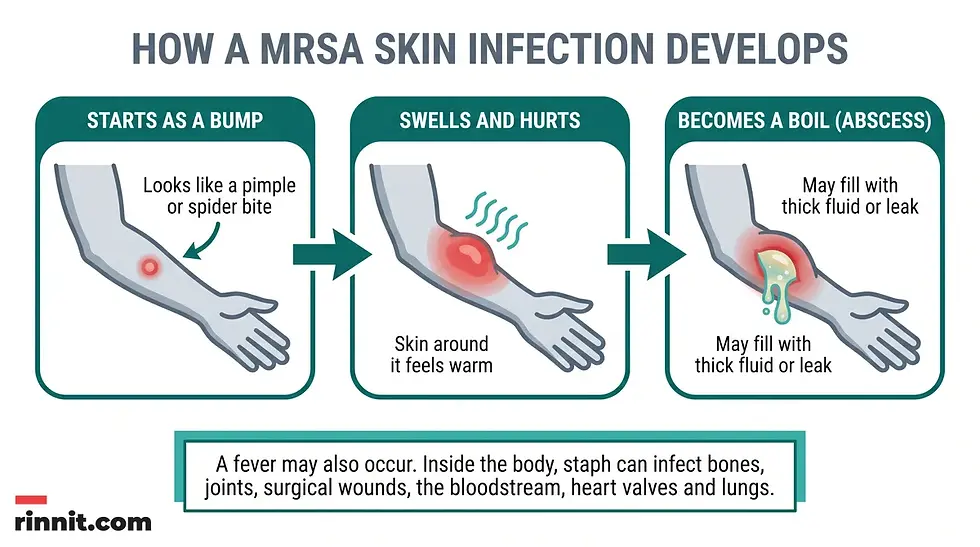
The skin around the bumps may feel warm to the touch. The bump may be filled with thick fluid or may be leaking that fluid. You may also develop a fever. [1] [5]
Staph infections can also happen inside the body. These internal infections can be life-threatening. They can develop in the bones, joints, surgical wounds, the bloodstream, the heart valves, and the lungs. The symptoms depend on where the infection is. [1]
When should you see a doctor?
Keep an eye on minor skin problems such as pimples, insect bites, or cuts and scrapes. This is especially important for children. See a healthcare professional if wounds seem to be infected, or if you have a wound along with a fever. [1]
What causes an MRSA infection?
MRSA is caused by a type of staph bacteria that cannot be treated by many of the antibiotics used for ordinary staph infections. [1]
The rise of MRSA is the result of decades of often unneeded antibiotic use. Even when antibiotics are used properly, they still add to the growth of drug-resistant bacteria. This happens because antibiotics do not destroy every germ they target. The bacteria that survive one antibiotic treatment soon learn to resist other antibiotics as well. [1]
Who is at higher risk for an MRSA infection?
Your risk depends on two things: whether you have already had an MRSA infection, and whether you have used antibiotics. Beyond that, the risk depends on your chances of coming into contact with staph bacteria. The two types of MRSA — healthcare strains and community strains — affect different groups of people. [1]
Healthcare strain risk factor | Why it raises your risk |
Getting care in a hospital | MRSA often affects older adults and people with weakened immune systems [1] |
Having surgery or using a medical device | Medical tubing such as IV lines or catheters can give MRSA a pathway into the body [1] |
Living in a long-term care facility | People may bring MRSA back from a hospital stay, or it may spread through contact with other patients or healthcare professionals [1] |
Community strain risk factor | Why it raises your risk |
Playing contact sports | MRSA spreads through cuts and scrapes and skin-to-skin contact [1] |
Living in crowded conditions | Outbreaks have occurred in military training camps, child care centers, and prisons [1] |
Being a man who has sex with men | This group has a higher risk of developing MRSA infections [1] |
Having HIV infection | People with HIV have a higher risk of developing MRSA infections [1] |
Using illegal injected drugs |

Can an MRSA infection cause complications?
Yes. Because MRSA resists many common antibiotics, the infections are harder to treat. Harder-to-treat infections spread more easily and can sometimes become life-threatening. [1]
MRSA infections may affect the bloodstream, lungs, heart, bones, or joints. [1]
Can you prevent an MRSA infection?
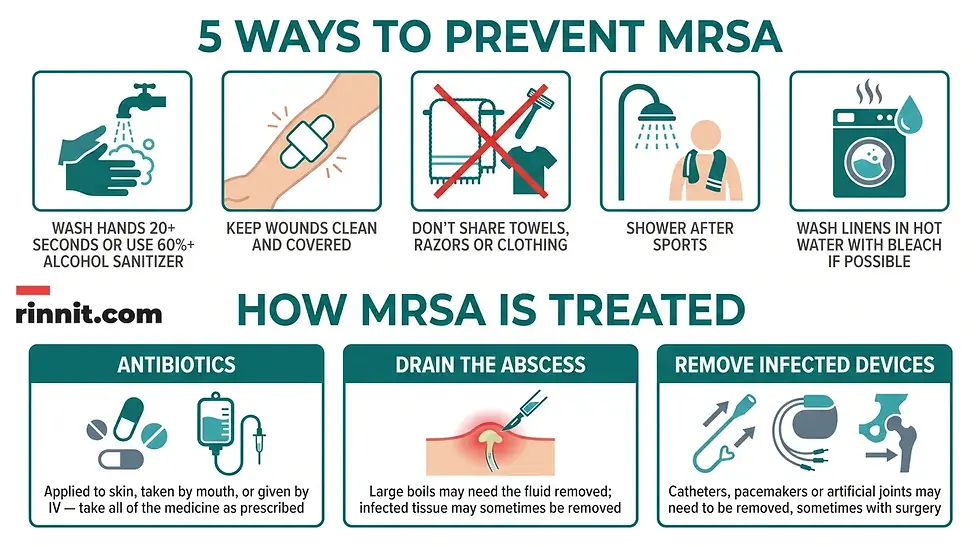
You can lower your risk by following good hygiene practices. [1] Five habits do most of the work.
Prevention step | What to do |
Wash your hands | Wash well and often with soap and water for at least 20 seconds, or use an alcohol-based hand sanitizer with at least 60% alcohol [1] |
Keep wounds covered | The fluid from infected sores may contain MRSA, so keep cuts and scrapes clean and covered with clean, dry bandages until they heal [1] |
Keep personal items personal | Don't share towels, sheets, razors, clothing, or athletic equipment [1] |
Shower after sports | Shower right after each game or practice with soap and water, and don't share towels [1] |
Sanitize linens | Wash towels and bed linens in the hottest water setting with bleach added if possible, and dry them in a hot dryer; wash gym and athletic clothes after each wearing [1] |
People in the hospital with an MRSA infection are often placed in isolation, apart from other patients. This helps stop the spread of MRSA. Visitors and healthcare professionals caring for people in isolation may need to follow strict hygiene practices and wear protective garments. [1]
How is an MRSA infection diagnosed?
For skin infections, the healthcare professional looks at any skin sores or areas of concern. Other symptoms, such as fever, can help the team determine the right treatment. [2]
If the infection is inside the body, imaging tests such as an MRI scan or a CT scan may be used to identify complications from the staph infection. An imaging test of the heart called an echocardiogram may also be suggested. [2]
How is an MRSA infection treated?
Despite its resistance to many drugs, MRSA can be treated with certain antibiotics. These medicines may be applied to the skin, taken by mouth, or given through an IV (into a vein). [2]
If you take an antibiotic by mouth, take it exactly as directed. Finish all of the medicine you are prescribed. Ask your healthcare professional what symptoms might mean the infection is getting worse. [2]
Treatment | When it is used |
Antibiotics on the skin | Applied to the skin [2] |
Antibiotics by mouth | For infections treated with an oral medicine; take all of the prescription [2] |
Antibiotics by IV | For infections treated through a vein |
Draining the abscess | When a large boil (abscess) needs the fluid removed [2] |
Removing infected tissue | In some cases, the infected tissue may need to be taken out [2] |
Removing a medical device | If the infection involves a urinary catheter, cardiac pacemaker, or artificial joint; removal may require surgery [2] |
These treatments may be used alone or together, depending on the infection. [2]
If the infection involves a medical device — such as a urinary catheter, a cardiac pacemaker, or an artificial joint — the device may need to be removed. For some devices, the removal might require surgery. [2]
Who will be on your care team?
For a skin infection, you may see your primary healthcare professional or a healthcare professional who focuses on skin diseases, called a dermatologist. Other members of your team may include a professional who focuses on infectious diseases or a heart specialist, called a cardiologist. [2]
How should you prepare for your appointment?
Before your appointment, you might want to write a list that includes detailed descriptions of your symptoms, key medical information including other health conditions, all medications, herbs, vitamins, and supplements you take along with the doses, and the questions you want to ask. [2]
Some basic questions to ask about an MRSA infection include:
What might be causing my symptoms?
Do I need tests to confirm the infection?
What is the best treatment for a staph infection?
Can I spread the infection to others?
How can I tell if my infection is getting better or worse?
What activities should I avoid for now?
I have other health conditions — how can I best manage these together?
Do you have any brochures or other printed material I can take? What websites do you recommend?
Your healthcare professional is likely to ask you questions too. They may ask when you first noticed your symptoms and how severe they are, whether you have been around anyone with a staph infection, whether you have any implanted medical devices such as an artificial joint or a cardiac pacemaker, whether you have ongoing medical conditions including a weakened immune system, whether you have recently been in the hospital, and whether you play contact sports. [2]
What should you do in the meantime?
If you think you have a MRSA skin infection, take extra steps not to spread the bacteria. Wash your hands often. Keep the area clean and covered, and do not pop or touch the sore. Do not share anything that touches your skin and could then touch the skin of others. [2] [5]
Conclusion and next steps
MRSA is a type of staph bacteria that resists many ordinary antibiotics, but it is still treatable. On the skin, it usually appears as painful bumps that can turn into boils and often responds well to the right antibiotic and, when needed, drainage. Inside the body, it can affect the bloodstream, heart, lungs, bones, and joints and become much more serious. Preventing MRSA mostly comes down to simple habits — washing hands, covering wounds, and not sharing personal items. If a skin sore looks infected or comes with a fever, see a healthcare professional early so treatment can start right away. [1] [2]
Talk with a healthcare professional. Keep an eye on minor skin problems such as pimples, insect bites, cuts, and scrapes, especially on children. See a healthcare professional if a wound seems infected or if you have a wound and a fever. If you have had an MRSA infection before or use antibiotics often, tell your healthcare team so they can watch for signs early. For more plain-language guides to infections and antibiotic resistance, explore the related articles on Rinnit.com.
Frequently Asked Questions
What does MRSA stand for?
Methicillin-resistant Staphylococcus aureus. It is a type of staph bacteria that resists many of the antibiotics used to treat ordinary staph infections. [1]
Is MRSA the same as a regular staph infection?
Not quite. Both are caused by staph bacteria, but MRSA cannot be treated by many of the antibiotics that work on ordinary staph. Because of that resistance, MRSA infections are harder to treat and can spread more easily. [1]
What does an MRSA skin infection look like?
An MRSA skin infection usually starts as swollen, painful bumps that look like pimples or spider bites. The bumps can turn into deep, painful boils called abscesses. The skin around them may be warm, and the bump may contain or leak thick fluid. A fever may also occur. [1]
How do you get MRSA?
Healthcare strains are linked to hospital care, surgery, and medical tubing such as IV lines and catheters, and often affect older adults and people with weakened immune systems. Community strains usually spread through skin-to-skin contact and cuts and scrapes, especially among people who play contact sports, live in crowded settings, or share personal items. [1]
Can MRSA be life-threatening?
MRSA can be. MRSA infections that happen in a healthcare setting can be life-threatening. Staph infections inside the body — in the bloodstream, heart, lungs, bones, or joints — can also be life-threatening and may affect those organs. [1]
Can MRSA be treated?
Yes. MRSA can be treated with certain antibiotics applied to the skin, taken by mouth, or given by IV. Large boils may need to be drained, infected tissue may sometimes be removed, and infected medical devices such as catheters, pacemakers, or artificial joints may need to come out. [2]
How can you prevent MRSA?
Wash your hands well and often (at least 20 seconds with soap and water, or sanitizer with at least 60% alcohol), keep wounds clean and covered with dry bandages, don't share towels, razors, clothing, or athletic equipment, shower after sports with soap and water, and wash and sanitize towels and linens in hot water. [1]
Can MRSA spread to other people?
Yes, which is why hygiene matters so much. The fluid from infected sores may contain MRSA. Keep sores covered, wash your hands, avoid sharing items that touch your skin, and don't pop or touch the sore while it heals. In hospitals, people with MRSA are often placed in isolation to stop the spread. [1] [2]
Should I pop or drain an MRSA boil myself?
No. Squeezing or cutting a boil at home can push the infection deeper and spread it to others. Keep it clean and covered, and let a healthcare provider drain it if needed.
Can MRSA come back after treatment?
Yes. Some people keep carrying the germ on their skin or in their nose and get repeat infections. Washing hands often, covering wounds and not sharing towels or razors lower the risk, and your provider may suggest extra steps if infections keep returning.
Related Reading
Read next on Rinnit.com:
References
Mayo Clinic Staff. MRSA infection - Symptoms & causes. Mayo Clinic. December 22, 2025. https://www.mayoclinic.org/diseases-conditions/mrsa/symptoms-causes/syc-20375336
Mayo Clinic Staff. MRSA infection - Diagnosis & treatment. Mayo Clinic. December 22, 2025. https://www.mayoclinic.org/diseases-conditions/mrsa/diagnosis-treatment/drc-20375340
Centers for Disease Control and Prevention. Infection Control Guidance: Preventing Methicillin-resistant Staphylococcus aureus (MRSA) in Healthcare Facilities. CDC. June 27, 2025. https://www.cdc.gov/mrsa/hcp/infection-control/index.html
Centers for Disease Control and Prevention. Clinical Overview of Methicillin-resistant Staphylococcus aureus (MRSA) in Healthcare Settings. CDC. June 27, 2025. https://www.cdc.gov/mrsa/hcp/clinical-overview/index.html
Centers for Disease Control and Prevention. Methicillin-resistant Staphylococcus aureus (MRSA) Basics. CDC. June 26, 2025. https://www.cdc.gov/mrsa/about/index.html
Talan DA, et al. Trimethoprim-Sulfamethoxazole versus Placebo for Uncomplicated Skin Abscess. N Engl J Med. 2016;374(9):823-832. PMID 26962903. https://doi.org/10.1056/NEJMoa1507476
Huang SS, et al. Targeted versus universal decolonization to prevent ICU infection. N Engl J Med. 2013;368(24):2255-2265. PMID 23718152. https://doi.org/10.1056/NEJMoa1207290
Klevens RM, et al. Invasive methicillin-resistant Staphylococcus aureus infections in the United States. JAMA. 2007;298(15):1763-1771. PMID 17940231. https://doi.org/10.1001/jama.298.15.1763
Medical disclaimer
This article is for informational purposes only and is not medical advice. Always consult a qualified healthcare professional for diagnosis and treatment decisions.



Comments