What Is a Yolk Sac Tumor? Symptoms, Causes, and Treatment Options

Updated: 3 days ago
Medically reviewed by Dr. Baraa Alnahhal, MD · Last reviewed: October 2026
Quick Answer
A yolk sac tumor is a rare, aggressive cancer of germ cells, the cells that normally become eggs or sperm, also called an endodermal sinus tumor. It most often starts in the ovaries or testicles and is found with an AFP blood test and imaging. Treatment is surgery followed by chemotherapy, and it is often curable when found early. [1] [3] [4]
What the research says
Outcomes are excellent with platinum-based chemotherapy: According to PubMed, a pooled analysis of 251 patients with ovarian yolk sac tumors (stage IC or higher; median age 13, range 0 to 38 years) from eight pediatric and adult trials found a 5-year event-free survival of 91% and a 5-year overall survival of 96%, with no difference by age. (Faure Conter et al., Int J Gynecol Cancer, 2018)
Spread beyond the ovary lowers survival: In a SEER registry analysis of 269 patients, 5-year overall survival was 91.5% when the tumor stayed in the ovary, compared with 74.8% when it had spread outside the ovary. (Wang et al., Curr Med Sci, 2021)
Chemotherapy-first care works in very young girls: A review of 137 reported cases of vaginal yolk sac tumor found that, since 2000, 51% of cases were treated with chemotherapy alone and 92% of patients were alive at the time of publication. (Mayhew et al., J Pediatr Adolesc Gynecol, 2021)
Key takeaways
Feature | Details |
Type of cancer | Malignant germ cell tumor (also called an endodermal sinus tumor) |
Common locations | Ovaries, testicles; less often the brain, chest, abdomen, or tailbone |
Most affected groups | Testicular: children under 3 and adults in their 20s and 30s. Ovarian: mostly people under 21 |
Growth speed | Highly aggressive and fast-growing |
Hallmark marker | Raised alpha-fetoprotein (AFP) in the blood |
Standard treatment | Surgery plus chemotherapy (often BEP) |
Outlook | Often curable when found early; depends on stage, AFP level, and response to treatment |

Yolk sac tumors start in germ cells and can grow quickly, but they respond well to treatment.
Understanding yolk sac tumors
A yolk sac tumor is a cancer that starts in germ cells, the cells in a developing fetus that later become eggs in females or sperm in males. It is one type of germ cell tumor, and it is known for growing and spreading quickly. [1][2]
Yolk sac tumors are rare, but they are among the most common cancers of the testicle in very young children. [3] When they form in a testicle they are a type of testicular cancer, and when they form in an ovary they are one type of ovarian germ cell tumor. They can appear in two main forms:
Gonadal: starting in the reproductive organs (the ovaries or testicles).
Extragonadal: forming outside the reproductive system, such as in the brain, chest, abdomen, or tailbone. [1]
The role of germ cells
During fetal development, germ cells travel to the ovaries or testicles. Researchers do not know exactly why some of these cells later turn cancerous. As with all cancers, the process begins when changes (mutations) in a cell's DNA make cells multiply too fast and form a mass. [1] Sometimes germ cells settle in other parts of the body, which is one way extragonadal tumors can arise.
Symptoms and warning signs
Symptoms depend on where the tumor is. Because these tumors grow quickly, symptoms can appear fairly suddenly. [1][3] Many other, more common conditions cause the same symptoms, so a symptom does not mean cancer, but it should be checked.
Symptoms in the reproductive organs
Symptoms outside the reproductive system
Brain: headaches or vision problems.
Chest: a cough and shortness of breath.
Tailbone: a swollen area that looks like a bruise or an infected bump and does not go away. [1]

Where a yolk sac tumor forms decides which symptoms appear.
Diagnosis and staging
Finding a yolk sac tumor early gives treatment the best chance of working. Doctors combine a physical exam, blood tests, imaging, and laboratory examination of the tumor. [1][2]
How doctors diagnose it
AFP blood test: Most yolk sac tumors make a protein called alpha-fetoprotein (AFP). A high level suggests a yolk sac tumor. AFP can also be raised in other conditions, so it is never used alone. [1][3]
Imaging scans: CT and MRI scans show the size of the tumor and whether it has spread to lymph nodes or other organs. [1][2]
Examining the tumor: Removing the tumor (and sometimes the whole affected organ) and examining it in a laboratory is the only way to be sure of the diagnosis. In some cases, such as very large tumors or tumors outside the reproductive organs, a biopsy is taken first. [1][2]
Understanding the stage
Staging describes how far the cancer has spread, and it helps the care team choose the best treatment. [1][2]
Stage | Testicular tumors | Ovarian tumors |
1 | Cancer is only in the testicle | Cancer is confined to one or both ovaries |
2 | Cancer has spread to lymph nodes | Cancer has spread to other areas of the pelvis |
3 | Cancer has spread to other organs | Cancer has spread to the lining of the abdomen (peritoneum) outside the pelvis and/or to lymph nodes at the back of the abdomen |
4 | Not used | Cancer has spread to distant organs or fluid around the lungs |
Management and treatment
Modern treatment has greatly improved the outlook. Care is planned by a team of specialists, and for children, by a pediatric oncologist. [1][2]
Surgery
The first step is usually surgery to remove the whole tumor. This typically means removing the affected testicle (orchiectomy) or ovary (oophorectomy), and sometimes nearby lymph nodes if the cancer has spread there. Surgeons try to keep as much healthy tissue and reproductive function as possible. [1][2]
Chemotherapy
Yolk sac tumors are very sensitive to chemotherapy. It usually follows surgery to kill any cancer cells that may remain. If a tumor is so large that surgery would be risky, chemotherapy may be given first to shrink it. A common combination is BEP: bleomycin, etoposide, and cisplatin. [1][3] Some early-stage testicular tumors, especially in young children, can instead be watched closely with regular tests after surgery. [2][3]
Treatment | Goal |
Surgery | Remove the whole tumor, protecting healthy tissue and fertility when possible |
Chemotherapy | Destroy remaining or spread cancer cells; sometimes used first to shrink a large tumor |
Follow-up | Regular exams, scans, and AFP blood tests to catch any return early |
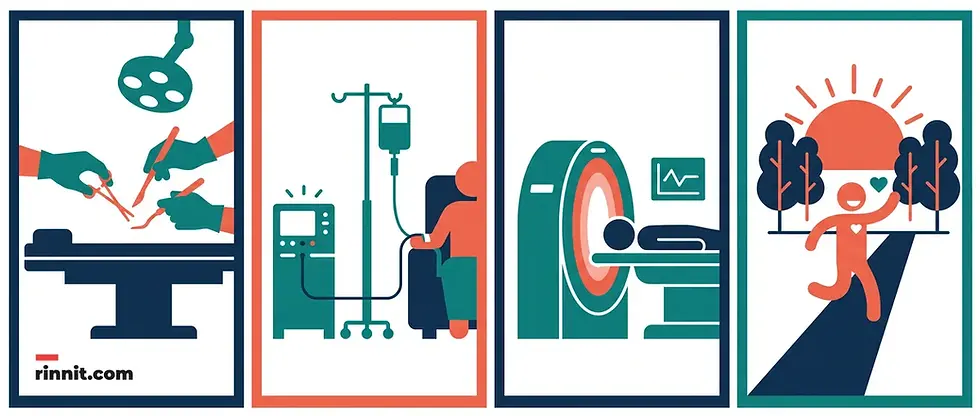
Treatment usually combines surgery and chemotherapy, followed by regular check-ups and scans.
Outlook and recovery
Prognosis
Untreated, yolk sac tumors are life-threatening, which is why early diagnosis matters. With treatment, the outlook is often good. The earlier the stage, the better the outcome, and nearly all stage 1 testicular yolk sac tumors are curable. Doctors also look at AFP levels: lower levels before chemotherapy usually suggest a better outcome. [1]
Long-term follow-up
After treatment, regular check-ups are essential, especially in the first five years. They include physical exams, CT scans, and AFP blood tests to make sure the cancer has not returned. [1] When childhood germ cell tumors do come back, it is usually within 3 years of surgery. [2]
Fertility and late effects
Cancer treatment can sometimes affect fertility, hearing, or kidney function months or years later. Ask your care team early about fertility preservation and about what to watch for after treatment. [2]
Supportive care
A cancer diagnosis is hard for patients and families. Palliative care teams can help manage treatment side effects at any stage, and support groups offer valuable emotional connection during recovery. [1]
Conclusion
A yolk sac tumor diagnosis can feel overwhelming because the disease is rare and fast-growing. The encouraging news is that treatment works well for many people. Knowing the early signs, such as a painless testicular lump, persistent abdominal swelling or pain, or an unusual swelling near the tailbone, and seeing a doctor promptly gives the best chance of a full recovery. For more on related topics, see our guide to childhood cancer.
Learn more. Explaining complex medical topics clearly helps families understand their options. Explore the infographic templates in the Rinnit.com marketplace to create clear, professional visual guides about rare conditions and treatment pathways.
Frequently Asked Questions
What is a yolk sac tumor?
A rare, fast-growing germ cell cancer that usually starts in the ovaries or testicles.
Is it the same as an endodermal sinus tumor?
Yes. Both names describe the same type of tumor.
Who is most likely to get a yolk sac tumor?
Testicular yolk sac tumors are most common in children under 3 and in adults in their 20s and 30s. Ovarian yolk sac tumors are most common in people under 21.
Is it common?
No. It is a rare cancer overall.
What are germ cells?
Cells in a developing fetus that later become eggs (in the ovaries) or sperm (in the testicles).
Can it form outside the reproductive organs?
Yes. These tumors are called extragonadal yolk sac tumors.
Where do extragonadal tumors form?
Common sites include the brain, chest, abdomen, and tailbone.
Is a yolk sac tumor cancerous?
Yes. It is a malignant (cancerous) tumor.
How fast does it grow?
It is highly aggressive and can grow and spread quickly, which is why prompt medical care matters.
What is the most common symptom in children?
In boys, a firm, painless lump in a testicle. In girls with an ovarian tumor, swelling or pain in the abdomen.
Can it cause abdominal pain?
Yes, especially when the tumor is in the ovary or abdomen.
Does it affect menstrual periods?
It can cause irregular periods or heavy bleeding in people who have periods.
Can it cause a cough?
Yes. A tumor in the chest can cause a cough and shortness of breath.
What are the symptoms of a brain tumor?
Headaches and vision changes.
What causes yolk sac tumors?
Researchers do not know the exact cause. Like all cancers, it starts when changes in a cell's DNA make cells multiply too fast.
Is it hereditary?
Most cases are not inherited. Some genetic conditions raise the risk of germ cell tumors in general, so talk to your doctor if you are concerned.
What is the AFP test?
A blood test that measures alpha-fetoprotein, a protein that yolk sac tumors often make.
Why is AFP important?
A high level helps point to the diagnosis. Doctors also track AFP during and after treatment to see how well it is working and to catch a return early.
How is the tumor diagnosed?
Through a physical exam, blood tests (including AFP), imaging such as CT or MRI, and examination of the tumor tissue in a laboratory.
What imaging is used?
CT scans and MRI are the most common.
Is a biopsy always necessary?
Not always. The tumor is often removed by surgery first and then examined in the lab. In some cases, a biopsy is taken before treatment.
What does staging mean?
Finding out how far the cancer has spread in the body.
What is the main treatment?
Surgery to remove the tumor, usually followed by chemotherapy.
What is an orchiectomy?
Surgery to remove a testicle.
What is an oophorectomy?
Surgery to remove an ovary.
Is chemotherapy effective?
Yes. Yolk sac tumors respond well to chemotherapy, often a combination called BEP (bleomycin, etoposide, and cisplatin).
When is chemotherapy used?
Usually after surgery, to kill any cancer cells that may remain.
Can chemotherapy be given before surgery?
Yes, sometimes, to shrink a large tumor first.
What is the outlook for children?
Very good. Most children are cured, especially when the tumor is found early, although the outlook depends on the stage and how the tumor responds to treatment.
What is the outlook for adults?
Often good, depending on the stage at diagnosis, AFP levels, and how well the tumor responds to treatment.
Can the tumor come back?
Yes, which is why regular follow-up is important.
How is a recurrence monitored?
Mainly with physical exams, AFP blood tests, and imaging scans.
Does treatment affect fertility?
It can. Talk with your care team about fertility preservation before treatment starts.
What is palliative care?
Care focused on relieving symptoms and side effects and improving quality of life. It can be given at any stage of illness.
Are there support groups?
Yes. Many organizations offer support for families facing germ cell tumors. Your care team can point you to them.
Is it the same as testicular cancer?
No. It is one specific type of testicular cancer when it forms in the testicle.
Is it the same as ovarian cancer?
No. It is one rare type of ovarian cancer (a malignant ovarian germ cell tumor).
Can it spread to the lungs?
Yes. As an aggressive cancer, it can spread to other organs, including the lungs.
What is the peritoneum?
The thin tissue lining the abdominal cavity. Ovarian yolk sac tumors can sometimes spread there.
Are there other types of germ cell tumors?
Yes. Yolk sac tumors are one type. Others include teratomas, seminomas and dysgerminomas, choriocarcinoma, and embryonal carcinoma.
Is it fatal?
It can be without treatment, but modern treatment is very successful for many people.
How long does treatment last?
It depends on the stage, but it usually involves surgery and several months of chemotherapy cycles.
What are the side effects of chemotherapy?
Nausea, hair loss, fatigue, and a higher risk of infection are common, and your care team can help manage them. Some effects can last longer, such as hearing or kidney problems.
Can a lump on the tailbone be a tumor?
In rare cases, yes. A swelling near the tailbone that looks like a bruise or an infected bump and does not go away should be checked by a doctor.
Does it cause weight loss?
Like some other cancers, it can cause unexplained weight loss, although this is not a typical early sign.
Is the surgery major?
Yes. It is a significant procedure done by specialists, and surgeons try to keep as much healthy tissue and function as possible.
Do adults need different treatment than children?
The drugs are similar, but the doses and number of cycles are tailored to the patient.
Do all yolk sac tumors need chemotherapy?
Not always. Some early-stage testicular tumors can be watched closely with regular tests after surgery, but most other cases need chemotherapy. Your care team decides based on the stage and AFP levels.
What should I do if I find a lump?
See a healthcare provider promptly. Most lumps are not cancer, but every new lump should be checked.
Where can I find more information?
The Cleveland Clinic and the National Cancer Institute offer reliable plain-language resources.
Related Reading
Testicular Cancer: The Young Man's Cancer That's Highly Curable — symptoms, self-exam guidance, and treatment explained.
Ovarian Germ Cell Tumors: Symptoms, Causes, and Management Strategies — the wider family of tumors that includes yolk sac tumors.
Childhood Cancer: What Parents Need to Know — early signs, types, and treatment, with hope for families.
Understanding Orchiectomy: A Comprehensive Guide to Testicle Removal Surgery — what the operation involves and what recovery looks like.
References
Cleveland Clinic. Yolk Sac Tumor. Cleveland Clinic. Last updated August 27, 2026. Accessed October 18, 2026. https://my.clevelandclinic.org/health/diseases/yolk-sac-tumor
National Cancer Institute. Childhood Extracranial Germ Cell Tumors Treatment (PDQ®)–Patient Version. NCI. Accessed October 18, 2026. https://www.cancer.gov/types/extracranial-germ-cell/patient/germ-cell-treatment-pdq
Kattuoa MI, Dunton CJ. Yolk Sac Tumors. In: StatPearls [Internet]. StatPearls Publishing. Updated December 16, 2025. PMID 33085310. Accessed October 18, 2026. https://www.ncbi.nlm.nih.gov/books/NBK563163/
Faure Conter C, Xia C, Gershenson D, et al. Ovarian yolk sac tumors; does age matter? Int J Gynecol Cancer. 2018;28(1):77-84. PMID 29194189. https://doi.org/10.1097/IGC.0000000000001149
Wang T, Wang B, Wang SX, et al. Clinicopathologic characteristics and survival of patients with rare malignant ovarian yolk sac tumors: a population-based analysis. Curr Med Sci. 2021;41(2):342-347. PMID 33877552. https://doi.org/10.1007/s11596-021-2353-y
Mayhew AC, Rytting H, Olson TA, et al. Vaginal yolk sac tumor: a case series and review of the literature. J Pediatr Adolesc Gynecol. 2021;34(1):54-60.e4. PMID 32628992. https://doi.org/10.1016/j.jpag.2020.06.020
Medical disclaimer
This article is for informational purposes only and is not medical advice. Always consult a qualified healthcare professional for diagnosis and treatment decisions.



Comments