Weeping Eczema: Symptoms, Causes, and Management

Updated: 2 days ago
Medically reviewed by Dr. Baraa Alnahhal, MD · Last reviewed: October 2026
Quick Answer
Weeping eczema is a condition in which active skin inflammation causes fluid-filled blisters that ooze serum, which often dries into a crust. [4] It signals worsening eczema and requires immediate medical attention to prevent secondary infections like Staph or Herpes. [4] Treatment reduces inflammation with topical or oral medications, while oatmeal baths can soothe the skin. [4]
What the research says
Diluted bleach baths probably help, but only modestly. In 10 randomized trials with 307 participants, bleach baths probably improved clinician-rated eczema severity by a relative 22% (ratio of means 0.78, 95% credible interval 0.59–0.99; moderate certainty), and side effects, mostly dry skin and irritation, did not differ clearly from no bleach baths (Bakaa et al., Annals of Allergy, Asthma & Immunology, 2022) [1].
The evidence for antibacterial treatments in eczema is limited. A Cochrane review of 41 studies (1,753 analysed participants) found insufficient evidence on anti-staphylococcal treatments overall; adding an antibiotic to a topical steroid may give slightly greater improvement than the steroid alone (risk ratio 1.10, 95% CI 1.00–1.21; 224 participants; low-quality evidence) (George et al., Cochrane Database of Systematic Reviews, 2019) [2].
Staph from eczema skin does not always respond to common antibiotics. In a meta-analysis of 61 studies covering 4,091 Staphylococcus aureus isolates from people with atopic dermatitis, susceptibility was 85% for methicillin, 80% for fusidic acid, 79% for clindamycin, and 73% for erythromycin (Elizalde-Jiménez et al., JAMA Dermatology, 2024) [3].
What is Weeping Eczema?
Weeping eczema is not a separate disease but a complication of typical eczema (dermatitis). [4] It is characterized by skin that oozes clear- to straw-colored fluid. [4] In some cases, small blisters filled with clear, red, or purple fluid may develop.
This condition is highly prevalent, as over 31 million Americans live with various forms of dermatitis, including atopic, contact, and seborrheic dermatitis. [4] Any type of eczema can potentially become "weeping" if the inflammation becomes severe enough. [4]

Recognizing the Symptoms
Weeping eczema often appears in areas where the skin flexes, such as the inside of the elbows, behind the knees, and the front of the neck. [4] However, it can affect the hands, face, lips, and feet. [4]
Common Signs
Blisters and Oozing: Small fluid-filled sores that leak clear or straw-colored serum.
Crusting: A yellow-to-orange crusty layer that forms as the fluid dries on the skin. [4]
Intense Inflammation: Increased redness, burning, itching, or soreness. [4]
Open Sores: Breaks in the skin that increase the risk of infection.
Severe Complication Signs
If the condition worsens or becomes infected, you may experience systemic symptoms:
Causes and Risk Factors
The primary cause of weeping eczema is active inflammation. When skin becomes severely inflamed, blood vessels dilate and leak serum into the surrounding tissue. [4] This fluid then oozes onto the skin surface.

Diagnosis and Treatment Options
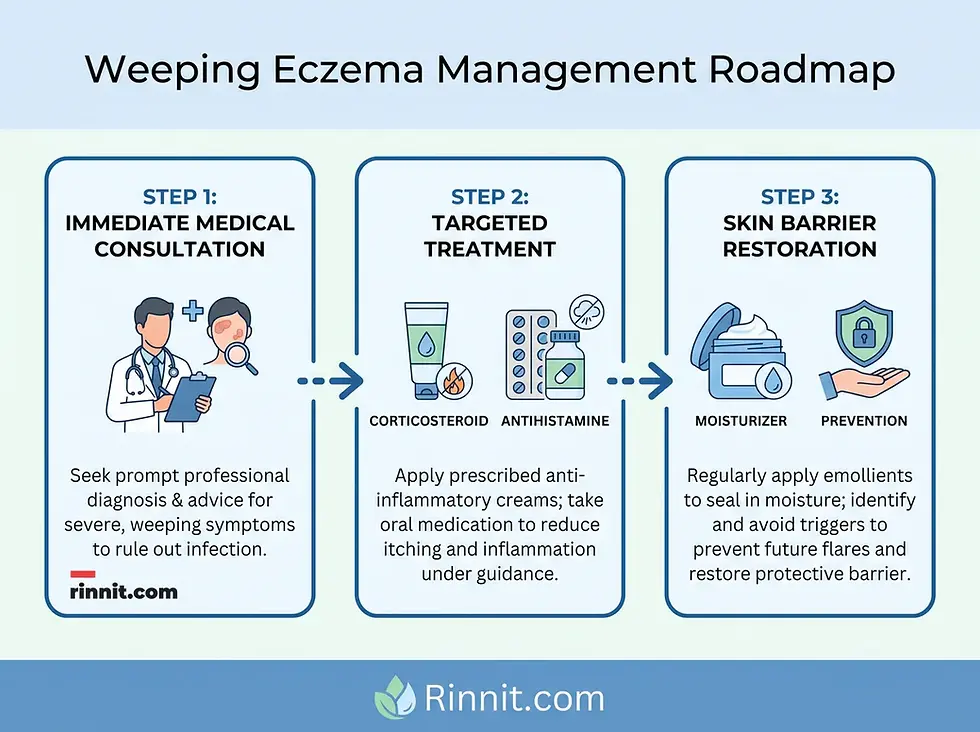
If your eczema begins to weep, you should consult a healthcare provider immediately. Diagnosis typically involves a physical exam, though providers may use skin biopsies or bacterial cultures to check for infections. [4]
Medical Treatments
Corticosteroids: Topical or oral steroids (like prednisone) to reduce inflammation and itching. [4]
Antihistamines: Pill-form medications to lower the body's allergic response and reduce itchiness. [4]
Immunosuppressants: Medications that lower the immune response to control severe inflammation. [4]
Infection Control: Antibiotics or antivirals if a secondary infection is detected.
Home Remedies and Soothing Care
While prescription medication is necessary for complete clearance, these home strategies can ease symptoms:
Colloidal Oatmeal Baths: Helps soothe dry, itchy, and inflamed skin. [4]
Natural Oils: Coconut and sunflower seed oils may help the skin barrier, but olive oil can weaken it and is best avoided.
Diluted Bleach Baths: A provider-approved method to kill surface bacteria (use with caution).
Supplements: Vitamin D, B12, and fatty acids (like evening primrose) may improve skin health. [4]
Prevention and Long-Term Outlook
With prompt medical care, weeping eczema usually clears within two weeks. [4] However, left untreated, it can lead to permanent scarring and dangerous systemic infections.
Prevention Tips
Moisturize Constantly: Apply emollient-rich creams at least twice a day.
Avoid Irritants: Use only dye-free and perfume-free shampoos and cleansers. [4]
Stress Management: Practice meditation or mindfulness [4] to reduce inflammation triggers.
Early Intervention: Use steroid creams at the first sign of worsening inflammation.
Frequently Asked Questions
1. Is weeping eczema contagious?
The eczema itself is not contagious. However, if the weeping is caused by a secondary infection like Staph or Herpes, that infection can be spread to others.
2. How long does weeping eczema take to heal?
With appropriate treatment, most cases clear up within two weeks.
3. Can I treat weeping eczema at home?
While home remedies like oatmeal baths can soothe symptoms, you need prescription medication to fully clear the inflammation and any underlying infection.
4. What does the fluid look like?
The fluid is typically clear to straw-colored. If it appears pus-colored, it likely indicates a bacterial infection.
5. Does weeping eczema cause scarring?
Severe or untreated cases can lead to scarring. Prompt treatment significantly reduces this risk.
6. Can babies get weeping eczema?
Yes. If a baby's eczema starts to weep, contact a pediatrician immediately for safe treatment options.
7. What is the difference between weeping eczema and impetigo?
Eczema is a type of dermatitis, while impetigo is a specific skin infection. Impetigo usually affects the nose and mouth, while weeping eczema can occur anywhere.
8. Can the herpes virus cause weeping eczema?
Yes, if the HSV-1 virus enters cracked skin, it can cause a severe form of weeping eczema.
9. Should I cover weeping eczema?
Follow your doctor's advice; generally, the area needs to be kept clean, and specific dressings may be recommended.
10. Can stress cause my eczema to weep?
Stress can trigger inflammation, which may lead to an eczema flare-up that eventually begins to weep.
11. Are bleach baths safe?
Diluted bleach baths can be safe and effective for killing bacteria, but you must consult your doctor for the correct ratio and frequency.
12. What vitamins help with eczema?
Vitamins D and B12, along with fatty acids like black currant seed oil, are often recommended to support skin health.
13. Does weeping eczema affect the lips?
Yes, it can occur on the lips. It is important to keep them moisturized with petroleum jelly while seeking medical care.
14. Why does the skin turn yellow or orange?
The yellow-to-orange color is a crust that forms when the leaked serum dries on the skin's surface.
15. When is weeping eczema an emergency?
If you develop a high fever, chills, or severe pain along with the weeping, seek medical attention immediately.
Trusted External Resources
National Eczema Association: Eczema Herpeticum — how to recognize this serious herpes skin infection in people with eczema.
American Academy of Dermatology: Eczema — dermatologist-reviewed guidance on eczema types and care.
Related Reading
Atopic Dermatitis (Eczema): Symptoms, Causes & Treatment — Complete Guide explains the most common type of eczema and its treatments.
Staph Infections: Symptoms, Causes, Treatment, and Prevention — Complete Guide covers staph infections, a common complication of weeping eczema.
Dyshidrotic Eczema: Tiny Itchy Blisters on Your Hands and Feet — Causes, Diagnosis and Treatment describes the eczema type that causes small blisters on hands and feet.
Contact Dermatitis: Symptoms, Causes, Diagnosis & Treatment — Complete Guide explains skin rashes caused by irritants and allergens.
References
Bakaa L, Pernica JM, Couban RJ, et al. Bleach baths for atopic dermatitis: A systematic review and meta-analysis including unpublished data, Bayesian interpretation, and GRADE. Ann Allergy Asthma Immunol. 2022;128(6):660-668.e9. PMID 35367346. https://doi.org/10.1016/j.anai.2022.03.024
George SM, Karanovic S, Harrison DA, et al. Interventions to reduce Staphylococcus aureus in the management of eczema. Cochrane Database Syst Rev. 2019;2019(10):CD003871. PMID 31684694. https://doi.org/10.1002/14651858.CD003871.pub3
Elizalde-Jiménez IG, Ruiz-Hernández FG, Carmona-Cruz SA, et al. Global Antimicrobial Susceptibility Patterns of Staphylococcus aureus in Atopic Dermatitis: A Systematic Review and Meta-Analysis. JAMA Dermatol. 2024;160(11):1171-1181. PMID 39320869. https://doi.org/10.1001/jamadermatol.2024.3360
Cleveland Clinic. Weeping Eczema. Cleveland Clinic Health Library. Last updated October 29, 2021. https://my.clevelandclinic.org/health/diseases/21991-weeping-eczema
Medical Disclaimer
This content is for informational purposes only and does not constitute medical advice. Always seek the advice of a physician or other qualified health provider with any questions regarding a medical condition.



Comments