Webbed Penis (Penoscrotal Webbing): Symptoms, Causes, and Treatments

Updated: 2 days ago
Medically reviewed by Dr. Baraa Alnahhal, MD · Last reviewed: October 2026
Quick Answer
Webbed penis, or penoscrotal webbing, is a condition in which scrotal skin extends onto the penile shaft, hiding the normal angle between them. It is mainly cosmetic in children but can later cause painful tension during erections. A physical exam confirms it. [3] The standard treatment is scrotoplasty, with recovery taking about six weeks without sexual activity. [3]
What the research says
Surgical repair in infants and young boys has a low complication rate. In a series of 138 boys (median age 9.6 months) who had double-V scrotoplasty, 7 (5%) had minor skin separation at the penoscrotal junction that healed completely, one had a superficial skin infection, and none needed reoperation (McLeod & Alpert, Journal of Pediatric Urology, 2014) [1].
No single repair technique has proven clearly better than the others. In 196 children under 5 years old who had Heineke-Mikulicz, V-Y, or Z scrotoplasty, 10 (6.7%) had complications and 4 (2.7%) needed surgical revision, with no significant difference in complications or parent satisfaction between the techniques (Bonitz & Hanna, Journal of Pediatric Urology, 2016) [2].
What is Webbed Penis (Penoscrotal Webbing)?
Webbed penis, also referred to as penoscrotal webbing (PSW) or congenital penile scrotal fusion, is a condition where the scrotal skin attaches higher than normal on the underside of the penis. This creates a "web" of skin that becomes visible when the penis is pulled away from the scrotum. [3]
While the condition is rare—with some research suggesting a prevalence of about 4% in newborns [3]—it is a recognized penile health concern. It is important to distinguish it from a buried penis, where excess fat or skin hides the penis; while webbing can contribute to a buried appearance, they are distinct conditions.

Symptoms and Physical Signs
For many, webbed penis is asymptomatic during childhood. However, as the body develops, the physical limitations of the extra skin can become apparent.
Key Indicators
Webbed Appearance: A visible fold of skin connecting the scrotum to the penile shaft.
Altered Angle: The angle between the penis and scrotum is reduced or obscured.
Painful Erections: Tension from the attached skin can cause discomfort or pain when the penis is erect. [3]
Intercourse Challenges: The webbing can make sexual activity difficult or uncomfortable. [3]
Cosmetic Concerns: Dissatisfaction with the appearance of the genitalia.
Causes and Types
Webbed penis is classified into two main types based on when and how it develops.

Diagnosis and Treatment
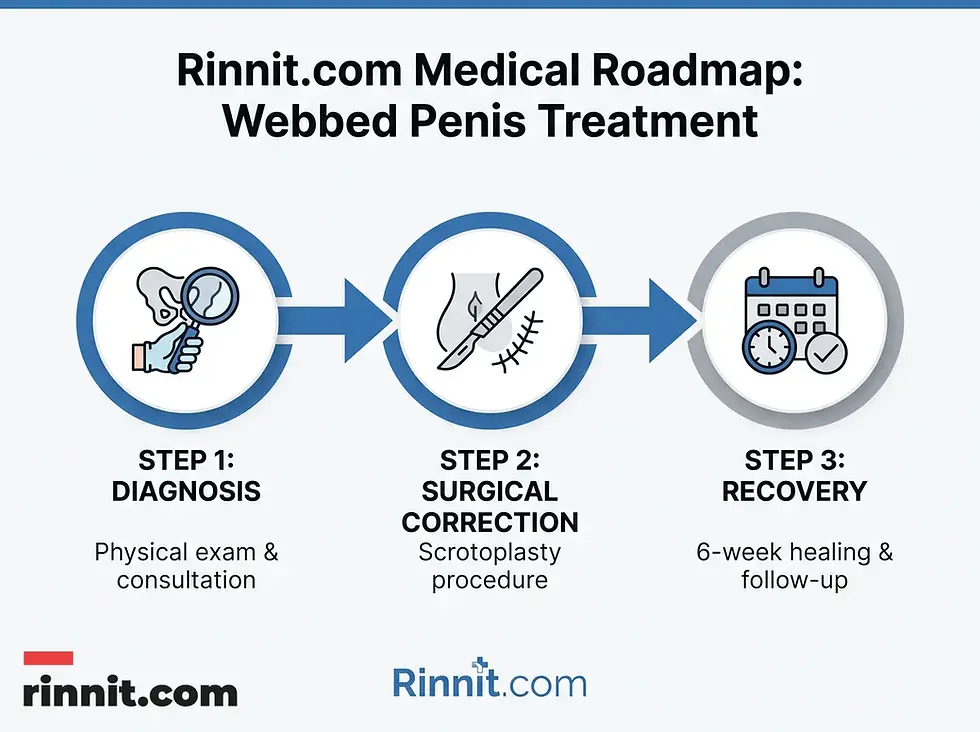
Diagnosis is straightforward and typically only requires a physical examination [3] by a healthcare provider or urologist.
Surgical Correction: Scrotoplasty
The primary treatment for webbed penis is scrotoplasty. [3] This surgery is recommended for those experiencing pain or those who are unhappy with the cosmetic appearance.
The Procedure: The surgeon cuts the webbed skin and reconnects it at the proper location to create a natural angle. [3]
Erection Relief: The surgery effectively eliminates the pulling sensation and pain during erections. [3]
Recovery Time: Initial discomfort lasts 3–5 days, with full healing taking approximately six weeks.
Post-Op Care: Patients are advised to wear support garments (like a jockstrap) and avoid sexual intercourse during the six-week recovery period. [3]
Living with Webbed Penis
It is important to note that webbed penis does not affect penis size or growth. However, the altered angle can affect the perception of size. If the condition is not causing pain or distress, medical intervention is not strictly necessary. [3]
When to See a Doctor
Consult a urologist if you experience:
Pain during erections.
Difficulty with sexual intercourse.
Significant distress over the appearance of the webbing.
Frequently Asked Questions
1. Is a webbed penis a serious health problem?
Generally, no. It is primarily a structural issue that may cause pain or functional challenges later in life, but it is not life-threatening.
2. Can webbed penis be prevented?
No. Since it is either congenital or a result of a surgical procedure like circumcision, there are no known preventive measures.
3. Does it affect fertility?
No, webbed penis does not impact sperm production or the ability to father children.
4. Is scrotoplasty a common surgery?
Yes, it is a routine procedure for urologists who specialize in penile conditions.
5. Can adults get surgery for webbed penis?
Yes. While often addressed in childhood, adults can undergo scrotoplasty to relieve pain or for cosmetic reasons.
6. Will the surgery leave a scar?
As with any surgery, there will be an incision, but surgeons aim to place stitches in a way that minimizes visible scarring.
7. Is the surgery painful?
The procedure is performed under anesthesia. Post-operative discomfort is common for the first few days but can be managed with medication.
8. How do I know if it's a webbed penis or a buried penis?
A webbed penis involves skin attachment between the scrotum and shaft, while a buried penis is hidden by excess abdominal fat or skin. A urologist can provide a definitive diagnosis.
9. Can circumcision cause a webbed penis?
Yes, if too much skin is removed during the procedure, it can result in acquired penoscrotal webbing.
10. Does the webbing go away on its own?
No, the skin attachment will not change without surgical intervention.
11. How long do I have to wait for sex after surgery?
Doctors typically recommend waiting at least six weeks for the surgical site to heal completely.
12. Does it affect the way I urinate?
In most cases, webbed penis does not interfere with urination.
13. Can I treat it at home?
No. There are no home remedies or exercises that can correct the skin attachment; surgery is the only effective treatment.
14. Is the surgery covered by insurance?
Insurance coverage depends on your provider and whether the surgery is deemed medically necessary (due to pain or functional issues) or purely cosmetic.
15. What is the success rate of scrotoplasty?
The outlook is excellent, with most patients achieving a successful functional and cosmetic outcome.
Trusted External Resources
Cleveland Clinic: Scrotoplasty — what scrotoplasty involves, its risks, and what recovery looks like.
Weill Cornell Medicine Pediatric Urology: Buried Penis — information on buried penis, a condition that can be confused with webbed penis.
Related Reading
Buried Penis: What It Is, Why It Happens, and How It's Treated explains a related condition where the penis is hidden by skin.
Hypospadias: Symptoms, Causes & Treatment Explained covers a common birth difference of the urethral opening and its repair.
Understanding Micropenis: Causes, Diagnosis, and Treatment explains how micropenis differs from conditions that only hide penis length.
Circumcision: Procedure, Methods, Recovery and Risks describes the procedure, its benefits, risks and recovery.
References
McLeod DJ, Alpert SA. Double-V scrotoplasty for repair of congenital penoscrotal webbing: a hidden scar technique. J Pediatr Urol. 2014;10(5):810-814. PMID 24572216. https://doi.org/10.1016/j.jpurol.2014.01.014
Bonitz RP, Hanna MK. Correction of congenital penoscrotal webbing in children: a retrospective review of three surgical techniques. J Pediatr Urol. 2016;12(3):161.e1-5. PMID 27020468. https://doi.org/10.1016/j.jpurol.2016.02.003
Cleveland Clinic. Webbed Penis (Penoscrotal Webbing). Cleveland Clinic Health Library. Last updated August 7, 2026. https://my.clevelandclinic.org/health/diseases/24133-webbed-penis
Medical Disclaimer
This content is for informational purposes only and does not constitute medical advice. Always seek the advice of a physician or other qualified health provider with any questions regarding a medical condition.



Comments