VV-ECMO: Advanced Life Support for Respiratory Failure

Updated: 3 days ago
Medically reviewed by Dr. Baraa Alnahhal, MD · Last reviewed: October 2026
Quick Answer: What is VV-ECMO?
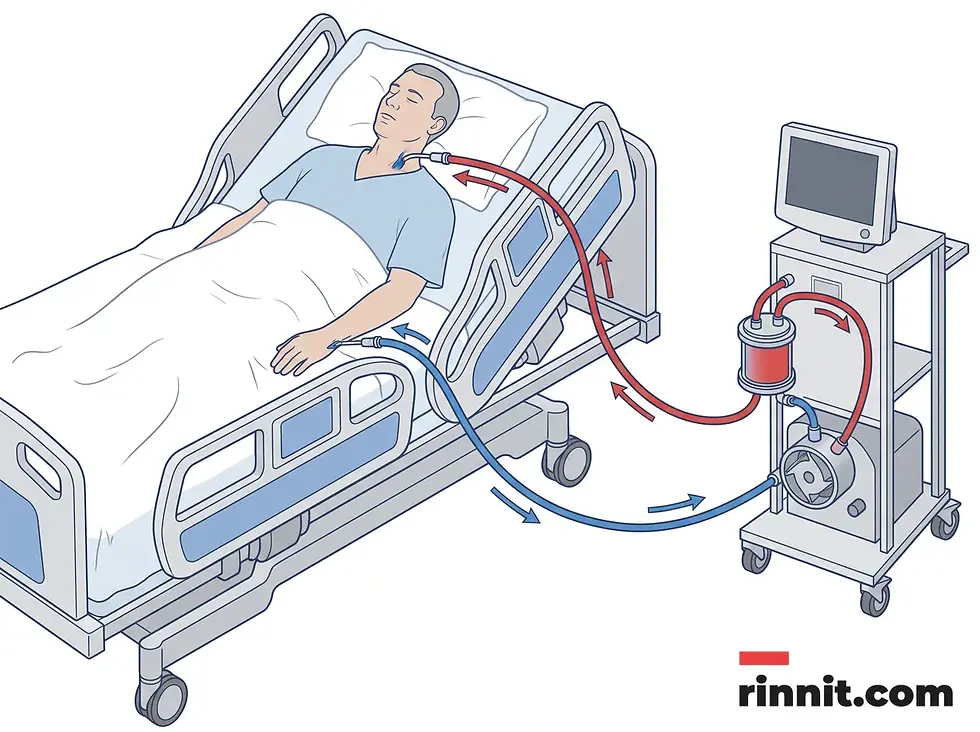
VV-ECMO is a medical procedure in which a machine adds oxygen to and removes carbon dioxide from the blood when failing lungs cannot. Blood is drained from a large vein, passed through a membrane oxygenator and returned to another vein. [1] It supports the patient while providers treat the underlying illness or while the patient awaits a lung transplant. [1]
What the research says
Early ECMO did not significantly lower deaths in the largest trial. In the EOLIA trial of 249 patients with very severe acute respiratory distress syndrome (ARDS), 44 of 124 patients (35%) in the ECMO group and 57 of 125 (46%) in the control group had died at 60 days (relative risk 0.76, 95% CI 0.55 to 1.04; P = 0.09). Of the control group, 35 patients (28%) crossed over to ECMO because of refractory low oxygen (Combes et al., N Engl J Med, 2018) [2].
A re-analysis suggests a likely, but uncertain, survival benefit. A post hoc Bayesian analysis of EOLIA found a 96% probability that early ECMO reduced 60-day mortality (relative risk 0.78, 95% credible interval 0.56 to 1.04) when using a minimally informative prior (Goligher et al., JAMA, 2018) [3].
ECMO carries real bleeding risks. In EOLIA, bleeding events that needed transfusion occurred in 46% of the ECMO group versus 28% of the control group, and severe thrombocytopenia (low platelets) in 27% versus 16%. Ischemic stroke occurred in none of the ECMO group versus 5% of controls (Combes et al., N Engl J Med, 2018) [2].
The Function and Purpose of VV-ECMO
Veno-venous extracorporeal membrane oxygenation (VV-ECMO) is a highly specialized intervention designed to support patients whose lungs can no longer maintain adequate oxygen levels or clear carbon dioxide. The term "extracorporeal" means the process occurs outside the body. Unlike other forms of life support that may also assist the heart, VV-ECMO targets lung function only and relies on the patient's own heart to circulate the oxygenated blood. [1]
It is typically used as a last resort, once it is clear that medications and other treatments are not helping the lungs recover quickly enough. [1] It does not treat the underlying cause of respiratory failure, but it can keep a patient alive while that cause is treated. [1]
How the Procedure Works
The care team first sedates the patient and gives anesthesia so the procedure is painless, then places large, flexible tubes called cannulas into major veins. [1] These cannulas are the entry and exit points for blood traveling to and from the ECMO machine. Blood-thinning medication (heparin) is given to lower the risk of clots, and monitors track blood pressure, oxygen levels, and other vital signs. [1]
Component | Function in the VV-ECMO Process |
Drainage Cannula | Typically placed in the femoral vein (groin) to remove blood from the vena cava. [1] |
Membrane Oxygenator | The "artificial lung" that adds oxygen and removes carbon dioxide from the blood. [1] |
Heat Exchanger | Keeps the blood at the patient's natural body temperature before it returns. [1] |
Return Cannula | Typically placed in the internal jugular vein (neck) to send oxygenated blood back to the heart. [1] |
VV-ECMO vs. VA-ECMO
There are two primary types of ECMO support. Both use similar technology, but they differ in whether the patient needs heart support in addition to lung support.
Feature | VV-ECMO (Veno-Venous) | VA-ECMO (Veno-Arterial) |
Primary Support | Lungs only. [1] | Both heart and lungs. [1] |
Blood Return Point | Returns blood to a vein. [1] | Returns blood to an artery. [1] |
Heart Requirement | The patient's heart must be functioning. | Supports a failing heart. |
Common Use | Severe respiratory failure. | Cardiac arrest or severe heart failure. |

Risks and Clinical Monitoring
VV-ECMO can be lifesaving, but it is reserved for the most critical cases because of the risks of extracorporeal circulation. Patients are monitored around the clock by a specialized team of physicians and surgeons.
Common risks include:
Bleeding: Often related to blood thinners such as heparin, which are needed to prevent clots in the machine.
Infections: A risk whenever cannulas are placed through the skin for an extended time.
Blood clots: Clots can form in the tubing and may travel through the bloodstream.
The Path to Recovery
The length of VV-ECMO support depends on the cause of the respiratory failure. Most patients stay on the machine for about 9 to 14 days, though some need support for four weeks or longer. [1] As the lungs show signs of healing, the care team begins "weaning," gradually reducing the machine's settings so the patient's lungs take over more of the work. [1]

Conclusion
VV-ECMO is a critical part of modern intensive care, offering a bridge to recovery for people with life-threatening lung conditions. By acting as an artificial lung, it buys time for treatments to work and for the body to heal. Although it is complex and carries risks, it remains a vital option when other treatments have reached their limits.
Next Steps
If a loved one is placed on VV-ECMO, the most important step is to keep communication open with the specialized intensive care team. Ask for regular updates on the "weaning" process and on the condition being treated. Because this is a high-stress time, families are encouraged to use hospital support services and to look after their own well-being too.
Frequently Asked Questions
1. What does the "VV" in VV-ECMO stand for?
The "VV" stands for veno-venous, meaning blood is taken from a vein and returned to a vein.
2. Is the patient awake during the procedure?
Patients are sedated for setup, and the care team may wake them once the system is stable. Some patients need to stay sedated.
3. How does the machine add oxygen?
The machine uses a membrane oxygenator that mimics the gas exchange process of human lungs.
4. Why is heparin used during ECMO?
Heparin is a blood thinner that prevents dangerous clots from forming in the artificial plastic tubing.
5. Can VV-ECMO treat the cause of lung failure?
No, it only supports the body while other treatments, such as antibiotics or surgery, address the cause.
6. How long can a person stay on VV-ECMO?
While 9 to 14 days is common, some patients remain on support for four weeks or longer.
7. What is weaning?
Weaning is the gradual process of reducing machine support as the patient's lungs begin to function again.
8. Where are the tubes usually placed?
Typically in the groin (femoral vein) and the neck (internal jugular vein).
9. Is VV-ECMO used for heart failure?
No, VV-ECMO only supports the lungs. VA-ECMO is used when the heart also needs help.
10. What are the most common risks?
The most frequent complications are bleeding, infection, and blood clots.
11. Do all hospitals offer VV-ECMO?
No, only specialized centers with trained ECMO teams can provide this level of life support.
12. What happens if the lungs do not recover?
The care team will discuss next steps with the family, which may include a lung transplant evaluation or palliative care.
13. Can I visit a loved one on ECMO?
Yes, though visits are managed within the Intensive Care Unit (ICU) environment. Ask the care team about visiting policies.
14. Does the machine stay outside the body?
Yes, "extracorporeal" means the blood is processed outside of the patient's body.
15. How is the blood kept warm?
The machine includes a heat exchanger that keeps the blood at normal body temperature.
Related Reading
Trusted External Resources
References
Cleveland Clinic. VV-ECMO. Cleveland Clinic. Last updated April 24, 2026. https://my.clevelandclinic.org/health/treatments/vv-ecmo
Combes A, Hajage D, Capellier G, et al. Extracorporeal membrane oxygenation for severe acute respiratory distress syndrome. N Engl J Med. 2018;378(21):1965-1975. PMID 29791822. https://doi.org/10.1056/NEJMoa1800385
Goligher EC, Tomlinson G, Hajage D, et al. Extracorporeal membrane oxygenation for severe acute respiratory distress syndrome and posterior probability of mortality benefit in a post hoc Bayesian analysis of a randomized clinical trial. JAMA. 2018;320(21):2251-2259. PMID 30347031. https://doi.org/10.1001/jama.2018.14276
Medical Disclaimer
This article is for informational purposes only and does not constitute medical advice. Always seek the advice of your physician or other qualified health provider with any questions you may have regarding a medical condition. Never disregard professional medical advice or delay in seeking it because of something you have read in this article.



Comments