Understanding Vogt-Koyanagi-Harada (VKH) Disease: Causes, Symptoms, and Treatment

Updated: 3 days ago
Medically reviewed by Dr. Baraa Alnahhal, MD · Last reviewed: October 2026
TL;DR: Vogt-Koyanagi-Harada (VKH) disease is a rare condition that causes inflammation inside the eyes and can also affect the hearing, skin, and hair. It moves through four phases, starting with flu-like symptoms, and can cause permanent vision and hearing loss if it is not treated early. Treatment combines corticosteroids with immunosuppressants to calm the immune response and protect sight and hearing.
Quick Answer
Vogt-Koyanagi-Harada disease is a multisystem inflammatory disorder that mainly targets the eyes, causing uveitis, but can also affect the inner ear, skin, hair, brain and spinal cord. [1] It is thought to be an autoimmune reaction. Starting corticosteroids and immunosuppressants early may help avoid later phases, and treatment has a good chance of reversing some vision and hearing loss. [1]
What the research says
Combining immunosuppressants with low-dose steroids worked better than steroids alone. In a retrospective study of 26 patients, 81% (21 of 26) treated with combined immunosuppressive therapy and low-dose steroids reached disease stability with a significant visual improvement at 24 months, and the combined approach gave significantly better visual improvement than steroid monotherapy (According to PubMed, Rahman et al., J Ophthalmic Inflamm Infect, 2023) [2].
Some early features predict a chronic, recurring course. In 62 patients, “sunset glow fundus” (a change in the back of the eye) appeared in 23.5% of the acute-resolved group versus 64.3% of the chronic-recurrent group, and older age at onset and sunset glow fundus predicted progression to the chronic recurrent phase (According to PubMed, Feng et al., BMC Ophthalmol, 2024) [3].
Recurrence is common even with treatment, and the best steroid dose is still debated. In 72 patients with initial-onset VKH, recurrence occurred in 41% treated with 1000 mg/day of intravenous methylprednisolone and 34% treated with 500 mg/day (p = 0.48), with no significant difference in efficacy (According to PubMed, Tsubota et al., Jpn J Ophthalmol, 2025) [4].
What Is Vogt-Koyanagi-Harada Disease?
Vogt-Koyanagi-Harada (VKH) disease, also called VKH syndrome, is a rare condition that causes inflammation and damage throughout the body. It can affect the eyes, inner ear, skin, hair, brain, and spinal cord. [1] Without quick treatment, the inflammation can permanently damage vision and hearing. [1]
VKH is often classified as an autoimmune disease, in which the immune system harms healthy tissue instead of protecting it. A genetic variation that affects human leukocyte antigens (HLA) might play a role. [1] HLA are proteins in your cells that normally help the immune system tell healthy cells from those that do not belong. [1] Experts think a variation in how the immune system reads HLA may lead it to attack healthy cells and cause the inflammation seen in VKH. [1]

The Four Phases of VKH Disease
VKH usually affects both eyes first, and vision changes are typically the first sign. [1] Symptoms in other parts of the body appear later, as the disease moves through four phases.
Phase | Duration | Primary Symptoms |
Prodromal | About 1 week | Flu-like symptoms, deep eye pain, headache, fever, dizziness or vertigo, tinnitus, and light sensitivity. [1] |
Acute uveitic | Several weeks | Blurry vision, severe light sensitivity, red eye, and eye pain as the choroid and retina become inflamed. [1] |
Chronic | Weeks to months | Patches of skin and hair losing color, hair loss, worsening tinnitus, and hearing loss. |
Recurrent chronic | Variable | Inflammation returns, with granulomas and leaking blood vessels, and the highest risk of complications and vision loss. [1] |
The prodromal phase often resembles a common illness, which makes early detection hard. In the acute uveitic phase the inflammation settles in the choroid and retina and causes noticeable vision changes. The chronic phase, which some providers call the convalescent stage, is when skin patches lose color and hair can turn white. In the recurrent chronic phase the eye inflammation returns and may be more severe than before, which is when complications such as glaucoma, cataracts, permanent hearing loss, and permanent low vision or blindness become most likely. [1]
Seek urgent care: See an eye doctor right away if you notice sudden changes in your vision or hearing. Some early VKH symptoms can look like meningitis, including fever and headache, and meningitis is a medical emergency, so go to the emergency room if you think you might have it. [1]
Causes and Risk Factors
Experts are still studying why VKH happens. The immune system is thought to target melanin-containing tissues [2] such as the eyes, skin, and hair, which helps explain why vision changes and loss of color in the skin and hair can occur together.
Factor | Description |
Age | Usually affects people between 30 and 40, but it can develop at any age. [1] |
Ethnicity | Higher risk in people of Asian, Indian, Native American, Hispanic, and Middle Eastern backgrounds. [1] |
Genetics | Variations in HLA proteins, which help regulate immune responses, may increase risk. [1] |
Diagnosis and Clinical Classification
A provider diagnoses VKH by dilating your eyes and doing a full eye exam, and will check your hearing or refer you for a hearing test. [1] Because VKH is rare, your provider will first rule out more common causes of eye inflammation. [1] Telling your provider when your symptoms started and how fast they came on can be an important clue. [1]
Diagnostic Tools
Imaging: CT scans, MRI, and optical coherence tomography (OCT) can show inflammation in the eyes and brain.
Angiography: helps find leaking blood vessels and other changes inside the eye.
Laboratory tests: blood tests and a lumbar puncture (spinal tap) can check for signs of neurological involvement.
Hearing tests: used to check for hearing loss or tinnitus.
Types of VKH
Providers classify VKH by how many parts of the body are involved:
Complete VKH: affects the eyes, the skin, and the neurological system (brain and nerves). [1]
Incomplete VKH: affects the eyes plus either the skin or the neurological system, but not both. [1]
Suspected VKH: your provider thinks you might have VKH but cannot diagnose it yet, usually because you have VKH-like eye inflammation without symptoms elsewhere. [1]

Management and Treatment Strategies
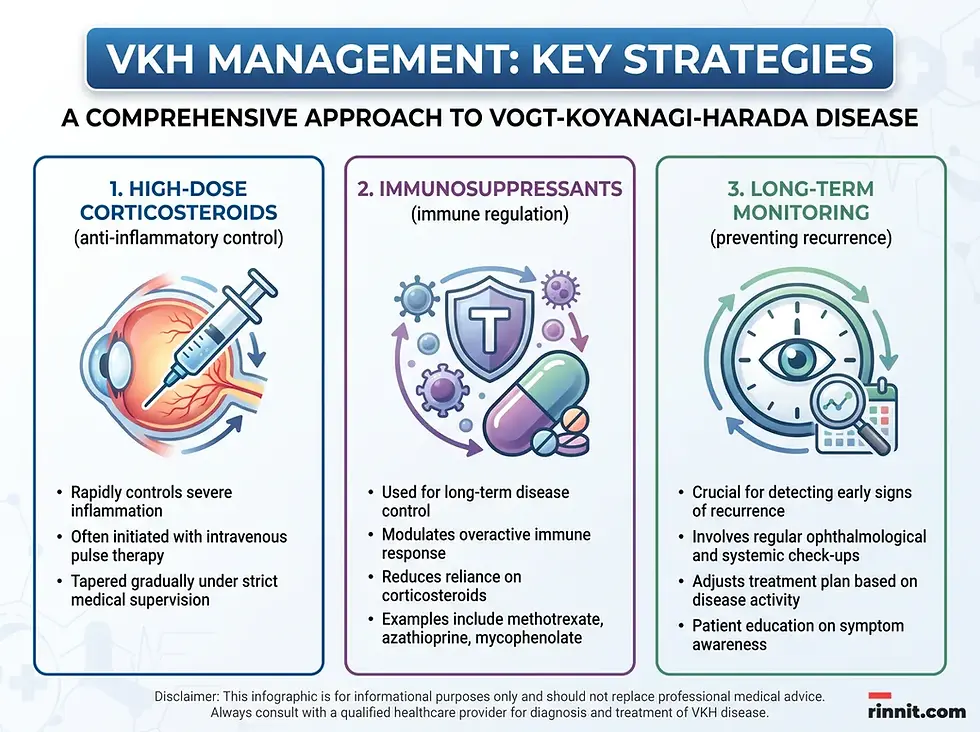
The goal of treatment is to control inflammation quickly to prevent permanent damage to vision, hearing, and skin. [1] Starting treatment early is the most important factor in a good outcome.
Medical Interventions
Corticosteroids: prescription anti-inflammatory medicines are the first line of treatment and reduce inflammation inside the eyes. [1] [2] You may need more than one type. [1]
Immunosuppressants: these medicines hold back the immune system so it stops attacking healthy tissue throughout the body. [1]
You may also need treatment for specific symptoms or complications as they appear, such as glaucoma or cataracts. Regular follow-up visits are essential so your eye doctor can watch for recurrence, especially between phases. [1]
Long-Term Outlook
VKH can respond very well to treatment, especially when it is caught in an early phase. [1] Every case is different, but there is a good chance that treatment can reverse some vision and hearing loss. [1] The risk of permanent complications, such as glaucoma, cataracts, permanent hearing loss, and blindness, grows the longer you have later-stage disease, especially in the recurrent phase. [1]
Conclusion
Vogt-Koyanagi-Harada disease is complex but treatable. Recognizing early flu-like symptoms and getting prompt eye care for vision or hearing changes gives you the best chance of protecting your sight and hearing. Ongoing monitoring and sticking with your anti-inflammatory treatment are key to managing this rare autoimmune-type disorder.
When to act: If you or a loved one notice sudden changes in vision or hearing, especially after a flu-like illness, see an eye specialist immediately. Early diagnosis is the best way to protect long-term sensory health.
Related reading: Uveitis · Panuveitis · Immunosuppressants · Glaucoma · Cataracts · Hearing loss
Frequently Asked Questions
Is VKH disease contagious?
No. VKH is thought to be an autoimmune condition and cannot be spread from person to person.
Can VKH cause permanent blindness?
Yes. If it is not treated, or if it reaches the recurrent chronic phase, VKH can cause permanent low vision or blindness.
What is the first sign of VKH?
VKH usually affects both eyes first. Early symptoms often resemble a flu-like illness, with headache, fever, eye pain, dizziness, ringing in the ears, and light sensitivity, followed by blurry vision.
Is VKH a genetic condition?
VKH is not inherited in a simple way, and experts are not sure what causes it. Genetic variations that affect human leukocyte antigens (HLA) are thought to raise the risk.
How long does treatment last?
Treatment duration varies from person to person. Medication often continues for months, and your provider will tell you how often you need follow-up visits to monitor for recurrence, especially between phases.
Can hearing loss from VKH be reversed?
There is a good chance that treatment can reverse some vision and hearing loss, especially when it starts early. The risk of permanent hearing loss rises in the later phases.
Who is most at risk for VKH?
Anyone can develop it, but it usually affects people between 30 and 40 and is more common in people of Asian, Indian, Native American, Hispanic, and Middle Eastern backgrounds.
Does VKH affect hair color?
Yes. In the chronic phase, patches of hair in the scalp, eyebrows, or eyelashes can lose their color, and some people also lose hair.
What is the difference between complete and incomplete VKH?
Complete VKH affects the eyes, skin, and the neurological system. Incomplete VKH affects the eyes plus either the skin or the neurological system, but not both.
What should I do if my vision suddenly blurs?
See an eye doctor or go to an emergency room right away. Sudden changes in vision or hearing can signal serious inflammation, and starting treatment early improves the outcome.
References
Cleveland Clinic. Vogt-Koyanagi-Harada Disease (VKH): Symptoms & Phases. Cleveland Clinic. Last updated 11/06/2025. https://my.clevelandclinic.org/health/diseases/vogt-koyanagi-harada-disease-vkh
Rahman N, Artiaga JCM, Bouras K, et al. Immunosuppressive therapy for Vogt-Koyanagi-Harada disease: a retrospective study and review of literature. J Ophthalmic Inflamm Infect. 2023;13(1):27. PMID 37204477. https://doi.org/10.1186/s12348-023-00333-6
Feng H, Chen W, Yang J, et al. Predictive factors and adalimumab efficacy in managing chronic recurrence Vogt-Koyanagi-Harada disease. BMC Ophthalmol. 2024;24(1):238. PMID 38849758. https://doi.org/10.1186/s12886-024-03511-9
Tsubota K, Goto H, Asakage M, et al. Comparative study of efficacy and safety of pulse versus half-pulse steroid therapy for Vogt-Koyanagi-Harada disease. Jpn J Ophthalmol. 2025;69(5):805-812. PMID 40418489. https://doi.org/10.1007/s10384-025-01213-3
Medical disclaimer
This article is for educational purposes only and is not a substitute for professional medical advice, diagnosis, or treatment. Always seek the advice of your physician or other qualified health provider with any questions about a medical condition.



Comments