Uterine Prolapse: What It Is, Symptoms, Causes, and Treatment Options

Updated: 3 days ago
Medically reviewed by Dr. Baraa Alnahhal, MD · Last reviewed: October 2026
Uterine prolapse happens when the pelvic floor muscles and ligaments weaken and the uterus slips down into or out of the vagina. [1] It most often affects people after menopause who have had one or more vaginal deliveries. [1] Mild cases may need no treatment, while bothersome cases can be managed with pelvic floor (Kegel) exercises, lifestyle changes, a silicone support device called a pessary, or surgery. [1] [2]
Quick Answer
Uterine prolapse is a condition in which the uterus drops into the vagina because the pelvic floor muscles and supportive ligaments have weakened, most often after menopause and vaginal deliveries. [1] Symptoms include a vaginal bulge, pelvic heaviness and urine leaking. [1] Mild prolapse often needs no treatment, while bothersome cases may be treated with Kegel exercises, a pessary or surgery. [1] [2]
What the research says
Vaginal delivery, age and higher body weight are linked to prolapse. A meta-analysis of 27 studies (47,429 women) found that higher body mass index (OR 1.75, 95% CI 1.17-2.62), older age (OR 1.34, 95% CI 1.23-1.47) and a levator ani defect (OR 3.99, 95% CI 2.57-6.18) were significant risk factors for primary prolapse, and that parity and vaginal delivery were confirmed risk factors (Schulten et al., American Journal of Obstetrics and Gynecology, 2022) [3].
Pelvic floor muscle training may lower the odds of prolapse after childbirth. A systematic review and meta-analysis of 65 studies (21,334 participants) found moderate-certainty evidence that postpartum pelvic floor muscle training reduced the odds of pelvic organ prolapse by 56% (OR 0.44, 95% CI 0.21-0.91), although this estimate came from one randomized trial of 123 women (Beamish et al., British Journal of Sports Medicine, 2025) [4].
A pessary costs less than surgery, but many women later switch to surgery. In an economic evaluation alongside a Dutch randomized trial of 440 women with symptomatic prolapse, non-inferiority of pessary therapy could not be shown, 54.1% of women assigned to a pessary crossed over to surgery within 24 months, and healthcare costs were significantly lower with a pessary (mean difference -€1,807) (Ben et al., BMJ Open, 2024) [5].
What Is Uterine Prolapse?
Supporting ligaments and other connective tissues hold the uterus in its normal position. [1] When these supportive tissues stretch and weaken, the uterus can slip down into the vagina. This is called a prolapsed uterus. [1]
Uterine prolapse develops when the pelvic floor muscles and ligaments weaken until they no longer provide enough support. [1] As a result, the uterus slips down into the vagina or protrudes out of it. It most often affects people after menopause who have had one or more vaginal deliveries. [1]
Mild prolapse is common after childbirth and generally does not cause symptoms or need treatment. [1] But prolapse that causes discomfort or disrupts daily life might benefit from treatment. [1]

What Are the Symptoms of Uterine Prolapse?
Mild uterine prolapse generally does not cause symptoms. Symptoms tend to appear with moderate to severe prolapse. [1] The most noticeable sign is seeing or feeling tissue bulge out of the vagina. [1] Other symptoms include:
Heaviness or pulling in the pelvis
Feeling that the bladder does not empty all the way when you use the bathroom [1]
Leaking urine (urinary incontinence) [1]
Trouble having a bowel movement, sometimes needing to press the vagina with your fingers to help [1]
Feeling as if you are sitting on a small ball [1]
Feeling as if vaginal tissue is rubbing on clothing [1]
Pressure or discomfort in the pelvis or low back [1]
Sexual concerns, such as feeling as though the vaginal tissue is loose [1]
Symptom Category | What You May Notice |
Bulge | Tissue bulging out of or inside the vagina; tissue rubbing on clothing [1] |
Sensation | Heaviness or pulling in the pelvis; feeling of sitting on a small ball [1] |
Bladder | Feeling that the bladder does not empty; leaking urine [1] |
Bowel | Trouble having a bowel movement; needing finger pressure on the vagina [1] |
Pressure | Discomfort in the pelvis or low back [1] |
Sexual | Feeling that vaginal tissue is loose [1] |
When Should You See a Doctor?
See a healthcare provider to talk about treatment options if the symptoms of uterine prolapse bother you and keep you from doing your daily activities. [1]
What Causes Uterine Prolapse?
Uterine prolapse results from the weakening of the pelvic muscles and the supportive tissues that hold the uterus in place. [1] Causes of this weakening include:
Cause | How It Weakens the Support |
Vaginal delivery | Stretches pelvic floor muscles and ligaments during birth [1] |
Age at first delivery [1] | Older women face a higher risk of pelvic floor injuries than younger women |
Difficult labor or trauma during childbirth [1] | Adds strain and possible injury to supportive tissues |
Delivery of a large baby [1] | More stretching of the pelvic floor |
Being overweight [1] | Extra pressure on the pelvic floor |
Lower estrogen after menopause [1] | Less estrogen can weaken vaginal tissue |
Chronic constipation or straining | Repeated straining during bowel movements [1] |
Chronic cough or bronchitis [1] | Ongoing coughing strains the pelvic floor |
Repeated heavy lifting [1] | Continuous strain on supportive structures |
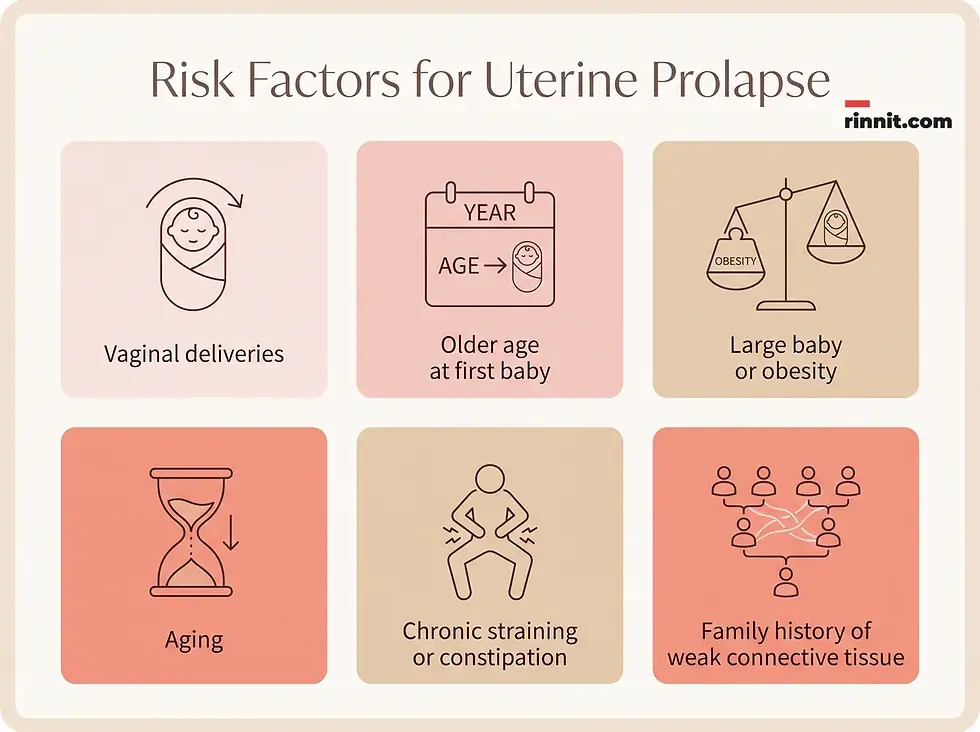
What Are the Risk Factors?
Several factors can increase the risk of uterine prolapse:
Risk Factor | Why It Matters |
One or more vaginal births [1] | Repeatedly stretches the pelvic floor |
Older age at first baby [1] | Higher risk of pelvic floor injuries |
Large baby [1] | More strain during delivery |
Aging [1] | Tissues naturally weaken with age |
Obesity [1] | Extra pressure on pelvic support |
Prior pelvic surgery [1] | Surgery can affect supporting structures |
Chronic constipation or straining | Repeated strain weakens tissues [1] |
Family history of weak connective tissue [1] | Connective tissue strength runs in families |
Being Hispanic or white [1] | Higher rates reported in these groups |
Chronic coughing (for example, from smoking) [1] | Ongoing strain on the pelvic floor |
What Are the Possible Complications?
Uterine prolapse often happens together with prolapse of other pelvic organs. [1] When the same supportive tissues weaken, other organs can bulge into the vagina as well.
Related Prolapse | What Happens | Common Name |
Anterior prolapse | Weak tissue between the bladder and the roof of the vagina lets the bladder bulge into the vagina [1] | Cystocele (prolapsed bladder) |
Posterior vaginal prolapse | Weak tissue between the rectum and the floor of the vagina lets the rectum bulge into the vagina [1] | Rectocele |
A rectocele might cause difficulty with bowel movements. [1] If you notice symptoms that suggest more than one organ is affected, your healthcare provider can evaluate each area. For a broader look at all types of prolapse, see our guide: Pelvic Organ Prolapse: What It Is, the 4 Types, and How It’s Treated.
How Can Uterine Prolapse Be Prevented?
These steps aim to lower the strain on the pelvic floor:
Prevent constipation. Drink plenty of fluids and eat high-fiber foods, such as fruits, vegetables, beans and whole grains. [1]
Avoid heavy lifting. If you must lift something heavy, lift correctly, using your legs instead of your waist or back. [1]
Control coughing. Get treatment for a chronic cough or bronchitis, and do not smoke. [1]
Avoid weight gain. Talk with your doctor about your ideal weight and get advice on losing weight if needed. [1]
How Is Uterine Prolapse Diagnosed?
A diagnosis of uterine prolapse often occurs during a pelvic exam. [2] During the exam, your healthcare provider may have you:
You might also fill out a questionnaire. This helps your provider assess how uterine prolapse affects your life, and that information helps guide treatment decisions. [2] If you have severe urinary incontinence, you might have tests to measure how well your bladder works. This is called urodynamic testing. [2]
Diagnostic Step | What It Reveals |
Pelvic exam | How far the uterus has slipped into the vagina [2] |
Bear-down maneuver | The degree of prolapse under strain [2] |
Muscle tightening test | The strength of the pelvic muscles [2] |
Questionnaire | How the prolapse affects daily life; guides treatment [2] |
Urodynamic testing (if incontinence is severe) | How well the bladder works [2] |
How Is Uterine Prolapse Treated?
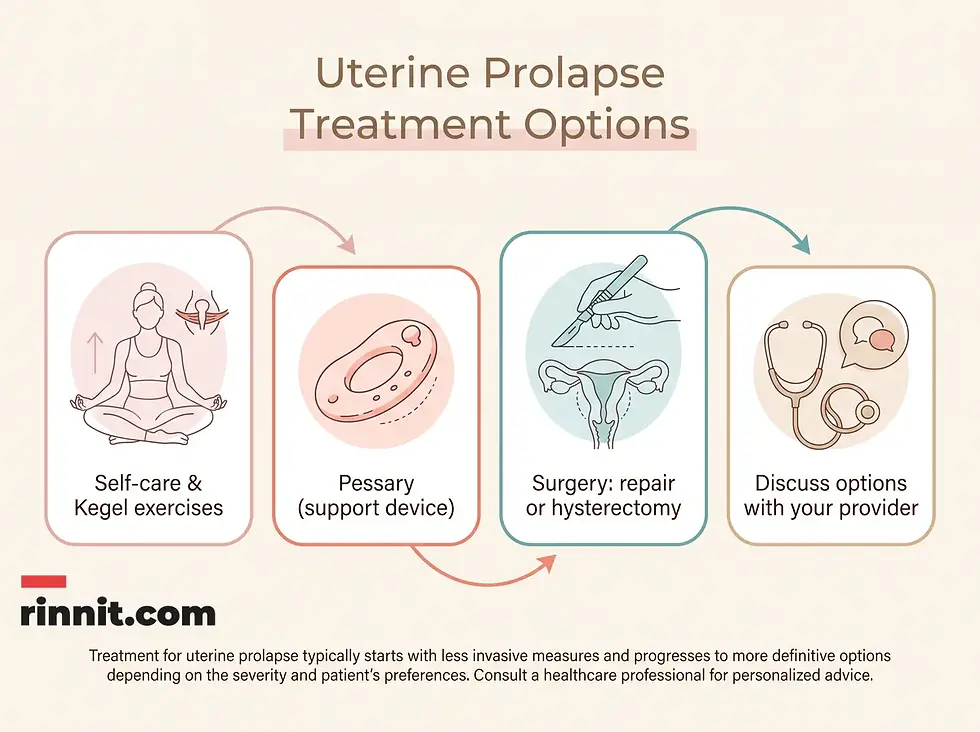
If you have uterine prolapse and it does not bother you, treatment may not be needed. [2] You might choose to wait and see what happens. [2] When prolapse symptoms do bother you, your provider may suggest a step-by-step approach.
Self-Care Measures
Self-care measures might relieve symptoms or help prevent the prolapse from getting worse. They include exercises that strengthen the pelvic muscles, losing weight if you are overweight, and treating constipation. [2]
Kegel exercises can strengthen the pelvic floor, which provides better support for the pelvic organs and might relieve symptoms. [2] A common routine looks like this:
Step | Instruction |
Tighten | Squeeze pelvic floor muscles as though trying to prevent passing gas [2] |
Hold | Keep the contraction for five seconds, then relax for five seconds [2] |
Starting point | If five seconds is too hard, hold for two seconds and relax for three [2] |
Build up | Work up to holding contractions for ten seconds at a time [2] |
Frequency | At least three sets of ten repetitions every day [2] |
Kegel exercises might be most successful when a physical therapist teaches them and reinforces them with biofeedback. [2] Biofeedback uses monitoring devices that help ensure you tighten the right muscles properly and long enough to work well. [2] Once you learn to do them correctly, you can do Kegel exercises discreetly at any time, whether sitting at a desk or relaxing on the couch. [2]
Other lifestyle and home measures include:
A Pessary
A vaginal pessary is a silicone device inserted into the vagina. [2] It helps prop up bulging tissues. [2] Pessaries come in many shapes and sizes, and a healthcare professional can fit one and help you choose the type that would work best. [2] A pessary must be removed regularly for cleaning. [2]
Surgery
Surgery may be needed to repair uterine prolapse. Minimally invasive surgery, called laparoscopic surgery, or vaginal surgery might be an option. [2] If you only have a uterine prolapse, surgery may involve:
If you have prolapse of other pelvic organs along with uterine prolapse, surgery may be a bit more involved. [2] Along with a hysterectomy, your surgeon may also:
Option | What It Involves |
Stitches to fix weak pelvic floor structures | Done in a way that keeps the depth and width of the vagina intact for sexual function [2] |
Colpocleisis | Closing the opening of the vagina. May allow for an easier recovery, and is only an option for people who no longer want to use the vaginal canal for sexual activity [2] |
Mesh support | A piece of synthetic mesh, placed through the abdomen, suspends the vaginal tissues from the sacrum (the bone just above the tailbone); the FDA stopped the sale of mesh placed through the vagina for prolapse repair in 2019 [2] |
Surgical Risks
All surgeries have risks. Risks of surgery for uterine prolapse include:
Talk with your healthcare provider about all of your treatment options so you understand the risks and benefits of each. [2]
Coping and Daily Management
Daily habits that protect the pelvic floor also help in everyday management of uterine prolapse. These include eating a high-fiber diet with plenty of fluids, avoiding heavy lifting and bearing down during bowel movements, controlling coughing, maintaining a healthy weight, and quitting smoking. [2]
Because treatment decisions depend on how much your symptoms bother you, keep track of how your symptoms change over time. Note what improves or worsens them, and ask about all of your options, including no treatment, a pessary, and surgery.
Preparing for Your Appointment
For uterine prolapse, you may see a doctor who specializes in conditions affecting the female reproductive system, called a gynecologist. [2] Or you may see a doctor who specializes in pelvic floor problems and reconstructive surgery, called a urogynecologist. [2]
What you can do. Make a list of your symptoms and when they began. List all medicines, vitamins and supplements you take, including doses. [2] Gather key personal and medical information, including other conditions, recent life changes and stressors. And prepare questions for your healthcare provider, such as:
Question for Your Provider | Why It Matters |
What can I do at home to ease my symptoms? [2] | Identifies self-care steps you can start now |
What are the chances the prolapse worsens if I do nothing? [2] | Helps you weigh watchful waiting |
What treatment approach do you recommend? [2] | Clarifies the plan that fits your situation |
How likely is it that prolapse happens again after surgery? [2] | Helps you understand long-term outcomes |
What are the risks of surgery? [2] | Lets you compare risks across options |
What to expect from your doctor. Your provider is likely to ask whether your symptoms have gotten worse, whether you have pelvic pain, whether you ever leak urine, whether you have had a severe or ongoing cough, whether you do heavy lifting, whether you strain during bowel movements, whether anyone in your family has had uterine prolapse or other pelvic problems, how many children you have given birth to and whether the deliveries were vaginal, and whether you plan to have children in the future. [2]
Conclusion
Uterine prolapse occurs when the pelvic floor muscles and ligaments weaken and the uterus slips down into or out of the vagina, most often after menopause in people who have had vaginal deliveries. Symptoms range from a vaginal bulge and pelvic heaviness to bladder and bowel trouble. Diagnosis usually happens during a pelvic exam, sometimes with a questionnaire and bladder function testing. Mild cases often need no treatment, while bothersome cases can be managed with Kegel exercises, lifestyle changes, a pessary, or surgery.
Your next step: If you feel a bulge, pelvic heaviness, or changes in how your bladder or bowel empties, make an appointment with a gynecologist or urogynecologist. Write down your symptoms and your questions before the visit. That information helps your provider choose the treatment path that fits your life.
Frequently Asked Questions
What is uterine prolapse?
Uterine prolapse is when the uterus drops from its normal position into or out of the vagina because the pelvic floor muscles and supportive ligaments have weakened. It most often occurs after menopause in people who have had vaginal deliveries.
What does uterine prolapse feel like?
Uterine prolapse can feel like heaviness or pulling in the pelvis, pressure or discomfort in the pelvis or low back, a feeling of sitting on a small ball, or vaginal tissue rubbing on clothing. Some people see or feel a tissue bulge.
What are the symptoms of uterine prolapse?
Symptoms include a vaginal bulge, pelvic heaviness, feeling that the bladder does not empty, leaking urine, trouble with bowel movements, pelvic or low back pressure, and sexual concerns such as feeling that vaginal tissue is loose.
What causes uterine prolapse?
Uterine prolapse results from weakened pelvic muscles and supportive tissues. Causes include vaginal delivery, difficult labor, a large baby, being overweight, lower estrogen after menopause, chronic constipation or straining, chronic cough, and repeated heavy lifting.
Who is at risk for uterine prolapse?
Risk factors include one or more vaginal births, older age at first baby, a large baby, aging, obesity, prior pelvic surgery, chronic constipation, family history of weak connective tissue, being Hispanic or white, and chronic coughing such as from smoking.
Can uterine prolapse go away on its own?
Mild prolapse after childbirth often causes no symptoms and may not need treatment. Pelvic floor exercises and lifestyle changes can relieve symptoms or help keep the prolapse from getting worse, and a healthcare provider can advise whether treatment is needed.
What are Kegel exercises for uterine prolapse?
Kegel exercises tighten the pelvic floor muscles as though preventing gas. Hold for five seconds, relax for five seconds, and work up to ten-second holds, aiming for at least three sets of ten repetitions daily. A physical therapist can teach them, sometimes with biofeedback.
What is a pessary for uterine prolapse?
A pessary is a silicone device inserted into the vagina that props up bulging tissues. Pessaries come in many shapes and sizes, a healthcare professional fits the right one, and it must be removed regularly for cleaning.
What surgery is done for uterine prolapse?
Options include hysterectomy, uterus-sparing procedures for people who may want future pregnancies, stitches to repair weak pelvic floor structures, colpocleisis (closing the vaginal opening), and mesh support that suspends vaginal tissues from the sacrum, the bone just above the tailbone.
Is surgery for uterine prolapse risky?
All surgeries carry risks, including heavy bleeding, blood clots in the legs or lungs, infection, anesthesia reactions, injury to the bladder, ureters or bowel, the prolapse happening again, and urinary incontinence. Discuss the risks and benefits with your provider.
Which doctor treats uterine prolapse?
A gynecologist, who specializes in the female reproductive system, or a urogynecologist, who specializes in pelvic floor problems and reconstructive surgery.
Related Reading
Pelvic Organ Prolapse: What It Is, the 4 Types, and How It’s Treated describes the four types of pelvic organ prolapse and their treatments.
Pessaries: A Non-Surgical Solution for Pelvic Support explains how a vaginal pessary supports the uterus without surgery.
Sacrocolpopexy: A Guide to Treating Pelvic Organ Prolapse covers a surgery that uses mesh to lift and support prolapsed pelvic organs.
Cystocele (Prolapsed Bladder): Symptoms, Causes, and Treatment explains bladder prolapse, which often occurs alongside a prolapsed uterus.
References
Mayo Clinic. Uterine prolapse - Symptoms and causes. Mayo Clinic. Last updated December 23, 2025. https://www.mayoclinic.org/diseases-conditions/uterine-prolapse/symptoms-causes/syc-20353458
Mayo Clinic. Uterine prolapse - Diagnosis and treatment. Mayo Clinic. Last updated December 23, 2025. https://www.mayoclinic.org/diseases-conditions/uterine-prolapse/diagnosis-treatment/drc-20353464
Schulten SFM, Claas-Quax MJ, Weemhoff M, et al. Risk factors for primary pelvic organ prolapse and prolapse recurrence: an updated systematic review and meta-analysis. American Journal of Obstetrics and Gynecology. 2022;227(2):192-208. PMID 35500611. https://doi.org/10.1016/j.ajog.2022.04.046
Beamish NF, Davenport MH, Ali MU, et al. Impact of postpartum exercise on pelvic floor disorders and diastasis recti abdominis: a systematic review and meta-analysis. British Journal of Sports Medicine. 2025;59(8):562-575. PMID 39694630. https://doi.org/10.1136/bjsports-2024-108619
Ben ÂJ, van der Vaart LR, E Bosmans J, et al. Cost-effectiveness of pessary therapy versus surgery for symptomatic pelvic organ prolapse: an economic evaluation alongside a randomised non-inferiority controlled trial. BMJ Open. 2024;14(5):e075016. PMID 38692718. https://doi.org/10.1136/bmjopen-2023-075016
Medical disclaimer
The information provided in this article is for educational purposes only and should not be used as a substitute for professional medical advice, diagnosis, or treatment. Always seek the advice of your physician or other qualified health provider with any questions you may have regarding a medical condition.



Comments