Understanding Viruses: Structure, Function, and Impact

Updated: 2 days ago
Medically reviewed by Dr. Baraa Alnahhal, MD · Last reviewed: October 2026
Editorial note: This article is provided for educational purposes only. It is not medical advice. Always consult a qualified healthcare professional about your individual health situation.
Quick Answer: What Is a Virus?
A virus is a microscopic infectious agent made of DNA or RNA inside a protective protein coat called a capsid. Lacking cellular machinery, viruses are obligate parasites that must infect a host to reproduce. They enter through mucous membranes or skin breaks and hijack host cells to replicate, causing illnesses ranging from the common cold to chronic conditions.
What the research says
Viruses cause a large share of the world's cancers. An analysis of 2018 global cancer data estimated 2.2 million infection-attributable cancer cases worldwide. Human papillomavirus accounted for about 690,000 cases, hepatitis B virus for 360,000 and hepatitis C virus for 160,000 (de Martel et al., Lancet Glob Health, 2020 [1]).
Vaccination against a cancer-causing virus lowered cervical cancer risk. In a Swedish registry study of 1,672,983 girls and women aged 10 to 30, cervical cancer was diagnosed in 19 vaccinated women and 538 unvaccinated women. The fully adjusted incidence rate ratio was 0.37 (95% CI 0.21 to 0.57), and 0.12 (95% CI 0.00 to 0.34) for those vaccinated before age 17 (Lei et al., N Engl J Med, 2020 [2]).
Handwashing modestly reduces respiratory illness. A Cochrane review of 78 randomized trials found that hand hygiene probably reduced acute respiratory infections by 14% (risk ratio 0.86; 95% CI 0.81 to 0.90; 9 trials, 52,105 participants; moderate-certainty evidence), though it made little or no difference to laboratory-confirmed influenza (RR 0.91; 95% CI 0.63 to 1.30) (Jefferson et al., Cochrane Database Syst Rev, 2023 [3]).
Defining the Virus: A Biological Hijacker
A virus is essentially a small package of genetic instructions in a protective "carrying case." They are not considered living cells because they lack the necessary equipment to grow or reproduce independently. Instead, they function by entering a host's body and using the host's own cellular "kitchen" to cook up new viral particles. This process often leaves the host cells damaged or destroyed once the new viruses are released.
While they are incredibly small—often 100 to 1,000 times smaller than a human cell—their impact on health is significant. They are found in almost every environment on Earth and can infect humans, animals, plants, and even bacteria.
The Architecture of a Virus
The basic structure of a virus is remarkably simple yet effective. Every virus contains a genome and a protective shell, though some have additional layers that influence how they interact with the human body.
Component | Description |
Genetic Material | The core instructions, which can be either DNA or RNA. |
Capsid | A protective protein shell that surrounds and shields the genetic material. |
Envelope | An optional outer fatty layer found in some viruses; those without it are called "naked" viruses. |
Capsomeres | The individual protein subunits that make up the capsid. |
Common Viral Shapes
Scientists often categorize viruses by their physical appearance under a microscope. The most common shapes include icosahedral (a geometric, soccer-ball-like shape), helical (a cylinder with coiled genetic info), spherical (enveloped viruses that appear ball-shaped), and complex (combinations of multiple shapes, often seen in viruses that infect bacteria).
How Viruses Infect the Body
Viruses typically enter the human body through mucous membranes, which are the moist linings found in the eyes, nose, mouth, and other openings. They can also enter through breaks in the skin or via bites from insects like mosquitoes and ticks. Once inside, the virus undergoes a multi-step process to replicate.
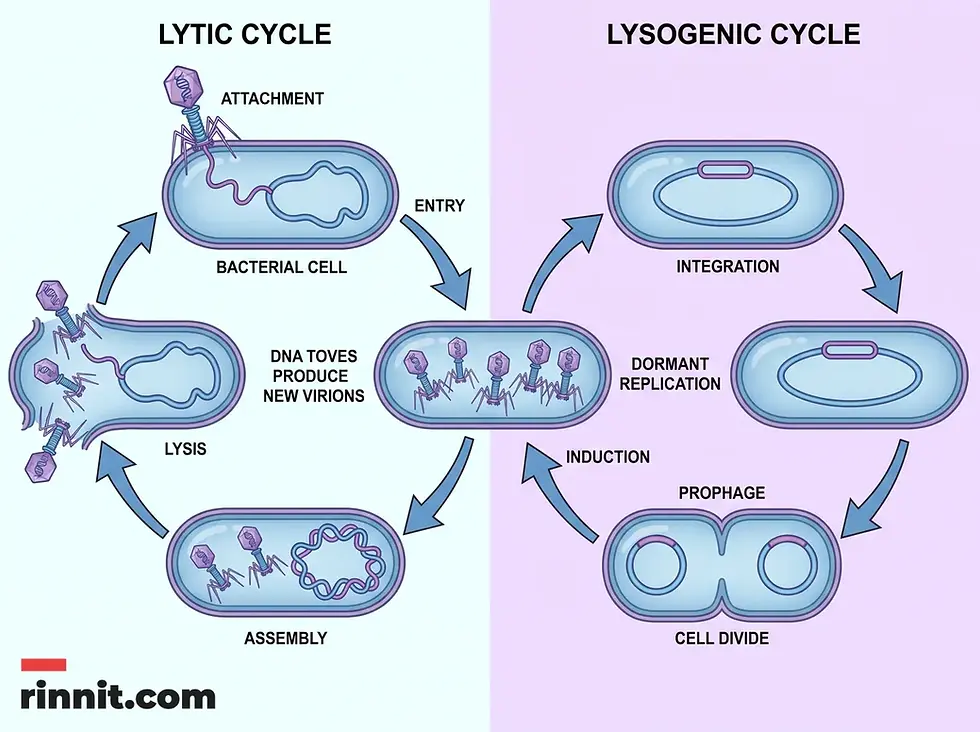
Attachment: The virus binds to specific receptors on the surface of a host cell, much like a key fitting into a lock.
Entry: The virus or its genetic material enters the cell through fusion or by tricking the cell into letting it in.
Replication and Assembly: The viral genetic material takes over the cell's machinery to produce new viral parts, which then assemble into complete particles.
Release: The new viruses exit the cell, often causing the host cell to burst (lysis) or by budding off from the cell membrane.
The Two Cycles of Reproduction
Viruses utilize two primary strategies for making copies of themselves, depending on their type and environmental conditions.
Cycle Type | Characteristics |
Lytic Cycle | The virus immediately hijacks the cell, replicates rapidly, and causes the cell to burst to release new particles. |
Lysogenic Cycle | The virus remains dormant, integrating its DNA into the host's genome. It replicates silently as the cell divides until a trigger (like stress) activates the lytic phase. |
Major Categories of Human Viruses
There are thousands of different viruses, but they are generally grouped into families based on their structure and the types of illnesses they cause.
Respiratory Viruses: Including influenza (flu) and coronaviruses (such as those causing the common cold or COVID-19).
Herpesviruses: A large family responsible for oral and genital herpes, chickenpox, shingles, and mononucleosis.
Hepatitis Viruses: Specifically targeting the liver, with types A, B, and C being the most prevalent.
Flaviviruses: Often spread by insects, causing Zika, West Nile, and dengue fever.
Retroviruses: Unique viruses like HIV that insert their own genetic code directly into the host's DNA.

The Connection Between Viruses and Cancer
Certain viruses, known as oncoviruses, have the ability to trigger changes in host cells that may lead to cancer. By inserting their genetic material into the host's DNA or causing chronic inflammation, these viruses can disrupt normal cell growth. Common examples include the Human Papillomavirus (HPV), which is linked to several types of cancer, and Hepatitis B and C, which increase the risk of liver cancer.
Protecting Your Viral Health
Because viruses are not made of cells, traditional antibiotics are ineffective against them. Managing viral health focuses on prevention and supporting the body's natural defenses.
Vaccination: Training the immune system to recognize and fight specific viruses before an infection occurs.
Antiviral Medications: Specialized drugs that can interfere with the viral replication process.
Hygiene Practices: Regular handwashing and avoiding contact with infected individuals to reduce the risk of transmission.
Immune Support: Maintaining a healthy lifestyle to ensure the body can effectively respond to viral invaders.

Conclusion
Viruses are complex microscopic entities that play a dual role in our world, acting as both significant pathogens and subjects of vital scientific research. By understanding how they enter our bodies, hijack our cells, and replicate, we can better appreciate the importance of preventive measures like vaccines and hygiene. Staying informed about viral biology is a key step in protecting individual and community health against these invisible invaders.
Call to Action
If you are experiencing symptoms of a viral infection, such as persistent fever, respiratory distress, or unusual rashes, consult with a healthcare professional for an accurate diagnosis. Proactive care, including staying up to date on recommended vaccinations and practicing good hygiene, is the most effective way to manage your viral health and prevent the spread of illness to others.
Related reading: Viral Meningitis: Symptoms, Causes, and Management | Hepatitis B: Symptoms, Causes, Prevention, Diagnosis and Treatment | Enterovirus: Symptoms, Causes, Diseases, Diagnosis, Treatment, Prevention and When to Seek Emergency Care — What You Need to Know
Sources: de Martel et al., 2020 | Lei et al., 2020 | Jefferson et al., 2023
Frequently Asked Questions
1. What is the difference between a virus and a bacteria?
Bacteria are single-celled living organisms that can survive on their own, while viruses are smaller, non-living particles that require a host cell to reproduce.
2. Do antibiotics kill viruses?
No, antibiotics only work against bacterial infections. Viral infections require antivirals or vaccines for management.
3. How do viruses make you sick?
Viruses make you sick by damaging or destroying host cells during the replication process and by triggering an inflammatory response from your immune system.
4. Can a virus survive on surfaces?
Yes, viruses can survive outside a host for varying amounts of time until their protective protein shell (capsid) breaks down.
5. What is an enveloped virus?
An enveloped virus has an additional outer layer made of lipids (fats) and proteins, which it often picks up from the host cell's membrane.
6. What is a bacteriophage?
A bacteriophage, or "phage," is a specific type of virus that only infects and replicates within bacteria.
7. How does a vaccine work against a virus?
A vaccine introduces a harmless piece of the virus or its instructions to your immune system, allowing your body to build defenses without getting sick.
8. What are the symptoms of a viral infection?
Common symptoms include fever, fatigue, muscle aches, cough, and sometimes digestive issues like vomiting or diarrhea, depending on the virus type.
9. What is a retrovirus?
A retrovirus is an RNA virus that uses a special protein to turn its RNA into DNA, which it then inserts into the host cell's DNA.
10. Can viruses be beneficial?
Yes, some viruses like bacteriophages are being studied as potential treatments for antibiotic-resistant bacterial infections.
11. How small are viruses?
Most viruses are between 20 and 400 nanometers, making them hundreds of times smaller than the average human cell.
12. What triggers a dormant virus to become active?
Triggers for the lysogenic (dormant) cycle to become lytic (active) can include physical stress, chemical signals, or changes in temperature.
13. How are viruses transmitted?
Transmission occurs through respiratory droplets, contact with infected bodily fluids, contaminated surfaces, or bites from insects like mosquitoes.
14. What is an oncovirus?
An oncovirus is a type of virus that has been linked to the development of certain cancers in humans.
15. Why do some viruses mutate so quickly?
Viruses, especially RNA viruses, often make errors when copying their genetic material, leading to mutations that can result in new strains.
References
de Martel C, Georges D, Bray F, et al. Global burden of cancer attributable to infections in 2018: a worldwide incidence analysis. Lancet Glob Health. 2020;8(2):e180-e190. PMID 31862245. https://doi.org/10.1016/S2214-109X(19)30488-7
Lei J, Ploner A, Elfström KM, et al. HPV Vaccination and the Risk of Invasive Cervical Cancer. N Engl J Med. 2020;383(14):1340-1348. PMID 32997908. https://doi.org/10.1056/NEJMoa1917338
Jefferson T, Dooley L, Ferroni E, et al. Physical interventions to interrupt or reduce the spread of respiratory viruses. Cochrane Database Syst Rev. 2023;1(1):CD006207. PMID 36715243. https://doi.org/10.1002/14651858.CD006207.pub6
Medical disclaimer
The information provided in this article is for educational purposes only and should not be used as a substitute for professional medical advice, diagnosis, or treatment. Always seek the advice of your physician or other qualified health provider with any questions you may have regarding a medical condition.



Comments